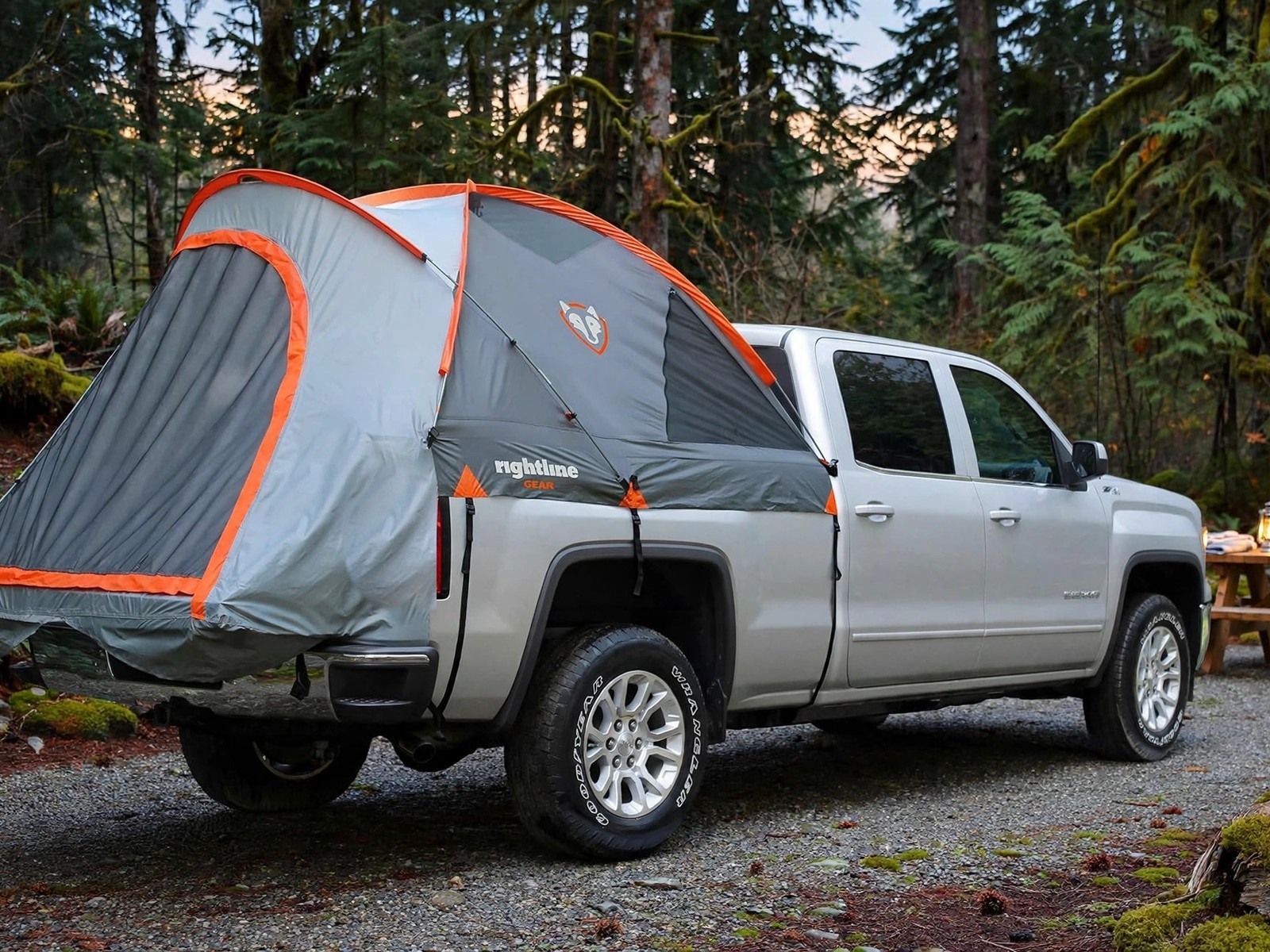
The best truck bed tent turns the box behind your cab into the flattest, driest campsite you own, up off the mud, away from the rocks, and level in a way no sloped meadow ever is. It also asks the hardest question in this class before you spend anything. Are you willing to empty your bed, pitch your bedroom inside it, and take the whole thing down before you can drive anywhere? This guide scores 21 truck bed tents on the five things that decide whether that trade is worth it, fit to your bed, room to sleep, setup effort, weather protection, and durability. The scores rest on maker documentation and on owner reports, 1,971 of them read and coded one by one across every listing examined.
The picks at a glance
- Best Overall. Rightline Gear Truck Tent, 6.0. The floorless tent that pitches over the gear already in your bed, with the highest Bed Fit and Attachment score in the field.
- Best for Midsize and Short Beds. Rightline Gear Truck Tent, 6.0. The same tent, holding the second slot on the strength of its fit score, the highest any tent here earned.
- Premium. Kodiak Canvas Truck Tent, 5.8. Canvas, a steel frame, and the only perfect durability score in the field, at the field’s highest weight and its lowest setup score.
Every pick here rests on research, not on use. This site has not tested any of these tents, and nobody here has slept a night in one. What the scores rest on is stated tent by tent, and the full method stands after the results.
One honest limit frames everything after this paragraph, and it is occupancy. A truck bed sleeps two adults, and this class is a poor fit for anyone who needs more, who is better served by the vehicle tent guide at Best SUV Tents of 2027. The buying guide at the end of this page works through the trade the opening named, the measuring, and the equipment conflicts in full.
Outdoor Footprints is reader supported. When you buy through links on this page, this site may earn a commission from Amazon at no added cost to you. Commissions never move a score. Every tent here was scored under the same rules, the picks and the rest of the field alike.
Rightline Gear Truck Tent
Rightline Gear Truck Tent
Pros
Pitches over a loaded bed, so gear, drawers, and platforms stay in place
The field’s highest Bed Fit and Attachment score, including the only documented answer to deep bed walls
No recurring failure pattern anywhere in its owner record
Concerns
No floor of its own, so the pad or mattress you supply is the sleeping surface
No awning or annex, so it adds no ground living space
Its maker states no peak height, and retailer height figures conflict
Best Overall.
Best for Midsize and Short Beds.
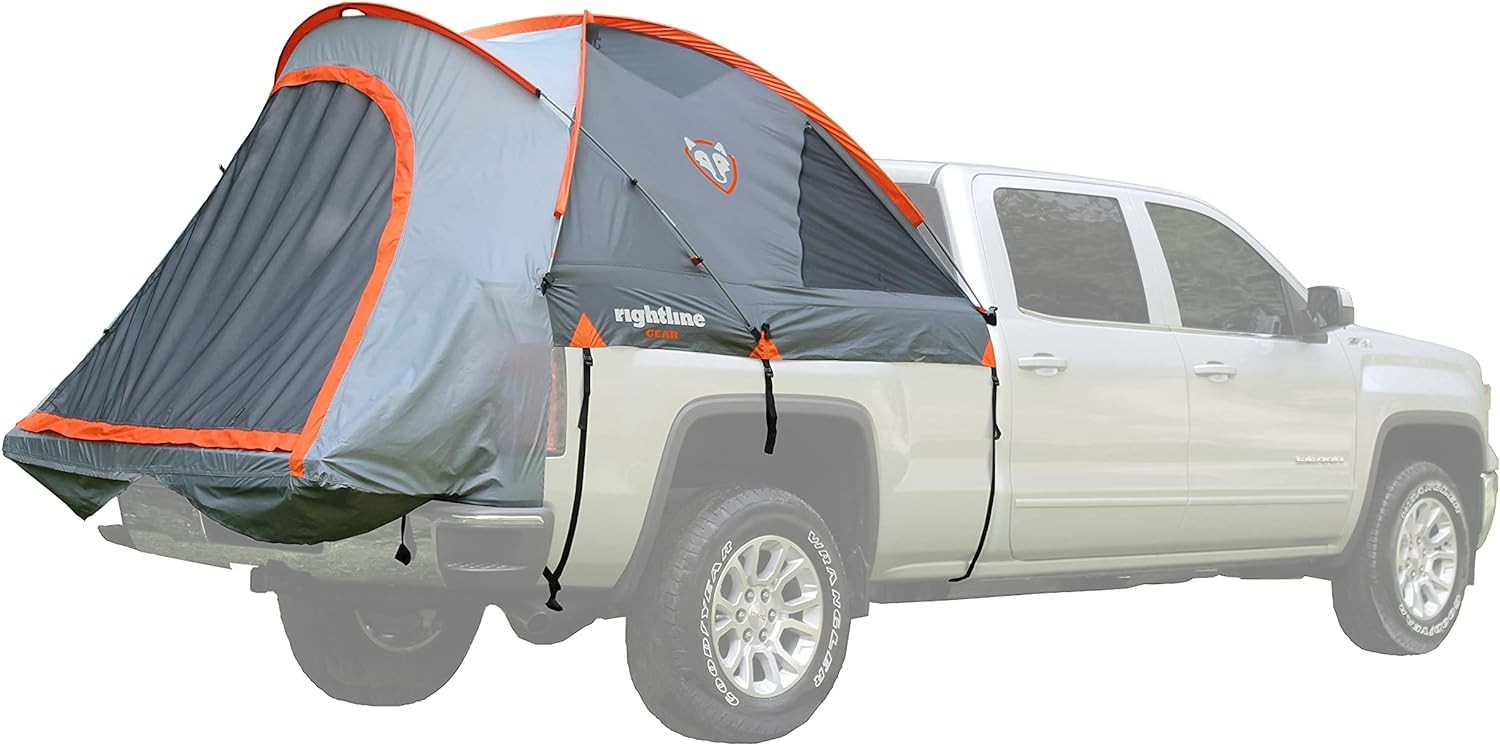
The Rightline Gear Truck Tent wins this guide on the property its whole design is built around. It has no floor. The tent pitches over the bed on straps and buckles, with color coded poles and pole pockets, a sky view vent, and a rainfly in the bag. A bed that carries a sleeping platform, a drawer system, or the week’s gear does not have to be unloaded before it can be slept in.
Owners bought it for exactly that, and their reports say so in the clearest terms in this field’s record. If your bed works for a living and still has to sleep you at night, check the Rightline Gear Truck Tent.
Its fit record is the strongest scored here, an 8.0 on the criterion this class lives or dies by. The maker documents eight sizes, and two of them are tall bed variants, the field’s only documented answer to the deep bed walls that leave other tents floating at the rails. Its owner record, 100 reports coded with 97 percent from verified purchases, backs the documentation with identified trucks, fit matches running ahead of mismatches, and the field’s only full score for pitching over bed equipment, tonneau covers and cargo included. The second slot falls out of the same record. Among tents whose documented fit covers the midsize and 5 ft class short beds, its fit score stands highest and its total stands highest, which is why one tent answers both the overall question and the short bed question.
Its costs are priced inside its scores rather than hidden. With no floor, the sleeping platform is the bed itself, so the pad or mattress you supply decides your night, and its livability score of 5.0 carries that dependence openly. Its weather score of 6.5 rests on documented fabric rated at 2000mm with tape sealed seams. Its durability record is the quietest in the field, no recurring structural failure across its owner record, a single zipper report that does not recur, and a stated 1 year warranty behind it. For the strongest all round record this field produced, pick the Rightline Gear Truck Tent.
Kodiak Canvas Truck Tent
Kodiak Canvas Truck Tent
Pros
The only perfect durability score in the field, canvas, steel, and a limited lifetime warranty
Canvas breathes, and its five mesh windows give it the field’s best condensation record
A clamp on steel rail frame that sets up with the tailgate down for added space
Concerns
The heaviest pitch in the field at about 44 lb, with the field’s lowest setup score and the longest owner reported setup times, 20 to 45 minutes
The midsize model’s fit band is stated differently by different sources
Tonneau cover rails can block the clamps it ships with
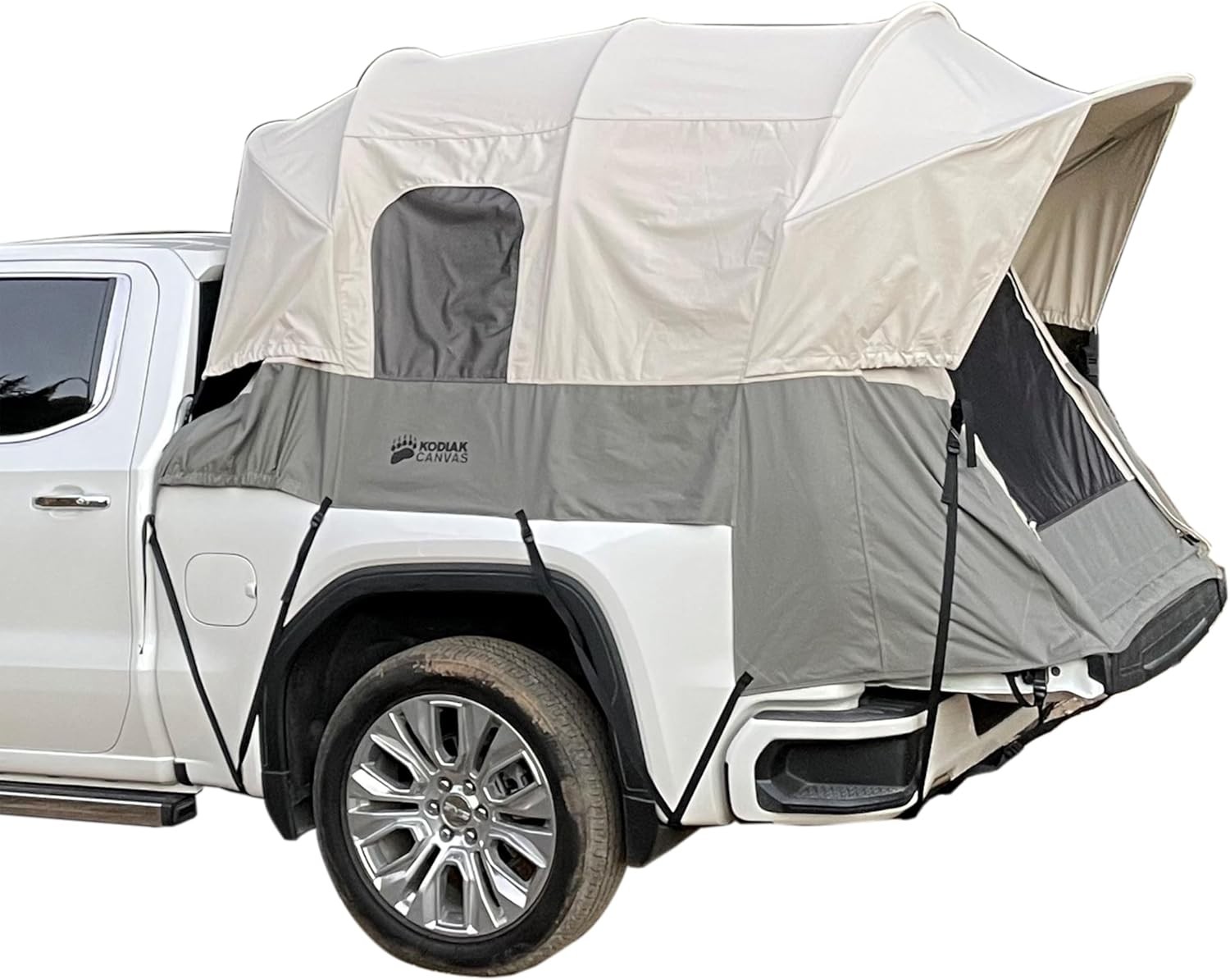
The Kodiak Canvas Truck Tent is the premium end of this class standing on its own, and it earns the slot on the record rather than on its price. The Premium slot is a ruled slot of one, the only premium band tent inside this guide’s gate this edition, so it is not a comparison the field ran. Its body is 8.5 oz cotton duck canvas on a 3/4 inch steel tube frame that clamps to the bed rails, with YKK zippers throughout and a limited lifetime warranty behind the whole structure. That documentation earns the only perfect criterion score anywhere in this field, a 10.0 for durability and build quality. If you camp in cold weather often enough that canvas earns its keep, look at the Kodiak Canvas Truck Tent.
Its owner record, 100 reports coded, agrees with the documentation about what this tent is. Fit reports split closer than the Napier lines below, matches ahead of mismatches, and rain reports split evenly, three owners dry and three reporting water in, which lifts nothing and is reported as the split it is.
The condensation story runs the other way. Five no-see-um mesh windows and a breathable canvas body give it the strongest vent record scored here, and canvas is the answer owners reach for when a polyester tent drips on them. One documented conflict rides with the fit record. An owner whose folding tonneau rails sat flush with the bed side found the shipped C-clamps blocked, and fabricated spring clamp mounts to solve it, which is scored as the documented incompatibility it is.
What keeps it second rather than first is the work. Its setup score of 1.5 is the lowest in the field. The owner record agrees with the documentation about why, reported setup times of 20 to 45 minutes and roughly 44 lb of tent to move before the first clamp bites. That is a property of the product, not a gap in its evidence.
Judge it as the tent you pitch for a parked camp and keep for a decade, not as the tent you throw up for one night between drives. For the longest service life this field documents, choose the Kodiak Canvas Truck Tent.
Runner ups
Napier Sportz Truck Tent 57 Series
Napier Sportz Truck Tent 57 Series
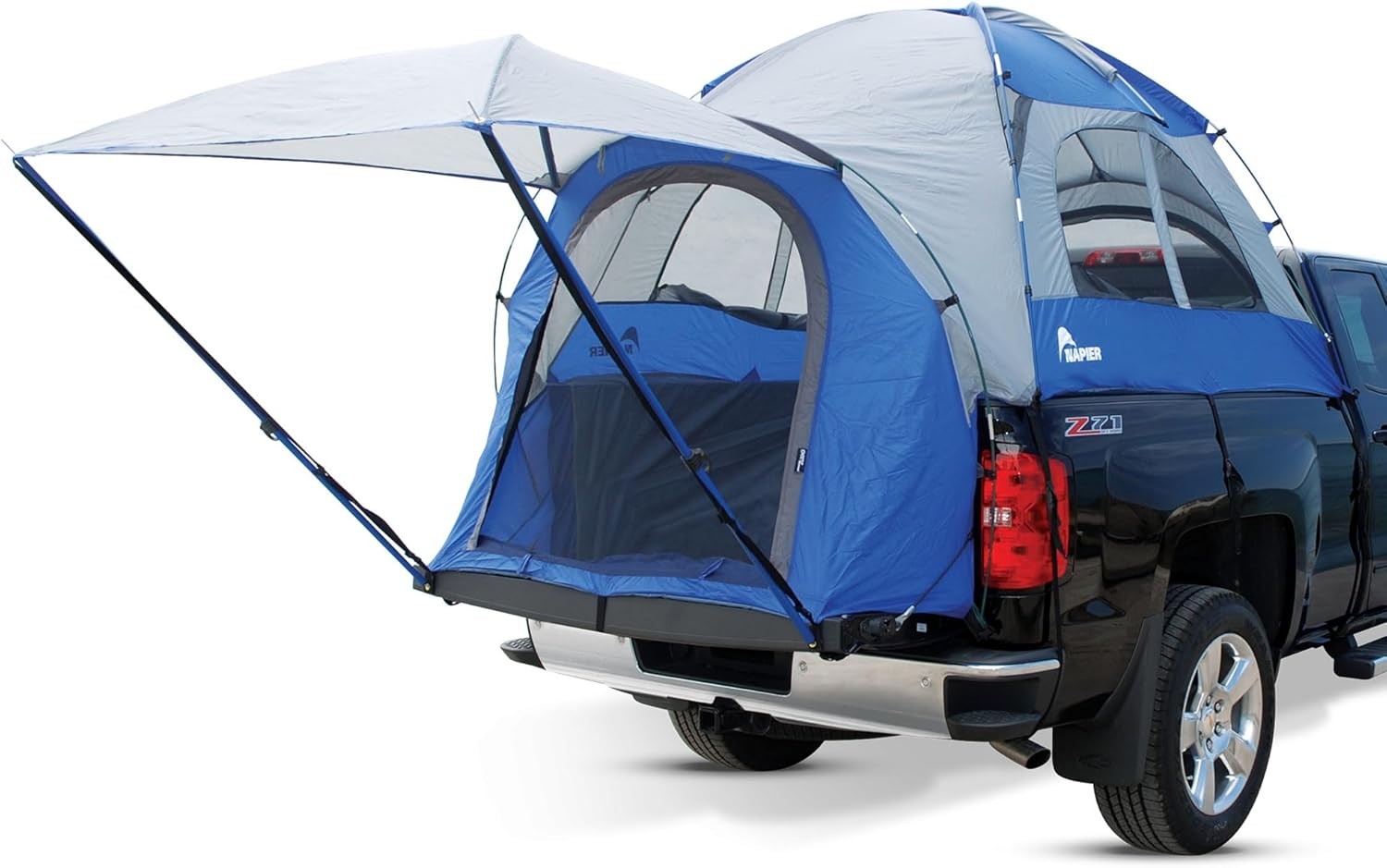
The Napier Sportz Truck Tent, 57 Series is the most livable tent in this field and the guide field’s other center, and its livability score of 8.0 is the highest any tent here earned on that criterion. The documentation explains it. A 5.7 ft peak, a rear access panel into the cab, a gear loft and pocket, and the field’s only documented awning, 4 ft of covered space over the tailgate. Its fit coverage spans five sizes with stated ranges, and its weather record rests on a documented coating with taped seams and a full rainfly, with owners’ rain reports running positive.
Two findings hold it at third. The first is a pole failure pattern in its owner record, 100 reports coded, with poles breaking at a recurring rate of about 8 in every 100 detailed reports. That pattern is priced into its durability score rather than used to remove it, and the price is worth a rank. Without it, this tent would stand at 5.875 and edge past the Kodiak Canvas into second place.
The second finding is solo setup. Owners name it directly, one calling the tent incredibly difficult to set up by yourself, and its setup score of 2.5 is the lowest scored outside the Kodiak. Its maker record also documents no vent provision, so its condensation control could not be scored at all, a named gap that rides with the tent rather than a figure invented to fill it.
Three tents tied at 5.5
Three tents land on exactly the same total, 5.500, and this guide presents them as the tie they are. The two Napier truck tent records differ in their evidence. The colourway’s owner reports run slightly stronger on fit while the 19 Series record runs deeper, and the GoHimal matches both on a record with the group’s best coverage of its own score. None of the three holds a pick, so the tie is stated rather than broken.
Napier Backroadz Truck Tent 19 Series
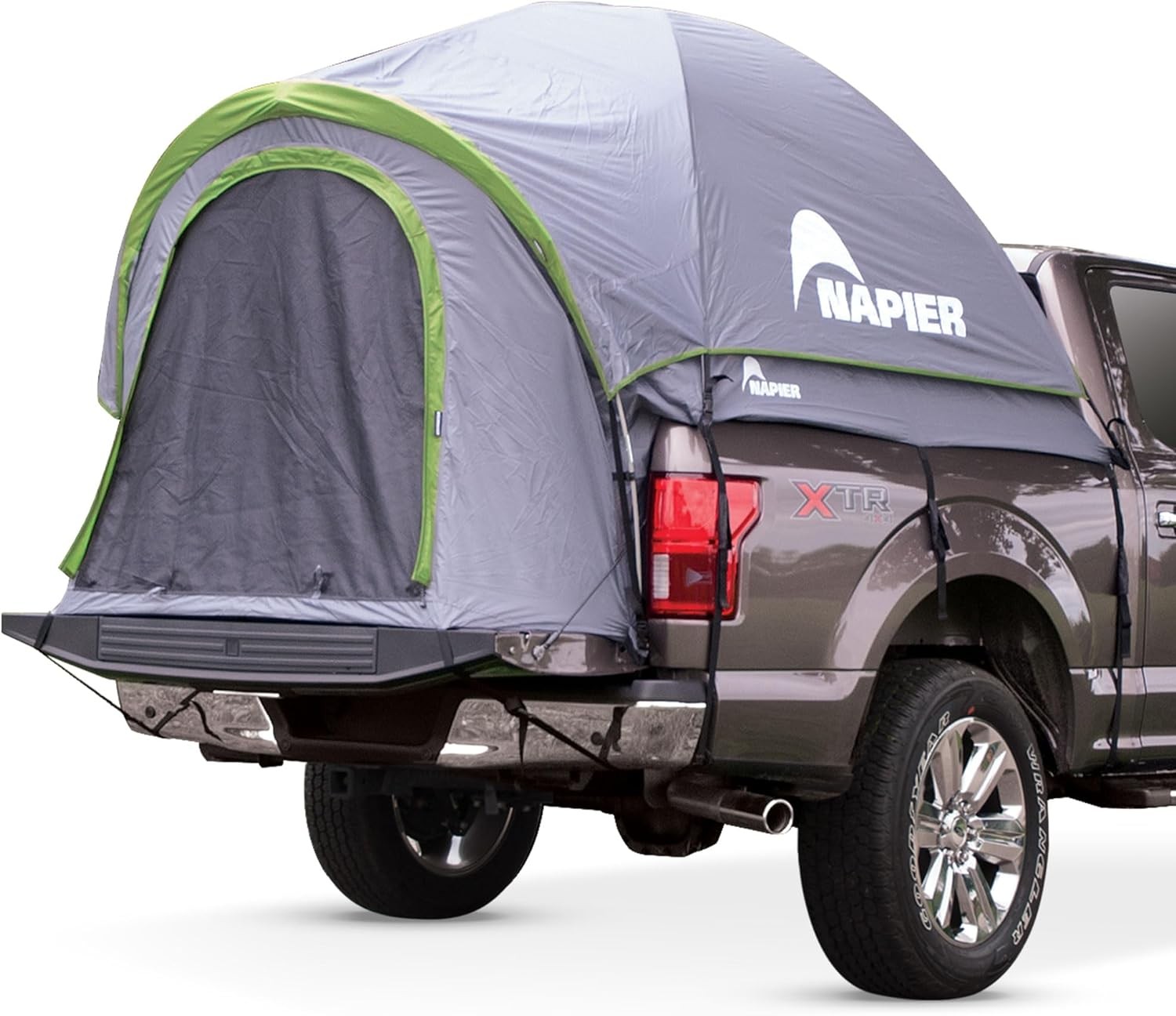
Napier Backroadz Truck Tent 19 Series
The Napier Backroadz Truck Tent, 19 Series carries the strongest fit quality figure of any Napier line here. Its owner record, 100 reports coded with 32 naming the truck, runs 11 fit matches against 2 mismatches. Its documentation earns on five size variants split by bed band and truck class, with a documented tonneau compatibility the older 13 Series below does not carry. Setup reports run strongly in its favor, 22 owners reporting an easy pitch against 1 reporting difficulty, including a solo assembly report that supports its solo score.
Its costs sit in weather and durability. Its rain record is the most negative among the field’s deep owner records, 7 negative reports against 4 positive, five of the negatives serious, and that record lowered its waterproofing figure inside the scoring caps. Its poles carry the same recurring pattern as its Sportz sibling, about 8 breakage reports in every 100 detailed reports, priced into its durability score the same way. Without that price it would stand at 5.650.
Two gaps ride with it in the open. Its maker record documents neither storage pockets nor a warranty for this line, so neither could be scored.
Napier Backroadz Camo Truck Tent
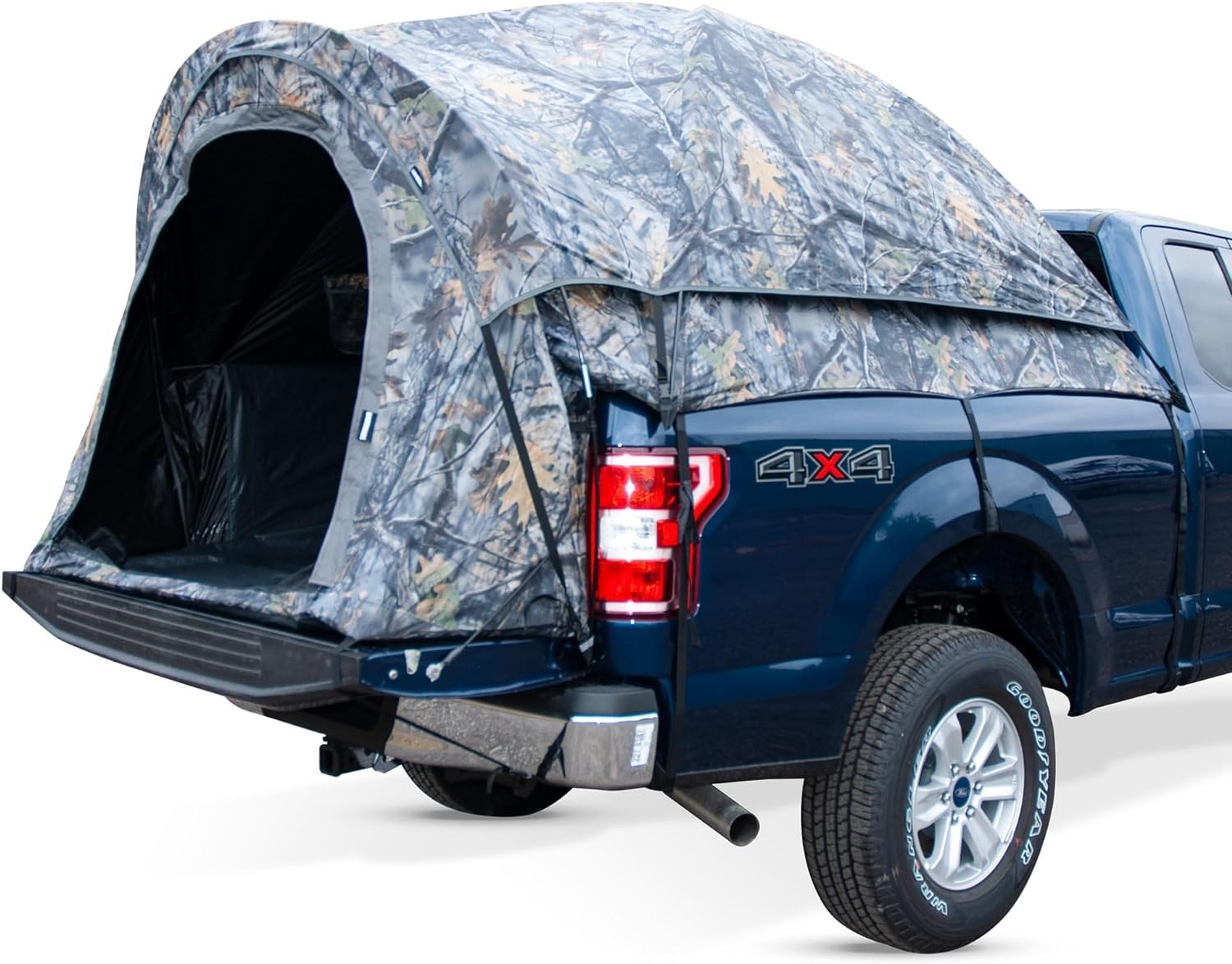
Napier Backroadz Camo Truck Tent
The Napier Backroadz Camo Truck Tent is the 19 Series line in a camo colourway, scored here as its own product on its own owner record rather than folded into the record above. That record, 98 reports coded with 93 percent from verified purchases, is in one respect stronger than its sibling’s. Its fit balance runs 14 matches against a single mismatch, the joint strongest fit quality figure in the field. Its rain record runs near neutral where the 19 Series record ran negative, which is the whole of the weather difference between the two tents.
The differences that hold it level rather than ahead are documentation gaps. The listing page captured for this guide stated no size selector, so which bed sizes this colourway sells stands unverified, and its fit coverage scores on that uncertainty. Its listing does document its attachment in more detail than the 19 Series page, 9 adjustable straps, and that specificity earns back part of the difference. Its pole reports, 2 serious breakage reports, stand below the level at which a pattern prices, so its durability figure carries a smaller allowance for the same weakness rather than the full price its siblings pay.
GoHimal Pickup Truck Bed Tent
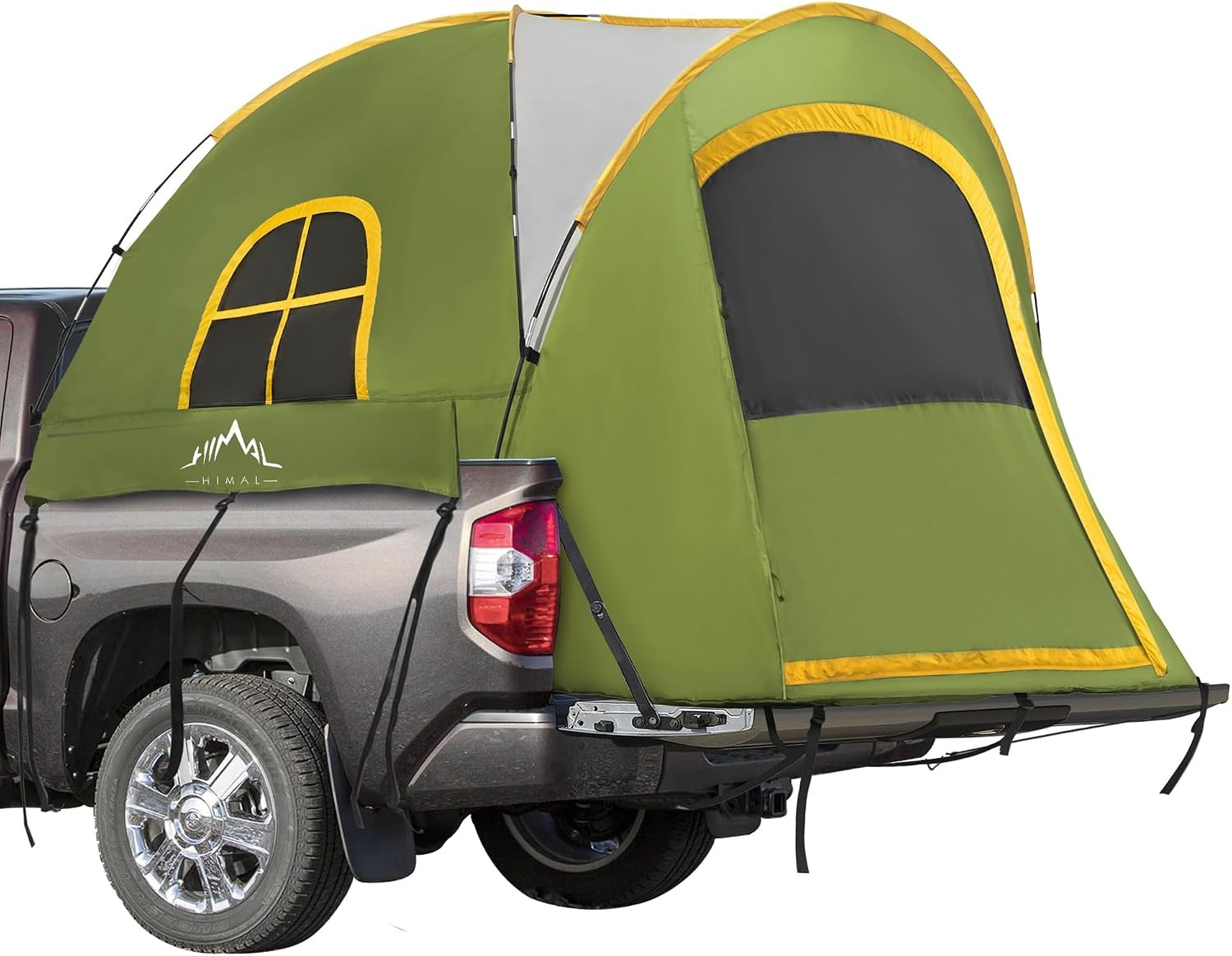
GoHimal Pickup Truck Bed Tent
The GoHimal Pickup Truck Bed Tent is the strongest of the names this edition added to the field, and its record explains why it ties two Napier lines. Its documentation is unusually complete for its end of the field, a named fabric and floor material, dimensions, a measuring method printed in the listing, three windows, and a double layer design with storage bags. Its owner record, 100 reports coded with 35 naming the truck, runs 16 fit matches against 3 mismatches, the strongest fit balance among the newly scored lines beside the Camo record’s.
Its deductions are specific rather than general. Rain reports run negative, 8 against 3 positive, including one owner whose fabric let moisture through until the whole tent soaked, and that record lowered its waterproofing figure inside the caps. Condensation reports, 5 of them, lowered its vent figure the same way.
A single pole breakage report stands in its record, below the level at which a pattern prices. No warranty document for this tent stands in the record, so its support could not be scored. Its attachment figure is its softest, resting on owners’ descriptions of its straps rather than on documentation of the anchor system itself.
Full results
Every scored tent in this guide, in score order. Form is stated for every tent, as it is in each tent’s specifications and in its section. Owner reports coded is the count of written owner reports read and coded for each tent’s score, the evidence base the method section describes. Provisional totals carry their label here as everywhere.
| Tent | Form | Bed sizes | Owner reports coded | Total | Standing |
|---|---|---|---|---|---|
| Rightline Gear Truck Tent | Floorless | 5 ft to 8 ft in eight sizes | 100 | 6.0 | Best Overall, Best for Midsize and Short Beds |
| Kodiak Canvas Truck Tent | Floorless canopy | 5.5 to 6.8 ft, 8 ft, and midsize | 100 | 5.8 | Premium |
| Napier Sportz Truck Tent, 57 Series | Sewn floor | Five sizes, 5 ft to 8.2 ft | 100 | 5.7 | Scored, no pick |
| Napier Backroadz Truck Tent, 19 Series | Sewn floor | Five sizes, 5 ft to 8.2 ft | 100 | 5.5 | Scored, no pick |
| Napier Backroadz Camo Truck Tent | Sewn floor | Not stated on the listing captured | 98 | 5.5 | Scored, no pick |
| GoHimal Pickup Truck Bed Tent | Sewn floor | 5.5 to 6.0 ft and 6.5 ft | 100 | 5.5 | Scored, no pick |
| JOYTUTUS Pickup Truck Tent | Sewn floor | Five sizes, 5.0 to 5.2 ft to 8.0 to 8.2 ft | 200, across two listings | 5.3 | Scored, no pick |
| Qualencey Pickup Truck Tent with Awning Shade | Sewn floor, with awning | 5.0 to 5.2 ft, 5.5 to 6.3 ft, 6.4 to 6.7 ft | 100 | 4.9 | Scored, no pick |
| WildFinder Truck Bed Tent | Sewn floor | Five sizes across two listings | 150, across two listings | 4.9 | Scored, no pick |
| Niphean Inflatable Truck Bed Tent | Inflatable, air frame | 5 ft and 5.5 ft styles | 75 | 4.9 | Scored, no pick |
| Umbrauto Truck Bed Tent | Poled, with awning, floor construction not stated | Three sizes across two listings | 100, on the listing its score rests on | 4.7 | Scored, provisional |
| HEYTRIP Truck Bed Tent | Sewn floor | 5.5 to 5.8 ft, as scored | 84 | 4.7 | Scored, provisional |
| Offroading Gear Truck Bed Camping Tent | Sewn floor, with awning | 5.5 ft and 6.5 ft | 56 | 4.4 | Scored, provisional |
| Hasika Double Layer Pickup Truck Bed Tent | Sewn floor | One size, 6 to 6.5 ft | 74 | 4.2 | Scored, no pick |
| Overland Vehicle Systems LD TACT Truck Bed Tent | Sewn floor | 5.0 ft and 5.5 ft, as sold here | 9 | 4.1 | Scored, provisional |
| DAC Full Size Truck Bed Tent for Caps | Cap extension | Tailgates 58 in or wider | 100 | 4.0 | Scored, no pick |
| Lanceton Pickup Truck Tent | Sewn floor | 5.5 to 6 ft and 6.5 ft | 56 | No total | Scored, evidence gaps named in its section |
| VEVOR Truck Bed Tent, pole line | Sewn floor | Three sizes, bands at 5 to 5.2 ft, 5.5 to 6 ft, 6.4 to 6.7 ft | 14 | No total | Scored, evidence gaps named in its section |
| VEVOR Inflatable Truck Bed Tent | Inflatable, air frame | One size claimed for 5.5 to 8 ft | Not separable from the pole line’s record | No total | Scored, evidence gaps named in its section |
| Pittman Outdoors Easy-Up Truck Bed Tent | Pop up frame, floor construction not stated | 5 to 5.2 ft and 5.5 to 5.8 ft | 48 | No total | Scored, evidence gaps named in its section |
| Napier Backroadz Truck Tent, 13 Series | Sewn floor | One size on the listing examined, two from the maker | 0 supplied | No total | Scored on documentation only |
For the highest Bed Fit and Attachment score in the field and the pick that answers both headline questions, check the Rightline Gear Truck Tent.
For the durability record nothing else here approaches, check the Kodiak Canvas Truck Tent.
The rest of the field
JOYTUTUS Pickup Truck Tent
The JOYTUTUS Pickup Truck Tent carries the deepest owner record in the field, 200 reports coded, 139 of them detailed, with 97 percent from verified purchases. The depth shows in its setup record, the strongest setup read in the field, 53 owners reporting an easy pitch against 5 reporting difficulty, and in its fit record, 31 matches against 7 mismatches. JOYTUTUS sells the tent through two listings, and this guide scores them as one product, because the design, the size run, and the evidence base are one line sold twice.
Its deductions are the usual ones at its end of the field, priced rather than hidden. Its poles carry a recurring breakage pattern at a lower rate than the Napier lines, about 3 reports in every 100 detailed reports, priced into its durability score. Without that price it would stand at 5.450. Its rain record splits evenly, 7 positive against 7 negative, which holds its waterproofing figure at the middle of its documented range rather than lifting it.
Two gaps ride with it. No warranty for the line stands in the record. The awning version sold through the maker’s own store is not the tent these listings sell, so the tent as sold here adds no ground living space and its score says so.
Qualencey Pickup Truck Tent with Awning Shade
The Qualencey Pickup Truck Tent with Awning Shade stands in the three tents tied just below 5 on the strength of its awning and storage pouches, which earn a livability score of 6.5. Its fit record is genuinely good, 15 matches against 2 mismatches across 100 coded reports. Its documentation names truck models with their bed lengths, a compatibility list most of this field never publishes. One documented consequence rides with that fit record. The listing instructs buyers to disassemble a tonneau cover before installing the tent, and that instruction is scored as the incompatibility it is.
Weather is where this tent fails, and it fails against its own headline. Its title claims a coating figure far above the field’s norm, but no seam treatment is documented and the design carries no rainfly, so its documented waterproofing starts low. Its owner record then lowers it by the full amount the scoring caps allow, 6 negative rain reports against 1 positive, three of them serious. The reports describe owners soaked through in a small shower and leaking despite a tarp pitched over the tent. Its condensation control could not be scored, because its vent documentation is a general claim with no window structure behind it, and its attachment system is not documented at all.
Its space earns its place if your trips run dry. Its weather score of 3.5 is the weakest of any tent that earned a total here.
WildFinder Truck Bed Tent
The WildFinder Truck Bed Tent carries the largest pole failure count in the field in its owner record, 9 serious breakage reports, each one read by hand and each a genuine pole breaking on a first or early use. Like the JOYTUTUS line, it sells through two listings and is scored as one line, on a combined owner record of 150 coded reports. The pattern prices at about 9 reports in every 100 detailed reports, the largest pole failure count scored here, and it is concentrated in the larger size listing, which contributes 8 of the 9 reports. Without that price the tent would stand at 5.050.
The rest of its record pulls in opposite directions. Its wind record is strong, 10 owner reports praising its stability against no negatives. Its documentation is more complete than its position suggests, a sealed floor layer, a connection tunnel for power and air conditioning, a color coded pole system, and a stated 1 year warranty. Against that, its rain record is the most negative among the newly scored lines, 12 negative reports against 3 positive, and that record lowered its waterproofing figure by the full capped amount.
Its fit mismatch reports also reach the level at which the scoring stops crediting a maker’s size claims at face value, because 5 owners report the tent does not fit beds the listing claims. That lowered its fit coverage figure before its fit quality was even read.
Niphean Inflatable Truck Bed Tent
The Niphean Inflatable Truck Bed Tent is the field’s air frame entry, and it posts the highest livability score among the newly scored lines, a 7.0. That score is built on documented stand up headroom, a panoramic skylight, an integrated awning, and an owner record full of room praise, 18 positive reports. Its wind record is the strongest single weather pattern in the entire corpus, 15 positive reports against no negatives on the documented dual anchoring system. Owners report inflation times of 2 to 10 minutes, recorded here as owner reports and scored nowhere, because no timed test exists for any tent in this field.
One warning belongs in this section in full, because it is the most serious single finding in the new field. Two owners report this tent deflating and collapsing on them overnight. One had a pinhole leak out of the box that dropped the shelter twice in a single night, and one had a tent that held air for four to five hours before deflating. Two reports stand below the level at which a failure pattern prices, and below the severity bar at which a tent would be removed from this guide entirely, so neither consequence applies. The finding is named here instead, and it holds the tent’s failure record figure at its lowest setting.
A buyer who chooses the air frame’s easy pitch is accepting the deflation failure mode that comes with the form. Its title also overreaches, claiming 5 to 8 ft of fit while the listing sells only 5 ft and 5.5 ft styles, and its fit coverage scores the styles actually sold rather than the claim.
Umbrauto Truck Bed Tent
Provisional total. Its evidence covers 77.5 percent of its score. The named gaps are its floor construction, stated in neither listing’s copy, and its warranty, which is not documented.
The Umbrauto Truck Bed Tent documents a wide run, three sizes with an expandable awning, a sky view vent and side vents on the second listing. Its fit balance on its scored record runs 14 matches against 4 mismatches, two of the four read by hand as genuine fit failures on identified trucks. It sells through two listings, and its score rests on the owner record of its awning listing alone, 100 reports coded with 96 percent from verified purchases. Its second listing carries a thinner record that did not meet the evidence bar, so that record is reported here and changed no figure.
Its pole pattern prices at exactly the level where a pattern begins, 3 serious breakage reports, about 4 in every 100 detailed reports. Without that price it would stand at 4.850. Two of those three owners record the maker sending replacement poles, a support fact that stands in this record because the line’s warranty term is undocumented and its support figure could not be scored.
Its largest gap is structural. Neither listing states how its floor is built, so its sleep platform could not be scored at all. A buyer who needs to know whether this tent floors its bed will not learn it from anything its maker publishes.
HEYTRIP Truck Bed Tent
Provisional total. Its evidence covers 78.5 percent of its score. The named gaps are its bed equipment compatibility, its attachment system, its storage, and its warranty, none of which its listing documents.
The HEYTRIP Truck Bed Tent is two tents in one record, a strong weather and durability performer wearing the weakest fit record of any tent that earned a total. Its documented double layer system and polyethylene floor earn weather and durability scores of 6.0 each, and its failure record is clean, a single pole report that does not recur. The tent scored here is its 5.5 to 5.8 ft size. Wider size claims were not scored. The listing’s own review page carries a wider size span than its product page states, and the size scored here is the product page’s 5.5 to 5.8 ft.
Fit is the failure, and it is measured rather than rumored. Across 84 coded reports, fit matches run 12 against 8 mismatches, 4 of the mismatches serious and read by hand. One owner’s tent came up about five inches short on a bed he had measured at 5 ft 3 in. Another’s tent pops off the far side on two different trucks. A third broke poles under tension on a truck the listing claimed.
When owners contradict a size claim at that rate, the scoring stops crediting the claim. Both halves of its fit score fall, and its Bed Fit criterion of 2.0 rests on exactly the minimum evidence the rules allow any criterion to carry. A buyer whose bed measures at the edge of this tent’s stated range should read its fit record as the warning it is.
Offroading Gear Truck Bed Camping Tent Granville II
Provisional total. Its evidence covers 77.0 percent of its score. The named gaps are its fit quality record, which falls short of the count its score requires, and its headroom, for which no figure stands in any record examined.
The Offroading Gear Truck Bed Camping Tent, sold as the Granville II on its maker’s own store, documents more than most of this field. It documents an integrated waterproof floor, a rear access window, a gear loft and shoe bag, elasticized straps with scratch free clips, and a stated 1 year warranty. Its owner record holds one account worth naming on the strength side. An owner reports the tent standing through wind bursts above 40 mph with hard rain while ground tents around it collapsed, read by hand and scored as the positive wind evidence it is.
Its pole pattern prices at 3 serious breakage reports, about 8 in every 100 detailed reports, and every one of the three sits on the 6.5 ft with awning configuration. Without that price it would stand at 4.500. Two of the three owners record that replacement poles were not obtainable as parts, which is the support fact a buyer of that configuration most needs. Its fit quality could not be scored, because its owner record carries 8 detailed fit reports where the score requires 10, and the balance in those 8 runs positive, so the gap is the count rather than the direction. Its owner record is also the stalest among the new lines, its captured reviews ending in June 2025.
Hasika Double Layer Pickup Truck Bed Tent
The Hasika Double Layer Pickup Truck Bed Tent sells in exactly one size under a title that claims a wider span, and its fit record is what that overreach costs. Across 74 coded reports, fit matches and mismatches run dead even at 8 apiece, the joint highest mismatch count in the field, with 4 of the mismatches serious and read by hand.
A tent that seems to fit only smaller beds on a 2005 F150. A 2000 Silverado it did not fit. A 6 ft Sierra it does not fit properly. When the mismatch record reaches that level, the scoring stops crediting the size claim, and both halves of its fit score fall to the joint lowest figures among the tents that carry totals.
The rest of its record is better than its position. Its documented weather system, a double layer design with a full rainfly at a stated coating rating, earns a weather score of 6.0, and its thin rain layer moves nothing in either direction. Its poles price a pattern at 4 serious breakage reports, about 9 in every 100 detailed reports, the highest rate in the field. Its construction figure also carries hand read reports of straps ripping at their seams across repeated setups.
Without the pole price it would stand at 4.375. Its maker’s setup claims, about 10 minutes the first time and under 6 after, are recorded as claims and scored nowhere, because no timed test exists to check them against. A contact invitation in its listing copy is not a warranty, and its support stands unscored for exactly that reason.
Overland Vehicle Systems LD TACT Truck Bed Tent
Provisional total. Its evidence covers 61.0 percent of its score. The named gaps are its fit quality, its failure pattern record, its headroom, and its entry design, none of which its evidence reaches.
The Overland Vehicle Systems LD TACT Truck Bed Tent is a documentation carried record, and its section should be read as one. Its maker documents a heavy 420D fabric at a stated coating rating, a PVC floor and perimeter skirt, 9 heavy duty adjustable straps, a storage loft and 2 pockets, and a 2 year warranty. That is a documentation set stronger than tents ranked well above it. Its sleep platform earns the highest figure of any tent here on the documented tailgate extension the design sleeps on. A marketplace table’s claim of a 4 year warranty stands against the maker’s own 2 year figure in the record and earns nothing.
What it lacks is owners. Its listing carries 9 coded owner reports, far below the count at which owner evidence is allowed to move any figure in this guide. That is why its fit quality and its failure record stand unscored and its total stands provisional at 61.0 percent coverage. Its maker’s largest size, the 6.5 ft model, is not sold on the listing examined, so its fit coverage reads across the two smaller sizes only.
Its maker’s capacity claim of 3 to 5 people conflicts with its own retailer copy at 2 to 3, and the scored layout reads the platform rather than the claim. Its 5 minute setup figure is a maker claim, recorded and scored nowhere.
DAC Full Size Truck Bed Tent for Caps
The DAC Full Size Truck Bed Tent for Caps closes the open back of a truck that already carries a camper shell or topper. It does not pitch over an open bed. It is presented in this ranking with that form stated in the open rather than smoothed over, because a buyer comparing it against bed tents deserves to know it answers a different question. It holds no pick and contends for none. Its job is to extend a capped bed’s enclosed space, and it is scored on how well it does that job.
On its own terms its record splits hard. Setup is its strength, 24 owners reporting an easy pitch against 1 reporting difficulty across the deepest owner record among the new lines, 100 reports coded and 83 of them detailed.
Fit and sealing are its failure, and sealing is this product’s whole job. Fit matches run 12 against 11 mismatches, the weakest fit picture in the additional pass, and owners report gaps at the tailgate sides they stuff with pillows to close. Its rain record lowered its waterproofing figure by the full capped amount, 8 negative reports against 1 positive, one owner reporting the tent leaking like a sieve. It documents one limit honestly, excluding tall and extra tall toppers, and that documented limit is scored as its consequence rather than held against it as a surprise.
Scored but no total this edition
A total in this guide is a promise that enough evidence stands behind every part of the score. Five tents were scored and earned no total, because in each case a named part of that evidence is missing. Their partial records stand in the scoring worksheet for the next edition, and the gaps below are the routes by which each one earns a total.
The Lanceton Pickup Truck Tent is the near miss. Its owner record qualifies in full, 56 reports coded with 93 percent from verified purchases, and its evidence covers three quarters of its score. What it lacks is specific. Its fit record rests on 9 detailed fit reports, 8 of them matches, where the score requires 10 before fit quality can count, and its listing documents its frame without ever documenting how the tent attaches to the bed. Its documentation is otherwise respectable, two size cuts, a rear cab access sleeve, color coded poles with illustrated instructions, and the only stated warranty among this edition’s new names, 12 months.
Its 2 pole breakage reports stand below the level at which a pattern prices. One more fit report in a future owner pull, or one maker document for its attachment system, earns this tent its total.
The VEVOR Truck Bed Tent, the maker’s pole line, documents a real tent, a sewn polyethylene floor, a stated coating rating, and 9mm fiberglass poles across three bed sizes. What it lacks is owners. Of its 123 listing ratings, only 14 came with written reports that could be coded, far below the count at which owner evidence moves figures, so its fit quality, its materials, and its failure record all stand unscored. Its fabric is never named in the specification blocks its maker publishes, and a fabric is never guessed at here. Its evidence covers barely half its score, under the coverage a total requires.
The VEVOR Inflatable Truck Bed Tent sells as a variant on that same listing, which creates a problem no scoring can solve honestly. Its owner reports cannot be separated from the pole line’s, so it has no owner layer of its own, and its air frame failure record stands untested rather than cleared. Its maker documents air beams with an included pump, dual use as a ground tent, and a single size claimed to fit beds from 5.5 to 8 ft. That universal claim earns the lowest fit figure the rules give, because every sized line in this field treats those beds as different tents. Its floor construction is never stated, so its sleep platform and its bed sealing stand unscored rather than assumed.
The Pittman Outdoors Easy-Up Truck Bed Tent carries the thinnest documentation of any tent evaluated for this guide. Its record settles its identity and its two sizes, a pop up frame in the two short bed bands, and almost nothing else. No dimensions, no peak height, no weight, no waterproof rating, and no statement of how its floor is built stand in any source examined. Its platform, its headroom, its entry, and its seams all stand unscored on missing documentation rather than on contrary evidence.
Its owner record coded 48 reports, 2 short of the count at which owner evidence counts. The direction in those reports, an easy setup lean and a fit lean in its favor, is recorded in the worksheet and moved nothing. Its maker’s 1 year warranty is its record’s one support fact.
The Napier Backroadz Truck Tent, 13 Series is the older Backroadz generation, and on the listing examined it sells only bundled with a ground tent attachment, in a single size. No owner record for it was supplied at all, so two entire parts of its score, setup and durability, rest on nothing, and no total can stand on that. Its maker sells the tent alone in two sizes and states one incompatibility in the open, that it will not work with a camper shell or cap installed, a documented limit scored as its consequence in its partial record. The bundle’s shape is a listing fact about how this generation is sold here, not a fact about the tent, and it is recorded as such in the worksheet.
How we scored these tents
This is a research lane evaluation. No tent in this guide was hands on tested for it, and nobody here has slept a night in one. Scores rest on two evidence legs, manufacturer documentation and a large body of owner evidence, combined under one scorecard, the one set out below.
The scorecard weights the five criteria as follows. Bed Fit and Attachment counts for 20 percent of the total, Livability and Sleep Usability for 25, Setup and Takedown for 20, Weather Protection for 20, and Durability and Build Quality for 15.
Fit and weather are the two criteria a tent must score from real evidence to earn any total at all, because fit failure in this class is total. A tent cut for one bed cannot be adjusted to another, and weather exposure is total, a tent that sits on top of a truck in the rain rather than beside it.
Documentation came first. Each figure began from the maker’s own specifications, fit tables, dimensions, and warranty documents, with retailer figures used where a maker publishes less and labeled as retailer figures wherever they stand. A claim a maker makes about its own tent, a setup time, a capacity count, a coating figure in a title, is recorded as a claim and scored only where independent evidence supports it. A universal fit claim, one size said to fit every bed, earns the lowest fit figure the rules give, because the sized lines in this field demonstrate that those beds take different tents.
Owner evidence came second, and it is the larger half of this guide’s work. Across every listing examined, 1,971 owner reports were read and coded one by one, each report counted once per owner per tent, with themes tallied as counts and rates rather than impressions. Where a tent’s section states a rate per 100 detailed reports, detailed reports are the reports carrying codable detail on the point in question. A tent’s owner record is allowed to move its score only when the record is deep enough to mean something.
In this guide’s Amazon owner record, that bar stands at at least 50 coded reports with at least half from verified purchases. Below that count, owner reports were read, their direction recorded in the worksheet, and they moved nothing. That single rule is why several tents below carry gaps where a thinner guide would have printed a number.
Failure patterns are priced, not hidden and not weaponized. When the same structural failure recurs across a tent’s owners, poles breaking in this class above all, the affected parts of its score carry a price computed from the failure rate. The pattern is named in the tent’s section with its rate and with the figure the tent would have carried without it.
Seven tents in this field carry such a price. A separate, reserved bar exists for a pattern so frequent and so severe that a tent would be removed from this guide entirely, and no tent in this field met it. The closest approach, the Niphean inflatable’s two overnight collapse reports, fell below both of that bar’s rates and is named in its section instead.
Three things this guide did not do deserve stating. It did not test any tent, and no language in it should be read as hands on experience. It did not time any setup, because no tested source timed a setup for any tent in this field, so the timed part of every setup score stands empty field wide and maker setup claims are printed as claims. And it did not score price. No price appears in this guide, and prices played no part in any total.
Totals were computed exactly and are displayed rounded to one decimal, and tents less than two tenths of a point apart on the exact figures are ties. Four totals are provisional. On the coverage limb, their evidence covers between 55 and 80 percent of their scores, below the 80 percent bar a normal total carries, and each also stands clear of the per criterion evidence floors the rules set. Each carries its coverage figure and its named gaps in its section.
Eleven further models sold for these beds were examined and not scored at all, because their owner records fall under the count described above. They are named here once, without endorsement and without purchase treatment, so the field’s edges are visible. The Fofana Pop-Up Truck Bed Tent, the JOYTUTUS Truck Tent with Awning in its topper form, the JOYTUTUS Inflatable Truck Bed Tent, the Napier Sportz Camo Truck Tent, the Bosvell Truck Bed Tent, and the Wakeman Outdoors Truck Bed Tent. Also named are the JOYTUTUS Automatic Truck Bed Tent, the GARIGLOOME Inflatable Truck Bed Tent, the OPL5 Electric Inflatable Truck Bed Tent, the TIPHOPE All-in-One Inflatable Truck Bed Tent, and the Everfire Inflatable Truck Bed Tent.
Truck bed tent buying guide
The scores answer which tents earned their standing. This guide answers the questions that decide whether any of them fits your truck, your gear, and your trips, in the order owners actually meet them.
Start with the floor question
Most tents in this guide are built in one of two architectures, and the architecture matters more than the brand. The sewn floor against floorless question is the bed tent field’s main divide. The air frame inflatables, the cap extension, and the pop up form in this field stand outside it, and each is taken on its own terms in its section.
A sewn floor tent gives you a sealed room. Its floor stands between your sleeping bag and the grit, the pooled water, and the cold of the bed itself, and it asks one thing in return. The bed must be empty before the tent can pitch.
A floorless tent gives you the bed as it stands. It clamps or straps at the rails and pitches over platforms, drawer systems, toolboxes, and cargo, and it asks one thing in return. The sleeping surface is yours to supply, because the bed floor is the floor.
Owner reports settle this by use, and the pattern in them is consistent everywhere it appears. If your bed carries a platform, drawers, or gear that lives there, owner reports favor the floorless form, because it pitches over the load instead of asking for the load to move. If your bed is emptied anyway and you sleep in it as found, the floored form’s sealed room is worth its setup cost.
Neither answer is the quality answer. Each is the answer for a different truck. If the floorless case is your case, the tent that proves it best in this field is the Rightline Gear Truck Tent, and floored readers start from the Napier Backroadz Truck Tent, 19 Series.
The scores price each form’s consequences rather than settling this choice for you. A floorless design pays for its open bed in its weather and sleep platform figures. A sewn floor pays for its sealed room in its durability figure, where its floor abrades against bed surfaces trip after trip. That is why both forms stand in one ranking in this guide. They answer the same job, and the consequences of each are already inside the totals above.
Measure the bed not the badge
Fit failure in this class is the purchase killing failure, and measurement is the first discipline against it. Truck makers round bed lengths in their marketing, so the badge on the truck is not the measurement the tent was cut to. The measurement that picks the tent is the inside bed length, from the bulkhead to the inside of the closed tailgate, taken with a tape rather than read off a brochure. A tape landing in a gap between a maker’s stated size ranges means checking that maker’s fit guide rather than rounding up, because a tent cut long bunches and a tent cut short will not anchor.
Two different beds hide under the words short bed, and confusing them is the class’s most common buying error. A midsize short bed, the bed under the Toyota Tacoma, Ford Ranger, Chevrolet Colorado, Nissan Frontier, and Jeep Gladiator, runs near 5 ft. Tacoma fit questions are the single largest model led search in this class for exactly that reason. A full size short bed, the crew cab Ford F-150, Chevrolet Silverado, Ram 1500, and Toyota Tundra class, runs 5.5 to 5.8 ft. They take different tents, cut to different lengths and widths, and no listing’s claim of universal fit changes that.
Width matters the same way. The space between the wheel wells runs about 48 in on full size trucks and about 44 in on midsize trucks. That is why a 54 in mattress from home will not lie flat between them and rides up over the humps instead. Midsize and short bed shoppers hold the strongest scored answer in this field, so check the Rightline Gear Truck Tent.
Tonneau covers, drawers, platforms, and shells
Bed equipment decides real purchases after length is settled, and the rules are more specific than most listings admit. A camper shell or cap is a hard stop for every bed tent in the main field, because a tent cut to pitch inside an open bed cannot share the space with a shell. The one scored exception is the cap extension form in the results above, a different product answering a different question.
A soft roll up tonneau cover, rolled fully forward, is the easiest cover to work around. Hard folding and retractable covers fight the tent for the front of the bed and for rail space. Some rail clamping tents meet tonneau rails that sit flush with the bed side, a conflict owners have solved with fabricated clamp mounts and should expect to check before the first trip.
Bed liners ride under all of this. Tents generally fit over a liner, but thick drop in liners, bed caps, and rail covers can interfere with straps and clamps, while spray in liners are usually the easier surface. A slick plastic liner can also let pads and mattresses creep toward the tailgate on any slope, and the fix owners use is a rubber bed mat or rug gripper under the pad.
Drawers and platforms sort by the floor rule above. A floorless body clamps to the rails and pitches over a drawer system or a sleeping platform without disturbing either. A sewn floor tent raised on a platform leaves its walls higher and its straps shorter, and the straps can run out of reach of their anchors.
One alternative skips the bed entirely. The C6 Outdoor Rev Tent carries its own raised platform and mattress and mounts on a flat surface, a long bed, a platform, or a rack. It is not sold through the retailer this guide links to, so it carries no score and no link here. It is named once, here, because a buyer weighing a platform build will meet it in this class, and it stands outside this ranking.
The trade nobody can sell you out of
The largest regret in this class is structural, and no tent in this guide escapes it. The truck is the campsite. On a floored tent, the bed is emptied before every pitch, the gear that lived there goes somewhere else for the night, and the tent comes down before the truck can move. Owners state the consequence in their own terms across every forum this guide’s research read.
Campers who move every day feel it most. The mobile hunter who drives to a new walk in spot each morning would strike camp in the dark twice a day. That buyer is better served by a shell, a ground tent, or a trailer than by anything scored here.
The same structure is the class’s strength for the trips that park. Arrive at a trailhead after work, pitch in the bed, sleep level and off the ground, and walk at first light instead of starting the day with a three hour drive. Sleep at a hunting camp that stays put, at a fishing access, at a festival field, anywhere the truck parks for the night and stays parked.
Judge this class by whether your trips park. If they do, the trade is cheap. If they do not, no score in this guide should talk you into it.
Condensation and the cold metal bed
Condensation in a bed tent has a second surface no ground tent has. Two sleepers’ breath condenses on the tent walls as it does anywhere, and it also collects against the sheet metal of the bed itself. A foam pad laid straight on a cold bed can gather a wet film underneath by morning even on a night when the walls look dry.
The fixes owners settle on are mechanical. Keep cross ventilation open even in cold or rain, because a sealed small volume over a bed fogs fast. Put a thermal barrier under the pad or mattress, because the metal bed is a heat sink that draws warmth and moisture all night. And know that fabric is a variable here, because canvas breathes where coated polyester sheds, which is part of what the premium end of this field is selling. For the strongest condensation record scored here, look at the Kodiak Canvas Truck Tent.
The mattress is half the sleep system
A truck bed tent sleeps on the bed floor, so the pad or mattress choice is half the sleep system, and it is the half first time buyers most underestimate. The bed floor is ribbed metal. Owners’ first nights on thin pads are the canonical complaint in this class, the ribs printing through before the night is out.
The working figures are concrete, and they come from buying guides that synthesize owner accounts rather than from any measurement of ours. Four to six inches of foam or a self inflating pad stops the ribs. A warmth rating around R 7 or higher carries shoulder season and winter nights, because the metal bed pulls heat through a thin pad for hours. A plain air mattress covers the ribs and does nothing for cold.
The two structural fixes are a mattress cut to fit between the wheel wells, which buys back the full width of the box, and a low platform with storage under it. The platform buys flatness at the cost of headroom a low tent cannot always spare.
Because the mattress decides the night as much as the tent does, it gets its own scored guide. Our companion roundup, Best Truck Bed Mattresses , scores the pads and bed mattresses made for these beds on the same evidence rules used here, and its rankings are the working answer for choosing one. The figures above are the short version, enough to plan a bed around from this page.
One safety fact
A bed tent is for a parked truck. Never sleep in the bed with the engine running, not for warmth, not for air conditioning, not for a few minutes. The exhaust carries carbon monoxide, a gas that gathers where a sleeper cannot smell it gathering, and no tent in this guide changes that fact.
Frequently asked questions
How do I know a truck bed tent will fit my truck?
Measure the bed, not the badge. The measurement that picks the tent is the inside bed length, from the bulkhead to the inside of the closed tailgate, taken with a tape, and it has to land inside the maker’s stated range for the size you buy. Truck makers round bed lengths in their marketing, and two different beds hide under the words short bed, a midsize short bed near 5 ft and a full size short bed at 5.5 to 5.8 ft, and they take different tents. Midsize and short bed shoppers hold the strongest scored answer in this field, the Rightline Gear Truck Tent.
Can I drive with a truck bed tent up?
No. A truck bed tent is a parked truck shelter, and it comes down before the truck moves. On a floored tent the bed is emptied before every pitch and the tent is struck before the drive, which is the structural trade this whole class makes. Judge the class by whether your trips park for the night, because no score in this guide changes that answer.
Do I have to empty the bed before pitching?
That depends on the floor. A sewn floor tent needs an empty bed before it can pitch, and the gear that lived there goes somewhere else for the night. A floorless tent clamps or straps at the rails and pitches over a platform, a drawer system, or cargo, and asks instead that you supply the sleeping surface, because the bed floor is its floor.
Will a truck bed tent work with a tonneau cover or drawers?
It depends on the hardware you run. A soft roll up tonneau cover, rolled fully forward, is the easiest cover to work around, while hard folding and retractable covers fight the tent for the front of the bed and for rail space, and rail clamping tents can meet tonneau rails that sit flush with the bed side. Drawers and platforms sort by the floor rule, a floorless body pitches over them without disturbing either. A camper shell or cap is a hard stop for every bed tent in the main field.
What should I sleep on in a truck bed tent?
The pad or mattress is half the sleep system, because every tent here sleeps on the bed floor and that floor is ribbed metal. Four to six inches of foam or a self inflating pad stops the ribs printing through, and a warmth rating around R 7 or higher carries cold nights, because the metal bed pulls heat through a thin pad for hours. A plain air mattress covers the ribs and does nothing for cold, and a mattress cut to fit between the wheel wells buys back the full width of the box. The mattress decision gets its own scored guide in this site’s planned companion, Best Truck Bed Mattresses.
How were these truck bed tents scored?
Documentation first and owner evidence second, under one scorecard of five weighted criteria, with recurring failure patterns priced into the scores rather than hidden. Across every listing examined, 1,971 owner reports were read and coded one by one, and no tent was tested, no setup was timed, and no price was scored. The full method stands in How we scored these tents, above.