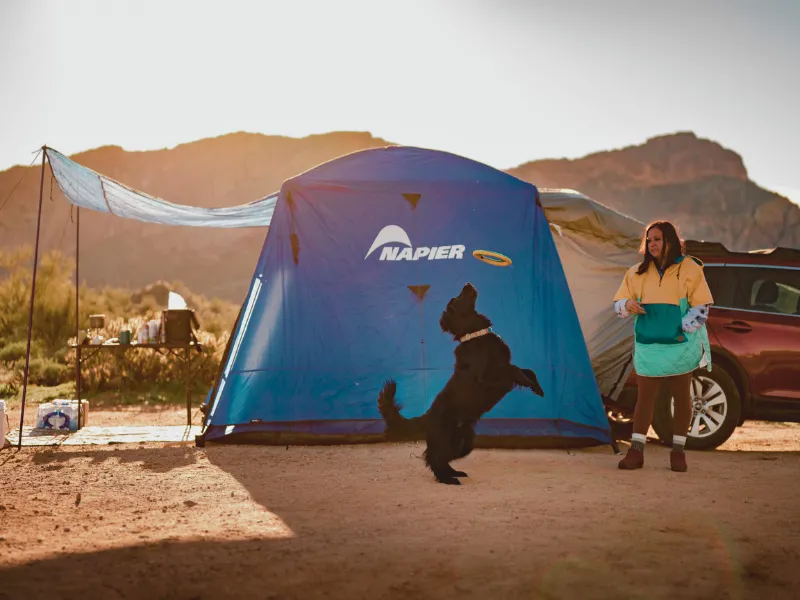
An SUV tent turns the back of your vehicle into part of the campsite, a real tent on the ground connected to your cargo area, so you gain a room and keep your gear within reach. Most of the tents in it are lightly built, many of the capacity claims are inflated, and the wrong pick usually fails in one of 3 ways: it fits the vehicle poorly, it takes too long to set up, or it lets the weather in.
We ranked 24 SUV tents on research scores and show the whole field here, not just the winners, so you can see what each pick beat. Every tent on this page is sold on Amazon and was checked in October 2026. One of the 24 is Daniel’s own tent; the other 23 were researched rather than used by us.
Our recommended SUV tents
- Best Overall SUV Tent: Napier Sportz SUV Tent 9×9. Rating 7.2.
- Best SUV Tent for Families: FanttikOutdoor Beta C6 Apex SUV Tent. Family rating 7.5.
- Best Budget SUV Tent: VEVOR SUV Camping Tent. Rating 6.6
- Best Tailgate Shelter: HREFEU SUV Tailgate Tent. Rating 6.1.
- The Tent Daniel Owns and Uses: Vevor SUV Tent 8×8. Rating 5.9.
A note on prices. Every price on this page is a range across the retailers and channels we checked, or the single figure we found where only one exists, and each display carries the date it was checked. Retailers move their prices, so check the current price before you buy.
Contents
- Our recommended SUV tents
- Best Overall: Napier Sportz SUV Tent 9×9
- Best SUV Tent for Families: FanttikOutdoor Beta C6 Apex SUV Tent
- Best Budget SUV Tent: VEVOR SUV Camping Tent
- Best Tailgate Shelter: HREFEU SUV Tailgate Tent
- The tailgate shelters behind the pick
- A vehicle cabana worth knowing about: Kelty Highroads Overlanding Shelter
- The Tent Daniel Owns and Uses: Vevor SUV Tent 8×8
- The best known SUV tent here, and why we do not recommend it: Napier Backroadz SUV Tent
- Portal 2-in-1 5 Person SUV Tent
- Full results: the 23 ranked SUV tents
- The rest of the field: scored under the retired method
- How we score SUV tents: the method
- How to choose an SUV tent: our buying guide
- TL;DR
- Frequently asked questions
- Notes
- Endnotes
- Update log
We may earn a commission when you buy through links on this page. Commissions do not change a product’s score or pick status, and brands cannot pay for placement in a ranking.
Best Overall: Napier Sportz SUV Tent 9×9
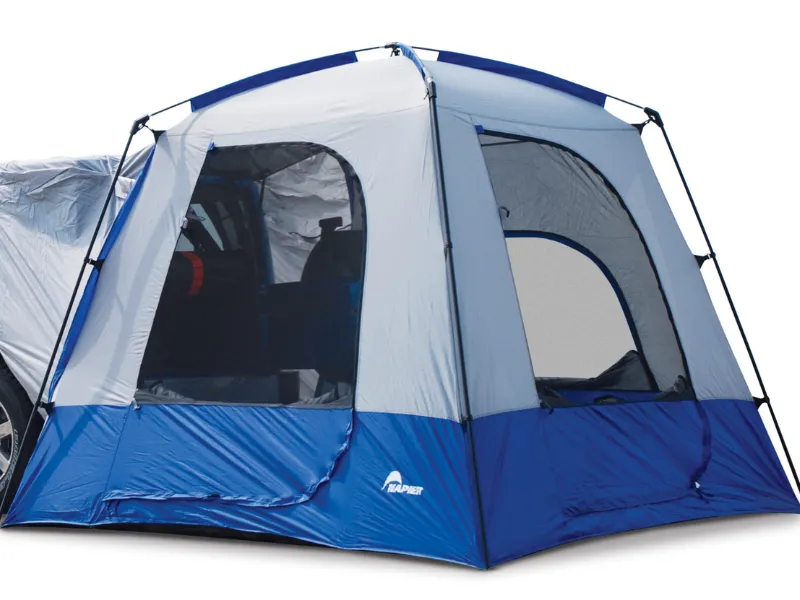
Napier Sportz SUV Tent
Pros
Documented fit for CUVs, SUVs, minivans, trucks
Full rainfly over a 2000mm coating
Queen mattress fits, with room to move
Concerns
10 poles, the most involved setup here
Premium price buys documentation, not space
Sleeps 5 on paper, 4 in practice
For the camper who wants the vehicle and the tent to feel like one settled camp, with the weather shut out and the fit documented rather than hoped for, the Napier Sportz SUV Tent is that setup. It carries the strongest fit and weather documentation in the field, from the category’s most established line, at the field’s premium price; its limits are a 10 pole setup and a 5 person claim that its floor does not quite support. For a dry room and a fit you can count on, choose the Napier Sportz SUV Tent.
Pros
- It holds the set’s strongest fit record, with a universal sleeve for CUVs, SUVs, minivans, and trucks with caps, and cargo sleeping for 2 documented rather than assumed
- Its full rainfly over a 2000mm coating is the strongest documented weather package among the leaders, and its owner record narrows its leaks to a known cause, the manual’s seam sealing step
- Its near vertical walls make the 81 sq ft usable, and a queen air mattress fits with room to move and store gear
- It has double wall construction with an integrated awning
- Its record is the deepest of the leaders, 99 Amazon reports, and in it the sleeve seals cleanly on vehicle after vehicle
Concerns
- Its 10 poles make it the most involved setup among the leaders, and users name the rainfly as the part they wrestle when pitching alone
- The premium price buys documentation and weather protection more than space; the Backroadz gives you a larger floor for less money
- Its 5 person claim is a realistic 4 on an honest layout
- Its arrival record is the caution in its file: 13 owner reports in its record describe a defect on arrival or at first installation, seams unsewn, fabric torn, or a floor giving way, though Napier’s warranty answer in the record is usually a replacement tent
- The failures in its record cluster early, so the first trip is the test: inspect the seams and fabric on arrival, and seal the seams before the first rain, as its manual directs
- The one independent tester who used it in heavier rain reports water through the uncoated sleeve panels and a leak at the seam between the tent walls and the floor
The Napier Sportz SUV Tent is the safe, established choice in this category, and under this page’s retired method it led the ranking for years. If your camping is wet, or if documented fit across vehicle types matters more to you than floor area, this was always your tent; it is now also the pick. The tent itself is unchanged: a well documented, double wall design from a brand with a long record in this product.
What campers report, across 99 Amazon owner reports. Campers describe a big, tall room that attaches to almost anything. The sleeve seals cleanly on vehicle after vehicle in this record, crossovers, minivans, full size trucks with caps, a 1997 4Runner, a Mercedes Metris. Campers use the connection as a true second room, sleeping in the vehicle and living in the tent, or the other way around.
Space is the standing praise, with standing room to spare and sleep counts that run 2 to 5 depending on how much of the party sleeps in the vehicle. The ritual that comes with owning one is seam sealer.
The manual calls for it, campers who do it report dry tents through downpours and week long rain, and the wet nights in its record belong almost entirely to campers whose sealing goes unmentioned. The fly is the solo tax: the tent goes up alone in about twenty minutes for camper after camper, including campers in their late sixties, and the fly is the part they wrestle.
The long view is mixed in a specific way. The failures cluster at the beginning, seams unsewn, fabric torn or holed, a unit that dissolved at its floor, and Napier’s answer, when customers reach Napier, is usually a new tent. Campers who get past the first trip tend to stay, some for years.
For the safe, established choice in this category, pick the Napier Sportz SUV Tent.
Specifications (manufacturer figures):
| Specification | Figure |
|---|---|
| Model | 82000 |
| Floor size | 9 × 9 ft (81 sq ft) |
| Peak height | 7.25 ft (87 in) |
| Capacity | 5 people listed; a realistic layout is 4 |
| Weight | 36 lb |
| Price | $339.99 to $399.99 across the channels checked on 2026-10-22 |
| Fabric | 75D 190T polyester taffeta with a 2000mm PU coating per Napier’s current catalog (an older Napier specification sheet listed 1200mm; the current catalog is the figure of record) |
| Poles | 10 in total, steel and fiberglass, including 2 awning poles |
| Warranty | 1 year, defects only |
Best SUV Tent for Families: FanttikOutdoor Beta C6 Apex SUV Tent
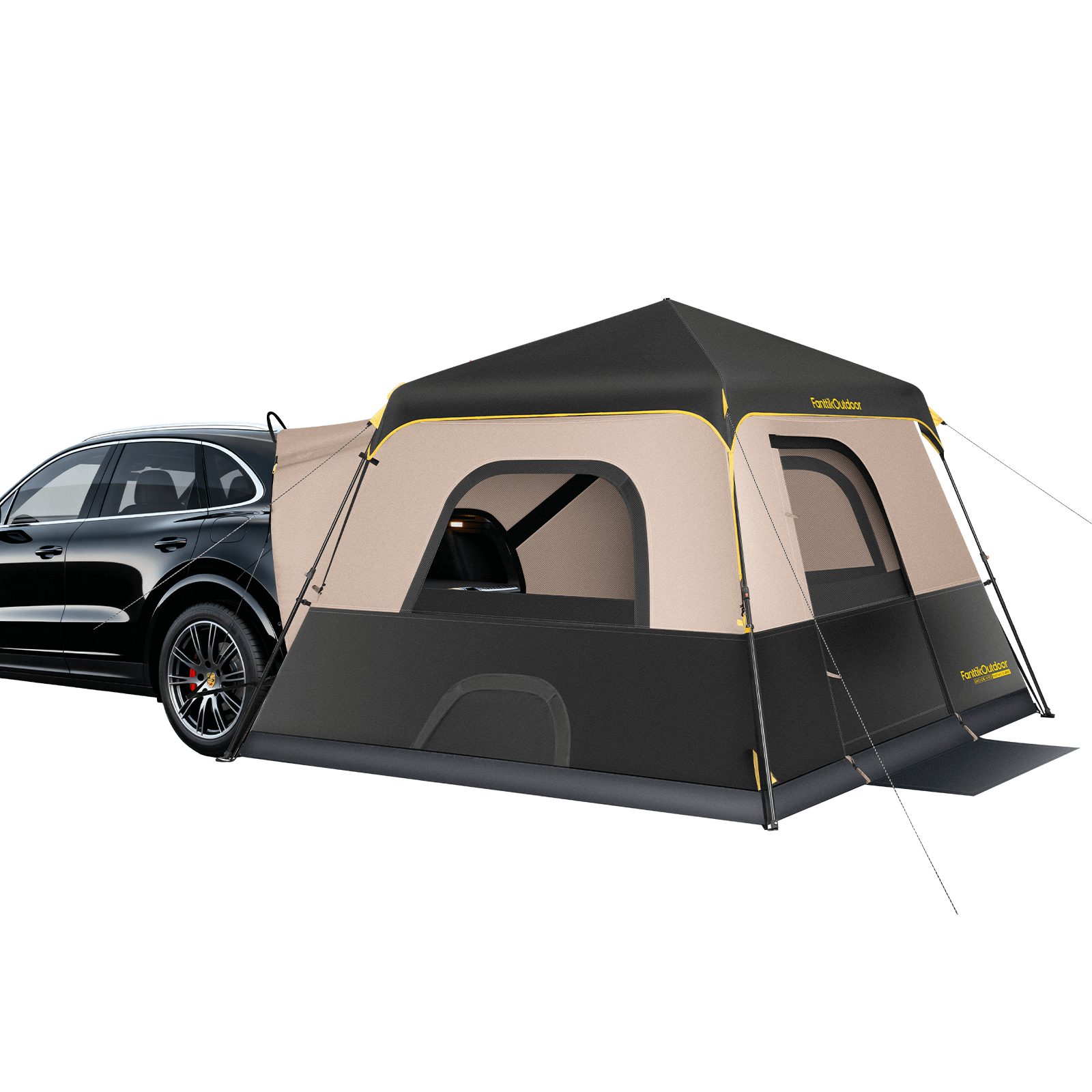
FanttikOutdoor Beta C6 Apex
Pros
Highest family score in the field
Queen air mattress fits with room to spare
Pre attached poles click into place
Concerns
Rainfly covers only the top, the known soft spot
Pack away has a learning curve
Young record, first season use only
For the family that wants the tent up fast and the kids spread out inside it, this is the roomiest easy pitch in the field. It is a full cabin on pre attached poles that click into place, with space and airflow campers praise nearly universally, and family camping as the most common use in its owner record, with its family reports describing the routine working, children asleep in the cabin and space to spare. It holds the family pick outright, on the highest family score in the field, 7.5, and it stands second overall on total. For a fast pitch and room for the whole family, pick the FanttikOutdoor Beta C6 Apex.
Families who would rather split into separate sleeping rooms than share one cabin can compare the multi-room tents that give each group its own space.
Pros
- It has the field’s highest family score, on the room and airflow campers praise nearly universally, with a queen air mattress fitting with room to spare
- Its pre attached poles click into place, and most users find the pitch quick and workable alone once the sequence is learned
- One owner reports the tent standing through 5 windy coastal days, the hardest exposure in its young record
Concerns
- Its rainfly covers only the top of the tent, the recurring criticism in its record, so weather protection is the known soft spot in its file
- Pack away has a learning curve: the early complaints were sharp, though across the full record most users get the tent back into its bag once they have done it
- First setup attempts can run long before the sequence clicks
- Its record is young and covers first season use only, so its durability score rests on documentation rather than ownership
The FanttikOutdoor Beta C6 Apex is the fast pitch family cabin of this field: a full size tent on an instant frame, its poles riding attached to the tent and clicking into place. If your camping is family camping, with kids to settle and daylight to spend on the day rather than the pitch, this is the tent aimed at your pattern. Its known soft spot is weather: the rainfly covers only the top of the tent, so weather protection is the thinnest part of its file. Its record is a young one, a first season of reports with nothing longer behind it.
What campers report, across 43 owner reports. Campers describe a big, airy cabin, and space and airflow draw the praise: standing room under near vertical walls. Sleep reports settle into a consistent shape, 2 to 3 people roomy on mattresses, a queen air mattress in with room to spare, and a family’s report of 2 adults and 2 toddlers fitting perfectly. Family camping is the most common use in the record, and the family reports describe the routine working, children asleep in the cabin and space to spare.
Fits are reported across a wide run of vehicles, a Transit Connect, an Outback, 4Runners, a Santa Fe, a Trailblazer, a Jeep, and a Bolt. The record’s 1 attachment failure is specific: a rear mounted spare tire blocked the connection outright, and that camper used the tent standing alone instead.
The pitch rewards practice. First attempts run long, the camper who called the first opening an adventure reports a practiced pitch under 5 minutes, and most users work it alone once the sequence is learned, the poles extending on push buttons and clicking when seated. Pack away is the divided half of the setup story. Most campers get the tent back into its bag, a first time learning curve recurs across the record, and a minority describe real difficulty, the sharpest report from a camper who says she would have left the tent at the campground without other campers’ help packing it.
The recurring criticism is the rainfly, a cap over the top that leaves the walls to take real rain. Against that judgment, no owner in the record describes rain reaching the walls, and the record’s hardest weather report has the fly staying secure through 5 days of coastal wind at Padre Island, 25 to 35 mph sustained, the tent staked and guyed and its zippers working in blowing sand. The limit on the whole record is time: it covers a first season only, with no durability failure described in it and no second season yet reported.
One honesty note on this pick. Its owner sample is still young and mostly free product Vine reviews, so its scores rest on its specifications and design rather than on owners, and the method section below carries the detail.
Make the family camp easy: look at the FanttikOutdoor Beta C6 Apex.
Specifications (manufacturer figures):
| Specification | Figure |
|---|---|
| Floor size | 10 × 9 ft (120 × 108 in) |
| Peak height | 80 in |
| Capacity | 6 people listed |
| Weight | 22 lb |
| Price | $329.99 on Amazon, in stock, verified by Daniel on 2026-10-23; the maker’s own store showed the same $329.99 figure at its check on 2026-10-24, sold out there |
| Frame | an instant cabin frame with pre attached poles on a carbon steel frame; the poles extend and retract with push buttons and click when seated |
Best Budget SUV Tent: VEVOR SUV Camping Tent
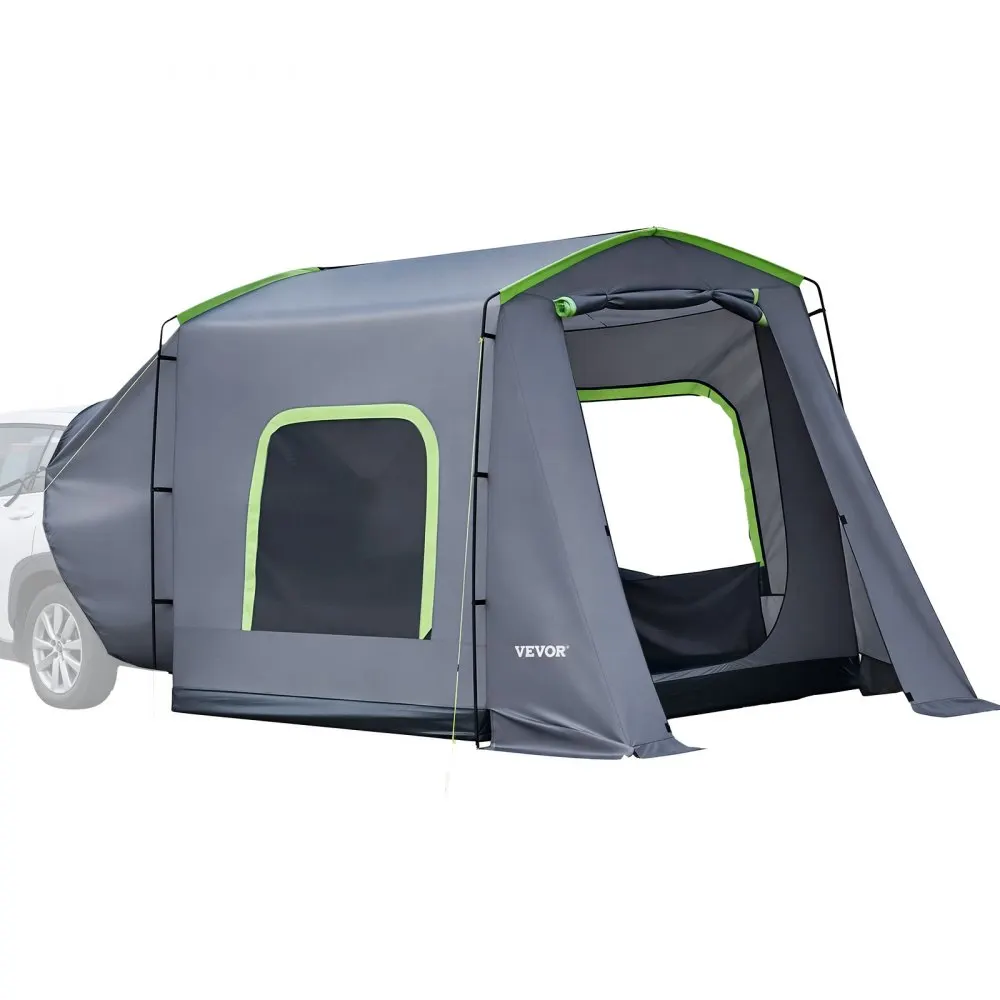
VEVOR SUV Camping Tent
Pros
Lowest qualifying price here, no membership needed
83 sq ft under a 90 in peak, the budget class’s best room
A measurable fit rule in the manual, not a bare claim
Concerns
Attachment hardware tears away in early use
Fit rule covers small and mid sized SUVs only
8 pole pieces, the most parts in the budget class
This is a different model from Daniel’s 8×8 Vevor below, and it inherits nothing from that tent’s scores or from his experience with it.
A bigger camp for a small budget, with stand up headroom, a floor the family can actually spread out on, and a double layer build, at the lowest qualifying price here. It is a newer and larger VEVOR than the one Daniel owns, with the strongest livability score of any budget priced tent here. Its limits are an 8 piece pole set and a documented fit rule written for small and mid sized SUVs. For the lowest qualifying price here, start with the VEVOR SUV Camping Tent.
Pros
- It is the cheapest qualifying tent under the budget rule, at the lowest live verified price without a membership
- Its livability score leads the budget class, on about 83 sq ft under a 90 in peak, the tallest headroom documented at this price
- Its manual gives a measurable fit rule, a tail perimeter under 6.1 m with an upward opening hatch, rather than a bare universal claim
- Its PU2000mm double layer build and rainfly match the weather system the pricier Napier leaders use, at a budget price
Concerns
- Its 8 pole pieces, 4 fiberglass and 4 iron, are the most parts to assemble in the budget class
- The manual’s fit rule covers only small and mid sized SUVs with upward opening hatches
- Seam treatment is not documented in the manual record we could check, which holds its weather score below what its coating alone would earn
- Its attachment hardware is its weak point: corner loops, clips, and tabs tear away in early use often enough in its owner record to be its signature failure
- Its winning margin is $2.09 on same day prices, and prices at this level move, so this pick is likeliest to change on a recheck
The VEVOR SUV Camping Tent is the budget end of this field at full size: about 83 sq ft under a 90 in peak, the tallest headroom documented at this price, in a double layer build with a PU2000mm coating and a rainfly. It holds the budget pick at $167.90, and its livability score of 8.5 leads the budget class.
It suits the price first buyer whose vehicle meets the manual’s fit rule, a small or mid sized SUV with an upward opening hatch and a tail perimeter under 6.1 m. Its known weakness is the small hardware: the corner loops, clips, and tabs that tie the tent to the vehicle and the ground, and the stitching behind them. That record is the price of the price, and it is the part of this tent a buyer should go in watching.
What campers report, across 62 Amazon owner reports. Space is the record’s unanimous finding. Camper after camper praises the standing height and the room, sleep reports run to a full size mattress with room to spare and 2 adults with gear never cramped, and no owner in the record reports sleeping fewer than the realistic layout of 4 to 5.
The vehicle connection is the split verdict. On named vehicles, a Jeep Wrangler, a Nissan Murano and a Chevrolet Suburban, a Tesla Model Y, a Honda van, a Subaru XV, a truck bed, and a Toyota Yaris, campers report the sleeve sealing or fitting snugly. Against that, 3 owners report water arriving at the connection, pooling at the bottom of the attachment, gathering in a sizeable puddle between car and tent, and running down at the foot of a bed through an unsealed hood. One camper’s connection could not be used at all, her zippered back wall sitting 3 ft short of her van and ending at mid thigh.
The pitch is mostly a solo job: 9 of the 10 owners who describe a solo attempt completed it. Among them are a woman in her 50s who works a garden stake around the fly’s height, a 66 year old whose only fight was the blue cross pole, and a camper who pitched alone in 25 minutes with a hernia and took the tent down in the rain in 10. First attempts run 11 to 45 minutes and practiced ones 7 to 12, the fight, where there is one, is the cross poles seating tight, and 2 owners report the tent resisting its own carry bag on pack away.
The weather record through the tent body runs positive: campers report staying dry through a 10 day Alaska trip in wind and rain, a violent first night thunderstorm, and very heavy rainfall, and a family of 4 stayed dry through the worst rain they had seen lately. Wind splits the record instead: 7 owners report the tent standing solid in strong wind and storms, against 3 wind failures, a tent the wind tore apart on its first use for want of ties at the foot, ending that trip in a hotel, a top that sagged and flopped in a light breeze. One owner found the tent very unstable.
Then the hardware, this tent’s signature failure. Six owners report attachment hardware tearing away or breaking in early use: corner loops coming off after the 2nd use for 1 owner, who camps on gator clips now; a top clip and both bottom corner loops ripped off by the 3rd use, repaired with tape while she waits on a seamstress; tabs broken on the first test pitch, sewn back on by the owner herself. A strap ripped off a mis stitched seam for another owner, who returned the tent inside her window when Vevor support did not answer; a rail mount torn clean off during a yard trial, on a unit its owner rejected as unusable; and clips snapping off in use for a 6th owner.
Around the pattern sit the smaller flags: a vehicle strap threaded the wrong way through its buckle at the factory, a workmanship flaw on the groundsheet, and a door flap that ripped beside a wear hole at 1 month. The record is bounded, and its bounds matter. No owner reports the tent body, the poles, or the floor failing the same way, the 2 worst outcomes were returns or rejections rather than collapses in use, and 4 of the 6 owners kept and use their tents. Nearly every criticism in the record arrives with the price attached, and several who report a failure also say they love the tent.
Why this tent holds the budget pick. Prices here are compared on what any reader can get without a paid membership, and on that basis the VEVOR SUV Camping Tent, at $167.90 on Amazon, checked by Daniel on 2026-10-22, is the cheapest real sleeping tent that clears our quality floor. The price rule and the floor are stated in the method section below.
The JOYTUTUS pole tent, at $169.99 to $189.99 by color, documents the stronger build on paper, a durability score of 5.5 against this tent’s 4.5. Its record carries poles breaking outright in a recurring pattern and a vehicle connection that leaks on nearly half the owners who describe it. That record bars it from picks and leaves it at 6.0 in the table.
The VEVOR Daniel does own, the 8×8 below, is the cheapest tent in this article, at $102.51 to $159.39 across the channels checked on 2026-10-22, and it is not the budget pick. A budget pick has to score 6.5 or better and pass the failure pattern check, and his tent clears neither bar, at 5.9 with zippers and straps failing across its wider record.
Prices at this level move, so check the VEVOR SUV Camping Tent.
Specifications (manufacturer figures, from the manual for model 224061301):
| Specification | Figure |
|---|---|
| Floor size | 10.1 × 8.2 ft (about 83 sq ft). The Amazon listing title calls this tent 10.6 ft; the manual figure governs and is the one scored |
| Peak height | 7.5 ft (90 in) |
| Capacity | 5 to 8 people listed; a realistic layout is 4 to 5 |
| Weight | 10.91 kg (24.05 lb) |
| Price | $167.90 on Amazon, in stock, checked by Daniel on Amazon on 2026-10-22; the same figure showed at the maker’s store and at Target when they were checked on 2026-10-24 |
| Fabric | 210T Oxford with a PU2000mm coating, double layer with rainfly |
| Poles | 4 fiberglass poles plus 4 iron tubes |
| Fit rule from the manual | mid sized and small SUVs whose tail perimeter is under 6.1 m and whose hatch opens upward |
| Warranty | 12 months under Vevor’s published policy |
Best Tailgate Shelter: HREFEU SUV Tailgate Tent
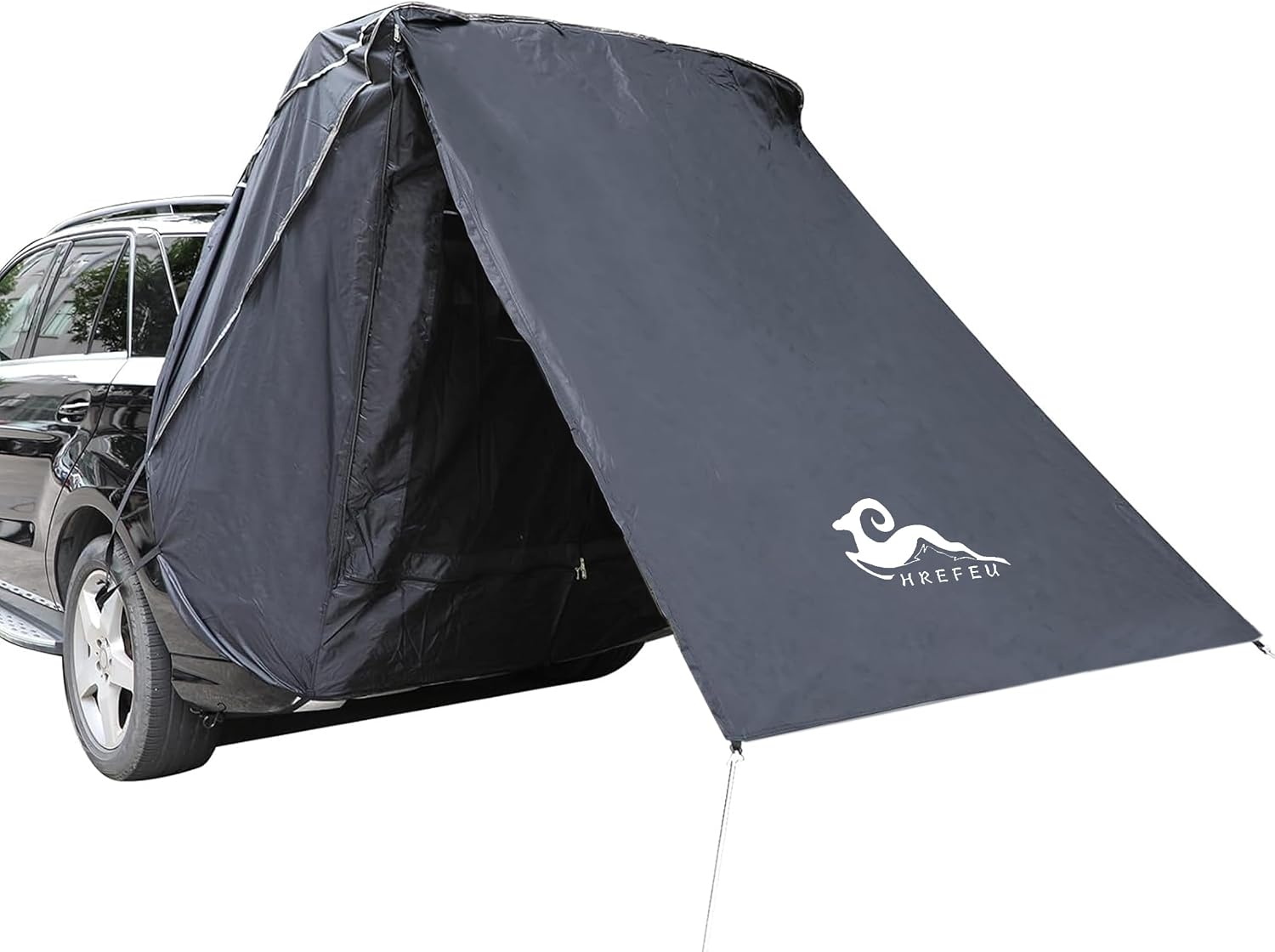
HREFEU SUV Tailgate Tent
Pros
Screened sleeve wraps the hatch, bug free cargo sleeping
13 owners stayed dry in real rain, one in a hailstorm
Up in 5 to 10 minutes, most users pitch it alone
Concerns
Straps, cords, and buckles fail, often on the first trip
Awning flap needs poles the base set leaves out
Fit is broad, with slack or tightness at a corner
A bug free back of the car, the hatch up all night, and the rain kept off the bed you sleep in. That is the job this sleeve does: it wraps the open tailgate in an elastic, screened enclosure, so the cargo area becomes a ventilated room and the vehicle stays the bedroom. It is the least expensive shelter scored in this article, and it earns the pick on a rain record its price does not suggest. For a screened, dry cargo bed with the hatch up all night, pick the HREFEU SUV Tailgate Tent.
Pros
- It is a genuine hatch enclosure: the screened sleeve wraps the open tailgate so the cargo area sleeps ventilated and bug free, which is what this class is for
- Its rain record is the surprise at this price: 13 owners in its record report staying dry in real rain, one of them through a thunder and hailstorm
- Users pitch it fast, most of them alone in five to ten minutes, because the base set is one elastic sleeve that stretches over the hatch
Concerns
- Its hardware is its weak point: straps, cords, buckles, and carabiners fail in report after report, often on the first trip, and the fabric tears where it stretches over the hatch
- The awning flap needs poles the base set does not include, so the shaded room in the listing photos asks for the pole set or poles of your own
- Fit is broad rather than exact: the same sleeve is praised from a Ford Focus to a Suburban, usually with slack or tightness at one corner, and stronger magnets are the campers’ standard finishing tool
The HREFEU SUV Tailgate Tent is the simplest form in this field: a floorless elastic sleeve that wraps the open tailgate and turns the cargo area into a screened, ventilated room, with the vehicle itself as the bedroom. At $55.99 it is the least expensive genuine hatch enclosure in its class, and it holds the tailgate pick at 6.1. It suits the camper who sleeps in the vehicle and wants the hatch open through the night: a screened room at the back of the car, privacy and moving air, pitched in minutes and packed small enough to live in the car. Its known weakness is the hardware that holds it on, the straps, cords, buckles, and carabiners, and the fabric where it stretches over the hatch. That record is why durability, at 4.4, is its lowest criterion score.
What campers report, across 98 owner reports. The pitch is the record’s easiest story. Most users have the sleeve over the hatch in 5 to 10 minutes, many of them alone, 17 owners report a completed solo setup against 2 who could not finish a solo pitch, and practiced pitches run 2 to 5 minutes.
What the sleeve buys them is the vehicle as a room: campers praise the screened space at the back of the car, bugs screened out and air moving through it, privacy with the hatch up, and a dry place to sleep in the cargo area itself. Rain is the record’s surprise: 13 owners report staying dry in real weather, pouring rain minutes after setup with the vehicle dry inside, a thunder and hailstorm, an all day rain, and a huge rainstorm with wind. Five owners report the sleeve holding in named wind, against 1 who rates it poor in wind and recommends it anyway.
The leaks in the record are few and located: 3 owners, a leak through the top of the sleeve, a leak into the trunk at the connection, and rain entering side screens that carry no zippered covers, and no entry point repeats. Fit is broad rather than exact: of the 48 owners who name a vehicle, about 36 report a clean or workable fit, on a Honda Passport, a Chevy Tahoe, a Nissan Rogue, Subarus, a RAV4, a Ford Focus and an Escape, minivans, and trucks. The problems gather at the extremes of size, slack of about 3 in to a side on a small hatchback and tightness on the largest vehicles, with stronger magnets the campers’ standard finishing tool.
Then the hardware, the record’s fault line: 8 owners report straps, cords, buckles, or carabiners failing in use, a strap broken on the first night, straps ripped on the 2nd use, a sewn strap pulled out under a slight pull, and 1 tire cord snapped under its first tensioning and left the sleeve unusable. And 5 owners report the fabric tearing, on the 1st use, at the bottom on the 3rd fitting, and where the sleeve stretches over the hatch.
Those failures recur across 4 calendar years, 2023 through 2026, so they read as the product’s weakness rather than 1 bad batch. The record’s bound is its split: at least 11 owners report repeated use with the hardware intact, a week at the Sturgis rally among them. Campers tend to land on 1 of 2 outcomes, a quick, useful sleeve they keep or an early hardware failure they return, which is the durability score of 4.4 in owner form.
Why this class has its own pick. A tailgate shelter is not a small tent; it encloses the space the open tailgate creates, and it should be judged against other shelters, not against the full tents you sleep in. The 6 hatch enclosures scored here are sleeves and screened wraps that turn the open hatch into usable, ventilated space while the vehicle stays the bedroom, and the HREFEU takes the pick among them at 6.1.
For cargo sleeping in a bug free bed, look at the HREFEU SUV Tailgate Tent.
Specifications (manufacturer figures):
| Specification | Figure |
|---|---|
| Form | a floorless elastic hatch sleeve; the buyer sleeps in the vehicle, and the sleeve’s flap works as an awning when poled, with poles included only in the set that says so |
| Weight | 2.66 lb |
| Price | $55.99 on Amazon, verified by Daniel on 2026-10-23 |
| Fabric | 210D silver coated polyester with a waterproof coating the listing states as 3000mm, tape sealed seams, and UPF 50 plus sun protection |
| Fit | elastic and universal, with the listing’s own exclusions: not for double doors, side doors, or vehicles with a rear mounted spare tire |
| Included | 2 stakes and guy lines |
| Warranty | none stated in any source we could find |
The tailgate shelters behind the pick
The name most readers know in this class is the Napier Sportz Cove, and it is the classic alternative. The Cove is a simple floorless enclosure that turns the open hatch into a shaded living area, Napier rates it to sleep 2 in the cargo area, and it is the product readers of this site have bought on Amazon more than any other in this category. It costs more than the HREFEU, $111.98 to $170 against $55.99, and what the extra money buys is the proven name and the longer service record. It scores 5.6 against the HREFEU’s 6.1: its weather and durability records are thinner, and its setup score of 8.5 flatters it, resting on its simple structure, with no timed result behind it.
Campers describe the Cove the same way the score does: simple in concept and fiddly at the attachment, with setup running longer than the advertised five minutes, straps routing inside the wheel wells, and clips that do not feel sturdy. On one rainy night it fit the tailgate corner to corner and the car stayed dry, and campers frame it as a fair weather shelter, with wind the worry.
If you want the proven, simple enclosure, the Cove remains a reasonable buy; the pick on score is the HREFEU. Fit is the Cove’s deciding risk, and its owner record names it: 15 owners report a clean fit on named vehicles, while a Telluride, an Odyssey, and a Highlander defeated it outright, and 8 owners taped, extended, or cinched gaps rather than return it.
Its durability record runs both ways inside the same small set: 3 owners met a failure inside their first few uses, on 3 different components, while 5 report 3 to 5 years of sound service. And solo setup divides its users: most pitch it alone in five to fifteen minutes once the pole threading is learned, a minority fight the sleeve, and one experienced camper gave up after an hour.
Behind the pick, the Hasika awning stands at 5.8 with straps and hooks as the parts that break, and the JOYTUTUS Tailgate Tent at 5.5, a screened tailgate room campers use exactly as designed. The KAMPKEEPER tailgate awning, at 5.8, was named Best Awning in Field and Stream’s tested 2026 roundup and sells at $94.22 to $129.90 across Amazon and Walmart, checked on 2026-10-22 and 2026-10-23. Its record carries a pole failure pattern, so it is barred from this pick while that record stands.
A vehicle cabana worth knowing about: Kelty Highroads Overlanding Shelter
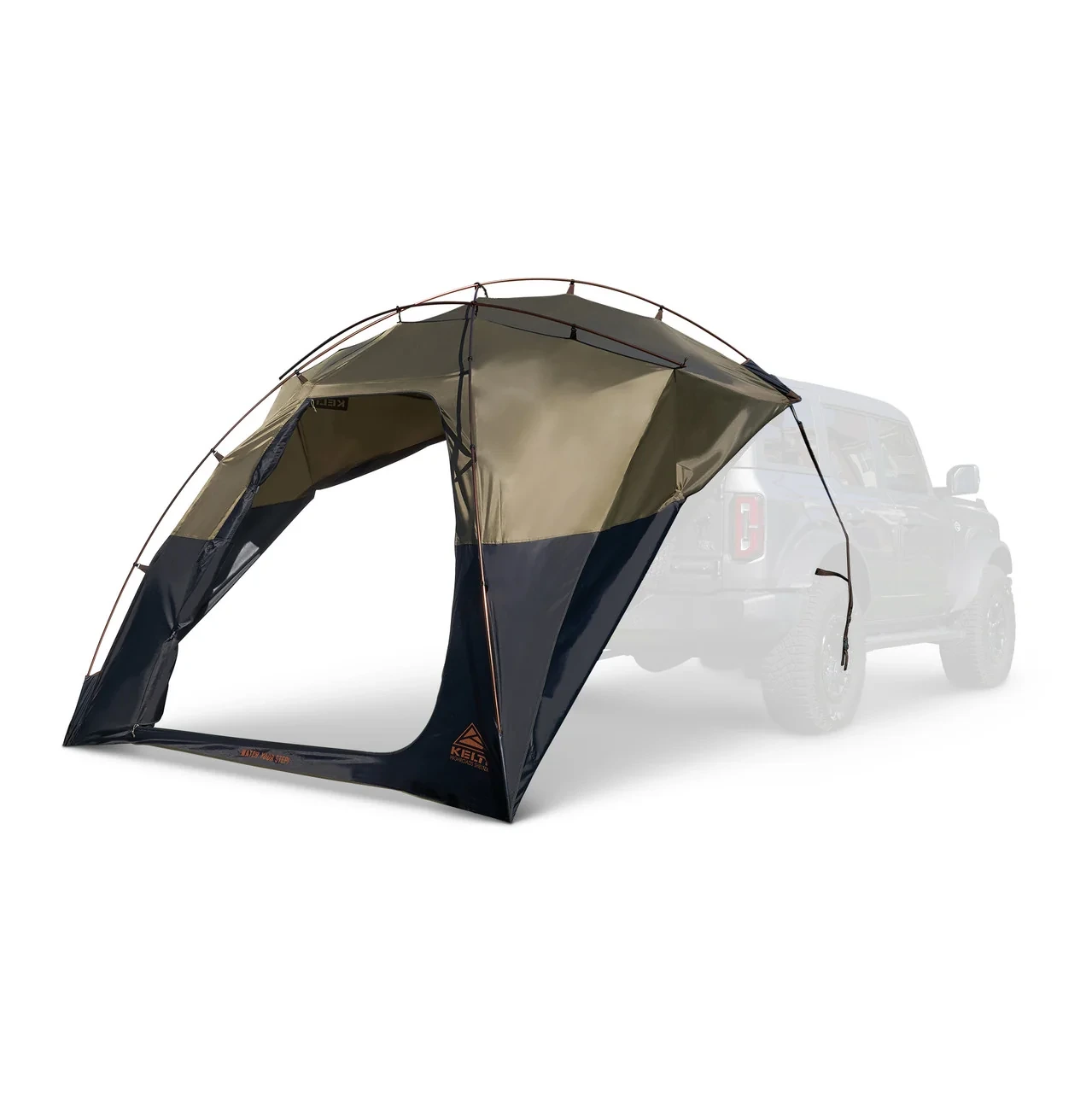
Kelty Highroads Overlanding Shelter
Pros
Heavy 210D fabric, 3 aluminum poles, lifetime warranty
Tarp reaches 11 ft 6 in of covered living space
Campers stayed dry under it through thunderstorms
Concerns
No floor and no enclosure, sleeping stays in the vehicle
Wind decides its days, unstaked it has blown away
Covered space and headroom depend on the vehicle
This feature is not a pick, and the Highroads is not ranked in this article. Daniel built this edition’s field from sleeping tents and hatch enclosures, and skipped the vehicle cabanas he found on Amazon on that basis. The Highroads was already scored here when that scope settled, and it is presented on its own, because readers whose camping centers on covered living space behind the vehicle are shopping for exactly this product.
Shade at noon, a dry place to cook when the rain starts, and evenings under a roof of your own at the back of the vehicle. The Highroads is a cabana for your vehicle: an open canopy on 3 aluminum poles that mounts at the rear or side and turns the ground behind or beside the vehicle into covered living space. It does not enclose the open tailgate, it has no floor, and nobody sleeps inside it. The vehicle stays the bedroom and the cabana is the living room. For shaded living space behind the vehicle, pick the Kelty Highroads.
What earns the recommendation is the build: a heavy 210D polyester Oxford fabric where the cheaper shelters in this article use lighter cloth, 3 aluminum poles where rivals use fiberglass, tape sealed seams, and Kelty backs it with a lifetime warranty against manufacturing defects, the strongest warranty on this page.
Its owner record, 38 reports, backs the build in brief: campers report staying dry under it through thunderstorms and a setup that runs about ten minutes once the pole order clicks. Wind is the condition that decides its days, and 1 owner reports a shelter that disintegrated inside 3 months, set against several multi year records of sound service.
On this article’s worksheet the Highroads scores 6.7. It stands outside the ranking because it is a different kind of product, not because of where that number would fall in the table.
Price: listings we found in the October 2026 checks ran from $169.95 to $284.95, and we could not verify one figure as the current price, so check it before you buy.
Pros
- The toughest built cabana we scored: heavy 210D fabric, 3 aluminum poles, tape sealed seams, and a lifetime warranty behind it
- Its tarp reaches 11 ft 6 in from the vehicle, a large covered footprint for cooking, changing, and staging gear
- It mounts at the rear or side of most vehicles and pitches alone as a sunshade or tarp
- Campers report staying dry under it through thunderstorms, and several have kept theirs in service for years
Concerns
- It has no floor and no enclosure, so it shelters a living area while sleeping stays in the vehicle, and its space depends on that vehicle, with headroom from 80 to 108 in
- Wind decides its days: staked and guyed it has stood through storms, and unstaked on hard ground it has bent poles and, once, blown away
- No single current price could be verified, and its listings span a wide range, so the price needs checking before any decision
One honesty note on this feature: its owner reports so far come from a narrow set of sources, so none of its score rests on what owners report, and the method section below carries the detail.
For a covered living room at the back of the vehicle, choose the Kelty Highroads.
The Tent Daniel Owns and Uses: Vevor SUV Tent 8×8
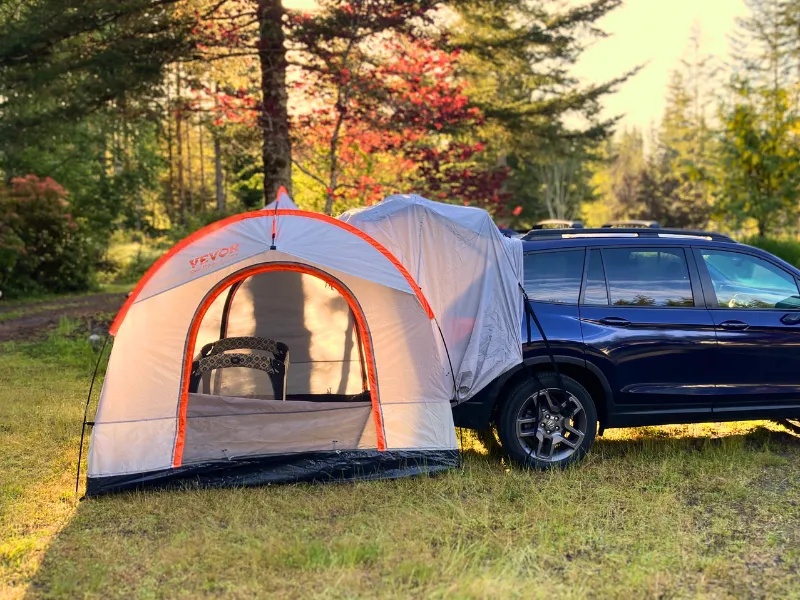
Vevor SUV Tent 8×8
Pros
Lowest priced full sleeping tent in the field
Double layer, PU2000mm, at half the premium price
Pack and play on the floor, parents in the SUV
Concerns
Poor instructions, setup is the friction point
Average materials, not Napier durable
Capacity is inflated, plan on 3 to 4 people
Scored from the documented record like every other product on this page. Daniel’s own experience with this tent is reported in this section.
This is the tent behind the family trips this site writes about, a toddler asleep in a pack and play on the tent floor, the parents in the back of the Passport, and camp life flowing between the two. It is the least expensive full tent in the scored field, and the only one on this page Daniel can speak about from use. If you came to buy rather than to read about his trips, go to the budget section above and pick the newer, larger VEVOR SUV Camping Tent.
Pros
- It is the lowest priced full sleeping tent in the scored field by a wide margin
- It is a double layer tent with a documented PU2000mm coating at about half the premium Napier’s price, though Daniel never used it in rain, so its weather record rests on documentation rather than his trips
- Its layout suited a young family: a toddler’s pack and play on the tent floor, the parents in the SUV, and access between the two
- Loading and unloading through the attached tent was genuinely convenient across repeated trips
Concerns
- The instructions were poor, and its setup score, from his experience rather than a brochure, is the second lowest among the totaled products
- Material quality and durability are average, and it is not nearly as durable as the premium Napier tents
- The capacity claims are inflated; plan on 3 to 4 people, not 6 to 8
What Daniel’s use actually looked like. The tent went on multiple trips in the summer of 2024, always on the same Honda Passport. The pattern that worked: the tent as the living and gear space, the vehicle as the parents’ bedroom, and the pack and play on the tent floor for the toddler. The space handled that arrangement with room to spare. What did not work as well: the connection. The sleeve fit tightly on the Passport and had to be lined up exactly, or it would not seal correctly, so each setup involved positioning the vehicle precisely against the staked tent. He never used the tent in rain, so whether that seal holds in wet weather is something his trips never tested. The poles were the other friction point, fiddly enough that setup and takedown were the least pleasant part of every trip. After those trips his summary is the one in the score: sturdy enough, acceptable materials, real convenience when it was up, and annoying enough at the edges that its setup criterion is the lowest scored part of an honest record.
One note from the wider record, which is not Daniel’s experience and does not revise it: owners beyond Daniel’s own unit report a rougher tent than the one he lived with, zippers failing and straps, clips, and stitching tearing away often enough that the model is barred from picks in this edition, and the full accounting is in the method section below.
Daniel’s whole ownership record is written up in his full Vevor SUV Tent review.
Shopping for a VEVOR today? Choose the budget pick above, the VEVOR SUV Camping Tent.
Specifications (manufacturer figures, from the manual for model TBT-8080):
| Specification | Figure |
|---|---|
| Floor size | 250 × 250 cm (8 × 8 ft, about 67 sq ft) |
| Peak height | 200 cm, about 79 in |
| Capacity | 6 listed in the manual, with some listings claiming 6 to 8; in Daniel’s use the realistic capacity is 3 to 5 people, and 3 to 4 is the comfortable recommendation |
| Weight | 18 lb (8.1 kg) |
| Price | $102.51 to $159.39 across the channels checked on 2026-10-22, the low figure on Amazon, in stock, checked by Daniel. The same tent was also listed through marketplaces on that date at $136.90 at Target, $147.03 at Lowes, and $159.39 at Walmart |
| Construction | double layer with an outer flysheet, PU2000mm coating, 120g sewn in polyethylene floor, 9 mm fiberglass poles |
| Warranty | 12 months under Vevor’s published policy |
The best known SUV tent here, and why we do not recommend it: Napier Backroadz SUV Tent
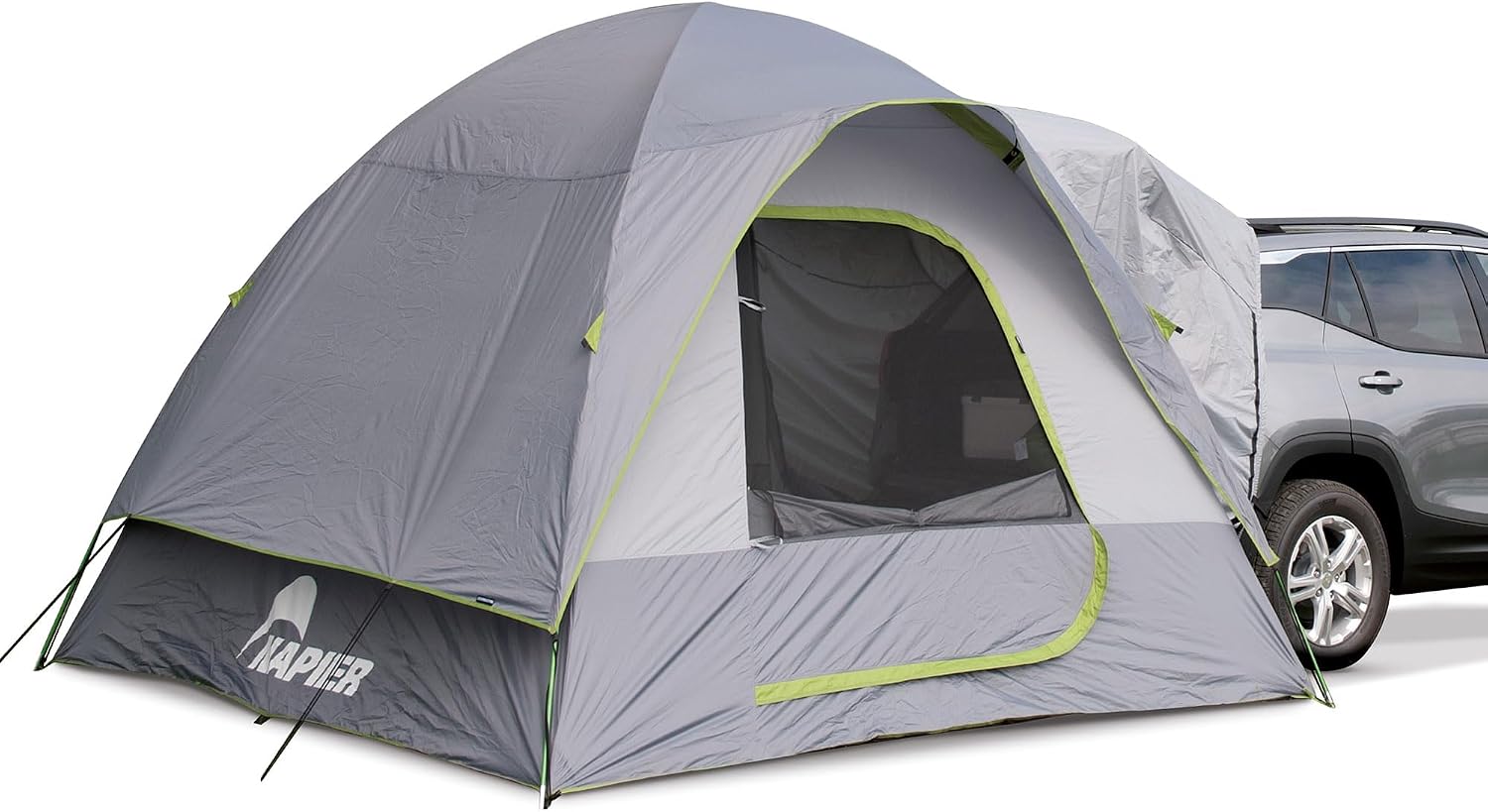
Napier Backroadz SUV Tent
Pros
The field’s largest floor, 10 × 10 ft
Tallest peak here, genuine standing room
Simple 3 pole design
Concerns
Fiberglass poles crack and splinter as a pattern
Water comes in at the seams near the floor
Barred from picks on its pole record
The former overall pick, barred from picks on its pole record.
The Backroadz is the tent most readers arrive already knowing, and its appeal is real. It is a simple 3 pole tent with the field’s largest floor, 10 × 10 ft, and its tallest peak, 7.4 ft, and room campers praise universally, a queen mattress with floor to spare and genuine standing room to change in. Its livability was always its genuine strength, and earlier editions of this page named it the overall and family pick. It scores 6.3 in this edition.
What changed is not the tent but the evidence. In its owner record, 225 reports, fiberglass poles cracking and splintering are the dominant failure, in the worst cases ending a tent inside its first trips. Water comes in at the seams near the floor often enough to be its signature weather complaint. A tent whose poles break as a recurring pattern is barred from picks however it scores; the full accounting sits in the table and the method section. If the space tempts you anyway, go in knowing the pole record is the price of it, and start with the family pick, the FanttikOutdoor Beta C6 Apex, or the overall pick, the Napier Sportz SUV Tent.
Price: $279.99 to $299.99 at the channels checked on 2026-10-22.
Portal 2-in-1 5 Person SUV Tent
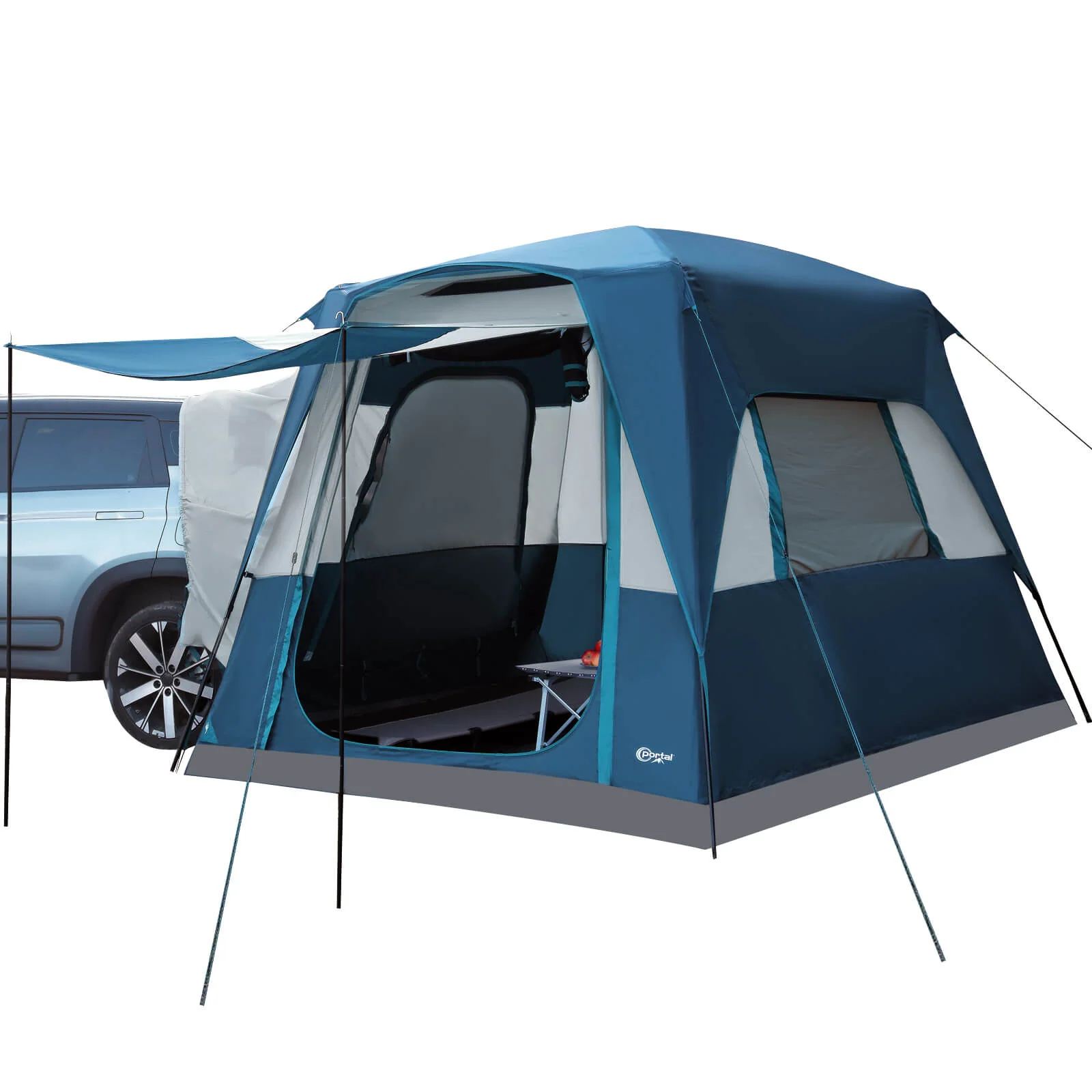
Portal 2-in-1 5 Person SUV Tent
Pros
Least expensive full size standalone tent in the field
Livability 8.5 matches the field’s leaders
Door panel raises into its own porch awning
Concerns
A 2 person pitch in practice, 23 owners needed help
The manual campers criticize most in this article
No warranty stated anywhere we could find
Stand up room, a floor that takes 2 mattresses with space to walk between them, and a door that lifts into its own porch, from $99 at the channels checked. The Portal is the least expensive full size standalone tent in this field, a 5 person tent with a floor that pitches against the open hatch or stands alone, and its livability score of 8.5 matches the field’s leaders. It suits the buyer who camps with a partner and wants the room first: couples and families who pitch together and spread out once the tent stands.
Its known weakness is getting it standing at all, a 2 person pitch in practice and the instruction manual campers criticize most in this article. A budget pick has to score 6.5 or better, and the Portal stands at 6.4 with a setup score near the bottom of the field, so the Portal 2-in-1 5 Person SUV Tent is the field’s price story rather than its budget pick.
Pros
- It is the least expensive full size standalone tent in this field, from $99 at the channels checked
- Its livability score of 8.5 matches the field’s leaders, on standing height and room campers praise in nearly every report
- Its record is the largest in this article, 100 reports spanning about 32 months, so its scores rest on the deepest owner sample here
- It fits a broad run of named vehicles, from a Ford Bronco and a lifted Toyota Tundra to a VW Golf wagon
- Its door panel raises into an awning porch, so the tent brings its own covered entry
- Campers who pitch it with a partner report keeping it for years, and no zipper failure appears anywhere in its record
Concerns
- Setup is its signature weakness: 23 owners in its record needed a second person or were defeated alone, against 4 clean solo pitches
- Its instruction manual is the one campers criticize most in this article, with print too small to read and vehicle straps the manual never explains
- Its weather record splits down the middle: campers stay dry through severe downpours, and other campers take water through the door opening and at the vehicle connection
- Its seal at the vehicle connection gaps often enough to recur across the record, and a short list of named vehicles defeats its fit outright
- 5 owners report structural failures, spread across strap stitching, poles, and fabric, with no single part dominating
- No warranty is stated in any source we could find
Its fit record is broad, clean or workable outcomes on a long list of named vehicles, with a seal at the vehicle connection that gaps often enough to be its recurring fit complaint. A short list of named vehicles defeats its fit outright. Its weather protection scores 6.5, an honest mid field value: the rain record genuinely splits, and wind splits with it.
Its durability scores 5.0 on a mixed record, 5 owners with structural failures across straps, poles, and fabric against users reporting years of sound use, and no warranty stands behind any of it. It suits the pair or family that pitches together, camps in fair to moderate weather, and values standing room over an easy first evening. It is the wrong tent for the solo camper, whatever the listing claims about pitching it alone.
What campers report, across 100 owner reports spanning about 32 months, the largest owner record in this article. Space is the praise that repeats: adults change clothes standing up, families lay 2 mattresses and still walk around, and the raised door panel that forms the porch earns its own following.
Setup is the complaint that repeats louder. Of the owners who describe pitching alone or needing help, 23 needed 2 people or could not finish alone, against 4 clean solo successes. The manual draws 18 critics against 1 defender: print too small to read without magnification, an unmarked fly that goes on the wrong way first, and 6 owners who never worked out what the vehicle straps were for, 1 of whom camped with the tent standing detached from the car.
Once it stands, the weather record splits. Campers report staying dry through several severe downpours across a 10 day trip and through a festival deluge measured at 40 litres of rain per square metre. Against them, campers report a tent that filled with water, water pouring through the door opening, and a fly that covers only the top, answered in 1 camp with shower curtains hung at the car gate. Wind divides the same way, a stormy night survived on the screw pegs and the car attachment against corners lifting and a tent that blew over in a small thunderstorm.
Fit runs broad: clean fits on the Ford Bronco, a lifted Toyota Tundra, the Toyota RAV4, the Ford Expedition, the Hyundai Tucson, the VW Golf 7 Variant, the Dacia Duster, the Seat Alhambra, the BMW X1, the Skoda Octavia, and the Peugeot Rifter. Four owners report a gap at the connection seal, a VW Touran whose entry the tent could not fit, and a Renault Espace whose hatch stands too tall for it.
The failures are specific rather than general: 1 strap torn from its stitching on a first use, poles bent in 2 wind events, 1 of them at the end of almost 2 years and 3 uses. One unit was delivered with its pole loops already broken, and small tears appear in 1 owner’s fabric. Against those stand the sustained records, a second festival season, yearly use as a camp kitchen, campers praising heavy fabric and sound zippers, and not 1 zipper failure in the 100 reports. Campers who pitch with a partner and camp in fair to moderate weather tend to keep this tent for years and recommend it at the price.
Specifications (from the listing of record and the owner record):
| Specification | Figure |
|---|---|
| Form | a standalone 5 person SUV tent with a floor, pitched against the open hatch or standing alone; its door panel raises into an awning, the 2 in 1 of its name, so the tent carries its own porch |
| Fabric | a single wall with a PU2000 coating; no denier figure is published in any source we could find |
| Poles | a 6 pole hub design, each pole seated by hand into a sewn corner bracket; the pole material is not confirmed in any source we could find |
| Capacity | 5 people listed; owners describe 2 adults with small children, or 3 adults, as the comfortable sleeping layout, with 2 mattresses down and room to walk between them |
| Weight | 13.4 kg (about 29.5 lb) |
| Price | $99 to $209.99 across Amazon and the maker’s own store, checked on 2026-10-23 and 2026-10-24 |
| Warranty | none stated in any source we could find, so a buyer carries the repair risk alone |
Full results: the 23 ranked SUV tents
All 23 tents here carry a score and sit in the grid below, ranked by overall rating. A 24th scored product, the Kelty Highroads cabana, stands outside this ranking as the standalone feature above the grid, because it is a different kind of product. The grid shows what a buyer needs to compare them: the overall rating, the family rating, the price range as we found it, and one line on what each tent is. The 5 criterion scores behind every total, and each tent’s evidence coverage, are printed in the method section below, and the full point by point record is the article’s scoring worksheet.
Every product was scored the same way, Daniel’s Vevor included, so the totals are like for like. Prices and status were checked on 2026-10-22, except where a cell gives a different check date. Each price is the range we found across the retailers and channels checked, or the single figure where only one exists, and retailers move prices, so check the current price before you buy. Scores were revised on 2026-10-23 when the coded owner evidence was applied, as the update log records. The Portal has its own section just above this one.
| Rank | Product | Overall rating | Family rating | Price | Verdict |
|---|---|---|---|---|---|
| 1 | Best SUV Tent for Families: FanttikOutdoor Beta C6 Apex SUV Tent | 7.4 | 7.5 | $329.99 on Amazon, in stock, verified by Daniel 2026-10-23 | A pre attached pole instant cabin that campers praise for room and easy pitching, with the highest family score here and a carry bag that takes some learning to repack. |
| 2 | Best Overall: Napier Sportz SUV Tent 9×9, 82000 | 7.2 | 7.2 | $339.99 to $399.99, checked 2026-10-22 | It carries the strongest fit and weather documentation in the field, at the field’s premium price. |
| 3 | Kelty Caboose 4P | 7.1 | 7.1 | Sold out everywhere checked, 2026-10-22 | A well rounded Kelty that would contend near the top if you could actually buy one. |
| 4 | Napier Sportz Dome-To-Go, 86000 | 7.0 | 7.0 | $299.99 at Summit Racing and DX Engineering, checked 2026-10-22 | The field’s hatchback and small CUV specialist, with fits confirmed by campers on small cars and seepage at the vehicle connection as the recurring complaint. |
| 4 (tied) | KingCamp SUV Car Tent (Camping Square) | 7.0 | 7.1 | $269.99 to $429.99 across Amazon and KingCamp direct, checked 2026-10-22 and 2026-10-24 | It offers the largest documented floor here, about 148 sq ft including its living area, and its score stands on KingCamp’s own documentation. |
| 6 | TIMBER RIDGE 5 Person SUV Tent | 6.8 | 7.1 | $200.51 on Amazon, verified by Daniel 2026-10-24 | A roomy 5 person sleeve tent whose livability scores well ahead of its weather record. |
| 7 | Best Budget: VEVOR SUV Camping Tent, 224061301 | 6.6 | 6.8 | $167.90 on Amazon, checked by Daniel 2026-10-22; the same figure at the maker’s store and Target, checked 2026-10-24 | The cheapest qualifying sleeping tent here, with stand up headroom and the strongest livability score in the budget class. |
| 8 | UNP SUV Tent | 6.5 | 6.7 | $149.99 Prime to $179.90 without Prime on Amazon, checked by Daniel 2026-10-22 | Its 2 prices are the story: the same tent costs less with a Prime membership than without one. |
| 8 (tied) | Napier Sportz SUV Tent 10×10, with screen room, 84000 | 6.5 | 6.5 | $398.99 to $459.99, checked 2026-10-22 and 2026-10-24 | The big screen room Sportz, whose connection seals well across many vehicles and whose setup is the slowest in the field. |
| 10 | Portal 2-in-1 5 Person SUV Tent | 6.4 | 6.6 | $99 to $209.99 across Amazon and the maker’s store, checked 2026-10-23 and 2026-10-24 | The cheapest full size tent in the field: roomy and tall once it stands, on a 2 person setup campers call the hardest part of owning it. |
| 11 | Napier Backroadz SUV Tent, 19100 | 6.3 | 6.3 | $279.99 to $299.99, checked 2026-10-22 | The roomiest tent here, in a 3 pole design whose poles have a documented cracking and splintering problem. |
| 11 (tied) | WildFinder SUV Tent 10×9 | 6.3 | 6.4 | $139.99 on Amazon, verified by Daniel 2026-10-23 | A first season 10×9 with unanimous praise from campers for its space and a record too young to judge its fabric. |
| 13 | UNP SUV Dome Tent | 6.2 | 6.3 | $119.98 to $129.99 on Amazon, checked 2026-10-23 and 2026-10-24 | A big 10×10 dome whose users correct its 6 person claim to 4 or 5, with poles and stitching its weak points. |
| 14 | Best Tailgate Shelter: HREFEU SUV Tailgate Tent | 6.1 | 6.0 | $55.99 on Amazon, verified by Daniel 2026-10-23 | The cheapest shelter in the class and its pick: a genuine hatch enclosure whose strong rain record outruns its strap and fabric hardware. |
| 15 | JOYTUTUS SUV Camping Tent | 6.0 | 5.8 | $169.99 to $189.99 by color, checked by Daniel 2026-10-22 | A well documented budget tent whose coded owner record carries a pole failure pattern and a leaky vehicle connection, so it is barred from picks in this edition. |
| 16 | The Tent Daniel Owns and Uses: Vevor SUV Tent 8×8, TBT-8080 | 5.9 | 5.9 | $102.51 to $159.39 across channels, checked by Daniel 2026-10-22 | The cheapest full tent in the field and the only one Daniel has lived with, tight fitting on his Passport and annoying at the poles. |
| 16 (tied) | GoHimal SUV Tent | 5.9 | 6.0 | $119.99 on Amazon, verified by Daniel 2026-10-23 | A low priced 8×8 with real room, scored with its pole failure pattern named and barred from picks. |
| 18 | KAMPKEEPER SUV Car Tent, Tailgate Shade Awning | 5.8 | 5.7 | $94.22 to $129.90 across Amazon and Walmart, checked 2026-10-22 and 2026-10-23 | A simple tailgate awning a tested roundup named its Best Awning, whose coded owner record carries a pole failure pattern. |
| 18 (tied) | Hasika Tailgate Awning | 5.8 | 5.6 | $69.99 to $79.99 by size on Amazon, verified by Daniel 2026-10-23 | A simple hatch awning campers find easy on the right vehicle, with straps and hooks the parts that break. |
| 18 (tied) | WildFinder Rectangle SUV Tent | 5.8 | 6.0 | Price not captured in the October 2026 checks; see the live listing | The roomiest of the new entrants, whose poles carry the same failure pattern that bars the Backroadz. |
| 21 | Napier Sportz Cove, 61500 | 5.6 | 5.4 | $111.98 to $170 by channel, checked 2026-10-22 and 2026-10-24 | The classic alternative: a simple, proven awning readers of this site have bought more than any other product in the category, fiddly at the attachment and happiest in fair weather. |
| 22 | JOYTUTUS Tailgate Tent | 5.5 | 5.2 | $59.99 on Amazon, checked 2026-10-23 | A screened tailgate room campers use exactly as designed, at the class’s lowest total. |
| 23 | aomxay SUV Tent | 5.3 | 5.3 | $129.99 on Amazon, verified by Daniel 2026-10-23 | A screen room that borrows its structure from the vehicle, the shelter class’s cautionary example. |
Notes on this grid are collected in the Notes section at the end of this article.
Compared enough and ready to choose? Act on the short list. For the strongest fit and weather documentation in this field, check the Napier Sportz SUV Tent. For a family camp, pick the FanttikOutdoor Beta C6 Apex. If the budget decides, start with the VEVOR SUV Camping Tent. If you sleep in the cargo area, pick the HREFEU SUV Tailgate Tent.
The rest of the field: scored under the retired method
The listings below come from the original field of 42 listings. They were last scored under the retired Version 1 method, which used 7 criteria (including aesthetics and price, which the current method handles outside the score) and reported totals to two decimals. They are not comparable to the current totals above, and no pick on this page comes from this table. Of the original legacy listings, 3 remain on this page.
The 5 listings that stood in this table in earlier drafts of this edition, the aomxay, the GoHimal, the Hasika Shade Awning, the JOYTUTUS Tailgate Tent, and the HREFEU, have since been scored under the current method and appear in the grid above. The rest were removed in the Amazon verification pass recorded in the status notes at the end of this article.
Standalone sleeve SUV tents, retired method ratings:
| Retired rank | Product | Size | Retired rating |
|---|---|---|---|
| 24 | Hasika SUV Tent | 8 × 8 ft | 6.1 |
| 29 | Outsunny SUV Tent | 7 × 6 ft | 5.1 |
| 30 | Elikoya SUV Tent | 8 × 8 ft | 5.1 |
Status notes for this table are collected in the Notes section at the end of this article.
How we score SUV tents: the method
The scorecard
Scorecard OF-SUV-TENT-2.6. Prices, availability, and specifications were last verified on October 22, 2026 for this edition. The scores were revised on October 23, 2026, when the coded owner evidence described below was applied under amendments 2.4 and 2.5, and the pick tie consideration of amendment 2.6 was adopted. Every scored tent is rated from 0 to 10 on 5 criteria, weighted by how much each one decides whether the tent works:
| Criterion | Weight | What it covers |
|---|---|---|
| Livability and Family Usability | 30 percent | Usable floor area and shape, headroom, a realistic sleep layout, and family workflow: child sleep space, parent access, nighttime entry, and keeping wet gear apart from sleep gear |
| Setup and Takedown | 20 percent | Structure complexity, whether one person can manage it, and instruction clarity. Timed setup results count when a real timed trial or a named independent timed report exists |
| Weather Protection | 20 percent | Waterproofing system and coverage, seams and openings, wind structure, and condensation control |
| Vehicle Fit and Attachment | 15 percent | Documented fit range, fit quality where it is evidenced, access between vehicle and tent, and attachment stability |
| Durability and Build Quality | 15 percent | Material strength, construction quality, recurring failure patterns, and warranty and support |
Price is not scored. It is checked, dated, and used in the budget pick rule below. Appearance is not scored either; design is discussed only where it changes fit, weather protection, setup, durability, or use.
The criterion scores and coverage behind every total in the results grid are printed in the table below, so the grid itself can stay a buyer’s comparison. Coverage is the share of the scorecard’s checklist we could score from evidence for that tent, and How to read the scores below explains what the figure does to a total’s strength. The Kelty Highroads row is kept in this table with its annotation. It was scored on the same criteria, and it is presented as the standalone cabana feature rather than in the ranking, for the scope reason its feature states. The 5 pick sections print the same scores for the tents they cover.
| Product | Vehicle Fit | Livability | Setup | Weather | Durability | Coverage |
|---|---|---|---|---|---|---|
| Napier Sportz SUV Tent 9×9, 82000 | 9.3 | 8.6 | 5.0 | 7.5 | 5.0 | 66.5 percent |
| FanttikOutdoor Beta C6 Apex SUV Tent | 8.0 | 8.0 | 10.0 | 5.0 | 5.0 | 60.0 percent |
| Kelty Caboose 4P | 8.0 | 7.0 | 7.5 | 6.5 | 6.5 | 66.5 percent |
| Napier Sportz Dome-To-Go, 86000 | 8.0 | 7.5 | 7.5 | 7.0 | 4.5 | 78.0 percent |
| KingCamp SUV Car Tent (Camping Square) | 7.0 | 8.5 | 5.0 | 7.5 | 6.0 | 66.5 percent |
| TIMBER RIDGE 5 Person SUV Tent | 6.5 | 8.5 | 7.5 | 5.0 | 5.0 | 52.0 percent |
| VEVOR SUV Camping Tent, 224061301 | 7.0 | 8.5 | 5.0 | 6.5 | 4.5 | 66.5 percent |
| Kelty Highroads Overlanding Shelter (standalone cabana feature, outside the ranking) | 8.0 | 5.5 | 7.5 | 6.5 | 7.5 | 66.5 percent |
| UNP SUV Tent | 7.5 | 7.9 | 7.5 | 5.0 | 3.6 | 66.5 percent |
| Napier Sportz SUV Tent 10×10, with screen room, 84000 | 8.5 | 8.5 | 2.5 | 7.0 | 5.0 | 84.0 percent |
| Portal 2-in-1 5 Person SUV Tent | 6.5 | 8.5 | 4.0 | 6.5 | 5.0 | 64.0 percent |
| Napier Backroadz SUV Tent, 19100 | 8.5 | 7.5 | 5.0 | 5.5 | 4.0 | 78.0 percent |
| WildFinder Rectangle SUV Tent | 7.0 | 8.0 | 5.0 | 5.5 | 1.5 | 73.5 percent |
| WildFinder SUV Tent 10×9 | 7.9 | 7.9 | 5.0 | 6.5 | 3.0 | 63.0 percent |
| UNP SUV Dome Tent | 7.5 | 7.5 | 5.0 | 4.5 | 6.0 | 73.5 percent |
| HREFEU SUV Tailgate Tent | 7.0 | 4.4 | 10.0 | 5.6 | 4.4 | 71.0 percent |
| JOYTUTUS SUV Camping Tent | 7.1 | 5.7 | 3.8 | 8.1 | 5.5 | 66.5 percent |
| Napier Sportz Cove, 61500 | 7.5 | 4.0 | 8.5 | 4.0 | 5.0 | 60.0 percent |
| Vevor SUV Tent 8×8, TBT-8080 | 7.0 | 7.0 | 4.0 | 6.5 | 4.3 | 76.5 percent |
| GoHimal SUV Tent | 6.5 | 7.5 | 5.0 | 6.0 | 3.0 | 78.0 percent |
| KAMPKEEPER SUV Car Tent, Tailgate Shade Awning | 7.0 | 5.0 | 10.0 | 4.4 | 2.5 | 62.0 percent |
| Hasika Tailgate Awning | 8.0 | 4.0 | 8.8 | 5.0 | 4.4 | 62.0 percent |
| JOYTUTUS Tailgate Tent | 8.5 | 4.0 | 7.5 | 4.4 | 4.0 | 60.5 percent |
| aomxay SUV Tent | 6.0 | 5.0 | 7.5 | 4.0 | 3.8 | 65.0 percent |
Researched, not tested, and what that means
Daniel has used exactly 1 tent in this article: his Vevor, on his Honda Passport, across multiple trips in the summer of 2024, including a trip to Yosemite. The parents slept in the back of the SUV, with a toddler’s pack and play on the tent floor. That experience is reported in the Vevor’s section and nowhere else.
He has not set up, slept in, or tested any other tent on this page, including the second VEVOR in the table, the newer 224061301 that holds the budget pick. It is a different product from his tent, scored from its manual and coded owner record like every other researched tent here. Everything, his tent included, is scored from the documented record: manufacturer specifications and manuals, independent reports, and owner reviews. A stricter hands on standard exists in our method for articles whose contenders have genuinely been tested under a full protocol. This is not one of those articles, and scoring 1 tent by a different standard inside the same table would compare apples to oranges.
The owner review layer of that record is Daniel’s own systematic reading of the Amazon owner reviews, done as part of the original research alongside the manufacturer specifications, before AI summarization was part of the process. Amazon blocks automated access, so that reading was his work and not software’s, and the Amazon listing checks in this edition are his for the same reason. Owner reviews inform a score; they never make a researched tent a tested one, and nothing on this page is written in the voice of use except Daniel’s own tent.
For 22 of the 24 tents in this ranking, the owner record has also been compiled into a coded corpus. Owner reports were extracted from public research datasets and independent sources, and from the reviews Daniel supplied by hand from each product’s Amazon listing, deduplicated so copies count once, and coded report by report against the same criteria as the rest of the scorecard. That coding is a separate, labeled layer of analysis, done apart from Daniel’s own reading of the reviews, and it supplements that reading rather than replacing it.
The corpora were assembled from the reviews reachable on each listing, most recent first, about 100 reviews per listing. That is a listing’s reachable recent layer, not a census of every review ever written: for a young product it is effectively the whole history, and for a long running listing it truncates the older record.
Pattern claims in this article rest on the texts in hand, and a claim that something does not happen holds only within the sample. Owner photos and videos inside Amazon reviews are an uncoded layer of the same record.
A sample can move a score only at a set size. It takes at least 30 owner reports over at least 12 months with enough source diversity, or a single deep marketplace record of 50 or more reports, at least half of them verified purchases, which can establish a pattern on its own. Smaller or younger samples are reported as patterns we noticed, and they do not change scores.
Owner reported setup times are recorded as a distribution and never scored. The sample behind each coded tent is stated in the worksheet, and its outcome stands in the table below. Where independent codings of a sample disagreed, the dispute and its settlement are carried in the endnotes, not settled quietly.
The owner samples, product by product
| Product | Reports | Span | Failure pattern outcome | What the record shows |
|---|---|---|---|---|
| Napier Backroadz SUV Tent | 225 | 2019 to 2026 | Fail, barred from picks | Poles cracking and splintering, and water coming in at the floor seams |
| Napier Sportz Dome-To-Go | 108 | 2011 to 2026 | Fail, barred from picks | Pole failures at 52.2 per 100 durability informative reports, 7 owners reporting poles broken outright |
| JOYTUTUS SUV Camping Tent (pole tent) | 98 | Fail, barred from picks | Pole failures at the highest severity, 3 owners outright and 5 at moderate severity or worse, and a vehicle connection that leaks on nearly half the owners who describe it | |
| Vevor SUV Tent 8×8, TBT-8080 | 93 | About 40 months | Fail, barred from picks | Zippers failing, and straps, clips, and stitching tearing away, with 18 of its 31 durability informative reports carrying a structural failure at moderate severity or worse; its failure pattern score is 0, and its total reads 5.9 rather than the 6.2 its documented record alone produced |
| KAMPKEEPER SUV Car Tent, Tailgate Shade Awning | 95 | Fail, barred from picks | Pole failures | |
| GoHimal SUV Tent | 93 | Fail, barred from picks | Pole failures | |
| WildFinder Rectangle SUV Tent | 99 | Fail, barred from picks (see endnote 1) | Pole failures, with no replacement poles obtainable | |
| Napier Sportz SUV Tent 10×10, 84000 | 149 | 2011 to 2023 | Pass | The connection seals well across many vehicles, with 2 structural failures across 12 years |
| Napier Sportz SUV Tent 9×9, 82000 | 99 | Pass | Seams that leak mainly where the manual’s sealing step was skipped, and the arrival defect record stated in its section | |
| UNP SUV Tent | 99 | Pass | The tent body holds in storms while its connector channel collects water and dumps it in | |
| VEVOR SUV Camping Tent, 224061301 | 62 | Pass (see endnote 2) | Attachment hardware and stitching tearing away in early use is its recurring failure, priced into its durability score, while its connection mostly seals | |
| Portal 2-in-1 5 Person SUV Tent | 100 | Pass (see endnote 3) | A setup that wants 2 people, against a durability record of 5 moderate failures and sustained use | |
| UNP SUV Dome Tent | 85 | Pass | Poles and stitching its weak points | |
| Hasika Tailgate Awning | 99 | Pass | Straps and hooks break | |
| HREFEU SUV Tailgate Tent | 98 | Pass | Straps and fabric tear, against a strong rain record | |
| JOYTUTUS Tailgate Tent | 100 | Pass | A strap pattern | |
| aomxay SUV Tent | 71 | Pass | Carried on the defensible set its own buyers support, after reports they identify as belonging to another seller’s product were set aside | |
| Napier Sportz Cove, 61500 | 51 | Pass (see endnote 4) | 3 early failures on 3 different components, against 5 owners reporting 3 to 5 years of sound service | |
| FanttikOutdoor Beta C6 Apex SUV Tent | 43 | January to October 2026 | Sample not yet adequate | The span is about eight and a half months against a 12 month floor, the sample is heavily weighted toward Amazon Vine free product reviews (26 of its 42 Amazon reports, a verified purchase share of 38 percent), and it comes from too few sources; no score rests on it, and the gap is named wherever its family pick appears |
| Kelty Highroads Overlanding Shelter | 38 | Sample not yet adequate | Inadequate on source diversity alone; its product is presented as the standalone cabana feature rather than in the ranking | |
| TIMBER RIDGE 5 Person SUV Tent | 30 | Sample not yet adequate | Inadequate on source diversity, for the size scored here, and its durability slice is thin | |
| WildFinder SUV Tent 10×9 | 27 | About 3 months | Sample not yet adequate | Inadequate on every ground, as a first season product’s sample usually is |
| Kelty Caboose 4P | No coded sample | Not run | The owner record remains Daniel’s hand reading alone | |
| KingCamp SUV Car Tent (Camping Square) | No coded sample | Not run | The owner record remains Daniel’s hand reading alone |
How to read the scores
Each criterion score is built from a checklist of named points in the scoring worksheet. Where the record says nothing about a point, it is left unscored, and it counts against the product’s coverage, the share of the checklist we could score from evidence, which is printed beside every total.
When you read the table, 2 consequences matter. First, no tent here has a timed setup result, because no measured trial or independent timed report exists for any of them, and we never score a manufacturer’s setup time claim. Setup scores rest on structure and documented handling. Second, a criterion score built on few points is weaker evidence than the same score built on many, which is what the coverage figure is for.
Totals within 0.2 of each other are a tie, judged pairwise, and the band is judged on the exact totals behind the printed figures, not on the rounded figures themselves. Every total is a research score in that sense: real, documented, and only as strong as the record behind it, with the thin places named at the product rather than hidden.
The family rating printed beside each total uses the same 5 criterion scores, weighted for family use. Livability and family usability count for 40 percent instead of 30, vehicle fit counts for 10 percent instead of 15, weather protection counts for 15 percent instead of 20, and setup and durability keep their overall weights of 20 and 15. Read the 2 numbers together. A family rating above the overall rating marks a tent whose strengths are its space and family usability; a family rating below it marks a tent whose strengths lie somewhere else.
The checks behind a pick
Before a tent can hold a pick, we check that it is the product actually offered for sale, that it can be bought at a live offer, and that no structural failure pattern is documented for it across independent sources or a qualifying deep owner record. We also check that a tent recommended for sleeping has documented rain protection, that a budget or family pick is a real sleeping tent, an enclosed tent with a floor and a sleep layout, and that its livability and weather scores rest on scored evidence.
Floorless shelters and awnings fail that sleeping tent check by design, so the hatch enclosures among them compete for the tailgate shelter pick instead, judged among themselves. The HREFEU takes that pick at 6.1, ahead of the 5 other scored enclosures, the Hasika awning and the JOYTUTUS Tailgate Tent at 5.8 and 5.5, the Napier Sportz Cove at 5.6, and the aomxay at 5.3, with the KAMPKEEPER barred by its failure pattern outcome. The shelter class in this edition is the hatch enclosure class. The 1 open canopy scored here, the Kelty Highroads, is the scored exception, and it is presented separately as the standalone cabana feature rather than in the pick arithmetic, because its form does not enclose the tailgate the class exists to enclose.
The failure pattern check behind the third check above has now been run for every tent with a coded owner record, and its outcomes stand product by product in the sample table above. Seven tents fail it and are barred from picks, 11 pass it, several of them on the single marketplace basis stated in the sample rules above, which is named there because a pass is only as broad as its basis. Four samples are not yet adequate, with the gap named wherever a pick is involved. For the Kelty Caboose and the KingCamp the sample has not been run, so for them the check still reads as no failure documented rather than sampled and clean.
One further rule decided a pick in this edition: where 2 products eligible for the same pick slot stand within the tie band, the editor may weigh which product’s owner record has actually been tested, provided the sampling behind the comparison was published and applied the same way to both products. That consideration separates the 2 headline picks at the top of this table. Both tents were sampled on the same terms in the same pass; 1 sample proved adequate and passed, the other’s is not yet adequate, and the worksheet records the deciding totals and the rule as the deciding factor.
The budget price basis
Budget comparisons use the lowest current price available without a paid membership, because a budget pick should be the cheapest qualifying tent for every reader, not only for subscribers. Where a product also carries a lower membership price, both prices appear as facts in the results table; the pick itself is always decided on the price anyone can get. Qualifying also takes a quality floor: a total of at least 6.5, with no criterion below 4. In this edition the governing figure is the budget pick’s $167.90 on Amazon, checked by Daniel on 2026-10-22; the same figure showed at the maker’s store and at Target in the October 2026 checks.
Worksheet
Every score on this page traces to the article’s scoring worksheet, which records each scored point, the evidence behind it, and the date it was checked. The full point by point record lives there and in the method record, rather than being narrated in this article. Where the worksheet and a manufacturer disagree, for example the Napier rainfly coverage and the Vevor peak height, the figure used is named at the product.
How to choose an SUV tent: our buying guide
SUV tent types
This article scores 3 classes, and choosing yours is the first real decision.
An enclosed sleeping tent is a ground tent with a floor and a sleeve to the vehicle, like the Napier tents and the Vevor here. You sleep in the tent; it detaches and stays standing when you drive away. It is larger, sturdier in weather, and slower to pitch and pack.
A hatch enclosure is a floorless sleeve or screened wrap over the open hatch, like the HREFEU and the Cove. The cargo area becomes the bedroom; the enclosure’s job is a screened, private room behind it. Enclosures pitch fast and pack small, and they come down when the vehicle moves; if that form is yours, look at this article’s tailgate pick, the HREFEU SUV Tailgate Tent.
An open canopy, or cabana, roofs the space behind or beside the vehicle: no floor, no enclosure, nobody sleeps inside it, and the vehicle stays the bedroom. The Kelty Highroads feature above is the 1 scored example here. Roof top tents sleep on the roof rack instead; the questions below cover that difference.
Vehicle compatibility
Most SUV tents claim universal fit through an adjustable sleeve or strap system. Treat it as a starting claim: the fit that matters is the seal at your vehicle’s opening, and a poor seal means frustration and a path for rain and wind.
Before you buy, measure:
- The hatch opening, where the sleeve has to seal
- Hatch top to ground, against the maker’s limit: under 80 in on Napier’s published rule
- Spoilers and roof racks crossing the seal path
- Strap landing points and strut clearance
The open hatch is an electrical state: on many vehicles the interior lights stay on while it stands open, and a night of that can drain the battery. Campers fool the latch with a carabiner clipped into it, or switch the lights off. The battery question below takes it up in full. Never idle the engine with a tent attached, and keep the exhaust pointed away from camp.
Look for: a published fit range naming your vehicle class. Avoid: a universal claim with no measurements behind it.
Size and capacity
Start with the discount every maker hopes you skip. Manufacturer sleep capacity counts bags fitted shoulder to shoulder, and the realistic layout runs lower: a 5 person claim is usually a comfortable 4, and the Vevor’s 6 to 8 claims are a realistic 3 to 5. The old rule survives because it works: size up.
Floor area decides what mattress, cot, or pad fits inside, and wall shape decides the usable share: sloped walls give much less than vertical walls at the same listed size. Peak height is the tallest point, usually at the center, and a dome takes it away at the edges. A tent for at least 5 or 6 is what 2 adults, a child, and a dog want, and the tent plus vehicle footprint has to fit the pad when you choose your campsite. For a family layout of that size, check this article’s family pick, the FanttikOutdoor Beta C6 Apex.
Setup and takedown
Crew size is the deciding variable: ask first whether 1 person can raise it, the question campers answer for each other before any other. In the owner record behind this article, the large sleeved models are 2 person pitches in practice whatever their listings claim, and solo attempts fail often enough to matter. Fewer poles and a foolproof attachment sequence help.
Manufacturer setup times are marketing until someone times them: none of the tents scored here has a verified timed result, including the pop up designs. Practice at home first: the first attempt is always the slowest, and instructions are not always a help, as Daniel’s Vevor notes show.
Look for: a pitch 1 person can finish alone. Avoid: a printed setup time taken as a promise.
Weather resistance
Season rating describes structure, not temperature: 3 season means spring through fall. Hydrostatic head states the water pressure a coating resists before it leaks: 1000 to 1500mm and above reads as waterproof, and published figures here run 1500mm to 3000mm.
For rain, judge the system, not 1 number. A rainfly over a double wall tent sheds water better than a single wall in direct rain, and the water campers report arrives at the vehicle connection and the sleeve first, at floor seams second. Tents publishing no rating earn capped waterproofing credit in our scoring.
For wind, want a sturdy frame and guylines; for condensation, vents and mesh that stay open under the fly. For the strongest documented weather package among the leaders here, choose the overall pick, the Napier Sportz SUV Tent.
Look for: a full rainfly and a connection that seals. Avoid: a coating figure with no system behind it.
Materials and durability
Higher denier fabric is thicker and tougher, and ripstop weaves stop small tears from running. Read the floor as carefully as the walls, since it takes the rocks and roots; reinforced or taped seams and sound zippers outrank a long feature list. Poles are fiberglass or aluminum; aluminum is stronger for its weight and the better sign in a larger tent. Check the warranty first: this field runs from 90 days at a retailer to Kelty’s lifetime cover, with 1 year the common standard, and an absent warranty says something about the brand.
Care is the half of durability you control: dry the tent fully before storage, treat seams and reproof the coating as they age, and patch tears while they are small. The full routine stands in the FAQ below.
Features worth weighing
Access comes first in the owner record: 2 or more doors ease entry and airflow, and the zip door between tent and cargo area seals the vehicle gap bugs otherwise enter by. Privacy is the enclosure’s second job: a screened room at the back of the vehicle doubles as a changing room campers use constantly.
A vestibule or awning gives boots and wet gear a covered place outside the sleep space; the Kelty Caboose builds its design around one. Interior pockets and hanging loops organize the small space at night. Floorless designs like the Cove carry no floor by design, a different product rather than a defect, and ports, clotheslines, and gear lofts are conveniences rather than reasons to buy.
Brand versus generic
Generic manufacturers dominate this category, which is why documentation matters more here than brand loyalty. A reputable brand shows its work: published specifications that agree with each other, a findable warranty, and customer service that answers.
Some vehicle manufacturers sell branded versions of established tents. The Honda tent for the CR-V, Pilot, HR-V, and Passport is a Napier Sportz design with a Honda badge, and Lincoln and Ford offer Napier built tents with guaranteed fit lists for their models. A guaranteed fit list from your vehicle maker is one of the few fit claims in this category you can take at face value. Where a brand’s own materials contradict each other, as several do in this article’s record, believe the manual over the marketing bullets, and price the uncertainty in.
Portability, weight, and budget
Packed size matters more than packed weight here, because the tent rides in the cargo area it attaches to. Money here buys documentation, fabric, and weather protection more reliably than it buys space.
| Tier | Price | What the money buys |
|---|---|---|
| Budget | $55.99 to $167.90 | A genuine hatch enclosure or a documented budget tent |
| Mid range | $167.90 to $299.99 | Established brands’ main lines and deeper owner records |
| Premium | $299.99 to $429.99 | The field’s strongest documented weather packages |
The tier bounds are the lowest and highest prices recorded across this article’s field in the October 2026 checks; each product’s own price range stands in the results grid above.
Fit cannot be confirmed until the tent meets your vehicle, so buy where returns are easy and test the fit inside the return window. If price is the deciding factor in your camp, start with the budget pick, the VEVOR SUV Camping Tent.
TL;DR
This edition scores 24 SUV tents, from documentation, independent reports, and coded owner reviews. The Napier Sportz SUV Tent (7.2) is the overall pick. It stands inside the tie band of the FanttikOutdoor Beta C6 Apex (7.4), and under the tie consideration stated in the method section the pick goes to the product whose owner record has been tested at depth, 99 coded reports with a passed failure pattern sample. The FanttikOutdoor holds the family pick outright on the field’s highest family score (7.5), with its not yet adequate owner sample named at the pick.
The budget pick is the VEVOR SUV Camping Tent (6.6) at $167.90, the cheapest qualifying tent on the price anyone can get without a membership; the JOYTUTUS pole tent (6.0) that once contested it on price is barred by its failure pattern record. The best tailgate shelter is the HREFEU (6.1) at $55.99 on Amazon, checked on 2026-10-23, the cheapest shelter scored and a genuine hatch enclosure, with the Napier Sportz Cove (5.6) as the classic alternative and its fit risk now named in its section.
The Kelty Highroads (6.7 on the worksheet) is not ranked in this edition: it is an open vehicle cabana rather than a hatch enclosure, and it is presented as a standalone feature for readers who want covered living space. The failure pattern check bars 7 tents from picks, among them the Napier Backroadz (6.3), the roomiest tent here, on 225 coded reports of poles cracking and splintering, and the Napier Dome-To-Go (7.0), the field’s hatchback and small CUV specialist, on the same basis.
The Vevor SUV Tent 8×8 (5.9) is the tent Daniel owns and uses, the cheapest full tent here, at $102.51 to $159.39 across the channels checked. His own trips stand as he reported them, and the model’s wider owner record, which fails the failure pattern check on zipper and strap failures, is stated beside his account rather than inside it. The Kelty Caboose (7.1) holds no pick only because it is sold out everywhere we checked, and the Portal (6.4) is the cheapest tent in the field, at $99 to $209.99 across the channels checked, on 100 coded owner reports with a passed failure pattern sample.
If you came to buy rather than to compare, act on the short list. Overall, choose the Napier Sportz SUV Tent. For a family camp, look at the FanttikOutdoor Beta C6 Apex. On a budget, start with the VEVOR SUV Camping Tent. For cargo sleeping, pick the HREFEU SUV Tailgate Tent.
Frequently asked questions
What is the difference between an SUV tent and a roof top tent?
SUV tents attach to the rear of your vehicle and extend the cargo area into a tent room that sits on the ground. They connect to SUVs, crossovers, minivans, and some trucks. Roof top tents mount on the roof rack and you sleep off the ground, which gets you a flat, elevated platform and a fast pitch, at several times the price and with the vehicle’s roof committed for the whole trip.
Why camp with an SUV tent?
An SUV tent gives you a comfortable home base at a lower cost than an RV or a run of hotel rooms: an extended living space connected to your vehicle for storage, changing, and cooking, with the option to sleep in the vehicle itself while the tent holds the living space and the gear. It is the cheapest way to make a vehicle you already own into a camper.
How do SUV tents work?
They attach at the vehicle’s rear opening with straps that secure around the wheel wells or body, and an elastic sleeve that wraps the opening to form a seal. The tent extends your cargo space into a private room on the ground behind the vehicle. Standalone models can detach and stay pitched when you drive away; tailgate models come down when the vehicle moves.
How do you set up an SUV tent?
- Find a level campsite and clear the ground behind your vehicle.
- Unroll the tent and stake down the floor.
- Raise the tent body and poles per the manufacturer instructions.
- Connect the sleeve over the vehicle’s rear opening.
- Attach and tighten the straps, then fit the rainfly if your model has one.
Practice the sequence at home first. The first attempt is the slowest, and doing it once in the driveway is worth more than any setup time printed on a box.
Will an SUV tent drain my car battery?
It can, and the cause is the open hatch itself: on many vehicles the interior lights stay on while a hatch stands open, and a night of that draw can drain a battery. Campers’ standard fix is a carabiner clipped into the hatch latch, which fools the vehicle into reading the hatch as closed; switching the interior lights off at their control does the same job. Make it part of setup, hatch open, lights dealt with, before you settle in for the night. The buying guide carries the same note beside its fit checklist.
Can you use a truck tent on an SUV?
Not well. Truck tents are designed to mount in an open truck bed and do not adapt to an enclosed SUV cargo area. SUV tents are the versatile direction: most attach to SUVs, crossovers, and minivans, and several fit trucks with covered beds or caps.
How do you maintain an SUV tent?
- Hand wash with mild soap and lukewarm water, and avoid scrubbing waterproofed coatings.
- Air dry thoroughly before storing, and never pack it away damp, which invites mildew.
- Brush off debris, droppings, and dirt with a soft brush or rag.
- Inspect for rips and holes after trips and repair them with a tent patch kit promptly, while they are small.
Notes
Notes on the results grid. Totals within 0.2 of each other are a tie, not a meaningful gap, judged pairwise on the exact totals: the tied pairs and groups at the printed figures are the FanttikOutdoor at 7.4 with the Napier Sportz SUV Tent at 7.2, the 9×9 Sportz with the Kelty Caboose at 7.1, the Dome-To-Go with the KingCamp at 7.0, the VEVOR SUV Camping Tent at 6.6, the UNP with the Sportz 10×10 at 6.5, the Portal at 6.4, the Backroadz with the WildFinder 10×9 at 6.3, the JOYTUTUS pole tent at 6.0, Daniel’s Vevor with the GoHimal at 5.9, the KAMPKEEPER with the Hasika awning and the WildFinder Rectangle at 5.8, and the Napier Sportz Cove at 5.6. No tent is tied with another tent more than 0.2 away from it. The Kelty Caboose holds no pick despite its score, because a pick has to be buyable.
The overall pick was decided inside the tie at the top under the tie consideration stated in the method section; the family pick was not a tie and was decided on score alone. The failure pattern gate bars 7 tents from picks whatever their scores: the Backroadz, the Dome-To-Go, the JOYTUTUS pole tent, the Vevor SUV Tent 8×8, the KAMPKEEPER, the GoHimal, and the WildFinder Rectangle; the gate outcomes for every coded tent are stated in the method section.
The FanttikOutdoor Beta C6 Apex holds the family pick. Its failure pattern sample is not yet adequate: Daniel supplied the listing’s complete Amazon set, 42 reviews, coded with 1 owner video for 43 reports in all, spanning January to October 2026. The sample fails on span (about eight and a half months against a 12 month floor), on composition (26 of 42 Amazon Vine free product reviews, a verified purchase share of 38 percent), and on source diversity, and its durability evidence, 5 informative reports with no failure described and nothing beyond a first season, is real but shallow. No score rests on it.
The Sportz 10×10’s total is the only one in the grid that is not provisional, because its evidence coverage of 84.0 percent clears the 80 percent line. The KingCamp’s livability reflects a large documented floor, about 148 sq ft including its living area, and its score stands on KingCamp’s direct documentation; Daniel’s listing check on 2026-10-22 confirmed that its Amazon listing is this tent. In this grid, 3 Setup scores of 10.0 rest only on how simple the structure is, with no timed setup result behind any of them: the FanttikOutdoor, the KAMPKEEPER, and the HREFEU. Read those as simple to pitch, not as timed results.
For the FanttikOutdoor, its owner sample separates the two halves of setup: campers praise the pitching, and getting the tent back into its carry bag carries a learning curve most users get past. The 6 floorless hatch enclosures, the HREFEU, the Napier Sportz Cove, the KAMPKEEPER, the Hasika awning, the JOYTUTUS Tailgate Tent, and the aomxay, are ranked in this grid by the same scores as everything else. They compete with each other for the tailgate shelter pick rather than for the sleeping tent picks. The 7th floorless shelter scored, the Kelty Highroads, is not in this grid: it is an open canopy cabana rather than a hatch enclosure, and it is presented as the standalone feature above the grid.
Status notes for the legacy table, from Daniel’s Amazon verification pass on 2026-10-22. From the original legacy table, 18 listings were removed from this page because Daniel confirmed they are not sold on Amazon, this site’s only affiliate channel. The removed listings are the Ytaoeo, the H and ZT, the Coumy, the Lelekdo, the GeerTop Instant, the IDOOGEN Mobility A1, the IDOOGEN Mobility A0, the IDOOGEN Mobility Bat, the MC Tomount, the S’more Glamping Tent, the Gardimax, the Headery, the Maizoa, the Wasagun, the Qaoar, the Pumbba, the HEYTRIP, and the DLucky. The Qaoar and the Pumbba, 2 of the removed listings, were probably the same 10 × 5 ft rear hatch design sold under 2 names.
Every listing that remains was verified by Daniel as sold on Amazon in that pass. No listing in this table is confirmed discontinued by a manufacturer notice.
Endnotes
Coding disputes and adjudications behind the samples in the method section. The outcomes stand in the method’s sample table; these notes carry how each disputed outcome was reached.
1. WildFinder Rectangle SUV Tent. Its sample carried a disagreement between independent codings that a third coding had to settle. The second coding differed on secondary counts and denominators, so its adjusted figures were held while a third tie break coding adjudicated the disputed points: the pole severity count and the vehicle connection sleeve pattern went to the second coding, the pole snag pattern went to the first, the durability denominator was set at 38 on a third reading, and the family workflow component was found not earned. The figures that coding supports are the ones in the grid (total 5.8, family total 6.0, coverage 73.5 percent), and its failure pattern outcome, on which all 3 codings agree exactly, is applied.
2. VEVOR SUV Camping Tent, 224061301. Its 2 codings (63 reports supplied, 62 coded) disagreed on the severity of 1 strap and clip failure, the grade its failure pattern outcome turns on. Adjudicated on 2026-10-23: the severity 2 reading stands, so its failure pattern check passes at anchor 1 and its priced figures are applied, as its section states.
3. Portal 2-in-1 5 Person SUV Tent. Its second coding disagreed on its failure pattern anchor and its 2 person setup count. Adjudicated on 2026-10-23: the first coding stands, so the Portal carries its total in this edition, anchor 1, as the grid and its own section above the grid state.
4. Napier Sportz Cove, 61500. Its failure pattern grade was ruled at 1 by Daniel on 2026-10-23, correcting the packet’s expressed grade of 3, which sat outside the subpoint’s 0 to 2 scale. Its priced package applies with the anchor corrected to 1: fit quality and seal at 1.5 of 3, solo feasibility at 0.5 of 1, and the failure pattern subpoint at 1 of 2, taking its total to 5.6 with coverage of 60.0 percent, with its failure pattern sample passing.
Update log
- First published June 2024, scored under the retired Version 1 method. Those totals appear in the legacy table above and are not comparable to the current totals.
- October 2026. An interim correction rewrote 3 passages that had described other tents in the first person, because Daniel has set up only 1 SUV tent himself. Those passages now read as the research they rest on.
- October 2026. This 2027 edition rescores the whole field under the current method, with coded owner reports applied across the record, across 24 scored tents. The current picks are the Napier Sportz 82000 overall, the FanttikOutdoor Beta C6 Apex for families, the VEVOR 224061301 for budget, and the HREFEU as the tailgate shelter pick.
- Prices were rechecked in October 2026 and are shown as ranges across the retailers and channels checked, each with the date it was checked. Retailers move their prices, so check the current price before you buy.
- The method section above, the article’s scoring worksheet, and the notes on this page carry the full record behind these scores and picks.
- Published on October 24, 2026.

I would like to know which of these tents would work best, “made for” a silverado 1500 with a lear camper/cap (same roof height as the cab of the pickup). Most ads only mention SUV’s. We sleep in the pickup with a nice air bed, want the tent for foul weather cooking, changing room and to hang out in. Thanks, Louis Hopkins