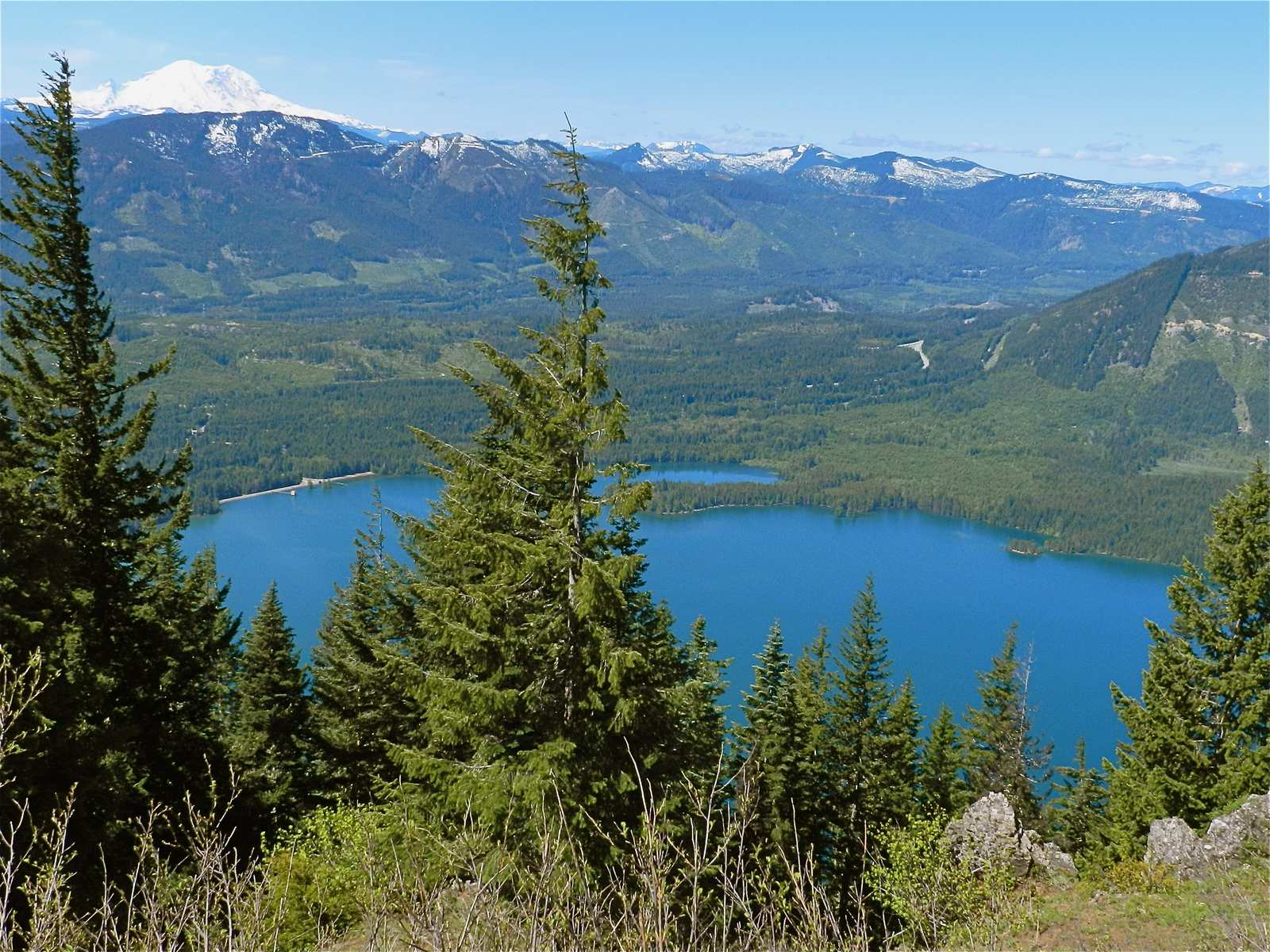
Kachess Lake is a big mountain lake about an hour east of Seattle. One large Forest Service campground sits in old growth on the northwest shore. One group site sits across the lake on the eastern shore. The Forest Service runs both campgrounds. The lake sits inside the wider Central Cascades camping country between Stevens Pass and Snoqualmie Pass.
Kachess Lake is a natural lake the Bureau of Reclamation dammed in 1912 to store irrigation water. Its level falls through the summer as that water is released. A June shoreline and a September shoreline are different places, and the launches, the beaches, and the swimming all move with the water.
The two campgrounds sit on different shores and plan differently. The big campground is on the northwest shore, up Kachess Lake Road. The group site is on the eastern shore, up a primitive Forest Service road. Dispersed camping runs along the same eastern shore road, in pull-offs campers pick for themselves.
Gold Creek Pond, at Snoqualmie Pass on the way in, is a well known day stop. A restoration closure makes it a winter only visit until 2028.
The entries in this guide rest on what the Forest Service publishes and on what campers report from their own stays. No firsthand stay stands behind them.
In this guide
Kachess Lake camping at a glance
Two campgrounds carry full entries in this guide. The dispersed camping along Forest Road 4818 and the Gold Creek Pond day use area follow in their own sections.
| Campground | Agency | Sites | Booking | Water | Nightly cost |
|---|---|---|---|---|---|
| Kachess Campground | Forest Service | The agency counts differ; see the entry | Mixed reservable and first come; reservations through Recreation.gov | Yes, by handpump and/or spigot | $27 single, $54 double, $158 group site |
| East Kachess Group Site | Forest Service | One group site | Reservation only through Recreation.gov | None, bring your own | $65 |
| Dispersed camping on Forest Road 4818 | Forest Service | Undesignated pull-offs | No reservations | None | No fee |
| Gold Creek Pond | Forest Service | Day use only | No reservations | Not applicable | No camping |
Crystal Springs, at Exit 62, carried a campground name once. The site there now operates as Crystal Springs Sno-Park, a winter parking and trailhead facility, and it has no summer campground.
Three absences shape every plan here. Neither campground has showers or a dump station. No site in this guide has hookups, so an RV trip here is dry camping, with tanks filled before arrival.
Kachess Lake holds 239,000 acre-feet of irrigation water behind Kachess Dam. The lake has two parts. Big Kachess is the main body, and Little Kachess is the narrower arm to the north. Above a pool elevation of about 2,224 feet the two parts merge into one lake. Below that elevation they separate at the Narrows.
The level falls through the summer and into fall, farther in dry years. Check the current level on the Bureau of Reclamation’s hydromet telemetry page before you tow a boat or count on a beach. In June the lake stands at the campground’s edge and both launches work. By late summer the shoreline has pulled back across mud and stumps, and the beaches sit well away from the water.
Cle Elum is the supply town for this lake. It sits about 20 interstate miles east of Exit 62 and holds the groceries, fuel, and services a camping trip needs. The Cle Elum Ranger District office is there too, at 803 W. 2nd Street. Easton, at Exits 70 and 71, is a small community and not a supply stop, so arrive with what you need or plan the Cle Elum run.
East of Cle Elum, the Teanaway camping guide covers the community forest campgrounds up the Teanaway River.
Lake Easton State Park is the other camping at this end of the pass, and it is a different product. It is a full hookup state park with showers and a dump station, nine interstate miles east of Exit 62, at Exit 71. The East Kachess Group Site leaves the freeway one exit earlier, at Exit 70, on a different lake, so the two exits are easy to conflate and worth keeping straight.
Two private operations sit in Easton as well, Lake Easton RV Resort and Alpine Lakes Lodge, both open year-round, the lodge with 22 RV sites with electric and water hookups. The park’s full entry, with its fees and its freeway noise, is in our guide to the best camping near Seattle. Winter camping in this basin takes the Sno-Park form at that park, not any form on Kachess Lake, where both campgrounds close by mid September.
No Kittitas County campground, no Department of Natural Resources campground, and no Fish and Wildlife campground exists on the lake or on either shore road. There is no second agency’s rule set to weigh.
Passes, fees, booking, and stay limits
One set of rules covers both campgrounds. The differences that matter sit in how each campground takes its money and its bookings.
Forest Service campgrounds
No pass pays a camping fee at either campground. At Kachess Campground, day use costs $11 per vehicle per day. A concessionaire, ExplorUS, operates the day use facilities there, and recreation passes are not accepted for that day use fee. The Forest Service page names ExplorUS as the campground’s contact, at (661) 702-1420.
An Interagency Senior or Access pass, or a Golden Age or Golden Access pass, cuts a single site fee or the day use fee by 50 percent. The discount does not apply to double or group sites. Trailhead parking away from the campgrounds follows the Northwest Forest Pass form, $5 per vehicle per day. The Discover Pass plays no part at either Forest Service campground. It belongs to the state parks, Lake Easton included.
The Forest Service publishes Kachess Campground’s full fee set. A single site costs $27 a night and a double site $54. The group site inside the campground costs $158 a night. An additional vehicle costs $11 a night, and day use costs $11 per vehicle per day. Firewood sells at the campground for $10 a bundle.
Recreation.gov’s rate table confirms the $27 and $54 rows for the 2027 season, May 21 to September 18. The East Kachess Group Site costs $65 a night, and its 2027 season runs May 27 to September 13. First come sites at Kachess Campground are paid on site by Scan & Pay through the Recreation.gov app.
Reservations run only through Recreation.gov, and the Forest Service does not track the availability of first come sites. Individual sites book on a six month rolling window and group sites on a twelve month rolling window.
Availability for the 2027 season at Kachess Campground releases on November 21, 2026 at 7:00 AM PST, through May 21, 2027. The East Kachess Group Site releases its 2027 availability on April 1, 2027 at 7:00 AM PST, through September 13, 2027. A reserved site is held until noon on the day after the scheduled arrival date. Arrive later than that and the booking counts as a no-show, at a $20 service fee plus the first night’s rate.
A developed site here means a defined site with a campfire ring with a grill, shared water and toilets where the entry lists them, and no hookups.
Forest Order 06-17-00-25-01 sets the stay limit for the whole forest, both campgrounds and the dispersed camping included. No one may camp at a single location for more than 14 consecutive days. After 14 days the camper leaves the forest and does not return for 30 days. Camping anywhere on the forest is capped at 28 days in a calendar year. The order runs through May 18, 2027, and its successor is worth a check before a long stay.
Reservation-required loops at Kachess Campground
One rule at Kachess Campground surprises campers, and no other guide explains it. Forest Order 06-17-03-00-331 requires a reservation for part of the campground. Mineral Creek Loop units 88 to 115, Box Canyon Loop units 159 to 172, and the campground’s group site may be occupied only with a valid reservation. The one exception is a stay the campground attendant authorizes for a set period. An empty site in those loops is not a first come opportunity, however open it looks on a Friday evening.
The rest of the campground carries no reservation requirement under the order, and its first come sites are genuinely first come. The East Kachess Group Site is not named in the order at all. It is reservation only under its own facility rule, a different authority, and the two should not be merged.
Kachess Campground
Quick facts: sites, over 100 campsites and one group campsite on the Forest Service page, 150 sites on Recreation.gov, with 106 single family sites and the group site reservable and the rest first come; booking, mixed reservable and first come, reservations only through Recreation.gov, individual sites on a six month rolling window and group sites on a twelve month rolling window; season, early June to mid September, with the 2027 peak season May 21 to September 18, 2027; potable water yes, by handpump and/or spigot, and RV hoses must not be attached to the water system; restrooms, flush toilets on the Forest Service page and vault toilets on Recreation.gov; hookups none; nightly fee $27 single, $54 double, $158 group site, $11 additional vehicle, $11 day use; stay limit 14 consecutive days under Forest Order 06-17-00-25-01; check in 2 p.m., check out noon; pets allowed, leashed in the campground at all times; two boat launches and a swimming area; firewood $10 a bundle; 2 accessible sites on the Recreation.gov listing.
Kachess Campground is the Forest Service campground on the northwest shore of Kachess Lake, 5.5 miles up Kachess Lake Road from I-90 Exit 62. It sits at 2,250 feet in dense old growth, about 62 miles east of Seattle. Recreation.gov calls it one of the most beautiful campgrounds in the Cle Elum Ranger District. It is the only developed campground on the lake.
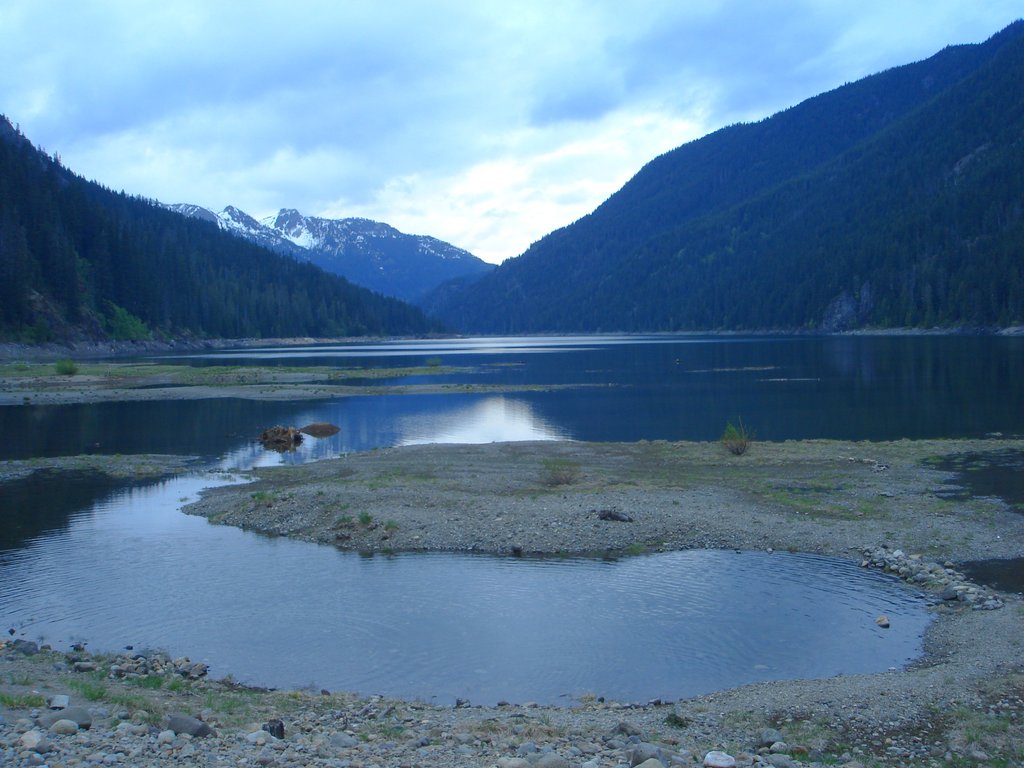
The campground stands where the lake divides. Big Kachess opens to the south and Little Kachess runs north, so different loops face different water. Sites near the shore go first, and some loops sit a short walk from the water rather than on it.
The old growth keeps most sites private even when the campground is full. Campers report flies and mosquitoes as a real evening cost in midsummer.
The campground fills on summer weekends despite its size, and the Forest Service warns that the boat launch and day use parking areas fill up fast on busy days. Campers put the first come remainder at about 40 sites, and it rewards an early arrival on a summer Friday. Two loop ranges, Mineral Creek Loop units 88 to 115 and Box Canyon Loop units 159 to 172, and the group site require a reservation under a forest order. The booking section above carries that rule.
Campers also praise the camp hosts across the review sets. Powerboats and jet skis run into the evening, and busy loops carry group noise with them. The freeway is 5.5 miles away at Exit 62, and the noise campers report here is water noise, not road noise.
The campground is the lake’s boating and swimming base. It has two launches, a paved launch at the south end and a gravel launch at the north end, with parking for vehicles and trailers. A swimming area and picnic areas sit on the shore. The launches, the swimming area, and the picnic areas are also the campground’s day use offer, at $11 per vehicle per day.
The falling water takes the launches as the summer runs. In 2026 the facility closed its launch on August 1 for low water. The Washington Department of Fish and Wildlife’s standing summary is blunter. There is no late summer boat launching facility on this lake, because of the drawdown.
Late season boating means hand launched craft from whatever shoreline the level leaves. The warm late season water is a swimming positive in the same weeks, so the second half of the season is a swim and paddle season. A swim and paddle season is this lake’s version of a documented trade, long days spent outside in exchange for the mood and sleep benefits of being outside.
Fishing runs from boat and shoreline, for rainbow trout, cutthroat trout, and kokanee salmon. Box Canyon Creek is closed to all fishing from its mouth, 2 miles up to the falls. The lake is closed to fishing for bull trout, and a caught bull trout must be carefully released. Current Department of Fish and Wildlife regulations govern every detail of a fishing trip here.
Campers report a strict 2 p.m. check-in enforcement, so a late start from the city is a risk to a first night, not a formality. Check the lake level on the Reclamation telemetry page and the facility’s alerts on Recreation.gov before you tow a boat up the road. Both checks take a minute, and either one can change the trip you pack for.
East Kachess Group Site
Quick facts: sites, one group site, with capacity in conflict, 100 people and 25 vehicles on the Forest Service page against 50 people and 20 vehicles on Recreation.gov; booking, reservation only through Recreation.gov, on a twelve month rolling window, with 2027 availability releasing April 1, 2027 at 7:00 AM PST; season, May 27 to September 13, 2027; potable water none, bring your own; restrooms, vault toilets; hookups none, and no electricity at the site; nightly fee $65; stay limit 14 consecutive days under Forest Order 06-17-00-25-01; check in 2 p.m., check out noon; maximum RV length 30 feet; gate combination provided with the reservation confirmation, or call the Cle Elum Ranger Station two business days ahead; campfires only in the developed rings.
East Kachess Group Site is a single group site on the lake’s eastern shore, reached from I-90 Exit 70. West Sparks Road runs half a mile to Kachess Dam Road, Forest Road 4818, and the site sits about 5 miles up that road, on the left.
The road is primitive, and the approach is part of the site’s character. The site stands at 2,300 feet in dense old growth, in full shade, hemmed in by high mountains, and Recreation.gov describes it as secluded and tucked away.
Kachess Campground mixes reservations with first come sites, and this site takes reservations only. The anchor campground has drinking water, and this site has none. The lack of water is its governing limit, so bring every gallon your group needs. There is no electricity at the site either.
The two agency records disagree about how large a group the site holds, and both figures stand in the Quick facts above. A group organizer should confirm the operative capacity on the Recreation.gov listing or with the Cle Elum Ranger District before inviting either number of people. The gate combination comes with the reservation confirmation letter. Without it, call the ranger station two business days before arrival at 509-852-1100, with the name and confirmation number ready.
What the site offers is a group camp in the trees on a quiet shore, with campfire rings with grills and picnic tables and no neighboring campers. The primitive road in and the water you haul are the price of it. The site’s own facility record notes a speed limit of 10 miles per hour for motorized vessels on Little Kachess.
Dispersed camping on Forest Road 4818
Dispersed camping at this lake lives on the east shore. Forest Road 4818, Kachess Dam Road, runs south from Exit 70 along the shore toward the dam, on Cle Elum Ranger District land. Campers use self-selected pull-offs along the 4818 and its 4818-101 spur. No Forest Service page names a designated dispersed camping area on this road, so there is no signed site to aim for and no service waiting when you get there.
Camper accounts of the east shore agree with each other. The pull-offs are rough and rocky, and campers report tires damaged on the rough tracks. There are no toilets, no water, and no trash service anywhere on the road. Campers concentrate near the shore access points, and crowding follows warm weekends.
ATVs and dirt bikes move through on warm weekends, and highway noise carries to the sites near the exposed shore. Litter and dumped waste are a problem in spots north of the main use area, and campers report fines for littering and for illegal fires. Pack out everything you bring.
The Kachess Dam reclamation zone at the lake’s outlet is closed to all public entry under Forest Order 06-17-03-04-481. It is not a shoreline or a campsite in any form. Campers also report that driving on the exposed lakebed is prohibited, because the bed is bull trout spawning ground. The Forest Service does not publish that rule on its Kachess pages, so it stands here as a reported rule.
Do not drive on the exposed lakebed, and check with the Cle Elum Ranger District for the rule’s current form. The forest stay limit in the passes, fees and booking section above applies here in full.
Older dispersed use at Box Canyon, at the developed campground’s north end, is described by campers as shut down from time to time. No current form is claimed for it, and the developed campground’s rules are the safe assumption there.
Hiking and trails from the campgrounds
The trails at this lake start at the campground, and they split into two kinds. One is an easy shore loop. The other traces the shoreline on the map and climbs and drops like a ridge trail underfoot.
A third trail leaves the campground’s north end for the backcountry, and the Pacific Crest Trail is accessible near the campground. All three campground trails leave from the campground itself, so the parking question is the campground’s own day use fee or your site, not a separate trailhead pass.
Kachess Lake Shore Trail
The Kachess Lake Shore Trail, Trail 1301, is a loop of about a mile beside the lake, starting at the campground. Recreation.gov calls it the Kachess Lake Trail. It is the camp walk, the one for the hour after dinner and the morning before the boats start, and campers walk it from their sites. Of the trails in this section, it is the easy option, and the only one to promise a mixed group.
Little Kachess Trail
The Little Kachess Trail is closed. Forest Order 06-17-03-2026-47 closes the trail inside the Three Queens Fire closure area on the Cle Elum Ranger District, and the closure runs through April 30, 2027. The Okanogan-Wenatchee National Forest alerts page carries the order and any change to it, so check it before planning a hike on this trail.
The Little Kachess Trail, Trail 1312, runs along Little Kachess Lake from the campground, about 9 miles roundtrip to the Mineral Creek Trail junction. The Washington Trails Association describes it as a rough shoreline trail that climbs and drops repeatedly along the shore. Trail accounts report the bridge over Box Canyon Creek removed, and put the creek’s ford window at low water, in late August and September. The through hike is a late season act.
The ford is the decision point on any through hike: cross it in the late season low water, or turn around there. Treat the trail as a rugged day hike, or an overnight with a ford in it, and not as a family stroll.
Mineral Creek Trail
The Mineral Creek Trail is closed. The closure comes from Forest Order 06-17-03-2026-47, in force for the Three Queens Fire closure area on the Cle Elum Ranger District through April 30, 2027. The Okanogan-Wenatchee National Forest alerts page carries the order and any change to it, so check it before planning a trip toward Park Lakes.
The Mineral Creek Trail, Trail 1331, leaves its trailhead near the campground’s north end and runs toward Park Lakes and the Pacific Crest Trail. Washington Trails Association trip reports give it a rough, lightly maintained reputation, with recent brushing work improving conditions on the Mineral Creek side.
The Pacific Crest Trail near Snoqualmie Pass
Both campground records name the Pacific Crest Trail as accessible near the campground. Its trailheads and their parking belong to the pass, and they are covered in our guide to the best camping near Seattle.
Gold Creek Pond
Quick facts: site type, day use only, no camping in any season; season, closed April 1 to November 30 under Forest Order 06-17-03-2026-12 through June 22, 2028, and open December 1 to March 31 for non-motorized winter recreation; parking, Gold Creek Sno-Park on Forest Road 4832 in winter, with a Sno-Park permit required December 1 through March 31 and no Special Groomed Trail sticker required at this Sno-Park; trail, Gold Creek Pond Trail 1250, a 1.0 mile paved barrier-free loop; restrooms, portable toilets.
Gold Creek Pond sits at Exit 54 at Hyak, east of Snoqualmie Pass, and a closure governs the place. Forest Order 06-17-03-2026-12 closes the pond’s day use area, the Gold Creek Trail, and the Forest Road 142 spur for the Gold Creek valley restoration project. The closure runs every year from April 1 to November 30, through June 22, 2028. The Forest Service put the closure into effect on May 4, 2026. A summer drive to the pond ends at the closure, in every summer the order runs.
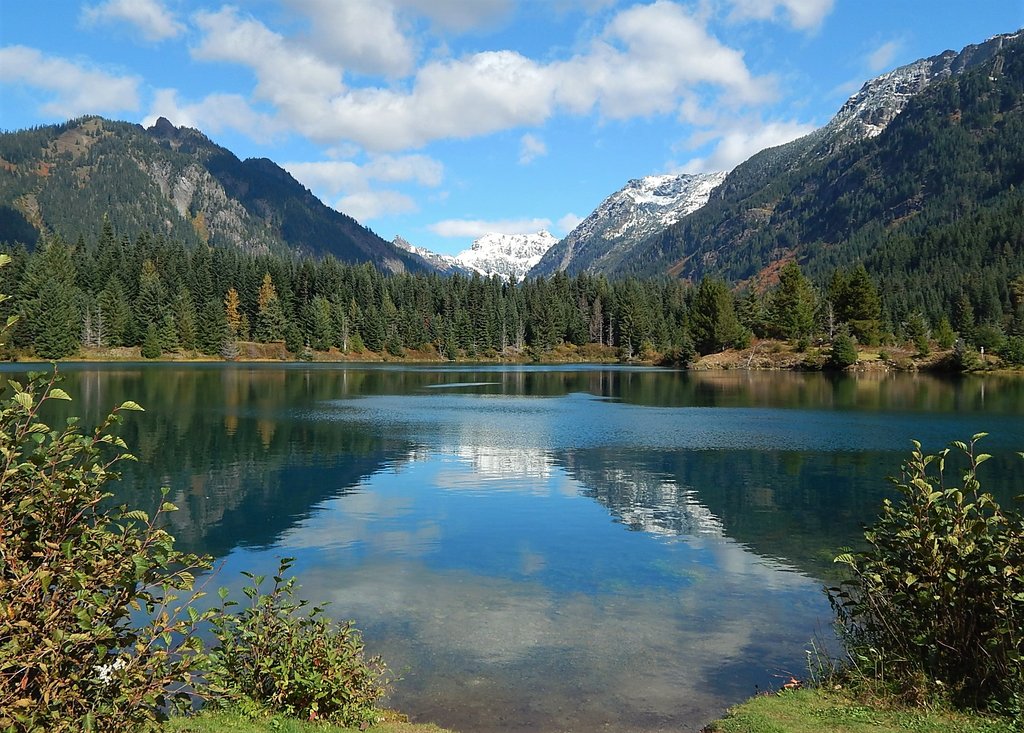
From December 1, 2026, the visit is a winter one. The Forest Service reopens the site on December 1, 2026 for non-motorized winter recreation, and it stays open through March 31. Park at Gold Creek Sno-Park on Forest Road 4832, the road that parallels the freeway about a mile east of Exit 54. Forest Road 142 is not plowed, so the pond is reached on foot or on snowshoes from the Sno-Park lot.
The Sno-Park permit season and the pond’s open season are the same months, December 1 through March 31, so the one permit covers the parking for the visit. No Special Groomed Trail sticker is required at this Sno-Park.
The summer loop returns when the order ends, and the Forest Service’s Gold Creek page carries the word. Gold Creek Pond Trail is a paved, barrier-free loop of one mile around a pond that began as a gravel pit from the I-90 construction of the 1970s. The pit was reclaimed into a barrier-free pond loop. In summer the loop is a stroller-friendly mile, and the picnic area makes it an easy outing. A picnic area with picnic tables sits near the loop’s start, and there is no swimming or fishing.
The summer parking lot sits at the end of Gold Creek Road, Forest Road 142. Reach it by following Forest Road 4832 east of Exit 54 and turning onto 142. Plan the pond as a winter stop for now.
Fire restrictions and emergencies
Fire restrictions
Campfires at both campgrounds belong in the campfire rings with grills the Forest Service provides. At the East Kachess Group Site, fires are allowed only in those developed rings. Firewood sells at Kachess Campground for $10 a bundle, and buying firewood where you burn it is the standing advice on this forest.
The Forest Service’s fire restrictions, on the forest’s alerts page, govern the campgrounds themselves. Kittitas County adds its own layer on the county Fire Marshal’s Burn Bans page, which carries the county’s fire safety bans and its air quality bans. The air quality bans are a separate system, run by the Department of Ecology, and they can bind when no fire danger ban does. The strictest applicable rule governs wherever you stand.
For questions about burning on Forest Service land, call the Cle Elum Ranger District at 509-852-1100. For unincorporated county land, the Fire Marshal’s Office is at 509-962-7000. Air quality ban questions go to the Department of Ecology at 509-575-2490. Check both sources before any trip in fire season, because no printed page can carry the current status.
Emergencies
Call 911 first in any emergency. Kittitas County’s emergency alerts run through the Sheriff’s Office of Emergency Management on Everbridge, and signing up before a trip is how those warnings reach you. The hospital town for this lake is Ellensburg. Kittitas Valley Healthcare’s hospital there runs a Level IV trauma emergency department, open 24 hours, at 603 S Chestnut Street.
Cell service at the campgrounds is shore dependent in campers’ reports, usable near the beach and the launches and limited in the loops. Download your maps and your reservation confirmations before you leave the freeway.
Frequently asked questions
Can you camp at Gold Creek Pond?
No. The pond is day use only in every season, and a restoration closure shuts it from April 1 to November 30 through June 2028. From December 1, 2026, the visit is a winter snowshoe walk in from Gold Creek Sno-Park, through March 31. See Gold Creek Pond.
Do you need a reservation at Kachess Campground?
For some sites, yes. The group site and the sites in Mineral Creek Loop units 88 to 115 and Box Canyon Loop units 159 to 172 require a reservation under a forest order. The rest of the campground is first come, and an empty site inside those loop ranges is not a first come opportunity. See Reservation-required loops at Kachess Campground.
Why is Kachess Lake so low in late summer?
Because it is a working irrigation reservoir. The Bureau of Reclamation stores water behind Kachess Dam and releases it through the summer for Yakima Basin irrigation, more in dry years. The level falls as the releases run, and the Reclamation telemetry page shows the current level before a trip. See Kachess Lake camping at a glance.
Can you launch a boat at Kachess in September?
Not from a trailer. The Department of Fish and Wildlife’s standing summary is that no late summer launching facility exists on the lake. The facility closed its launch on August 1 in 2026, and hand launched craft from whatever shoreline the level leaves are the late season form. See Kachess Campground.
Are there hookups or a dump station at Kachess?
No. Neither campground has hookups, and neither has a dump station. Fill your tanks before you arrive. Lake Easton State Park has a dump station, and its full entry is in our guide to the best camping near Seattle. See Kachess Lake camping at a glance.
How big an RV can Kachess Campground take?
No agency page publishes a campground-wide maximum for Kachess Campground, and the directory figures in circulation conflict with each other. Site sizes vary, and the per-site records on Recreation.gov govern the site you book. The East Kachess Group Site, across the lake, states a maximum RV length of 30 feet. See Kachess Campground.
Where can a group camp near Snoqualmie Pass?
At two Forest Service sites on Kachess Lake. The East Kachess Group Site takes a whole group on its own at $65 a night, and the group site inside Kachess Campground costs $158 a night. East Kachess’s capacity stands in two conflicting agency forms, so confirm it on the listing before you invite a crowd. See East Kachess Group Site.
Is there free camping at Kachess Lake?
Yes, in the dispersed form. Campers use undesignated pull-offs on Forest Service land along Forest Road 4818 on the east shore, under the forest’s stay limit. The dam reclamation zone is closed to all public entry, and campers report that driving on the exposed lakebed is prohibited. See Dispersed camping on Forest Road 4818.
Which loop at Kachess Campground should I choose?
Choose by distance to the water and by trail access. Campers describe some loops on the shore and others a short walk from it, with the old growth keeping sites private in most of them. Only two loop names are agency geography, Mineral Creek Loop and Box Canyon Loop, and parts of both carry the reservation requirement the passes, fees and booking section names. See Kachess Campground.
Can you camp at Lake Easton instead?
Yes. Lake Easton State Park is a state park with full hookup sites, nine interstate miles east at Exit 71. It has showers and a dump station the Kachess campgrounds do not have, and freeway noise of its own. Its full entry is in our guide to the best camping near Seattle. See Kachess Lake camping at a glance.
Sources
Forest Service pages for Kachess Campground and the East Kachess Group Site, Cle Elum Ranger District, Okanogan-Wenatchee National Forest, and the forest’s alerts page. Recreation.gov facility records for Kachess Campground and the East Kachess Group Site, including their Seasons & Fees and Facility Information tabs. Forest Orders 06-17-03-00-331 (campground reservations required), 06-17-03-04-481 (dam reclamation zone closures), 06-17-00-25-01 (occupancy and stay limits), and 06-17-03-2026-12 (Gold Creek area closure), with the Forest Service’s May 2026 release on the Gold Creek closure. Washington Department of Fish and Wildlife, Kachess Lake page. Bureau of Reclamation hydromet telemetry for the Yakima basin. Kittitas County Fire Marshal, Burn Bans page, and the Kittitas County Sheriff’s Office Emergency Management alerts on Everbridge. Kittitas Valley Healthcare, Emergency Department page. Washington Trails Association hike pages for the Little Kachess Trail, the Mineral Creek Trail, and Gold Creek Pond.