I’ve taken the Vevor SUV Tent on multiple camping trips and wanted to share my thoughts about it.
The verdict up front. Recommended as a cheap budget pick with caveats.
This tent scores 5.9 out of 10. Under the current criteria for the Best SUV Tent, it fails because other users report recurring failures of the zippers, straps, clips, and stitching.
I never had any problems with the Vevor SUV Tent. I still recommend the tent, as a cheap budget pick for compact and mid-size SUVs, the Honda CR-V and Toyota RAV4 class. I do not recommend it for a larger SUV like my Honda Passport, where the fit runs too tight.
We may earn a commission when you buy through links on this page. Commissions do not change a product’s score or pick status, and brands cannot pay for placement in a ranking.
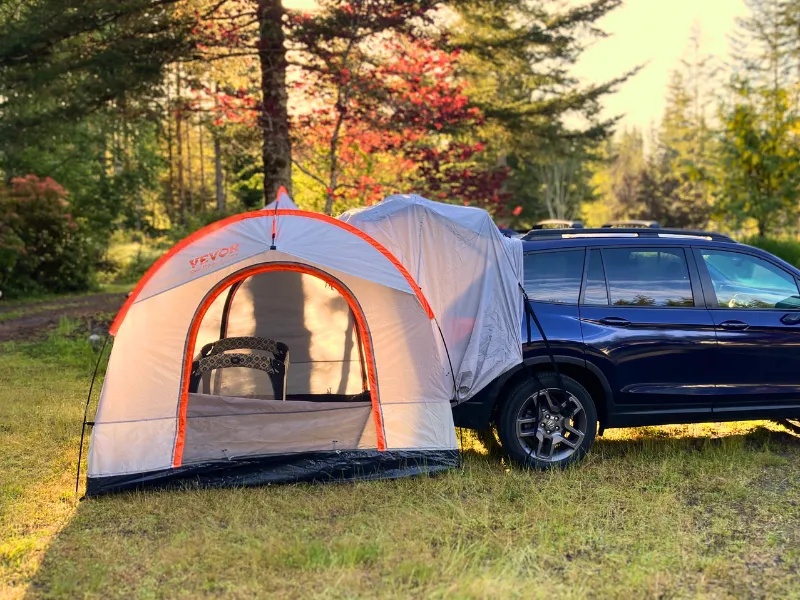
Vevor SUV Tent 8×8
Pros
Lowest priced full sleeping tent in the field
Double layer, PU2000mm, at half the premium price
Pack and play on the floor, parents in the SUV
Concerns
Poor instructions, setup is the friction point
Average materials, not Napier durable
Capacity is inflated, plan on 3 to 4 people
The shortlist. Our Recommended SUV Tents:
- For a compact or smaller SUV on the tightest budget, with the arrival inspection below run inside the return window, pick the Vevor SUV Tent 8×8.
- For the same budget idea in a bigger, newer tent with stand up headroom, pick the VEVOR SUV Camping Tent.
- For the strongest fit and weather documentation in the field, at the field’s premium price, pick the Napier Sportz SUV Tent.
- For a family camp where pitching is the easy part rather than the fight, pick the FanttikOutdoor Beta C6 Apex.
I found the Vevor SUV Tent to be an adequate car camping tent. Since it’s an SUV tent, the ability to load and unload the back of our SUV, a Honda Passport, was very convenient. It seemed sturdy enough, and the material and design were acceptable. However, I didn’t like the fit of the Vevor SUV tent to our Honda Passport, and the set-up and take-down were annoying due to the pole system design.
What this tent is
The Vevor SUV Tent is an 8×8 tent that attaches to the open hatch of an SUV, so the vehicle and the tent work as one camp. A sleeve connects the tent to the back of the vehicle, and the cargo area stays reachable from inside the tent. The floor measures 250 × 250 cm (about 67 sq ft), and the peak stands 200 cm (about 79 in), high enough to move around and change clothes without crouching the whole time. It is a double layer design with an outer flysheet and a PU2000mm coating, a sewn in polyethylene floor, and 9 mm fiberglass poles.
Vevor lists the capacity at 6 people, and some listings claim 6 to 8. My use says otherwise, and the wider record agrees with me: plan on 3 to 4 people in comfort, 5 at a stretch with gear discipline. In my family’s layout the tent was never asked to sleep everyone anyway. The tent floor held our toddler’s crib (our pack and play), we slept in the back of the Passport, and the tent carried the living space, the gear, and the daytime life of camp between the two.
Is it good
For its price class, the honest answer is the one I gave up top: adequate, with real convenience when it is up and real annoyance getting it there. It is the least expensive full sleeping tent in the scored field, and it gave my family a working camp across multiple trips in the summer of 2024, including a trip to Yosemite. Loading and unloading through the attached tent was genuinely convenient, the space handled our young family’s arrangement with room to spare, and my unit came home from every trip intact.
The limits are just as plain. The fit on my Passport was tight enough to dominate every setup. The pole system made setup and takedown the least pleasant part of every trip, and the instructions were poor. The materials are average, a step well below the premium Napier tents in durability. And I never used the tent in rain, so this review makes no claim about wet weather from my experience; the weather account below rests on documentation and on what other users report.
The fit on the Honda Passport
The connection is this tent’s defining experience. The sleeve fit tightly on the Passport and had to be lined up exactly, or it would not seal correctly, so each setup began with a small positioning job performed to the inch. When the alignment was right, the seal worked and the two spaces flowed together. When it was off, the connection simply was not sealed, and there was no forcing it.
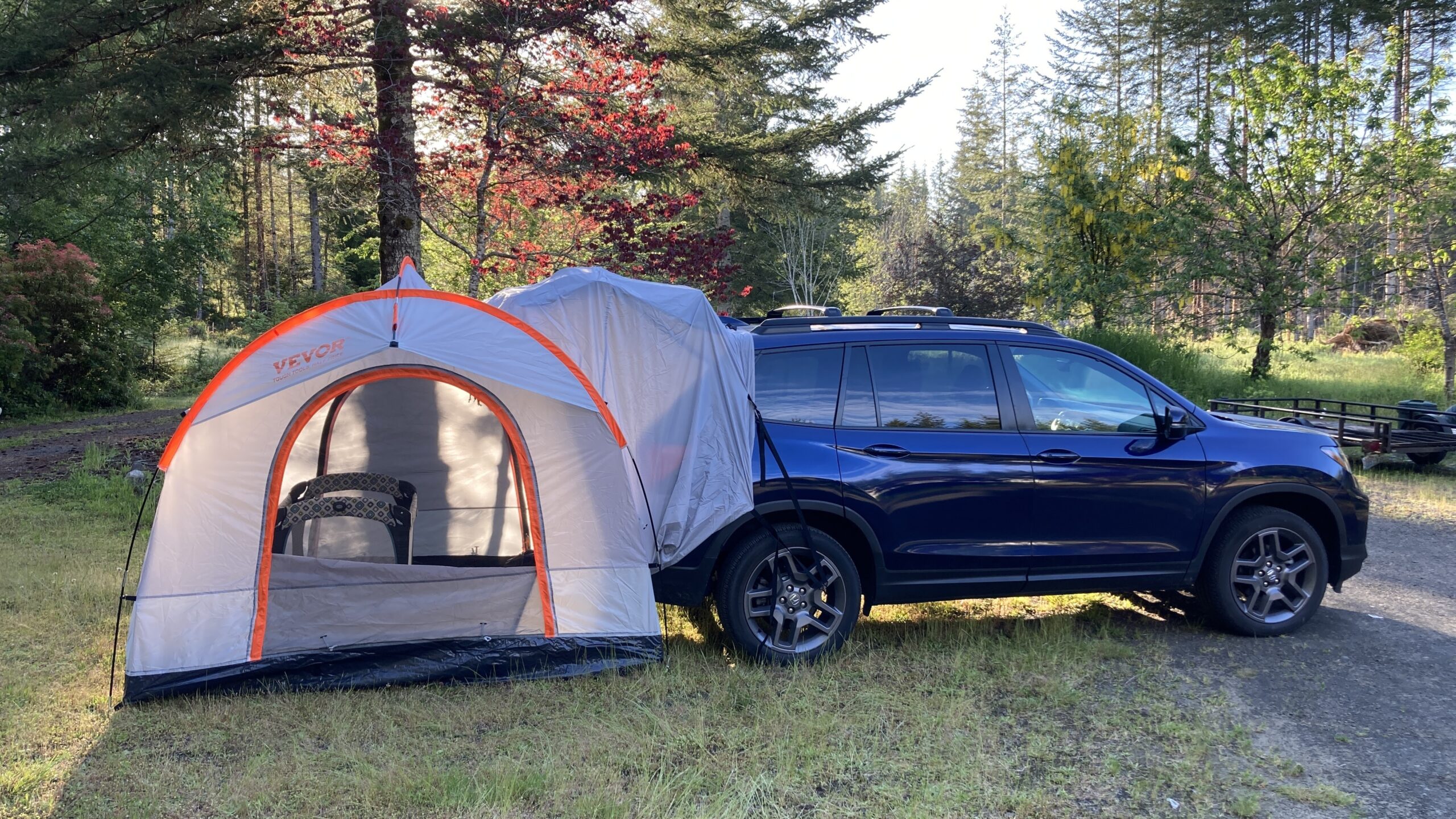
My unit is not unusual in this. In the wider owner record, 22 reports name a vehicle and describe the connection: 15 fit (among them the Honda Pilot, the Hyundai Palisade, the Subaru Outback, the Kia Seltos, and the Tesla Model Y). The other 7 report fit trouble, 3 of them on vehicles inside the claimed range: a 2022 Outback so snug the hatch could not open completely, a Hyundai Santa Fe set up carefully every time for fear of ripping the tent, and a Model Y forced hard enough against its clips to break the car’s glass roof.
The same model also carries clean fits on some of those vehicles, which is the story of this whole review in miniature: the fit is vehicle specific, exact, and unforgiving of approximation.
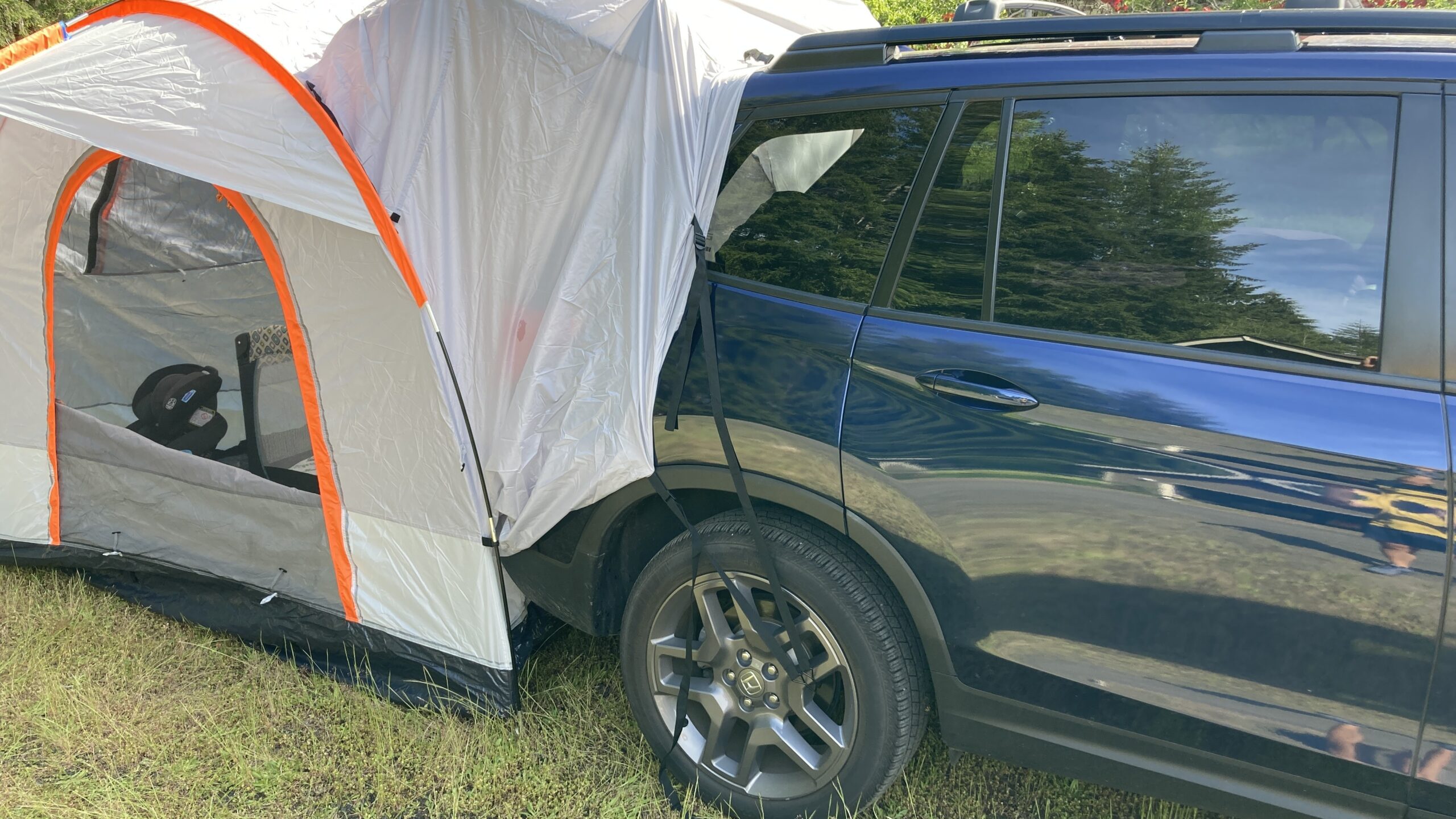
Practice did not change any of it. The fit still needs fairly precise lining up; my routine is to move the tent into position and work the fit before staking it down, because once the tent is staked the precise adjustment gets much harder. My explanation is the vehicle itself: the Passport’s hatch is so large when it opens that the sleeve does not quite fit it correctly, and the connection sits quite tight. On my vehicle, that exactness is permanent, not a beginner’s stage I grew out of.
Living space and the family layout
What the tent did well, it did in daily camp life. The pattern that worked: the tent as the living and gear space, the vehicle as our bedroom, and our toddler’s crib on the tent floor. The space handled that arrangement with room to spare. Access between the vehicle and the tent meant loading and unloading ran through the tent rather than around the camp, the convenience I named in my intro.
Campers in the wider record land on the same realistic capacity I report: 4 adults at most with gear, 2 easy and 3 comfortable, fine for 1 or 2 and not for the 6 to 8 the listings claim. One honesty note: family reports in the owner record are thin, only 2, so the family side of this review stands on my own layout rather than on a broad family pattern.
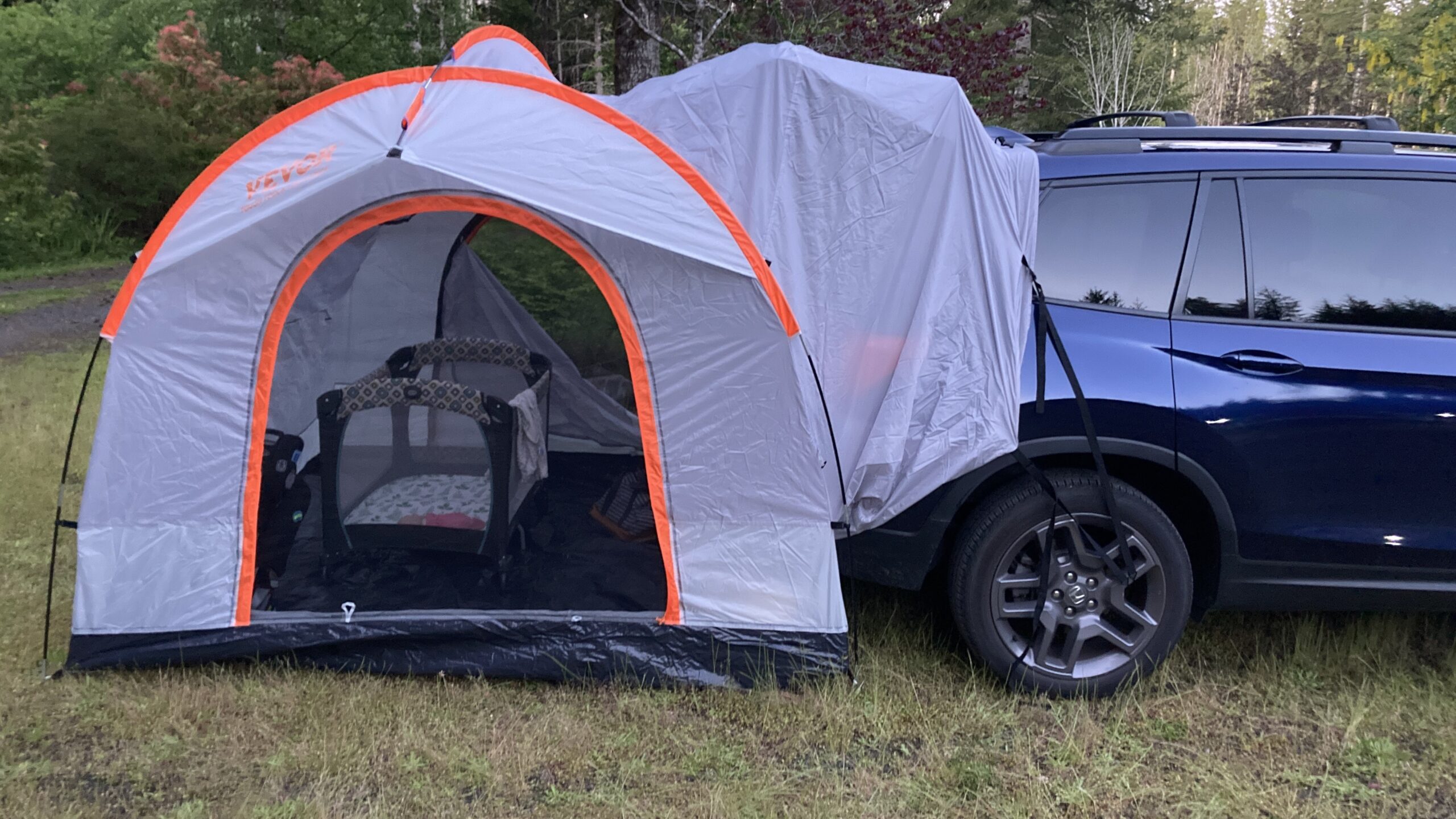
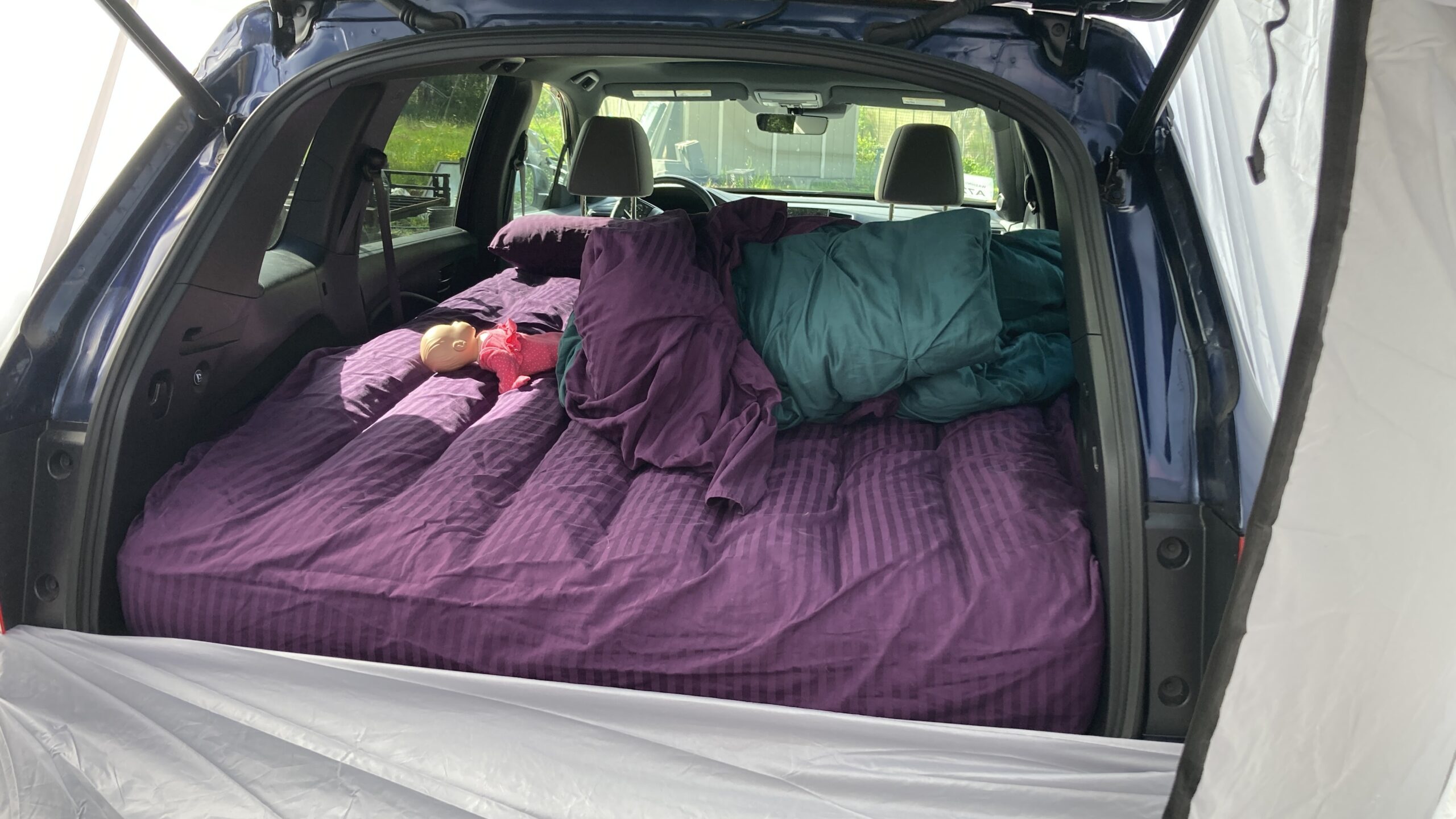
Night ran on the same arrangement, and it worked well. Entry between the tent and the vehicle after dark worked great. Our daughter slept in the crib on the tent floor while we slept in the back of the Passport on an air mattress. The one chore the layout imposed was moving all the gear out of the Passport and into the tent to clear the bed space: somewhat a pain until it was organized, and fine once it was.
Setup, takedown, and the pole system
Setup is where this tent spends its goodwill. My record names the pole system as the annoyance on every trip. The poles were fiddly to run and seat, snagging somewhat in their channels and hard to feed through without the sections coming apart, and takedown shared the friction. The instructions did not rescue the process; they were poor. My setup score of 4.0 is the lowest criterion in my tent’s record apart from durability, and it comes from that experience rather than from a brochure.
Other users say the same thing: 10 of the reports criticise the instructions unprompted, 4 of them in the strongest terms, and strap routing is the complaint that keeps coming back.
The video below is my own setup on the Passport, my practiced pitch, so a buyer can watch the pole work and the vehicle positioning rather than read about them. It is not a first attempt: my first setup took about 20 to 30 minutes, part of that time spent reading the documentation. Later setups went quicker, and with another person helping, the pitch takes about 10 to 15 minutes.
What helps: pitch the tent once at home before the first trip, work out the strap routing there rather than at a campsite, and treat the vehicle’s final position as part of the pitch rather than as parking. Solo pitching is possible, 9 reports in the record describe managing alone, but a second pair of hands makes the pole work much easier. The tent also pitches entirely on its own: I usually set mine up detached from the vehicle, and reached for the sleeve connection on the trips where the combined camp was the point.
Materials, weather, and the test I never ran
The construction is basic, and most of what is known about it comes from Vevor’s documentation: a double layer tent with a PU2000mm coating, a 120g sewn in polyethylene floor, and 9 mm fiberglass poles, under a 12 month warranty in Vevor’s published policy. My judgment from use is that the materials are acceptable and sturdy enough, and not nearly as durable as the premium Napier tents.
The weather limit is the one this review will not blur: I never used this tent in rain, so my trips never tested whether the seal holds in wet weather or whether the seams shed water. The weather protection score of 6.5 rests on the documented coating and coverage and on the wider record, not on my trips.
What my trips did test, they passed quietly. Wind gave the tent no trouble. In summer heat the light tent stayed fairly cool, helped by the screened windows on the back and sides and by the door arrangement, a solid door and a screen door, the screen door earning its keep in Yosemite when it was really hot. I never had a condensation problem. None of that touches the rain limit above; it is the fair weather record, and rain remains the test I never ran.
The wider record splits on weather, and the split runs along the seams and the vehicle connection. Seven users report staying dry or sealed in real weather, one of them rained on every use across 2 seasons. Against them, 3 reports describe leaks bad enough to end the night’s comfort: every seam leaking, rain spilling in from the car side and through the seams, and leaks at the roof seams. The tent can stay dry, and the seams and the sleeve are where it fails when it fails. A buyer who camps in wet country should weigh that split carefully.
How it scores
Two numbers carry the story. Setup at 4.0 is my own experience priced in: the pole friction and the poor instructions, scored from use. Durability at 4.3 is where the wider record pulled the total down: documentation alone scored 6.2, and the recurring failure pattern described below brought it to 5.9. The full point by point record stands in the roundup’s scoring worksheet.
The wider owner record, and why units vary
What follows is not my experience; it is the model’s wider owner record, 93 reports spanning about 40 months, 91 percent of them verified purchases. It belongs in this review because a buyer is not buying my unit. They are buying the next unit off the line, and the next unit’s odds are what this record describes.
The failure pattern is specific. Nine reports describe zipper problems, 5 of them losing a door zipper outright, on the first use, the first night, or the third setup. Seven reports describe straps, clips, tabs, or their stitching tearing away, 5 of them badly enough to end a trip, several on the very first setup and in calm weather. Counted together, 18 of the 31 reports that say anything about durability describe a structural failure, moderate or worse. That is the record that fails this model under the current criteria.
Set against that, the same record holds campers who praise the tent across seasons, and the strongest evidence that both stories are true is a single buyer who owned 2 of these tents. Her first was well made and served until its tags ripped in genuinely high winds. Its replacement ripped at its first pitching, at the point where the pole sits, and its fly net mesh tore days later. The arrival record points the same way: a hole in the fabric on arrival, a tear on arrival, a top sewn 2 inches too small to pitch, and a unit whose seams had already been repaired before sale. The 2023 reports, including the early Vine cluster, praise the stitching and the reinforcements at the tension points, the very points the 2025 and 2026 reports tear at.
My unit holds up against the same failure points. Both door zippers still run clean end to end, with no catching; my one reservation is that they do not feel super sturdy, a judgment about the build rather than a failure of it. Every strap, tab, clip, and grommet point is intact, with no tearing, no stitching lift, and no deformation. The fiberglass poles never splintered and their shock cords never loosened; the snagging recorded in the setup section is a handling fault, not wear. On each of the model’s named failure points, my unit is the counterweight, the unit the record says some buyers receive and others do not.
The reports cannot settle whether quality declined over time or simply varies unit to unit, and this review does not pretend to. Either way, the lesson for a buyer is the same: the model’s floor is much lower than its ceiling. My unit, which served repeated trips without a recorded failure, sits at the good end of its own model’s distribution. A buyer should shop for this tent the way that record teaches: as a unit to inspect, not a model to trust on average.
If you buy one, inspect it like this
The failure points users name turn into an arrival routine. Run every item below in the first days, inside the return window, before the first trip depends on the tent.
- Pitch it fully at home, on your own vehicle, before any trip. The fit check and the defect check are the same pitch.
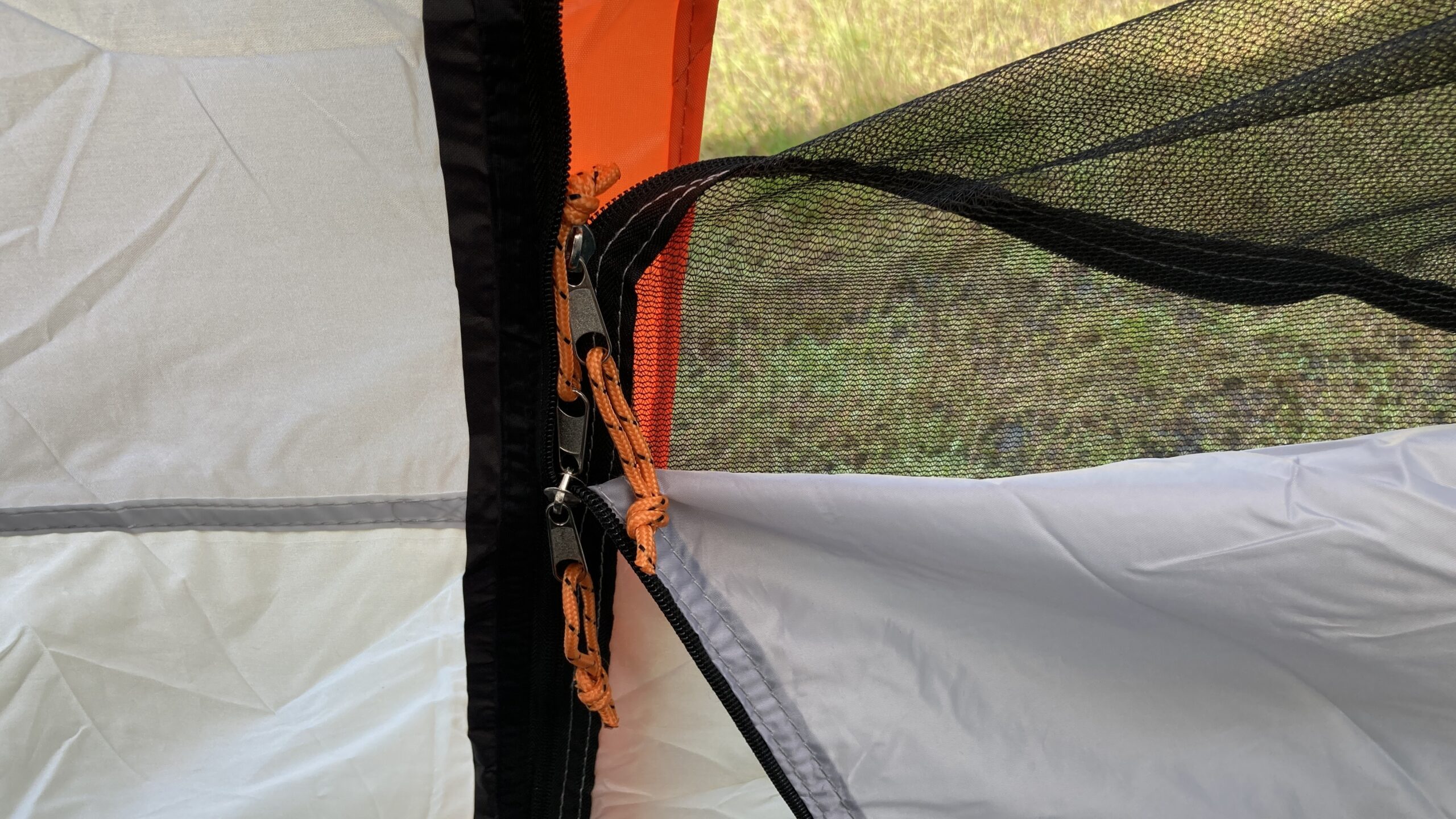
- Work both door zippers end to end, repeatedly, and watch the pulls and the stitching where the pulls seat. Door zipper failure is the model’s most common early failure, and it clusters in the first 3 uses.
- Pull each strap, tab, clip, and grommet point firmly by hand. The tear off record concentrates at these points, several of them letting go under a slight pull at first tensioning.
- Run every pole through its channel or pocket slowly, and check the pole pockets and click in sockets afterward. Poles snag in tight channels, and stitching at the pouches has torn under that force.
- Check the fabric and seams under tension: look for holes, thin spots, and any seam that arrives repaired. Then confirm the top fits its poles; at least 1 unit arrived sewn too small to pitch at all.
- Seat the fiberglass poles and inspect your hands and the pole ends for splinter flecks, which some reports describe when forcing the last rod home.
- Line the tent up on your vehicle more than once, and learn what exactly lined up means for your hatch before a campsite teaches you. Leave the setup standing while you check the seal at the sleeve from inside.
- Keep the box and the return path until the home pitch and 1 real trip are done. On this model, the first trip is the test the record describes.
Alternatives worth your money
The roundup scored 24 tents under the same method, and 3 of them answer the needs this tent serves, each from a stronger record. The full comparison stands in Best SUV Tents of 2027.
The newer, larger VEVOR SUV Camping Tent (model 224061301) is the roundup’s budget pick, at 6.6. It is a different and newer model from my 8×8 (model TBT-8080), not my tent, and it is the natural step from my tent for a VEVOR buyer: a bigger floor, stand up headroom, and the strongest livability score in the budget class. It inherits nothing from the TBT-8080’s scores or from my experience with my tent; it earned its own record. For the budget step that keeps the brand and fixes the size, pick the VEVOR SUV Camping Tent.
The Napier Sportz SUV Tent is the overall pick, at 7.2, and the durability answer to everything this review has described: the strongest fit and weather documentation in the field, from the category’s most established line, at the field’s premium price. My own comparison runs through my intro and my trips; the Napier tents are the durability benchmark my Vevor does not reach. For a fit you can count on, check the Napier Sportz SUV Tent.
The FanttikOutdoor Beta C6 Apex is the family pick, at 7.5 on the family weighting, a pre attached pole instant cabin that answers this tent’s worst criterion directly: pitching is its praised strength rather than its friction. Families who camp the way my family does, children asleep in the vehicle and living space in the tent, are its exact audience. For the family camp without the pole fight, pick the FanttikOutdoor Beta C6 Apex.
My own tent (the 8×8, model TBT-8080) is the fourth answer here, and the scoped one. The roundup’s bar stands, because the model’s failure pattern is what it is. In this review I recommend it anyway, for the vehicles it suits: a cheap budget pick for compact and mid to smaller SUVs, bought with the inspection routine above run inside the return window, and not the pick for a large hatch like my Passport. For the smaller hatch camp, pick the Vevor SUV Tent 8×8.
Who this tent suits, and who should skip it
It suits a buyer who camps the way my family did: fair weather trips, the vehicle as the bedroom, the tent as the living room, and a budget that makes the least expensive full tent in the field a rational gamble inspected on arrival. It suits a buyer who will pitch it at home first, work the zippers and straps while the return window is open, and accept the pole system as the price of the price.
It is the wrong tent for a buyer who needs the first trip to work without a home rehearsal, who camps where rain is expected rather than possible, or who wants a tent to hand down across seasons. It is also the wrong tent for a large group, whatever the listings claim: 3 to 4 people is the honest planning number, and 6 to 8 is a claim the record does not support.
My own verdict closes the question, and it is a recommendation with a boundary. I recommend this tent as a cheap budget pick for compact and mid to smaller SUVs, the Honda CR-V and Toyota RAV4 class, and I would use it again on such a vehicle. That fit judgment is my expectation, not a measurement: I tested the tent on the Passport, not on a compact SUV, so the smaller hatch fit is what I expect rather than a result I measured. On the Passport I would not choose it again, knowing how tight the fit is. In my case, suitability comes down to the vehicle: the same unit in the same hands, recommended for the smaller class and not for my own larger vehicle.
Specifications
Manufacturer figures from the manual for model TBT-8080, except the peak height, which is my measured figure and is labelled as such. I bought my unit at retail on Amazon in May 2024, at the original list price of $145.19.
| Specification | Figure |
|---|---|
| Model | TBT-8080 |
| Floor size | 250 × 250 cm (8×8 ft, about 67 sq ft), manufacturer figure |
| Peak height | 200 cm, about 79 in, measured |
| Capacity | 6 listed by the manufacturer, with some listings claiming 6 to 8; in my use the realistic capacity is 3 to 5 people, and 3 to 4 is the comfortable recommendation |
| Weight | 18 lb (8.1 kg), manufacturer figure |
| Construction | Double layer with an outer flysheet, PU2000mm coating, 120g sewn in polyethylene floor, 9 mm fiberglass poles, manufacturer figures |
| Warranty | 12 months under Vevor’s published policy |
Frequently Asked Questions
Did I test the Vevor SUV Tent in rain?
No. Across multiple trips in the summer of 2024 I never used it in rain, and this review makes no wet weather claim from my experience. The weather picture here comes from the documented coating and from the wider record, which splits between people who stayed dry across seasons and people whose seams and vehicle connection leaked.
What vehicle did I test it on?
A Honda Passport, on every trip. The sleeve fit tightly and had to be lined up exactly to seal. Fit on other vehicles is vehicle specific in the wider record, with clean fits and strained fits sometimes reported on the same vehicle, so my Passport result is evidence for the Passport and a warning about precision, not a universal fit promise.
Did leaving the hatch open drain my battery?
No. My overhead dome lights turned off automatically after about 15 minutes, so I did not need to trick the tailgate switch. I had no problems with battery draining.
Can this tent stand alone, without the vehicle?
Yes. It stands alone and independent, and I usually pitched mine detached from the vehicle. The sleeve connection is an option the design offers, not a requirement it imposes; my fit record comes from the trips where I used it attached, on the Passport.
How many people does it really sleep?
Plan on 3 to 4 in comfort, 5 at a stretch. The manufacturer lists 6 and some listings claim 6 to 8; in my family’s layout, we slept in the vehicle and our toddler slept in a crib on the tent floor, and other reports converge on the same realistic numbers.
Why is a tent I own barred from picks on my own site?
Because the bar is about the model, not my unit. The wider owner record carries recurring zipper failures and straps, clips, and stitching tearing away, at a rate that fails the model under the current criteria. My unit never showed those failures. That is why my own review can recommend the tent for compact and smaller SUVs, inspection routine and all, while the roundup’s bar stands.
Method note and update log
My experience claims come from my own Drive draft, my recorded account in the 2027 roundup, and my answers to this review’s experience questions, given on 2026-10-25, and from nothing else. I bought my unit at retail on Amazon in May 2024, at the original list price of $145.19. The owner record figures come from the 93 reports described above. Retail prices are not shown in this review; I checked them on 2026-10-25 and found them unchanged from the figures held in the working record.
The tent’s life since those trips: it has stored well, and it has not been used much since the summer of 2024. We now have a better quality multi room car camping tent, and that tent is the easier setup for our car camping. Using the back of the car for storage also beats filling the Vevor just to get the mattress into the back of the car. The Vevor remains usable, attached or standalone, but its season as our family’s main camp was the summer of 2024.