San Juan Islands camping spreads across an archipelago in the Salish Sea, reached by ferry from Anacortes. Four islands take the ferries, Lopez, Shaw, Orcas, and San Juan Island, and a chain of smaller islands around them takes boats only. Nineteen public campgrounds stand inside San Juan County, run by the county parks department, Washington State Parks, and the state Department of Natural Resources. Two more boat-in campgrounds on Cypress Island and a city campground at the ferry terminal town stand in this guide’s gateway section.
The governing fact is that every vehicle trip runs on two reservations. The campsite is booked with San Juan County Parks or with Washington State Parks. The vehicle space on the ferry is booked with Washington State Ferries. The two systems do not talk to each other, neither one holds the other, and missing either reservation ends the trip. The islands are one of the state’s camping regions, gathered with the rest in the Washington campgrounds by region guide.
A camper who books a site and assumes the ferry will work out is planning to sleep in the vehicle at the terminal. So is a camper who books the ferry and assumes a site will be open.
Below, the comparison table and the water classes come first, then both booking systems whole. Then come the islands in the order campers search for them, Orcas, Lopez, San Juan, and Shaw, each with its boat-in campgrounds inside its own section. The mainland gateway follows, then fire restrictions and emergencies, the private campgrounds that hold the system’s overflow, and the questions campers ask most.
Contents
San Juan Islands camping at a glance
Every campground in this guide sits behind the same two bookings. A vehicle camper reserves a campsite on one system and a ferry space on another, on separate timelines that this guide’s booking section lays out as one problem. The ferry system holds back a tenth of its standard space for emergency and standby vehicles, which is a working margin for the system, not a plan for a camper. A camper who arrives on foot, by bicycle, or by kayak needs no ferry vehicle space at all. Both public campground systems hold some room for those arrivals, in forms the booking section states exactly.
The table below compares all twenty-two campgrounds on the facts a booking decision turns on: how many sites, what water, what reservation form, and how a camper reaches it.
Water sorts this roster into three classes, and the classes do not follow the ferry map. Some campgrounds carry drinking water reliably in season. Some carry it seasonally and shut it off in winter, each on its own window. The rest have no drinking water at any time of year, and most of the boat-in campgrounds stand in that third class. The safe plan at any boat-in campground is to pack all water in.
Jones Island is the roster’s standing exception to its own class. Its water runs May to September in a normal year. An agency notice dated June 26, 2026 closes it until further notice, so its entry and its table row carry that dated form instead of a bare yes. The county parks share one off-season, November 1 to March 31, that takes every county campground’s water off together. That is why the county rows in the table carry the same seasonal class.
The eleven boat-in marine state parks, the county parks’ marine trail sites, and the DNR stops work as one route system for paddlers, not as a list of separate parks. Their shared facts stand here once. Primitive and water trail campsites cost $12 a night in all seasons. Every marine state park campground is pack out, with no garbage service. Moorage runs $23 a buoy and $1 a vessel foot at docks.
The Cascadia Marine Trail is the access system that designates the human-powered sites across the chain. The State Parks Winter Schedule governs the seasonal forms, the dock removals, and the water windows. And a boat-in camper is hours from the county’s single emergency room in Friday Harbor, which is a planning fact, not a warning label.
Three nils hold across the islands. No county park campground and no island state park campground offers hookups. The Fairgrounds RV sites in Friday Harbor are the one public exception, and the private resorts hold the rest. Showers stand only at Moran State Park and, seasonally, at the Fairgrounds, and the roster’s only dump stations stand at Moran and Spencer Spit.
There is no dispersed camping anywhere in this guide’s territory. Friday Harbor is the archipelago’s full-service town and the seat of its only hospital. Eastsound on Orcas and Lopez Village on Lopez serve at town level. Shaw has a single store, at its ferry landing.
| Campground | Island | Sites | Water | Reservations | Access |
|---|---|---|---|---|---|
| Moran State Park | Orcas Island | 124 standard, plus 6 hiker and biker | Reliable in season | Reservable, state system | Ferry-served drive-in, Orcas landing |
| Obstruction Pass State Park | Orcas Island | 9, plus 1 marine trail site | None, ever | First-come only | Ferry-served, walk-in from parking |
| Point Doughty | Orcas Island | 3 | None, ever | First-come only | Boat-in only |
| Sucia Island Marine State Park | Sucia Island | 60, plus 4 group camps | Seasonal, early April to September | First-come; group camps reservable | Boat-in, moorage buoys and docks |
| Patos Island Marine State Park | Patos Island | 7 | None, ever | First-come only | Boat-in, Active Cove |
| Matia Island Marine State Park | Matia Island | 6 | None, ever | First-come only | Boat-in, Rolfe Cove |
| Clark Island Marine State Park | Clark Island | 15 | None, ever | First-come only | Boat-in, moorage buoys |
| Doe Island Marine State Park | Doe Island | No agency count; 5 in older directories | None, ever | First-come only | Boat-in, 60-foot dock |
| Spencer Spit State Park | Lopez Island | 37 standard, 16 hiker and biker, 3 marine trail | Reliable in season | Reservable, state system | Ferry-served drive-in, Lopez landing |
| Odlin County Park | Lopez Island | 35, plus an 8-site group camp | Seasonal, off in the county off-season | Reservable, county system | Ferry-served drive-in, Lopez landing |
| James Island Marine State Park | James Island | 13 | None, ever | First-come only | Boat-in, East and West Coves |
| San Juan County Park | San Juan Island | 20, plus a group campsite | Seasonal, off in the county off-season | Reservable, county system | Ferry-served drive-in, Friday Harbor |
| San Juan County Fairgrounds RV sites | San Juan Island | 8 RV sites | Hookups at the sites | Reservable, county system | Ferry-served drive-in, Friday Harbor |
| Jones Island Marine State Park | Jones Island | 24 | May to September in a normal year; closed until further notice on a June 26, 2026 agency notice | First-come; group camps and shelters reservable | Boat-in, North Cove |
| Stuart Island Marine State Park | Stuart Island | 14, plus 4 marine trail sites | Seasonal, May to September | First-come only | Boat-in, Reid and Prevost Harbors |
| Turn Island Marine State Park | Turn Island | 12 | None, ever | First-come only | Boat-in, from Jackson Beach |
| Posey Island Marine State Park | Posey Island | 2 group campsites | None, ever | Reservable May 15 to September 30, marine trail arrivals only | Boat-in, human-powered only |
| Shaw Island County Park | Shaw Island | 12 | Seasonal, April 1 to October 31 | Reservable, county system | Ferry-served drive-in, Shaw landing |
| Blind Island Marine State Park | Blind Island | 4 | None, ever | First-come only | Boat-in, human-powered only, Blind Bay |
| Washington Park | Mainland, Anacortes | 68 | Hookups at 46 sites | 43 sites reservable 14 or more days ahead; 25 first-come | Drive-in, mainland |
| Pelican Beach | Cypress Island | About a half dozen | None, ever | First-come only | Boat-in, from the Anacortes launch |
| Cypress Head | Cypress Island | No settled count | None, ever | First-come only | Boat-in, from the Anacortes launch |
Four exclusions ride with this roster, and they are decisions, not oversights. Griffin Bay, on San Juan Island, was a marine state park whose State Parks operation ceased in August 2014. Its present manager and camping status are unconfirmed, so it prints here and nowhere else in this guide. Burrows Island appears on the State Parks area contact sheet, and no camping was found for it anywhere.
San Juan Island National Historical Park is day use only, with camping prohibited. Inside the San Juan Islands National Monument, camping exists only at the designated campgrounds on Blind, Posey, and Patos islands, which this guide rosters as state parks campgrounds.
Campsite reservations and ferry reservations
Plan the two bookings as one task, in this order: the campsite first, because its windows open earliest, and the ferry space second, on the tiered release below. County campsites for 2027 open to county residents on January 6, 2027, and to the public on January 13, 2027. State park campsites book nine months ahead, rolling.
Ferry vehicle space releases two months before each season, then again two weeks and two days before each sailing. A summer trip can therefore hold a campsite months before its ferry space exists to book. The camper’s job is to be at the ferry release the way they were at the campsite opening.
The combined timeline a summer party plans against runs like this. A county campsite for July is booked in January, at the resident window or the public opening. A state park campsite for July is booked the previous October, at the nine-month edge, or whenever the party commits after that. The ferry space for that July sailing releases in May at the two-month tier, again two weeks out, and again two days out. Three dates, three systems, one trip; the section below takes each system in turn.
Booking the campsite
The county system runs San Juan County Park, Odlin County Park, Shaw Island County Park, and the Fairgrounds RV sites, and it books through the county’s reservation portal at sanjuancountywa.perfectmind.com. For the 2027 season, residents book from 9:00 AM on January 6, 2027 through 4:00 PM on January 8, 2027. The portal opens to the public at 9:00 AM on January 13, 2027. Resident reservations are non-transferable to any other party for the length of the stay, and residents should be ready to show local identification at the campground. Summer reservations are strongly recommended; any site left unreserved is first-come, and individual and group sites alike are reservable online.
The county prices by site class, with extra person and extra vehicle charges and a per-person rate for campers who arrive under human power. The current figures live in the portal. County campsites are primitive in the county’s own form: no showers and no campsite electricity at any county park campground. A picnic table and a fire ring stand at every site, and drinking water stands at spigots. Each park also carries a day-use area and beach access, with the Fairgrounds standing as the system’s exception.
The county’s cancellation and no-show terms have ferry teeth. Cancelling costs 25 percent at thirty or more days out, 50 percent inside twenty-nine to three days, and the full fee inside three days. Partial changes are not allowed, so a change means cancelling and rebooking. A reservation is cancelled if the party has not arrived, or told the park it is running late, by 2:00 PM on the second day of the reservation. A missed sailing on arrival day therefore does not end the booking by itself, but a missed sailing plus silence does.
County stays run to fourteen days within a thirty-day period at the three parks, and ten days within a thirty-day period at the Fairgrounds. From November 1 to March 31 the county parks run strictly first-come on self-registration, with reduced fees and reduced services: no water, no garbage service, and some restrooms possibly closed.
The state system runs Moran, Spencer Spit, and Obstruction Pass, and every marine park, and it books at washington.goingtocamp.com or by phone at (888) 226-7688, up to nine months ahead. The reservation fee is $8 online and $10 by phone. Same-day reservations run until 2:00 PM, and sites left over are released first-come at 2:30 PM.
The state no-show rule is stricter than the county’s. A party that has not arrived by 1:00 PM on the day after its scheduled arrival date forfeits the entire stay. A party running a day late should call the park. Late arrival runs on a form of its own: campers may enter until 10:00 PM. If the gate stands closed, a party enters by the slider bar, closes the gate behind it, and registers the next morning.
State park stays run to ten nights in one park in a thirty-day period and ninety days a year across the system, one party and eight people to a site. Peak-season standard sites, May 15 to September 15, cost $31 to $43 a night, and primitive and water trail sites cost $12 in all seasons. An extra vehicle costs $10 a night, and a Discover Pass, $10 a day, covers day use parking.
Booking the ferry
Washington State Ferries releases vehicle space on the Anacortes route in three tiers. Two months before the season starts, at 10:00 AM, it releases 30 percent of standard vehicle spaces and 90 percent of tall and non-standard spaces, the class that includes RVs. Two weeks before each sailing date, at 7:00 AM, it releases another 30 percent of standard spaces. Two days before each sailing, at 7:00 AM, it releases the last 30 percent.
The final 10 percent of standard space is held for emergency and standby vehicles. A virtual waiting room operates at the releases. The system works as designed in winter: reservations for the winter season, December 27, 2026 through March 20, 2027, opened on November 10, 2026, at the two-month tier.
The terms around a ferry reservation are as strict as the campsite’s. A reservation must be made at least two hours before the sailing. The vehicle must be through the tollbooth at least thirty minutes before the sailing or its space is released to standby. A reservation not changed or cancelled by 5:00 PM the day before draws a no-show fee.
Fares are collected westbound at Anacortes only and cover the round trip. They scale by vehicle length band and by destination, Lopez the lowest and Friday Harbor the highest, with a peak-season surcharge in the May to September window. Eastbound, vehicle space from Orcas and Friday Harbor reserves on the same release. From Shaw or Lopez to Anacortes there are no vehicle reservations at all; those returns load first-come, first-served, and a party leaving from either island queues rather than books.
The author of this guide has driven a vehicle onto the Anacortes ferry for the islands and the crossing went well. The systems still have to be worked, in the order above.
Going without a vehicle
Arriving without a vehicle removes the ferry reservation problem entirely. Walk-on passengers need no reservation and should arrive at least fifteen minutes before the sailing, and once the westbound fare is paid, walk-on travel between the islands is free. A bicycle rides the same way. What waits on the far side differs by system, and the difference matters.
Each county park sets aside a limited human-power safe haven for campers who arrive by bicycle, kayak, or on foot with no vehicle in the park. The county’s own words are that the space can fill and is not guaranteed, and it does not serve groups or commercial tour companies. The state parks hold dedicated hiker and biker sites, first-come, with no promise behind them either. Spencer Spit’s own park notice, dated May 26, 2026, states that its sixteen hiker and biker sites reach capacity on weekends. Campers who arrive when the park is full may be directed to private camping on Lopez.
Plan the walk-on trip around a first-come site the way the record states it, not around a guarantee no agency makes. The bicycle camper’s working set is the landing-adjacent campgrounds. Washington Park stands at the mainland end, Odlin a mile from the Lopez landing, and Spencer Spit beyond it. San Juan County Park stands across its island, and Moran and Obstruction Pass stand on Orcas.
Orcas Island
Orcas is the largest island in the archipelago and the longest drive of the four. The ferry lands at the island’s south end, and the road runs north through Eastsound, the island’s town for groceries and fuel, to Moran State Park under Mount Constitution. In November 2026, emergency reporting recorded cracks in the Orcas terminal’s transfer-span beams, temporary vehicle size limits, and a county emergency declaration. Some February to March 2027 sailings stand unreservable during the construction that follows. Both are dated facts, and a winter or spring party checks the sailing schedule before it plans around it.
For water, Moran carries drinking water reliably in season, while Obstruction Pass has none at all. The boat-in campgrounds stand at none, ever, apart from Sucia’s seasonal supply, so the safe plan for a boat-in night on Orcas waters is to pack water in. For booking, Moran reserves on the state system, and Obstruction Pass, Point Doughty, and the marine campgrounds are first-come in their own forms, apart from Sucia’s four reservable group camps.
Moran State Park
Quick facts: form, four campgrounds with 124 standard sites plus 6 hiker and biker sites, drive-in; potable water, verified; restrooms, 5; showers, 10; campfires and firewood, fire rings at sites, firewood from vending machines stocked with locally sourced wood from Dancing Tree Farms, the first arrangement of its kind in the state system on the park page’s own statement; check-in and check-out, 2:30 PM and 1:00 PM, entry until 10:00 PM; reservations, reservable on the state system to nine months ahead, the hiker and biker sites first-come; pets, leashed; dump station, 1; quiet and generator hours, quiet 10:00 PM to 6:30 AM, generators 8:00 AM to 9:00 PM; site character, four campgrounds around five lakes below Mount Constitution, maximum site length 45 feet with limited availability, no electrical hookups; resupply, Eastsound at town level; emergency readiness, Island Primary Care clinic on Orcas, the hospital at Friday Harbor; pass and price, Discover Pass for day use, standard sites in the $31 to $43 peak class.
Moran State Park is the roster’s anchor, the largest campground system on any island and Orcas’s demand leader. Its four campgrounds spread around the park’s five lakes below Mount Constitution, the archipelago’s high point, and its roughly forty miles of trails run from lakeshore to the summit. It is the only island state park campground with showers, and it holds the roster’s only dump station outside Spencer Spit. The park stands roughly a half hour’s drive from the Orcas ferry landing. A party that wants a reservable site, water, and a shower on an island trip is describing Moran, and a family is describing the islands’ fullest measure of what time outside does for a child, five lakes and forty miles of trail to spend it on.
Two named forms ride inside the park. The LEANTO sites are five walk-in platform tent sites in the South End Campground, reservable from June through September through the operator. Camp Moran is the park’s retreat center for groups. The State Parks Winter Schedule governs the park’s seasonal closures, and a winter party reads its campground’s form there before it counts on a loop standing open.
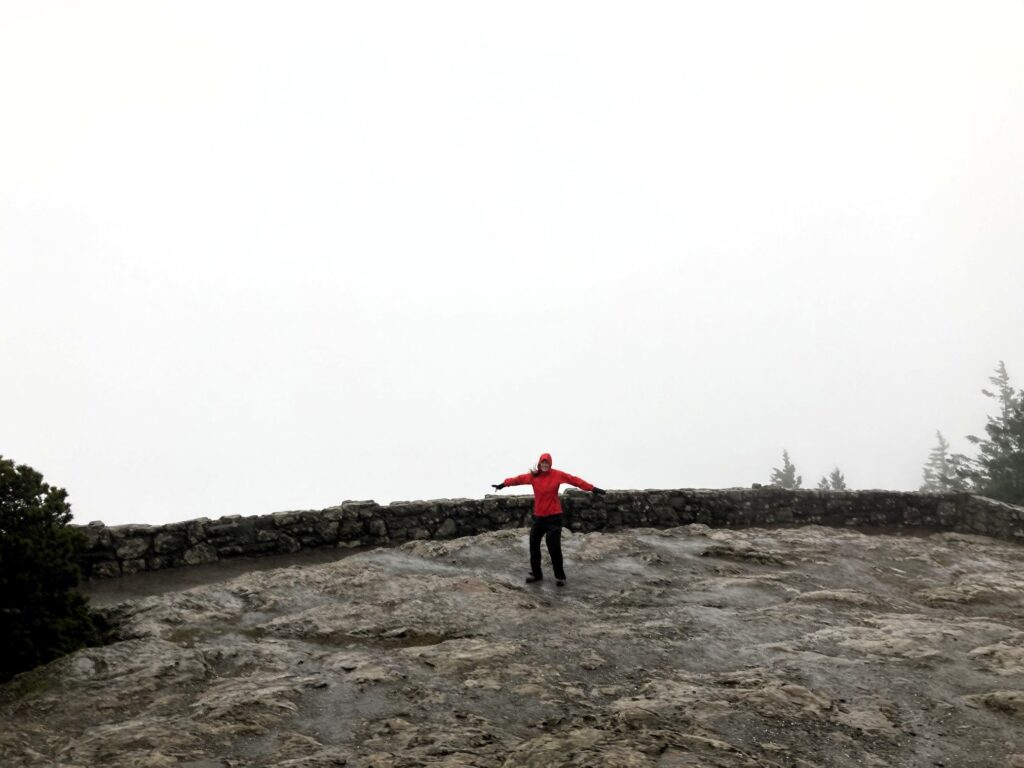
The author’s own Orcas trip was a January 2021 stay in a hotel, a trip up Mount Constitution, and hiking around the summit and along the coast. The summit that day stood in winter fog, in high wind, with no view. That trip’s hiking also took in the Turtleback Mountain Preserve, on the island’s west side, up to one of its lookouts over the islands. No campground night on the island stands behind this guide, and Moran’s record above is the agency’s, not a memory.
Obstruction Pass State Park
Quick facts: form, 9 primitive sites plus 1 Cascadia Marine Trail site, walk-in from the parking area; potable water, none, no running water in the agency’s own words; restrooms, 2 composting toilets; showers, none; campfires and firewood, fire pits, under the park’s posted burn level; check-in and check-out, 2:30 PM and 1:00 PM in the state system form; reservations, none, every site first-come; pets, leashed; dump station, none; quiet and generator hours, quiet 10:00 PM to 6:30 AM, generators 8:00 AM to 9:00 PM; site character, 76 acres at the island’s south end, one of the few public beaches on Orcas, 1.8 miles of trails, 3 moorage buoys; resupply, Eastsound at town level; emergency readiness, Island Primary Care clinic on Orcas, the hospital at Friday Harbor; pass and price, Discover Pass for day use, primitive sites in the $12 class.
Obstruction Pass State Park is the Orcas campground the roundup literature gets wrong, and its correction is part of its value. It is a Washington State Park, and none of its sites can be reserved. Listings that assign it to the county parks or take bookings for it are wrong on both counts. Its nine primitive sites stand at the island’s south end on one of the few public beaches Orcas has, reached on foot from the parking area. A party carries in every drop of its water, because the park has no running water at all.
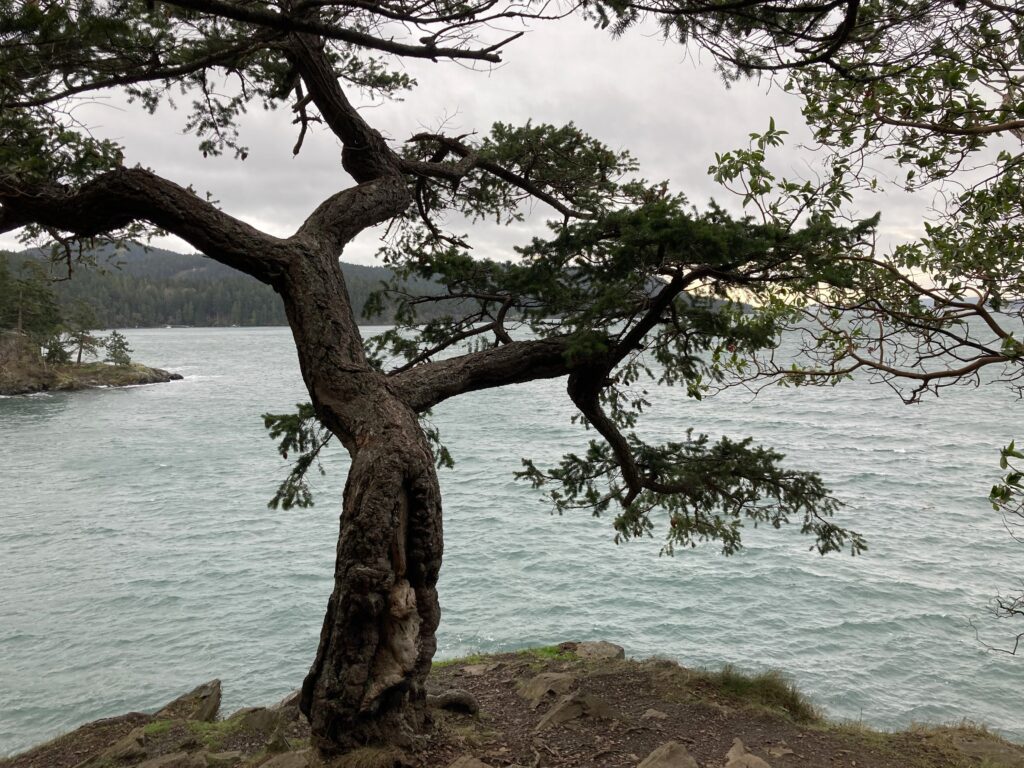
Its tenth site belongs to the Cascadia Marine Trail, so the park serves two arrivals at once. The driver walks in from the lot, and the paddler beaches below the sites. Its three moorage buoys stand offshore for the boaters between those two.
The author’s own Orcas trip reached this park too: he hiked Obstruction Pass on that winter trip, as a day hike. No night in its nine sites stands behind this guide, and the park’s record above is the agency’s, not a memory.
Point Doughty
Quick facts: form, a three-site camping area at a Department of Natural Resources natural area preserve, boat-in only; potable water, none; restrooms, a toilet; campfires and firewood, no settled rule, stated in the prose below; reservations, none, first-come; site character, an exposed point on Orcas’s north shore, reached by a steep and slippery path from the beach; resupply, Eastsound, by boat and road; emergency readiness, off the point to the Orcas clinic or Friday Harbor; price, no fee found in any source opened.
Point Doughty is the Department of Natural Resources layer’s seat inside the county, a small camping area on the point inside a natural area preserve. Legal access is by boat only; the overland approach crosses private land and is trespass. The preserve covers 57 acres of the point. The department’s February 2025 draft management plan for the preserve describes the three-site camping area near the point’s northwest corner.
No settled rule stands in either direction. A 2026 public comment record reports the department stating that no campfires are permitted and overnight camping is discouraged at the preserve. A party packs in its water, packs out everything it brings, and treats the camping as the preserve’s tolerated use rather than its purpose.
Sucia Island Marine State Park
Quick facts: form, 60 primitive sites first-come plus 4 reservable standard group camps, boat-in; potable water, early April to September only, none from October 1 to April 15; restrooms, restrooms on the island; showers, none; campfires and firewood, fires in designated pits, under the park’s posted burn level; check-in and check-out, 2:30 PM and 1:00 PM in the state system form; reservations, primitive sites first-come, group camps reservable; pets, leashed; quiet and generator hours, quiet 10:00 PM to 6:30 AM, generators 8:00 AM to 9:00 PM; site character, the marine class’s largest campground, spread across several bays, 48 moorage buoys and 2 docks with the second dock removed from October to April, about 6 miles of trails; resupply, seasonally at West Beach Resort on Orcas, full service at Blaine, Deer Harbor, Roche Harbor, and Friday Harbor; emergency readiness, no services on the island, Friday Harbor by boat; price, primitive sites in the $12 class, moorage $23 a buoy and $1 a vessel foot at docks.
Sucia Island Marine State Park is the marine class’s flagship, the largest boat-in campground in the islands. Its sixty primitive sites spread across several bays. Its water runs only from early April to September, so a shoulder-season party packs water the way it would at any other marine park. There is no garbage service; everything packs out.
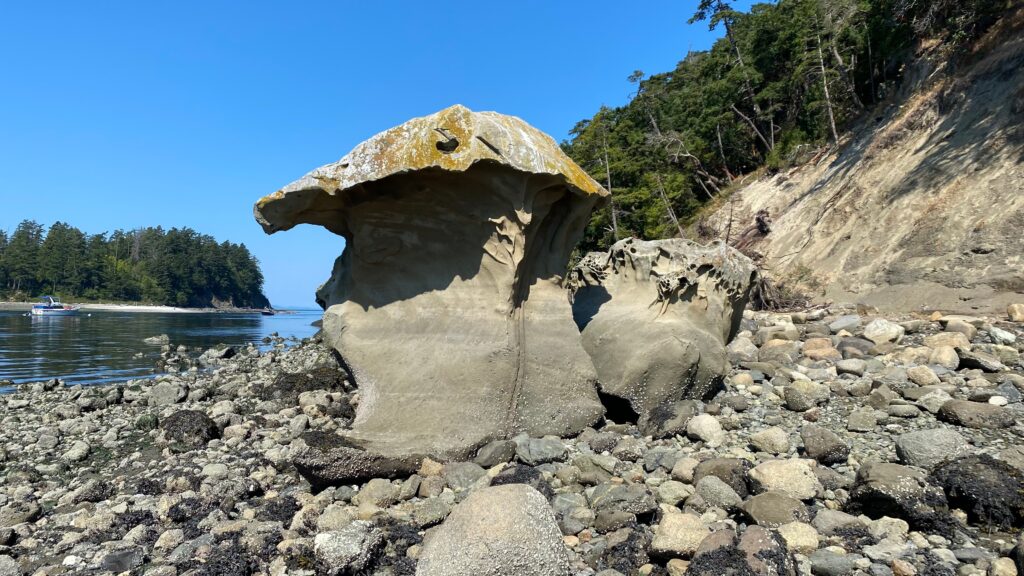
On summer weekends its buoys and docks fill with recreational boaters. Kayak arrivals, who can beach a boat, still find campsites ashore, which is the marine system’s working shape in miniature. One dated note rides with the entry. Construction on the Fossil Bay pumpout station runs from mid-November 2026, and a party counting on the pumpout checks the park page before it sails.
Patos Island Marine State Park
Quick facts: form, 7 primitive sites, first-come, boat-in; potable water, none; restrooms, 1 vault toilet; campfires and firewood, under the park’s posted burn level; reservations, none; pets, leashed; site character, the northernmost island in the group, 2 moorage buoys at Active Cove, a half-mile trail to the lighthouse; resupply, none on the island; emergency readiness, off-island; price, primitive sites in the $12 class.
Patos Island Marine State Park camps at Active Cove under the island’s lighthouse, the northernmost camping in the archipelago. Tours of the light station run most weekends from Memorial Day to Labor Day and book through the Sucia park phone, (360) 376-2073. The island stands inside the San Juan Islands National Monument, where camping is allowed only at designated campgrounds. Patos is one of the three, and its campground is the State Parks campground at the cove. The light station itself stands on Coast Guard land slated for transfer to the Bureau of Land Management under the Monument plan, which changes the lighthouse’s landlord, not the campground’s.
Matia Island Marine State Park
Quick facts: form, 6 sites, first-come, boat-in, at Rolfe Cove only; potable water, none, ever; restrooms, restrooms at Rolfe Cove; campfires and firewood, no fires at any time; reservations, none; pets, dogs not allowed; site character, a 128-foot dock and 2 moorage buoys at the cove, the rest of the island closed refuge wilderness; resupply, Gooseberry Point and seasonally West Beach Resort, per the agency; emergency readiness, off-island entirely; price, primitive sites in the $12 class.
Matia Island Marine State Park is a five-acre recreation area at Rolfe Cove on an island that is otherwise a closed National Wildlife Refuge. The U.S. Fish and Wildlife Service owns the island and State Parks manages the cove under an agreement dating to 1959. Its three nils are absolute: no potable water, no fires at any time, and no dogs. A party lands at the cove, camps in the cove, and leaves the rest of the island to the refuge.
On the agency’s own statement, its resupply line runs off the island entirely. It runs to Gooseberry Point at the Lummi ferry dock on the mainland, and seasonally to West Beach Resort on Orcas.
Clark Island Marine State Park
Quick facts: form, 15 sites, first-come, year-round, boat-in; potable water, none; restrooms, 1 composting toilet and 2 vault toilets; campfires and firewood, fires in designated areas; reservations, none; pets, dogs on leash; site character, 9 moorage buoys, 6 on the east side and 3 on the west, no vessels over 45 feet on buoys; resupply, nearest fuel and limited groceries at Blakely Island Marina, per the agency; emergency readiness, off-island; cell service, sporadically available, close to a cell tower on Orcas Island, carrier unspecified in the agency’s own note; price, primitive sites in the $12 class.
Clark Island Marine State Park is a year-round campground in the Orcas waters group, fifteen sites first-come in every month on a low island between Orcas and Lummi. It carries no water and no garbage service, and its agency page carries the marine class’s only cell statement, printed above in the agency’s own words. For a paddling route down the eastern chain, Clark is the reliable middle night, on the record’s terms: first-come, dry, and quiet. Because it stands open in every month, it is also a winter night on the chain, for the few parties paddling the islands in the cold season.
Doe Island Marine State Park
Quick facts: form, primitive sites with table and firepit, first-come, boat-in, 5 sites by an old directory’s count, the agency page gives no count; potable water, none; site character, 6 to 7 acres southeast of Orcas, a 60-foot dock on the north side removed for winter on a dated agency alert of October 21, 2026, no moorage buoys, a 0.3-mile loop trail; resupply, nearest fuel and limited groceries seasonally at Blakely Island Marina, per the agency; emergency readiness, off-island; price, primitive sites in the $12 class.
Doe Island Marine State Park is a pocket island off Orcas’s southeast shore. Its dock comes out for the winter, so a cold-season landing is a beach landing, and with no moorage buoys of its own, a boat party anchors out or beaches. Everything else about the island is the marine form at its plainest: a handful of primitive sites, no water, and nothing to buy. On a route down Orcas’s east side it is the small stop between the Orcas shore and Clark Island.
The Orcas Island campgrounds, in the guide’s one table form:
| Campground | Sites | Water | Reservations | Access |
|---|---|---|---|---|
| Moran State Park | 124 standard, plus 6 hiker and biker | Reliable in season | Reservable, state system | Ferry-served drive-in, Orcas landing |
| Obstruction Pass State Park | 9, plus 1 marine trail site | None, ever | First-come only | Ferry-served, walk-in from parking |
| Point Doughty | 3 | None, ever | First-come only | Boat-in only |
| Sucia Island Marine State Park | 60, plus 4 group camps | Seasonal, early April to September | First-come; group camps reservable | Boat-in, moorage buoys and docks |
| Patos Island Marine State Park | 7 | None, ever | First-come only | Boat-in, Active Cove |
| Matia Island Marine State Park | 6 | None, ever | First-come only | Boat-in, Rolfe Cove |
| Clark Island Marine State Park | 15 | None, ever | First-come only | Boat-in, moorage buoys |
| Doe Island Marine State Park | No agency count; 5 in older directories | None, ever | First-come only | Boat-in, 60-foot dock |
Lopez Island
The Lopez ferry landing sits at the island’s north end. Lopez is the flattest riding in the archipelago, which makes it the center of the walk-on and bicycle system. A camper who leaves the vehicle at Anacortes can reach both of its drive-in campgrounds by bike, and Odlin County Park stands one mile from the landing. Lopez Village, at town level for groceries and fuel, sits mid-island.
For water, both drive-in campgrounds carry drinking water in season, and the island’s one boat-in campground has none at any time. For booking, Spencer Spit reserves on the state system, Odlin reserves on the county system, and James Island is first-come. One ferry fact belongs to this island’s booking answer as much as to the booking section’s. No eastbound vehicle reservation exists from Lopez, so the return sailing is a queue, not a booking.
Spencer Spit State Park
Quick facts: form, 37 standard sites plus 16 hiker and biker sites and 3 Cascadia Marine Trail sites, drive-in; potable water, drinking water listed; restrooms, 2, plus a composting toilet; showers, none, in the agency’s own summary; campfires and firewood, under the park’s posted burn level; check-in and check-out, 2:30 PM and 1:00 PM, entry until 10:00 PM; reservations, standard sites reservable on the state system to nine months ahead, hiker and biker and marine trail sites first-come; pets, leashed; dump station, 1; quiet and generator hours, quiet 10:00 PM to 6:30 AM, generators 8:00 AM to 9:00 PM; site character, a sand spit enclosing a saltwater lagoon, private wooded sites and open beachside sites, 11 moorage buoys, about 2 miles of trails, no hookups; resupply, Lopez Village at town level, about 5 miles; emergency readiness, Lopez Island Medical Clinic, the hospital at Friday Harbor; pass and price, Discover Pass for day use, standard sites in the $31 to $43 peak class.
Spencer Spit State Park is Lopez’s demand leader, and its hiker and biker sites are the best-known walk-in capacity in the islands. The park wraps a sand spit around a saltwater lagoon, with wooded sites on the approach and open sites on the beach. A party chooses between shade and shore inside one campground.
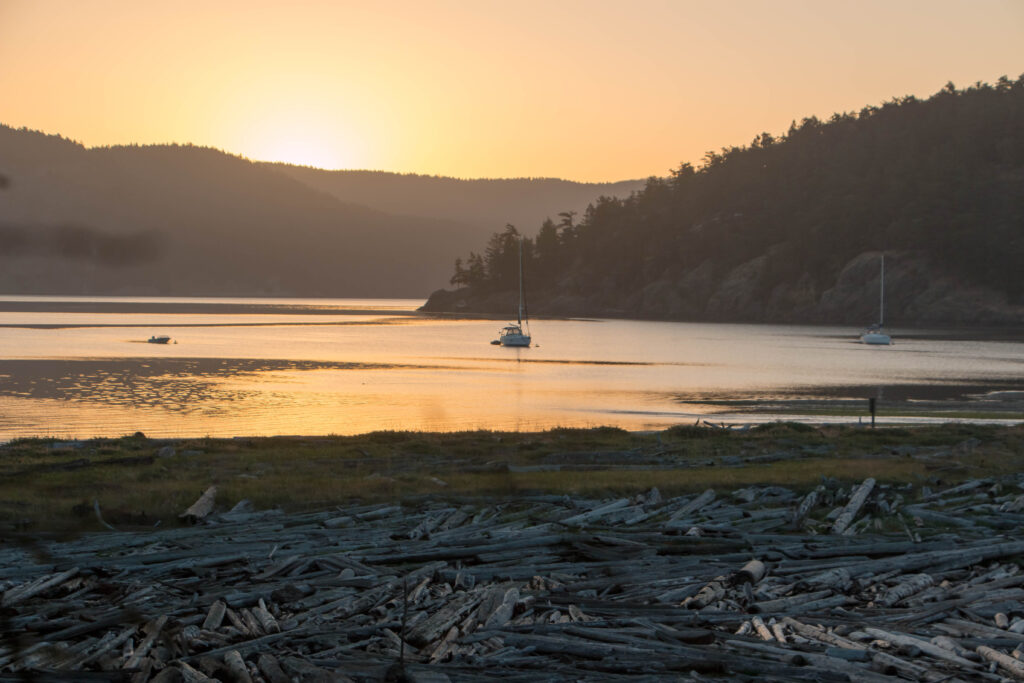
Its sixteen hiker and biker sites are the state system’s largest island set. They carry the most useful sentence in this guide’s booking research, from the park’s own notice dated May 26, 2026: the sites are first-come, and they reach capacity on weekends. Campers who arrive when the park is full may be directed to private camping on Lopez. No promise stands behind them, and a bicycle party plans on that basis.
Two group camps stand as named forms inside the park. Group camp G-1 holds three walk-in sites and an Adirondack shelter with eight bunks, for up to twenty-four people and three vehicles. Group camp G-3 holds a kitchen shelter with an electrical outlet, for up to twenty-four people, a trailer, six tents, and five vehicles. Both are reservable on the state system.
Odlin County Park
Quick facts: form, 35 campsites including 10 beach sites, plus a group camp of 8 sites, drive-in; potable water, in season, off in the county off-season; restrooms, restrooms; showers, none; campfires and firewood, fires in established fire pits only and out by 10:30 PM, no beach fires, firewood sold at the park; check-in and check-out, 2:00 PM and noon; reservations, reservable on the county system, unreserved sites first-come, a human-power safe haven on site; pets, leashed, no unattended dogs; dump station, none; quiet and generator hours, quiet 10:00 PM to 7:00 AM, generators 11:00 AM to 5:00 PM, at most one hour at a time with a two-hour break; site character, a Upright Channel shore campground one mile from the ferry landing; resupply, Lopez Village, 3 miles; emergency readiness, Lopez Island Medical Clinic, the hospital at Friday Harbor; pass and price, no Discover Pass and no day-use fee at county parks, five mooring buoys and a day-use dock.
Odlin County Park is the walk-on system’s landing on Lopez: one mile from the ferry, on the Upright Channel shore, with the island’s village three miles on. Its thirty-five sites include ten on the beach, and its group camp holds eight more.
For rigs, the county’s per-site limits govern and they are granular. Sites 5 and 9 take a single unit under 22 feet, or a trailer and vehicle to 30 feet combined. Sites 6 and 7 take under 20 feet in total. Sites 8A, 8B, and 10 take under 30 feet, and no RVs or trailers stand in sites 11 to 30 at all. Trailers under 10 feet may be hand-moved into named tent sites.
Hammock tents stand in designated sites only. A party with a rig reads its site’s limit in the reservation system before it books, because the island has no second county campground to fall back to. Its five mooring buoys and day-use dock make it the one Lopez county campground a boater can also reach by water. From November to March the park runs on the county’s off-season form, first-come and self-registered with no water. That makes it a different and quieter campground from the one the summer ferry crowds meet.
James Island Marine State Park
Quick facts: form, 13 primitive sites, first-come, boat-in, in three areas; potable water, none, on a dated agency notice of June 16, 2025; restrooms, pit and composting toilets by camping area; reservations, none; site character, East Cove sites 1 to 4, the Saddle sites 5 to 10, and West Cove sites 11 to 13 reserved for human and wind-powered arrivals as Cascadia Marine Trail sites, much of the island closed as a Natural Forest Area, a 128-foot dock at West Cove and 4 moorage buoys at East Cove; resupply, nearest fuel and groceries at Anacortes, per the agency; emergency readiness, off-island; price, primitive sites in the $12 class.
James Island Marine State Park stands off Decatur Island in the Lopez anchorage area, close enough to the Lopez shore to read as part of its waters. Its three camping areas split by cove and saddle, and the West Cove sites belong to the marine trail. Much of the island stands closed as a Natural Forest Area, so the camping areas and the shore are the visit; the interior is not. The agency’s resupply line points off the islands entirely, to Anacortes, which ties this campground to the gateway section. A James Island party provisions on the mainland or in Lopez Village before it crosses.
The Lopez Island campgrounds, in the guide’s one table form:
| Campground | Sites | Water | Reservations | Access |
|---|---|---|---|---|
| Spencer Spit State Park | 37 standard, 16 hiker and biker, 3 marine trail | Reliable in season | Reservable, state system | Ferry-served drive-in, Lopez landing |
| Odlin County Park | 35, plus an 8-site group camp | Seasonal, off in the county off-season | Reservable, county system | Ferry-served drive-in, Lopez landing |
| James Island Marine State Park | 13 | None, ever | First-come only | Boat-in, East and West Coves |
San Juan Island
Friday Harbor is the ferry system’s hub and the landing for this island’s campgrounds. It is also the county seat and the seat of the county’s only hospital, so every system this guide tracks runs through one town. For water, both county campgrounds carry it in season, the boat-in campgrounds stand in their own classes, and Jones Island carries its dated closure form. For booking, both county campgrounds book on the county system with its January windows. The marine campgrounds are first-come in their forms, apart from Jones Island’s reservable group camps and shelters, and Posey Island reserves in its season, for human-powered arrivals only.
San Juan County Park
Quick facts: form, 20 campsites plus a group campsite, plus the human-power safe haven, drive-in; potable water, at spigots in season, off in the county off-season; restrooms, flush toilets; showers, none; campfires and firewood, fires in established fire pits only and out by 10:30 PM, no beach fires, firewood sold at the park; check-in and check-out, 2:00 PM and noon; reservations, reservable on the county system, unreserved sites first-come; pets, leashed, no unattended dogs; dump station, none; quiet and generator hours, quiet 10:00 PM to 7:00 AM, generators 11:00 AM to 5:00 PM, at most one hour at a time with a two-hour break; site character, about 12 acres of Haro Strait shoreline, most sites with water views over a meadow, small RVs and camper vans in designated sites only, hammock tents banned; resupply, Friday Harbor, about 10 miles; emergency readiness, Peace Island Medical Center, Friday Harbor; pass and price, no Discover Pass and no day-use fee at county parks, overnight vehicle parking for kayakers and boaters $20 a night, Cascadia Marine Trail designated.
San Juan County Park is the head island’s demand leader, a small park on the island’s west side. Its meadow runs down to the Haro Strait shore, the islands’ orca water. Most of its twenty sites look over the water. The park carries a day-use area and beach access, as every county park does, and the day-use shore faces the same stretch of Haro Strait the campsites overlook.
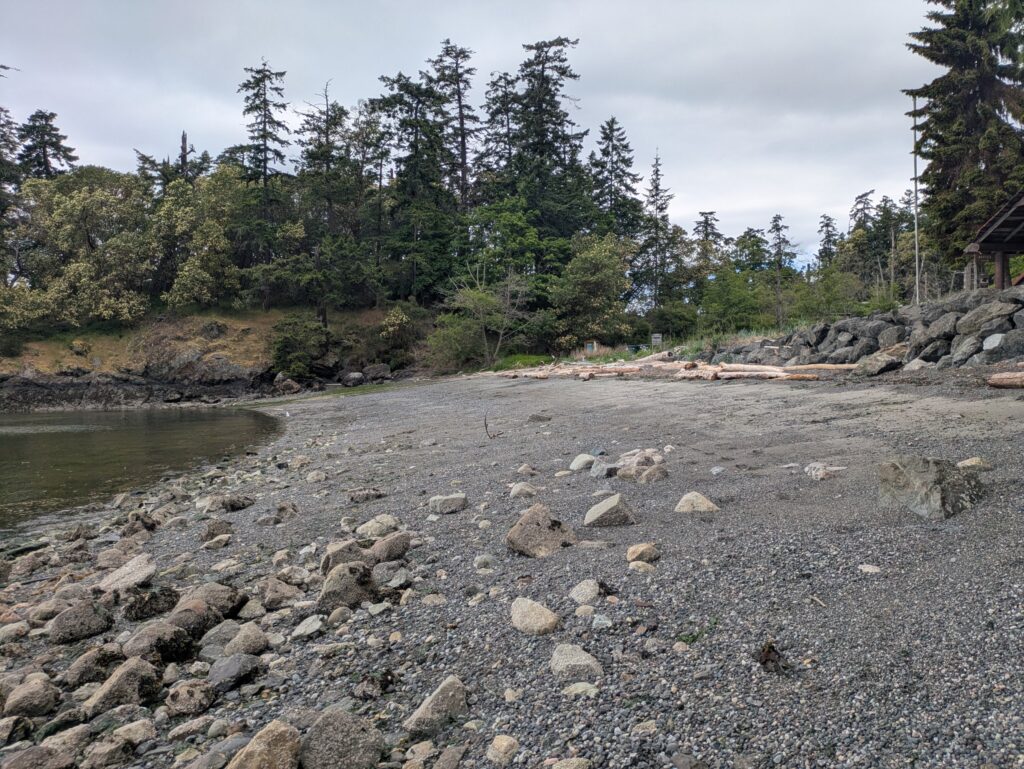
It is a tent and small-rig park. Small RVs and camper vans stand in designated sites only. The reservation system carries per-site length limits (single units to 25 feet in sites 6, 7, 10, and 15), and hammock tents are banned outright. The county’s water rationing rules apply here as at every county park: no filling RV tanks, no vehicle or boat washing.
The park’s human-power safe haven stands here in the county’s own form. The county sets aside limited space for campers who arrive by bicycle, kayak, or on foot with no vehicle in the park. The space can fill. The county does not guarantee it, and it does not serve groups or commercial tour companies.
A kayaker who launches from the park’s shore, or leaves a vehicle in its overnight parking, is using the park the way its marine trail designation intends. A kayaker counting on the safe haven as a reservation is misreading it. The park is a designated Cascadia Marine Trail campsite, and its beach is a working landing for the paddling routes that run the Haro Strait shore.
San Juan County Fairgrounds RV sites
Quick facts: form, 8 RV sites with power and water hookups at 35 and 45 foot lengths, no tent camping; potable water, hookups at the sites; restrooms, seasonal restroom and shower access; showers, seasonal, the county system’s only shower exception; check-in and check-out, 2:00 PM and noon in the county form; reservations, reservable on the county system, stays to ten days within a thirty-day period, not available during County Fair week in mid-August; pets, leashed in the county form; quiet and generator hours, quiet 10:00 PM to 7:00 AM in the county form; site character, a fairgrounds utility row in Friday Harbor; resupply, Friday Harbor, on foot; emergency readiness, Peace Island Medical Center, walking distance.
San Juan County Fairgrounds RV sites are what their name says: a utility row at the county fairgrounds, eight RV sites with hookups, and no tent camping in any form. Their value is exact. They are the only public hookups on San Juan Island, they stand walking distance from Friday Harbor’s groceries, fuel, and hospital, and they take rigs the county parks cannot. The sites stand empty of their purpose for one week a year, County Fair week in mid-August, when they are not available at all. A party that needs power and water on this island books here or books private; there is no third public option.
Jones Island Marine State Park
Quick facts: form, primitive sites first-come, 24 by the directory’s count, plus reservable group camps and Adirondack shelters, boat-in; potable water, May to September in a normal year, closed until further notice on the agency notice stated below; restrooms, restrooms on the island; campfires and firewood, fires in designated areas, under the park’s posted burn level; reservations, primitive sites first-come, the west-side Cascadia Marine Trail sites reservable to human-powered arrivals, group camps and Adirondack shelters reservable; pets, leashed; site character, 7 moorage buoys, a 128-foot dock at North Cove removed from early October to early April, 4 miles of trails including an ADA trail; resupply, none on the island, Friday Harbor by boat; emergency readiness, Friday Harbor by boat; price, primitive sites in the $12 class.
Jones Island Marine State Park stands between Orcas and San Juan Island, reached by boat from Friday Harbor. The island’s drinking water runs May to September in a normal year. An agency Water Closure notice dated June 26, 2026 states that drinking water is not available until further notice, because of a leak. A party checks the park page before it counts on the water, and packs water in until the notice lifts.
The west-side Cascadia Marine Trail sites carry the agency’s own wording making them reservable to human-powered arrivals, where the marine trail’s default form elsewhere is first-come. The park-specific wording governs at this park. The island’s group camps and Adirondack shelters reserve on the state system. That gives a paddling group or a scout party a bookable form of the island the first-come sites do not.
Stuart Island Marine State Park
Quick facts: form, 14 primitive sites plus 4 marine trail sites, all first-come, boat-in; potable water, May to September, none from October 1 to April 15; restrooms, composting toilets at both docks; reservations, none; site character, two harbors, Reid and Prevost, 20 moorage buoys, 13 at Reid Harbor and 7 at Prevost, and 448 feet of dock in total, a pumpout at Reid Harbor; resupply, none on the island, Roche Harbor and Friday Harbor by boat; emergency readiness, off-island; price, primitive sites in the $12 class.
Stuart Island Marine State Park is the far side of the San Juan waters group, a two-harbor park at the archipelago’s northwest edge. Its four marine trail sites, numbered 15 to 18 at the head of Reid Harbor, are reserved for human and wind-powered arrivals. Reid Harbor holds the dock, the pumpout, and the marine trail sites. Prevost Harbor holds the quieter half of the moorage, and a party chooses its harbor the way it chooses a campsite, by what it needs within reach.
Two dated notes ride with the entry. Construction on the Reid Harbor dock runs from October 13, 2026 to February 2027, and the Reid Harbor pumpout stood closed from October 14 to November 23, 2026. A winter party reads both as dated facts and checks the park page for the current state.
Turn Island Marine State Park
Quick facts: form, primitive sites first-come all year, 12 by the directory’s count, boat-in; potable water, none; restrooms, restrooms on the island; campfires and firewood, no fires at any time; reservations, none; pets, dogs not allowed; site character, U.S. Fish and Wildlife Service land inside the National Wildlife Refuge, managed by State Parks, 2 moorage buoys, best small-boat access from Jackson Beach on San Juan Island; resupply, Friday Harbor, about a mile by water; emergency readiness, Friday Harbor, minutes by boat in good conditions; price, primitive and water trail sites in the $12 class.
Turn Island Marine State Park is the closest boat-in camping to Friday Harbor, a mile off the town, and one of the strictest sets of rules in the roster. The island is federal refuge land, and its three nils are standing rules, not seasonal states: no water on the island, no fires at any time, and no dogs. A party that treats Turn as a convenient overflow for a full Friday Harbor weekend without reading those three lines will have a short trip. The practical route in is a small boat from Jackson Beach, the agency’s named access. The crossing is short enough that a party can time it to the weather rather than endure it.
Posey Island Marine State Park
Quick facts: form, 2 primitive group campsites, Cascadia Marine Trail only, motorized visitors day use only, boat-in; potable water, none; restrooms, 1 composting toilet; reservations, reservable from May 15 to September 30 for human-powered arrivals, first-come the rest of the year and on unreserved nights, on the caps stated below; pets, dogs on leash; site character, one acre north of Pearl Island near Roche Harbor, Bureau of Land Management land leased to State Parks since 1960, administered through Lime Kiln Point State Park; resupply, Roche Harbor, by boat; emergency readiness, Friday Harbor, by boat; price, water trail sites in the $12 class.
Posey Island Marine State Park is the marine class’s one wholly reservable human-powered campground, two group campsites on a one-acre island. The whole campground reserves, which is what sets it apart from Jones Island, where only the west-side trail sites reserve and the primitive sites run first-come. Its reservation caps are the tightest in the guide. Friday and Saturday nights take one site and one night per reservation, with five such reservations a month in total. Sunday to Thursday nights take one site and up to two nights, with six reservations a month.
The island is a designated campground inside the National Monument, one of the three where Monument camping is allowed. The island’s stated maximum is sixteen people at once. Administration runs through Lime Kiln Point State Park, (360) 378-2044.
The San Juan Island campgrounds, in the guide’s one table form:
| Campground | Sites | Water | Reservations | Access |
|---|---|---|---|---|
| San Juan County Park | 20, plus a group campsite | Seasonal, off in the county off-season | Reservable, county system | Ferry-served drive-in, Friday Harbor |
| San Juan County Fairgrounds RV sites | 8 RV sites | Hookups at the sites | Reservable, county system | Ferry-served drive-in, Friday Harbor |
| Jones Island Marine State Park | 24 | May to September in a normal year; closed until further notice on a June 26, 2026 agency notice | First-come; group camps and shelters reservable | Boat-in, North Cove |
| Stuart Island Marine State Park | 14, plus 4 marine trail sites | Seasonal, May to September | First-come only | Boat-in, Reid and Prevost Harbors |
| Turn Island Marine State Park | 12 | None, ever | First-come only | Boat-in, from Jackson Beach |
| Posey Island Marine State Park | 2 group campsites | None, ever | Reservable May 15 to September 30, marine trail arrivals only | Boat-in, human-powered only |
Shaw Island
Shaw is the self-sufficiency island, and its three answers all run through that fact. The ferry landing holds the Shaw General Store, the island’s only store. There is no fuel and there are no restaurants, and the county campground stands about two miles from the landing at Indian Cove. Its drinking water runs from April 1 through October 31 and is off the rest of the year.
It books on the county system like the other county parks. There are no showers anywhere on the island, at the campground or anywhere else, so a Shaw party arrives provisioned, filled, and washed on its own schedule. The return sailing takes no vehicle reservation from Shaw, so the trip home is a queue at the landing rather than a booking. A Shaw party plans its last day around that.
Shaw Island County Park
Quick facts: form, 12 wooded water-view campsites on 60 acres at Indian Cove, drive-in; potable water, drinking water from April 1 through October 31; restrooms, vault toilets; showers, none, and no public showers anywhere on the island; campfires and firewood, fires in established fire pits only and out by 10:30 PM, no beach fires, firewood sold at the park; check-in and check-out, 2:00 PM and noon; reservations, reservable on the county system, unreserved sites first-come, a human-power safe haven on site, site 12 a Cascadia Marine Trail site; pets, leashed, no unattended dogs; dump station, none; quiet and generator hours, quiet 10:00 PM to 7:00 AM, generators 11:00 AM to 5:00 PM, at most one hour at a time with a two-hour break; site character, wooded sites over the water at Indian Cove, about two miles from the ferry landing, a boat launch and a picnic shelter; resupply, the Shaw General Store at the ferry landing, the island’s only store; emergency readiness, no clinic or hospital on Shaw, care off-island by ferry or air; pass and price, no Discover Pass and no day-use fee at county parks, overnight vehicle parking for kayakers and boaters $10 a night.
Shaw Island County Park asks more of a camper before arrival than any other campground in this guide, and it gives back the archipelago’s quietest county camping. The store at the landing is the whole of the island’s retail: no fuel, no restaurant, no second shop to catch what a party forgot. RVs and trailers are not advisable here and nothing on the island supports them.
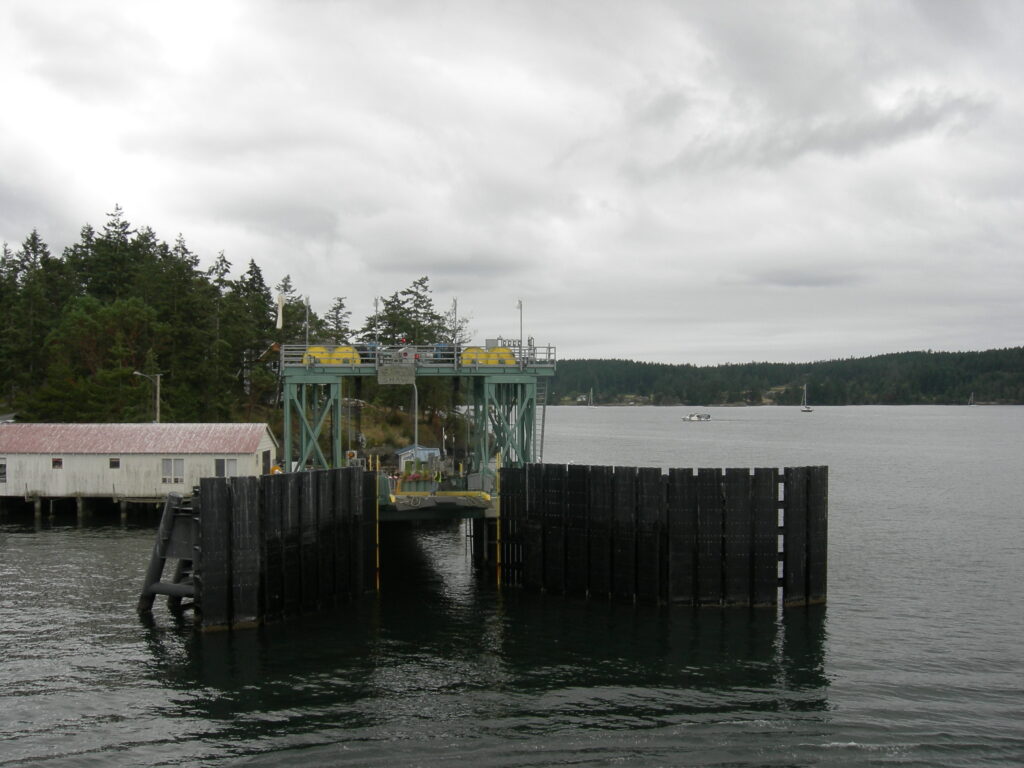
A party that provisions in Anacortes or Friday Harbor, and fills its water containers against the off-season, is the party this campground serves. It comes for the quiet itself. In the county off-season the park runs first-come with its water off. A winter party treats it the way it treats a marine park: everything carried in, everything carried out.
Blind Island Marine State Park
Quick facts: form, 4 primitive Cascadia Marine Trail sites, first-come, restricted to human and wind-powered arrivals, motorized arrivals day use only, boat-in; potable water, none; restrooms, 1 composting toilet; site character, about 3 acres at the entrance to Blind Bay, 4 moorage buoys, co-managed with the Bureau of Land Management; resupply, the Shaw General Store at the Shaw landing, by water; emergency readiness, off-island; price, water trail sites in the $12 class.
Blind Island Marine State Park is a paddlers’ campground in the strictest form: four marine trail sites, no water, and no camping at all for anyone who arrives under power. It is one of the three designated campgrounds inside the National Monument, and it is co-managed with the Bureau of Land Management, whose land it stands on. A motorized boater may land for the day and no longer; the night belongs to arrivals under human or wind power. For a kayak route working the Shaw and Lopez shores, Blind is the small, certain night in the middle of it.
The Shaw Island campgrounds, in the guide’s one table form:
| Campground | Sites | Water | Reservations | Access |
|---|---|---|---|---|
| Shaw Island County Park | 12 | Seasonal, April 1 to October 31 | Reservable, county system | Ferry-served drive-in, Shaw landing |
| Blind Island Marine State Park | 4 | None, ever | First-come only | Boat-in, human-powered only, Blind Bay |
The mainland gateway: Washington Park and Cypress Island
This section is mainland: the trip to the islands starts in Anacortes, and the campgrounds here serve the sailing, not the islands. Washington Park stands minutes from the ferry terminal, and the Anacortes launch is the departure for the two Cypress Island campgrounds across the water. Washington Park’s water stands at its hookup sites in season; Cypress Island has no water at all. Washington Park books on a fourteen-day minimum advance rule; the Cypress campgrounds take no reservations and charge no fee in any source opened.
The county changes at this section’s line, so the fire and alert pair changes with it. Skagit County burn restrictions run through the Skagit County Fire Marshal, and Skagit County emergency alerts run through Skagit Ready.
Washington Park
Quick facts: form, 68 campsites for RVs and tents, 43 reservable and 25 first-come, drive-in, mainland; potable water, 46 sites with water and electric hookups; restrooms, a restroom with showers; showers, in the restroom; reservations, at least 14 days in advance, inside fourteen days every site is first-come; site character, a 220-acre city park at 6300 Sunset Avenue in Anacortes, minutes from the ferry terminal, a reservable group tenting site for about 30 people and 8 tents with no electricity; resupply, Anacortes, in full; emergency readiness, Island Health, the hospital in Anacortes; pass and price, utility sites $39 a night for nonresidents and $29 for city residents, non-utility sites $31 and $26, the group camp $138, hiker and biker sites $16, on the city’s 2026 price list; no day-use entry or parking fee and no Discover Pass, open year-round.
Washington Park is the campground at the ferry terminal town, and its function is the sailing schedule. It is the night before an early sailing, and the night a missed sailing strands a party on the mainland. It is also the base for the leave-the-vehicle pattern, where a camper parks, walks onto the ferry, and camps the islands on foot or by bike. Of its twenty-five first-come sites, nineteen carry hookups and six do not.
The city’s 2026 price list puts a utility site at $39 a night for a nonresident and $29 for a city resident. A non-utility site stands at $31 and $26, the group camp at $138, and a hiker and biker site at $16. A city resident pays the posted rate at the pay station and claims the difference back by mail, on proof of residency at City Hall.
A recorded information line, (360) 293-1927, updates campsite and boat trailer availability three times a day in season. It makes this the one campground in this guide whose fullness a party can check before it drives.
Cancellations run through the Parks office, on the city’s terms. Cancel at least twenty-four hours ahead and the refund carries a $10 fee, plus $5 a night for the second and later nights of a multi-night booking. A no-show refunds nothing. The park stands open year-round, and its winter form is the ferry system’s own: a quiet mainland campground a short walk from a terminal that never fully sleeps.
Pelican Beach
Pelican Beach stands in this gateway section because its trip function is the Anacortes launch. The paddling routes that use the marine parks use Cypress Island too, and Pelican Beach is one of the two closest free boat-in campgrounds to that launch. It is a Department of Natural Resources campground on the island’s northeast shore, boat-in only and first-come. It carries no fee in any source opened, and no water or anything to buy on the island.
The paddling literature treats both Cypress campgrounds as stops on the Cascadia Marine Trail, which is their working role. They are mainland-side nights on a route that otherwise runs on state parks land. About a half dozen shoreline sites stand with tables and fire rings, with ADA-compliant composting toilets and mooring buoys offshore. The Eagle Cliff trail climbs from the water’s edge, and it closes from February 1 to July 15 for nesting eagles.
Cypress Head
Cypress Head is the Cypress pair’s second campground, on the same terms as its partner: boat-in only, first-come, no fee in any source opened, and no water. A party lands with every drop it will use. Its sites split between the beachfront and the woods behind it, with composting toilets, and the island’s roughly twenty miles of trails run from both campgrounds.
Both campgrounds stand inside the island’s natural resources conservation area, which is the frame that explains the pair. Trails and campsites run across a whole island, and no services stand on any of it. Between them, the pair gives a paddling route a free mainland-side night at either end of a Cypress stop.
The mainland gateway campgrounds, in the guide’s one table form:
| Campground | Sites | Water | Reservations | Access |
|---|---|---|---|---|
| Washington Park | 68 | Hookups at 46 sites | 43 sites reservable 14 or more days ahead; 25 first-come | Drive-in, mainland |
| Pelican Beach | About a half dozen | None, ever | First-come only | Boat-in, from the Anacortes launch |
| Cypress Head | No settled count | None, ever | First-come only | Boat-in, from the Anacortes launch |
Fire restrictions and emergencies
Fire rules in the islands stack in four layers. At county parks, fires stand in established fire pits only, out by 10:30 PM, never on the beach, and gathering firewood is prohibited; the county sells firewood at its parks.
Over the county stands the fire marshal framework. Burn permits run from early October to May 31 and are issued by the island fire districts jointly. The districts are Orcas Island Fire and Rescue, San Juan Island Fire and Rescue, Lopez Island Fire and EMS, and the Shaw Island Fire Department.
No permits issue from July to September, when all outdoor burning is closed except campfires. Recreational campfires are allowed year-round without a permit except when a county burn ban is in effect. Fireworks are banned county-wide year-round, and burn barrels are prohibited. San Juan Island Fire and Rescue maintains a live Fire Safety status panel, and parks may suspend all burning, gas grills included, in high-risk conditions.
At state parks, each park posts its own burn level, dated as it changes. Spencer Spit stood at Level 2 on July 23, 2026, which is the form a summer party reads on arrival rather than a standing fact about the park. Two parks in this guide stand outside the level system entirely: Turn Island and Matia allow no fires at any time. Inside the National Monument, the fire rules of the managing campground carry the layer. Check the County Fire Marshal page and the district status pages before any fire, because a county ban overrides every layer below it.
Firewood follows one settled rule: buy it near where you burn it, with wood sourced within ten miles the best practice. Untreated firewood from outside Washington is barred by the state firewood quarantine in effect since August 18, 2026. No San Juan-specific firewood rule exists. On these islands the rule and the practice meet, because both public systems sell wood on-island. The county sells at its parks, and Moran sells from vending machines stocked with locally sourced wood.
Emergency care in the county runs through one hospital: PeaceHealth Peace Island Medical Center in Friday Harbor, with a 24-hour emergency department. Air transport partnerships, with San Juan Island EMS’s Island Air Ambulance and Airlift Northwest, carry the cases that need the mainland. Clinic care stands on two islands: Island Primary Care on Orcas and the Lopez Island Medical Clinic, operated by Sea Mar since June 26, 2026. Shaw has no clinic or hospital. At the ferry’s mainland end, Island Health is the hospital in Anacortes.
County emergency alerts run through the county’s Everbridge system, with signup through SJCounty911.net. For a boat-in party, all of this sits at the end of a crossing, which is the fact to plan around. The marine campgrounds are hours from Friday Harbor on a slow night, and the crossing is part of the emergency plan, not an afterthought to it.
Private campgrounds and the overflow layer
The private campgrounds hold what the public system does not: the hookups, the showers, and the overflow capacity. On Orcas, Doe Bay Resort and Retreat takes drive-in and walk-in campers alongside its cabins, yurts, and domes, with soaking tubs, a sauna, a cafe, and a store. West Beach Resort takes tent sites and RV sites with power and water hookups, with tent cabins, cabins, a store, and a marina. State Parks names West Beach as the seasonal fuel and grocery source for Sucia and Matia; Mount Baker Farm takes tent campers.
On San Juan Island, Lakedale Resort takes campsites including RV sites with electric and water hookups, with glamping canvas cabins, yurts, showers, and a lodge. Snug Harbor Resort at Mitchell Bay runs cabins, suites, and a marina, and secondary sources describe year-round camping and RV sites for smaller rigs there. A working horse farm on the island takes informal farm campers, the layer a late-booking party actually lands in when the public campgrounds fill. On Lopez, the Lopez Islander Resort holds some electric hookup sites, and Lopez Farm Cottages takes tent campers.
None of this layer’s figures print here. Its role is structural, and it is real enough that the state parks’ own Spencer Spit notice names private Lopez camping as its overflow. The layer books on its own terms, outside both public systems, which is exactly why it absorbs the campers those systems turn away.
Frequently asked questions
Do you need two reservations to camp in the San Juan Islands?
For a vehicle trip, yes. The campsite and the ferry vehicle space are separate reservations on separate systems, neither one holds the other, and missing either one ends the trip. The booking section above lays both systems out as one sequenced problem.
When do San Juan County Parks reservations open?
For 2027, county residents book from January 6 to January 8, 2027, and the public opening is January 13, 2027, at 9:00 AM, through the county’s reservation portal. Resident reservations are non-transferable, and residents show local identification at the campground. Summer reservations are strongly recommended, and any site left unreserved is first-come.
When do ferry vehicle reservations open?
In three tiers. Two months before the season, at 10:00 AM, 30 percent of standard spaces and 90 percent of tall and non-standard spaces release, through a virtual waiting room. Two weeks before each sailing, at 7:00 AM, the next 30 percent of standard spaces releases. Two days before each sailing, at 7:00 AM, the last 30 percent releases, with 10 percent of standard space held for emergency and standby vehicles.
Can you camp in the San Juan Islands without a car?
Yes, and it removes the ferry reservation problem entirely. Walk-on passengers and bicycles need no vehicle reservation, and walk-on travel between the islands is free once the westbound fare is paid. Both public systems hold sites for human-powered arrivals. The county’s safe haven is expressly not guaranteed, and the state parks’ first-come hiker and biker sites are known to fill on weekends. Lopez is the system’s center, the flattest riding in the archipelago, with Odlin one mile from its landing and Spencer Spit’s sixteen hiker and biker sites beyond it.
Which San Juan Islands campgrounds have hookups?
None of the county park campgrounds and none of the island state parks. The San Juan County Fairgrounds’ eight RV sites are the public exception on San Juan Island, and the private resorts hold the rest. Washington Park in Anacortes holds 46 water and electric sites at the gateway.
Is there drinking water at the island campgrounds?
It depends on the campground and the month. Moran and Spencer Spit carry water reliably in season. The roster then sorts into water seasonally, off in winter on its own window, and no water ever. The no-water class covers Obstruction Pass, Turn Island, and most of the marine parks, and Jones Island’s water stands closed until further notice on a dated agency notice. The safe plan at any boat-in campground is to pack all water in.
Can you have a campfire at island campgrounds?
At county parks, in established fire pits only, out by 10:30 PM, and never on the beach. At state parks, under the park’s posted burn level. At Turn Island and Matia, never, under standing rules. A county burn ban overrides everything when one is in effect.
Are dogs allowed at San Juan Islands campgrounds?
Leashed dogs are welcome at most campgrounds in this guide, with two hard exceptions: Turn Island and Matia do not allow dogs at all, under their refuge rules. Both entries state it in their own lines.
Is there dispersed camping in the San Juan Islands?
No. No public system in the archipelago offers dispersed camping. Inside the San Juan Islands National Monument, camping is allowed only at the designated campgrounds on Blind, Posey, and Patos islands, which this guide rosters as state parks campgrounds.
What if every island campground is full?
Work the valves in order. The first-come forms stand open: the marine parks, Obstruction Pass, and the county parks in their off-season. The private resorts and farm stays named above take the overflow the public system cannot, and Spencer Spit’s own park notice names private Lopez camping as its overflow. Washington Park at the gateway holds a party for the night before a retry.
Sources
San Juan County Parks, the Camping Information, Tent Camping, Campground Rules, and FAQ pages, the county park page for Shaw Island County Park, and the county’s PerfectMind reservation portal, for the county system’s windows, terms, rules, and per-park records. Washington State Parks, the camping, fees, Park Rules, and Winter Schedule pages and the park pages for Moran, Spencer Spit, Obstruction Pass, Sucia, Patos, Matia, Clark, James, Jones, Stuart, Turn, Posey, Blind, and Doe Island, for the state system’s forms and each campground’s record. Washington State Ferries, the Vehicle Reservations page and the state ferry tariff, for the release tiers, the tollbooth and no-show terms, and the fare structure.
Washington Department of Natural Resources, the Point Doughty Natural Area Preserve and Cypress Island pages and the preserve’s February 2025 draft management plan, for the DNR campgrounds. Bureau of Land Management, the San Juan Islands National Monument pages and the Monument’s approved Resource Management Plan, for the designated-site camping rule. City of Anacortes, the Washington Park pages, the park’s 2026 price list, and the park policy document, for the gateway campground’s mechanics and fees.
San Juan County Fire Marshal and the island fire districts, with San Juan Island Fire and Rescue’s live Fire Safety panel, for the fire framework; the San Juan County Office of Emergency Management and SJCounty911.net, for the Everbridge alert system; the Skagit County Fire Marshal and Skagit Ready, for the gateway section’s pair. PeaceHealth, for Peace Island Medical Center; San Juan County’s Community Health Network mapping, for the clinic layer. Washington State Parks firewood guidance and the state firewood quarantine, chapter 16-476 WAC, for the firewood rule. Washington Trails Association, the Sucia Island page, for the trail figures. U.S. Fish and Wildlife Service, for the Turn Island and Matia Island refuge layer.