Should you lock your tent?
You can lock a tent, and sometimes you should. Just be clear about what the lock buys you. A lock through the zipper pulls stops the camper who unzips the wrong tent in the dark, and it sends a casual snooper on to an easier target. Against anyone willing to cut the fabric it does nothing at all, and every honest answer on this subject starts with that limit stated plainly.
Think of the people who might open your tent in three groups. The first is the mistaken entrant, the festival camper who unzips the wrong door at 3 in the morning, and a joined zipper ends that encounter before it starts. The second is the casual opportunist, who tries a zipper because it is there and gives up the moment it resists. The third is the determined thief, for whom the lock is a few seconds of work: a sharp point pushed through the closed zipper coil parts it without touching the lock at all, and a knife through the wall takes seconds. A lock is a deterrent, not an impenetrable force field, and it earns its keep entirely against the first two groups.
That limit is why a school of experienced campers argues against locking at all. Their case runs that a visible padlock advertises a tent worth robbing, signals that its owners are away, and protects nothing the fabric cannot. Their answer is to carry valuables on your person and keep nothing in the tent worth cutting for.
This guide’s position sits between the two schools. Lock for the sleeper’s problems, the mistaken entrant, a wandering child, an animal at the zipper, and plain privacy. Handle valuables as though the lock were not there.
What follows is the method first, from inside and from outside, because it is the part you can act on tonight. One safety rule governs everything fastened from inside, and it is stated before any method, because two of the methods below fail it and the guide says so where they stand. Then come alarms, the festival and family cases that drive most of the questions on this subject, the animal answer, and the campsite layer that does more work than any lock on this page.
The one rule for anything fastened from inside
A fire can destroy a tent in about 60 seconds. Fire and rescue services state that figure in plain words, and their standing advice is to have an escape plan and be ready to cut your way out. Against that figure, every fastening used from inside a tent is judged by one rule in this guide: it must release in one motion, in the dark, by a half-awake person, with no key, no combination, and no fine work for cold fingers.
Here is how the fastenings sort under it. A shoelace tied in a bow passes, because one pull frees it. A bread tie passes, because a twist undoes it. A bungee passes, because it lifts off.
A combination dialed by feel at 3 in the morning fails, and a key fails further. Where a method fails the rule, its honest use is from outside, on a tent you have left, or on gear, and it is taught in the outside section below, each method saying so where it stands rather than leaving the condition buried in one section.
How to lock a tent from the inside
Every method in this section does the same mechanical job. It joins the two zipper pulls of the door so the zipper cannot be drawn open in the ordinary way. Tent windows with two pulls join the same way. The methods assume a door whose two pulls meet, with holes a fastening can pass through, which is the common tent door. The methods differ in what they cost, what they defeat, and how they score against the rule above.
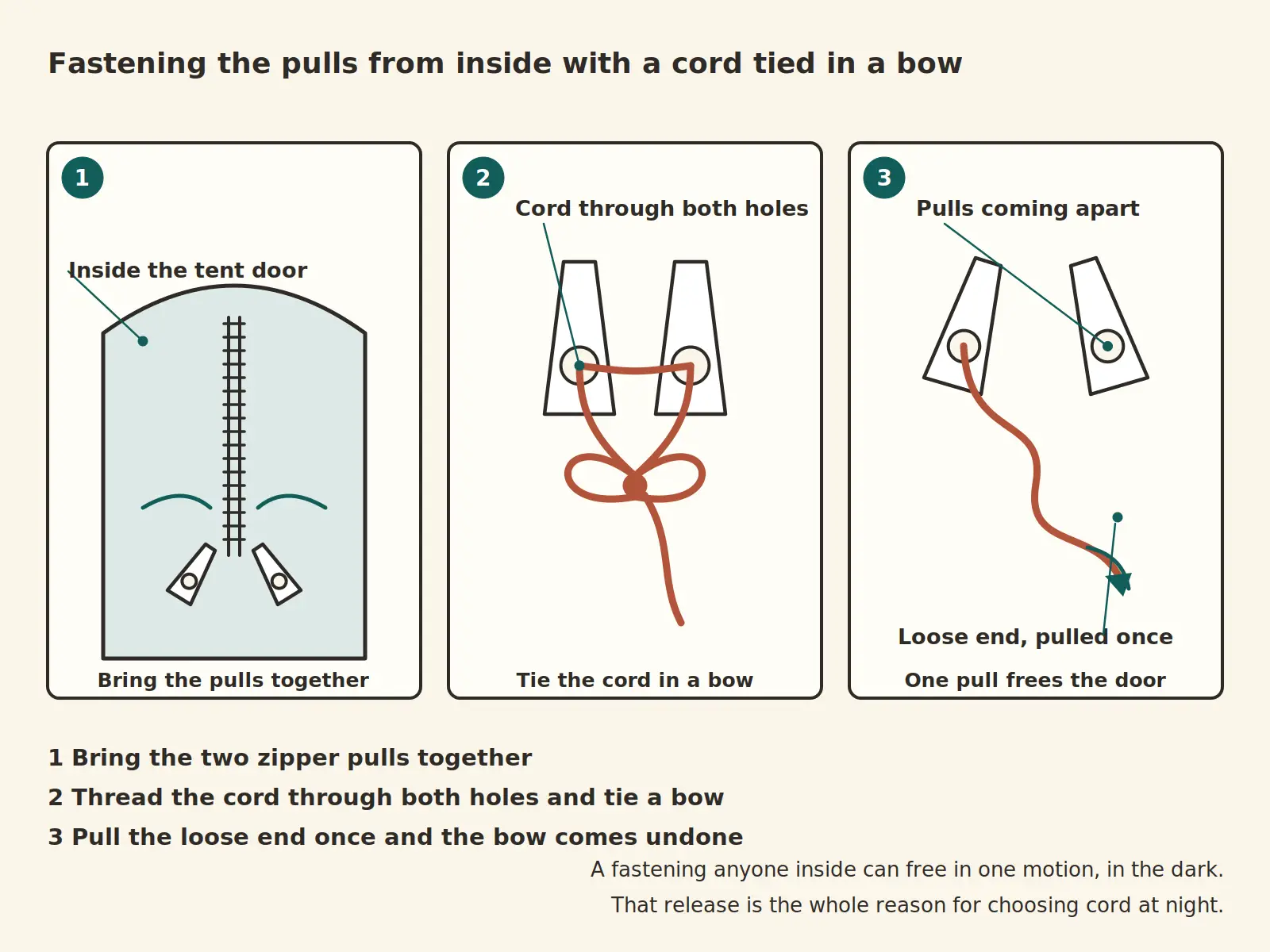
Tie the pulls together with cord or a shoelace
The inside fastening the guides in this field recommend by name is also the simplest. Zip the door closed, bring the pulls together, and tie them to each other with a shoelace or a length of cord, tied in a bow. It holds the door against the mistaken entrant and against a sleeping child’s first attempt. It secures nothing against intent, and it asks for nothing in return: one pull on the loose end and the door is open, which is the whole point of choosing it. Its one weakness is that a bow can work loose, so tie it snug and check it as you settle.
Twist a bread tie or a piece of wire through the pulls
A wire bread tie threaded through both pulls and twisted shut is the same idea in metal. It defeats paws, beaks, small hands, and casual fingers, and campers who use it report the wire is harder to break than it looks. Undoing it for a bathroom break takes one twist, so it passes the rule with room to spare.
A determined adult twists it open in seconds, which is the trade the method makes openly: it is a fastening for animals and accidents, not for adversaries. A large safety pin through the pulls is the make do of the same family, and a pin is fiddly in the wrong way in the dark, so reach for cord or wire first.
Loop a bungee through the pulls
A short bungee cord looped through or around both pulls holds them together under tension and lifts off in an instant from inside. Its best ground is animals. In one much told campsite story, the single tent in a ransacked site that seagulls left alone was the one whose pulls were bungeed, because the elastic confused birds that had learned to work plain zippers. Treat that as the anecdote it is. The method is cheap, instant to release, and genuinely awkward for a beak or a paw, and it holds the pulls together rather than shut against real force.
We independently evaluate everything we recommend. We may earn a commission when you buy through links on this page. Commissions do not change what this guide teaches, and brands cannot pay to be named in it.
How to lock a tent from the outside
Locking a tent you have left is a different job from locking yourself in. With nobody sleeping inside, the one motion rule falls away, and the fastenings that failed it earn their place here, because they make entry slower, louder, and visibly forced. They work under the same limit as everything else in this guide: they deter the casual opportunist and stop the curious hand, and against anyone willing to cut the fabric they are a delay of seconds. The valuables rule from the front answer therefore still decides what you leave inside.
Lock the pulls with a cable luggage lock
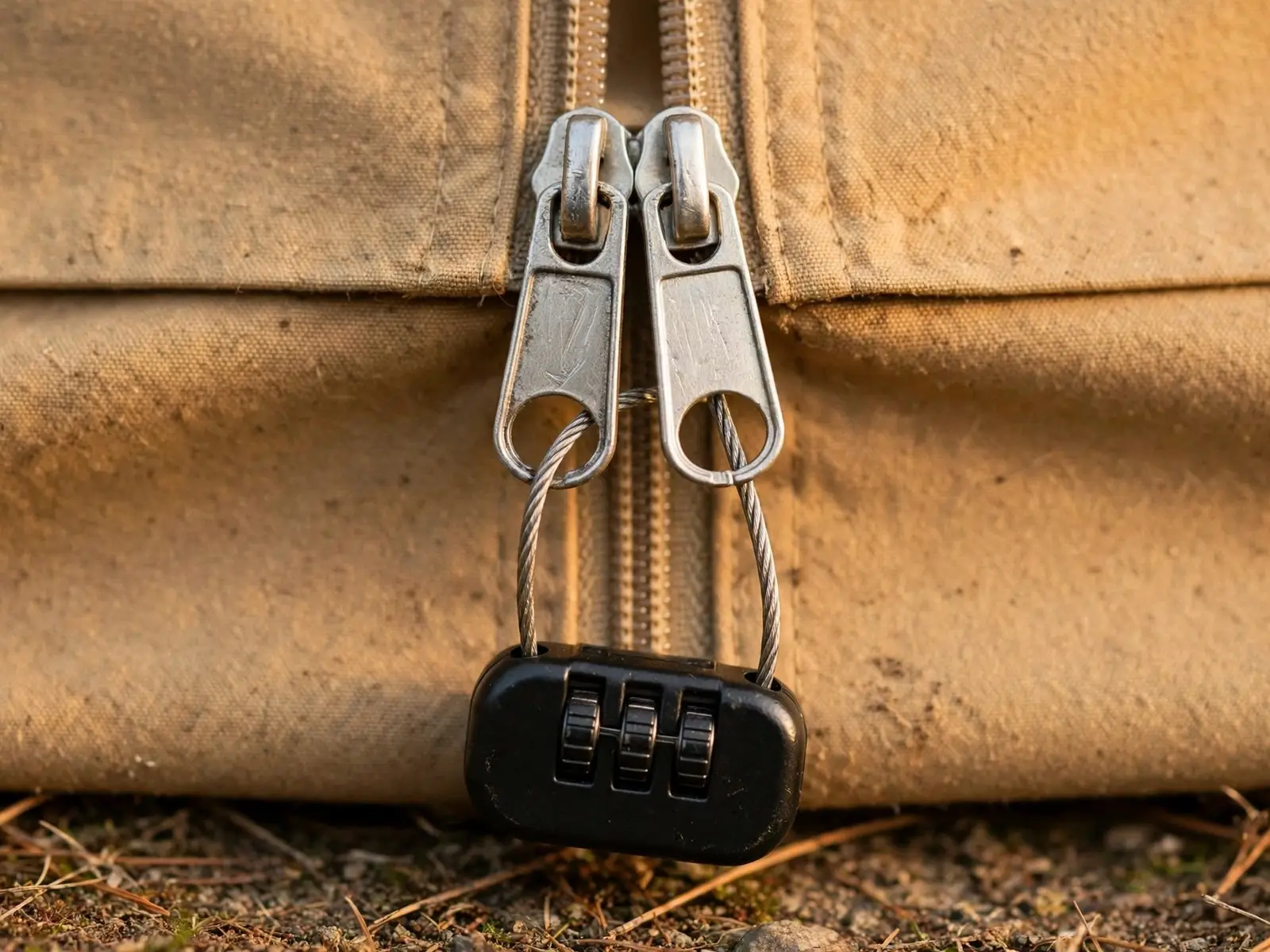
The lock itself earns its place from outside, and the form that fits the job is a cable lock. Tent zipper pulls often sit apart or at an angle, and a rigid shackle needs them to meet exactly. A flexible cable forgives the gap, threads through both pull holes, and joins the zipper against any ordinary attempt to open it. Choose a combination over a key, because a small key is a losable thing at a campsite and a combination leaves nothing to lose.
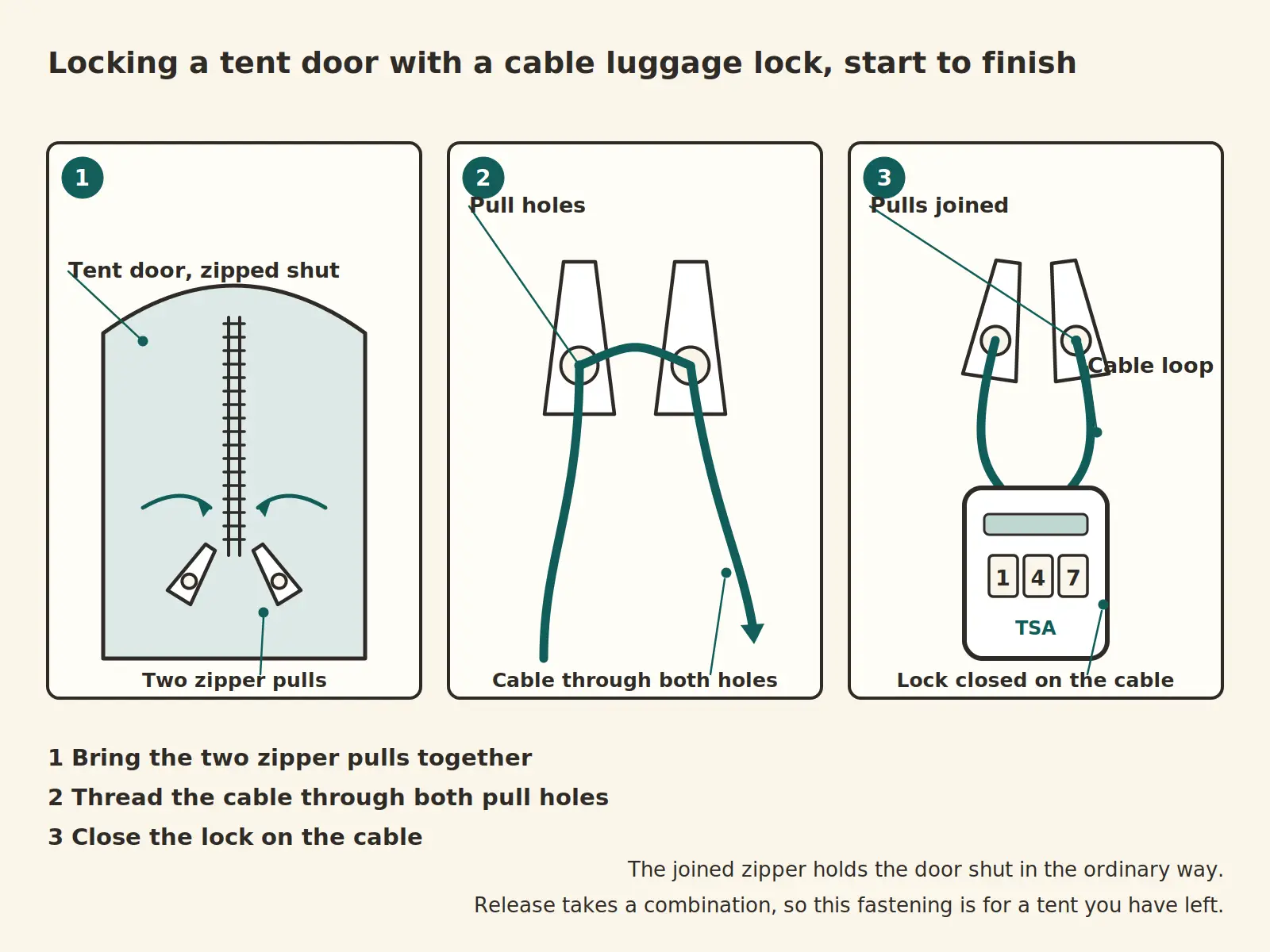
The named lock in this guide is the Master Lock TSA Combination Luggage Lock, a small metal bodied lock with a flexible braided steel cable 3 mm thick and 38 mm long and a set-your-own three-digit combination. It is TSA accepted, so airport screeners can open and relock it. That last point is why the same lock doubles for the luggage it was built for, which is the standing side argument for carrying one at all. For pulls that sit too far apart for a rigid shackle, check the Master Lock TSA Combination Luggage Lock.
Judge it by the rule before you use it from inside. Dialing a combination in the dark is fine motor work, so as a night fastening for a sleeper it fails the standard the shoelace passes. Its real uses are locking the tent from outside when you leave it, locking gear and bags at any hour, and standing as the strongest joined zipper this guide teaches for a tent nobody is sleeping in.
Zip ties and the tent peg for a tent you have left
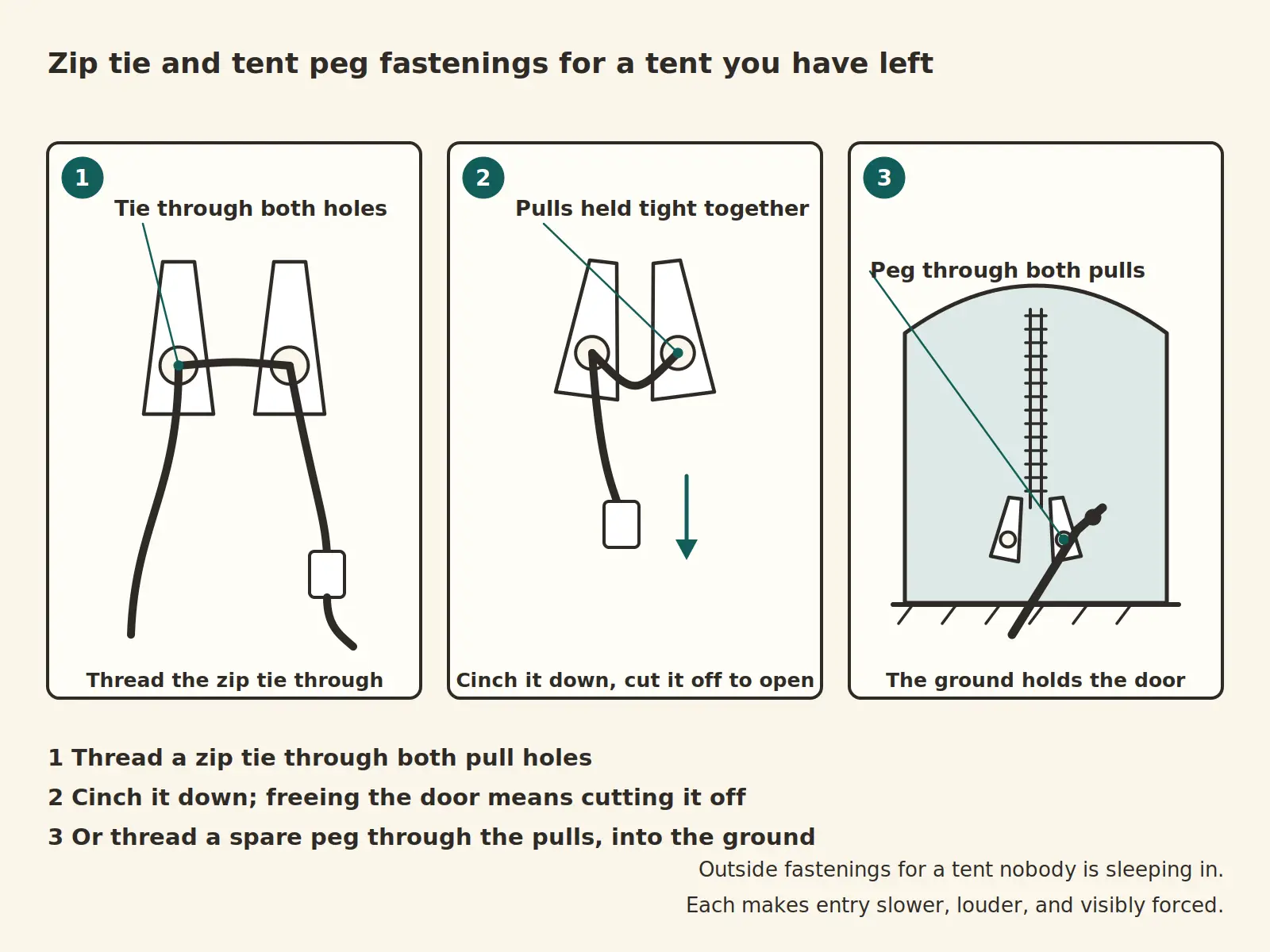
A zip tie through both pulls, cinched down, is the cheapest outside fastening in the field. It is single use, you cut it off to free the door, and its security is exactly that: entry stops being silent and starts leaving visible damage. From inside it is the worst performer in this guide, a fastening its own user cannot release quickly, so it belongs to the unattended tent only. The tent peg trick runs on the same outside logic at no cost at all. Thread a spare peg through both pulls, where they hang low enough to reach it, and push it into the ground beside the door, and the door is held by the ground itself, reading as one more piece of pitching rather than as a lock announcing valuables inside.
The cable’s second job
A longer cable lock, the retractable kind sold for luggage, earns its keep away from the zipper. Run the cable through your gear and around a tree, a picnic table, or the vehicle, and bags and equipment can no longer be lifted in passing, which is the loss an unattended camp invites rather than a tent broken into. As a zipper lock the long cable is more tool than the job needs. As a gear lash it is the form campers in the threads actually use, and it is worth the small bulk if your camp leaves gear sitting out.
Alarms: the bell, the tripwire, and the message
Alarms secure nothing physically. They convert an entry, or an attempt at one, into noise or a message, and everything about their value follows from who hears it and how fast that person can act. The four forms below run from the most used alarm in the camper forums and threads behind this guide to the one no camper in those threads reports using at all.
Hang a bell on the zipper
The bell is the field’s own alarm, and the one parents and festival campers reach for first across decades of threads. A small bell or a short string of bells on the zipper pull wakes the tent and only the tent. It costs almost nothing, never runs out of battery, and cannot be defeated silently by anyone who does not know it is there. Its limit is range: it speaks to someone within earshot, which for a sleeping camper is exactly the person who needs to hear it. Start here, and add a louder form only when your situation names a reason.
Rig a pull pin alarm across the door
A pull-pin alarm sounds a siren when its pin is pulled free, and rigged with its loops across a zipper or on a line around camp it fires at the moment of entry. It wakes the tent and startles the entrant in the same instant, and its perimeter form warns you before the door is ever reached. The named form in this guide is the BASU Tripwire Alarm, a pull-pin personal alarm under an ounce, rated at 120 dB on the tripwire model this guide links, with loops at both ends made for exactly this rigging. For a door or a perimeter line that needs a voice, check the BASU Tripwire Alarm.
Two costs ride with it. Its batteries are sealed rather than replaceable and give about 30 minutes of total alarm time across the alarm’s life, with standby measured in years, so it is a device you rig carefully rather than test nightly, and careful setup against false alarms from wind and wildlife is its standing owner complaint. It is also not waterproof.
And 120 dB spends campsite goodwill every time it fires at 3 in the morning for a hedgehog, which is why the bell leads this section and why the family section below steers parents away from sirens. One correction belongs here as well: a tripwire at the perimeter can wake you if an animal works at your camp, and waking up is all it does. It is not bear protection, and the animal section below covers what bear safety actually rests on.
Motion sensing
Motion alarms exist as small personal alarms with an infrared sensor, and the honest tent problem is aim. Inside a sleeping tent the sensor’s field covers the sleepers, so the tent’s own occupants become its most likely trigger. Its realistic placements are the vestibule or the outside of the door, watching an approach rather than the door itself.
The motion form campers actually use is light rather than sound: a motion sensor light aimed at the campsite, which puts a visitor in view without waking the whole site. A related want deserves a plain answer. Parents regularly ask whether a tent door alarm exists, a contact alarm made for fabric doors, and no camping product answers it. A fabric door gives the two halves of a contact alarm nothing stable to align on, which is the mechanical heart of the problem. The answers parents land on are the bell above and a personal alarm tied across the zips so the pin pulls when the door opens.
The sensor that messages your phone
One step past noise is a message, and it is the only form in this guide that speaks to an owner who is away from the tent. The Simtek StealthALERT is a small sensor that sits in a dark, still space and watches it for light, infrared motion, and acceleration. On triggering, it sends a text message and a push alert to your phone over a built in 4G cellular connection, typically within about 15 to 20 seconds on the maker’s own figures. Its rechargeable battery runs for months between charges, depending on how often it fires.
Two conditions decide whether it works for you, and both belong in the open. Alerts run on a paid data plan after a 30 day free trial, and the sensor needs cellular coverage where you pitch, which festival fields and backcountry sites often lack. The maker sells the sensor for safes, luggage, storage units, and vehicles, and tent use is this guide’s application of a general sensor rather than the maker’s purpose. No camper in the forums and threads behind this guide reports using one in a tent, so weigh it as an option beyond field practice, documented by its maker, rather than as what campers do. For an alert that reaches you away from camp, look at the Simtek StealthALERT.
What to weigh when you choose an alarm
Four considerations sort the forms, and each carries its caveat. How it senses: motion activated suits an approach, while a pull pin suits a door itself, and the bell senses the zipper directly. How it reaches you: noise on site wakes the tent, while a message reaches a phone anywhere with coverage, and the message form is the cellular one with its plan. How it is powered: the bell needs no power at all, the electronic forms run on batteries, and sealed batteries trade replacement for a finite total alarm life. How discreet it is: a low profile alarm draws no attention while it waits, which matters before it fires and not at all during, since being noticed is its job at that moment.
Locking your tent at a festival
A festival field is thousands of lookalike tents, drink, and darkness, and in that setting the mistaken entrant is a when rather than an if. The festival answer therefore splits in two, because the tent you are sleeping in and the tent you have left behind face different problems.
While you sleep, fasten the door from inside with a releasable fastening, the shoelace or the bread tie from the inside section, judged by the one rule. A joined zipper turns the lost neighbour away at the moment of contact, quietly, and most wanderers correct themselves and move on. Mark your tent as well, with a flag or a marker that makes it findable, because the mistake happens less in the first place when your tent is easy to tell from the next one. And name privacy as the legitimate reason it is: a joined zipper is a latch for changing and for sleeping undisturbed, and wanting one needs no security argument behind it.

While you are away, the festival argument runs both ways and this guide will not pretend otherwise. One school locks the zippers and accepts the remaining risk. The other holds that a visible padlock advertises a tent worth robbing and that the working answers are valuables on your person, the lockers many festivals provide for exactly this problem, and bringing only what you can afford to lose. The second school has the better of the valuables question, and the first has the better of the privacy one, so the settled practice is to split it: fasten for privacy and the casual hand, store valuables with the festival or on your body, and keep the irreplaceable items at home. At night, valuables you keep go inside your sleeping bag with you, where a sleeper’s own body is the alarm.
Know your neighbours, because they are the festival’s actual security system, a point the campsite section below takes up in full. Most people at a festival are there for the same good time you are, and the plan above is cheap insurance sized to the real risks, which are a lost neighbour and a snooper rather than a professional.
Locking your tent when camping with kids
The worry underneath this section deserves naming first, because it decides what the right answer looks like. Parents in the threads behind this guide are not afraid a stranger will take their child. They are afraid a half-asleep toddler will unzip the door, wander a dark campsite, and find water, a road, or a fire pit. The plan that follows from that fear is to slow the child and wake the parent, and locks barely appear in it.
Start with reach and position, which cost nothing. Park the zip pulls at the top of the door, out of a small child’s reach, the single most repeated tactic in decades of parent threads. Sleep in the doorway’s way, a parent in front of the door or the child in the middle between two parents, so an exit attempt has to climb over an adult. Then add noise: hang a bell on the zipper, the second most repeated tactic, because it wakes the tent and only the tent. Gear stacked inside the door, a cooler or the bags, adds a slow, noisy obstacle behind all of it, one an adult can shove aside in a single motion and a half-asleep toddler cannot pass quietly. The zipper’s own racket helps too, since a parent sleeps feet from the door.
Reserve locks for gear and valuables, never as the plan for keeping a child inside. A lock that holds a child in holds that child in during a fire as well, and the 60 second figure from the rule section is the whole argument. If a fastening is used on the inside door at all around kids, it must be one a parent can free in one motion in the dark, which in practice is the cord tie, and the exit must stay as fast for the family as the entry is slow for the child. Teach the rule at the child’s age alongside the hardware: the tent stays zipped, the door is a grown up job at night, and the reasons are the dark, the water, and the other tents.
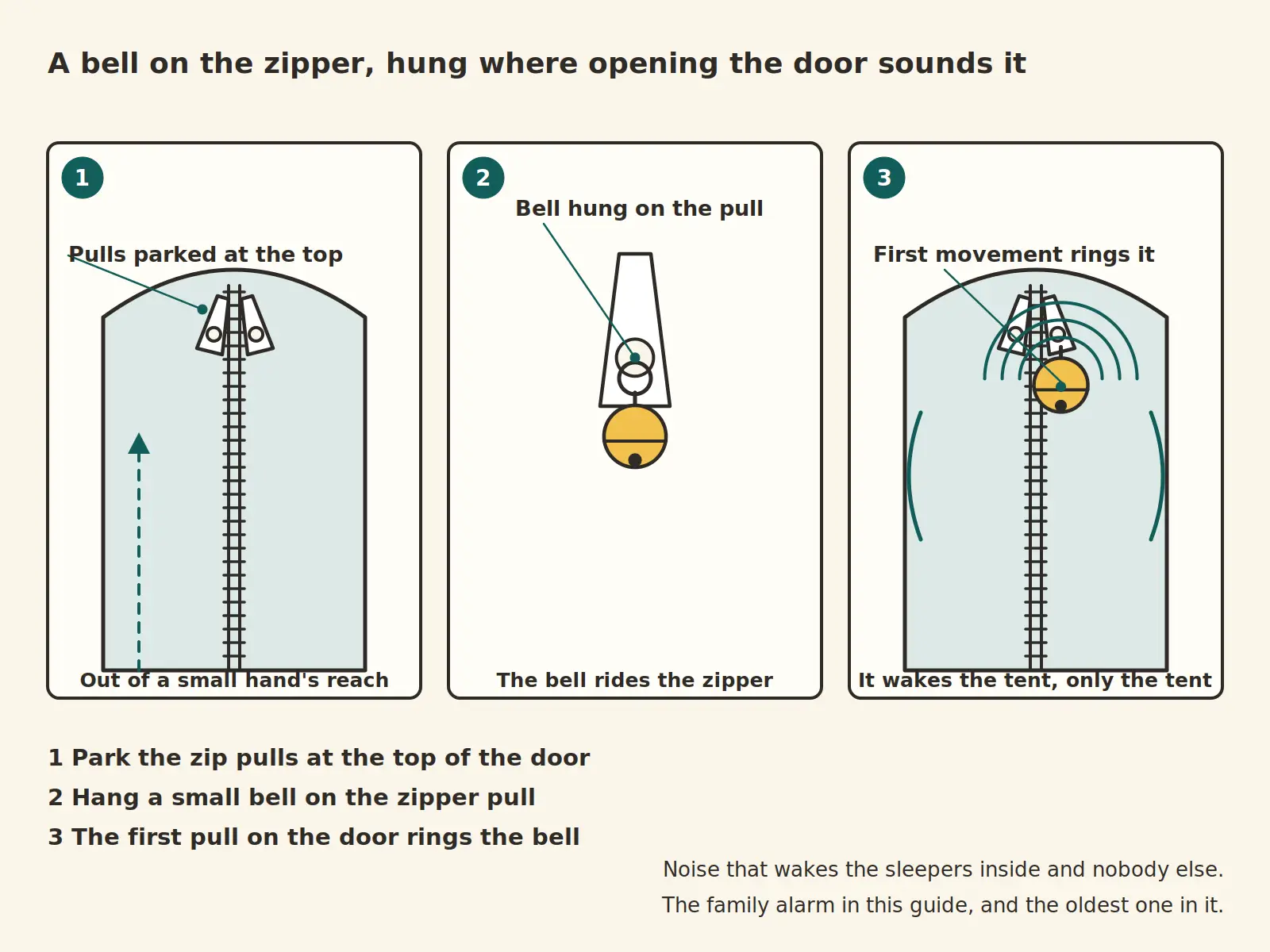

On alarms around children, the parents in those threads are specific, and this guide follows them. A 120 dB siren on a shared site wakes every family in earshot and terrifies the children it was meant to protect, and parents object to exactly that in the threads that ask for a tent door alarm. The bell is the family alarm. If you want a device as well, the form parents land on is a personal alarm tied across the zips so the pin pulls when the door opens, rigged on the door rather than left sounding across a sleeping campsite.
Keeping animals out of your tent
Animals divide into two problems, and only one of them is a locking problem. The first is the animal that works zippers: foxes, seagulls, and raccoons that have learned a loose zipper opens to food. Almost any joined zipper beats it, because paws and beaks defeat slack rather than fastenings, and the bungee and bread tie from the inside section earn their keep here without any theft argument at all. The second problem is the animal that smells dinner, and no fastening answers it. An animal that smells nothing has no reason to test your zipper, so the real animal layer is removing the attractant.
Bear country practice, stated whole, runs as follows. Keep food, toiletries, and every scented item out of the tent entirely, at all times. Store them in the form your setting provides, in this order for most readers of this guide: a campground food locker or a locked hard-sided vehicle first, and a certified bear canister where a ranger checked trip requires one or no vehicle exists. Set the canister on the ground well away from the sleeping area, never hung from a tree; park guidance on the distance runs from about 50 feet to 100 yards downwind, depending on the park. Distance and a scent free tent do the work that no lock on this page can do.
Where the canister is the form, the named product is the BearVault BV500, a polycarbonate food canister certified bear resistant by the Interagency Grizzly Bear Committee, holding about seven days of food for one person on the maker’s rating, with a lid that opens without tools. It locks nothing on your tent and is not presented as a lock. It is the bear country form of the storage practice above, and it stands in this guide as exactly that. For trips where a ranger checks your food storage, check the BearVault BV500.

Secure the campsite not just the tent
The guides and camper threads behind this article rank this layer above every fastening above it, and the fastenings make more sense once it is in place. Locks are the garnish on a system made of setting, habit, and neighbours.
Site choice is the first decision. At a festival, pitch where eyes are, close to walkways and communal areas rather than at the dark edge. In the backcountry the same rule reads in reverse, and there distance from trailheads and people does the protective work. On ordinary trips, choose the campground on its reputation and staffing the way you would a hotel, because a well kept, well reviewed site with present staff is a security feature; the fuller treatment stands in this site’s guide to choosing a campsite.
Valuables practice outranks every product in this guide. The cardinal rule is that nothing valuable stays in the tent: it rides on your person, sleeps inside your sleeping bag, uses a festival locker where one is provided, or locks in the vehicle. Where the vehicle is the vault, a sturdy metal box fastened inside the trunk is the strong form of it. A bolted box raises the time, tool, and noise cost of a theft past what a smash and grab allows, and it must be fastened to the vehicle, because an unfastened safe can simply be taken. Time defeats it, as time defeats everything in this guide, and its job is to move your gear out of the quick and quiet categories.
Neighbours close the system. Every guide read for this article teaches community watch, and campers in the forums behind this guide treat it as the actual mechanism, with introductions made early and a simple “Could you keep an eye on my tent?” doing real work in both directions. One last question in this layer has two honest answers, and the guide leaves both standing: a tent that looks lived in deters some campers’ thieves, and a tent shut up tight advertises an absence to others. The practical middle both schools accept is a tent that looks occupied and holds nothing worth cutting for.
Locking a tent well is mostly these habits with a joined zipper on top. Build the rest of the trip with the same care: assemble your camping checklist, plan some camping meals, and put together a custom first aid kit that meets your needs. Leave a comment with how you secure your campsite, and whether you lock your tent at all.
Frequently asked questions
Should you lock your tent and does a lock deter thieves?
Yes to locking for the right problems, with the limit stated. A lock through the zipper pulls stops the mistaken entrant cold and deters the casual opportunist, and it does nothing against anyone willing to cut fabric or part the zipper coil, which takes seconds. Treat the lock as a deterrent for sleepers’ problems, privacy, kids, and animals, and handle valuables as though it were not there.
How do you lock a tent from the inside?
Join the two zipper pulls with something that releases in one motion in the dark. A shoelace or cord tied in a bow is the field’s first answer, a bread tie or wire twist is the metal form of it. A bell on the zipper is not a fastening but an alarm, and it wakes you if the door moves. Judge every inside fastening by the fire figure: a tent fire can destroy the tent in about 60 seconds, so no key and no combination stands between a sleeper and the exit. A tent you are leaving empty takes the opposite fastenings, answered in the next question.
How do you lock a tent from the outside?
Join the zipper pulls of the empty tent so the door cannot be drawn open in the ordinary way. A cable luggage lock is the strong form, because its flexible cable forgives pulls that sit apart. A zip tie cinched through both pulls is the cheap form and is cut off to free the door, and a spare tent peg threaded through the pulls and pushed into the ground holds the door at no cost where the pulls hang low enough. Every one of them can be defeated by a knife in seconds, so lock an empty tent for deterrence and privacy, and keep valuables on your person, in the festival’s lockers where it provides them, or in the vehicle.
Are there special locks made for tent zippers?
No separate class of tent lock exists. The answer everywhere in the field is a small luggage or cable lock through the zipper pulls, the Master Lock TSA Combination Luggage Lock named in the outside section being this guide’s example. Tents sold as lockable run on the same mechanism: the word means their zipper pulls are built to take the same small lock, not that a different locking system exists.
How do you keep kids from wandering out at night and still get out fast in an emergency?
Slow the child and wake the parent, in that order. Park the zip pulls at the top of the door out of reach, sleep in the doorway’s way with the child between the adults, hang a bell on the zipper, and stack gear inside the door. Reserve locks for gear, because a fastening that holds a child in during the night holds that child in during a fire too, and every inside fastening around kids must free in one motion in the dark.
How do you keep animals out of your tent?
Join the zipper against the animals that work zippers, with cord, a bungee, or a lock, and remove the attractant against everything else. Keep food, toiletries, and all scented items out of the tent, and store them in a campground locker, a locked hard-sided vehicle, or a certified bear canister, set on the ground well away from where you sleep. An animal that smells nothing has no reason to test the zipper at all.
Notes
- Research note. This guide is researched rather than tested. Its methods rest on the guides and camper community threads named in the Sources, its product claims on the makers’ own documentation, and its safety ground on fire service and National Park Service guidance. No product named here was hands on tested for this guide.
- Simtek framing. The maker positions the StealthALERT for safes, luggage, drawers, storage units, and vehicles. Its tent use is this guide’s application of a general sensor. The alert timing of about 15 to 20 seconds, the 30 day trial and paid plan, and the cellular coverage condition are stated from the maker’s FAQ and features pages, read in October 2026.
- BASU model. The listing this guide links sells the tripwire model of the BASU eAlarm, rated at 120 dB, with sealed batteries giving about 30 minutes of total alarm time. A Plus model rated at 130 dB exists under the same brand, and the figures in this guide match the linked model. Listing confirmed in October 2026.
- Master Lock form. The lock named in the outside section is Master Lock’s TSA accepted set-your-own combination luggage lock, the 4688D form, with cable and body dimensions as the maker documents them.
- Changelog. This article was rebuilt in full for its 2026 edition, on the evidence named above. The previous edition’s alarm list, product framing, and festival figure do not carry over.
Sources
- Boutique Camping and PropelRC (the zipper pull lock method).
- National Park Service bear storage guidance, Kenai Fjords, Grand Teton, Shenandoah pages (scented items out of the tent, storage forms, distance from the sleeping area).
- North Wales Fire and Rescue Service and Greater Manchester Fire and Rescue Service (a fire can destroy a tent in 60 seconds, escape planning).
- Master Lock, product documentation for the TSA combination luggage lock.
- Simtek, StealthALERT FAQ and features pages (detection, alert timing, data plan, coverage).
- BASU, eAlarm documentation, and the owner record at Trailspace (rigging uses, battery life, standing cautions).
- BearVault, BV500 documentation, and Interagency Grizzly Bear Committee certification 5339.
- Camper community threads: Mumsnet camping threads 2008 to 2025, Mamapedia, Rokslide, Codidact Outdoors, and Cragmama (festival argument, kids consensus, animal practice).