You can leave Seattle after work on a Friday and pitch a tent on a Puget Sound beach before dark. Or you can drive east and fall asleep to a river running through the Cascade foothills. Ten campgrounds sit within two hours of South Seattle. Between them, they offer saltwater beaches, two rivers, a lakefront state park, yurts on Port Susan, and full hookup RV parks inside the metro area. This guide sorts the ten by drive time, gives each one a full entry, and explains how to book your stay, whether you camp in a tent, a trailer, or take the kids out for a first trip. Near Seattle, the drive decides the trip.
One warning before the entries. Saltwater State Park, the state park closest to the city among the ten, closed its campground in 2026, and Washington State Parks has set no reopening date. Plenty of lists still show it as open. Its entry below covers what remains open at the park and directs families to Dash Point, the next state park down the Sound.
Keep our camping experience in mind as you read this guide. We have camped at exactly one of the ten full entry campgrounds, Joemma Beach State Park, in the summer of 2017. Our experience runs long on backpacking and short on car camping close to home. We have backpacked in Washington for over a decade. Our routes have included the Olympic coast, the Enchantments, the Goat Rocks, and the high country around Mount Baker. Most of our nights outside have been backpacking trips. Car camping close to home is the newer habit for us, and we have not yet had the chance to do much of it. We have group camped at Lake Sammamish State Park, which runs group camping only, so this guide lists it in the tables rather than giving it an entry. We have visited Saltwater, the park we would recommend to a family for a first night out. Because its campground is closed, the entry below directs families to Dash Point, twenty minutes farther on. We researched everything else from the operators’ and land managers’ own pages, checked November 10, 2026, and each entry says so where it matters.
Planning beyond the metro? Start with our Washington campgrounds by region guide, which covers the state region by region.
In this guide
- Camping near Seattle at a glance
- Campgrounds by drive time
- Choosing by how you camp
- Booking near Seattle
- South of the city
- East King County river campgrounds
- The I-90 corridor
- North to Snohomish County
- The South Sound
- Private campgrounds and the in city RV question
- Across the water
- Noise and picking a site
- A first night out from Seattle
- Security and emergency readiness
- Frequently asked questions
Camping near Seattle at a glance
This table lists the ten campgrounds this guide covers in full and one more with a short entry, along with a key fact about each. Drive times are planning times from South Seattle with no ferry wait, defined in the drive time section below.
| Campground | Drive time | Booking | Best for | Key fact |
|---|---|---|---|---|
| Saltwater State Park | Under an hour | State Parks system | A first family night, when it is open | Campground closed and camping under reevaluation, checked November 10, 2026 |
| Dash Point State Park | Under an hour | State Parks system | Tent and RV camping on a Puget Sound beach | The state parks reservation system lists 114 tent spaces and 27 utility spaces |
| Kanaskat-Palmer State Park | Under an hour | State Parks system | A first campground night on a river | Standard and partial hookup sites on the Green River, with winter camping listed |
| Tolt-MacDonald Park | Under an hour | King County, reservation only | Tent, RV, yurt, and group camping in one park | No first come sites, and no booking inside five days of arrival |
| Tinkham Campground | Under an hour | Recreation.gov and first come | A chance to get a first come site in the corridor | All sites without hookups, roughly four dozen of them, beside I-90 |
| Denny Creek Campground | 1 to 1.5 hours | Recreation.gov | A reservable site by a creek in the corridor | Flush toilets and drinking water, with electric hookups at a handful of sites |
| Middle Fork Campground | 1 to 1.5 hours | Recreation.gov | A night deep in the forest in the corridor | 39 sites including two group sites, 12 miles up the Middle Fork road |
| Lake Easton State Park | 1 to 1.5 hours | State Parks system | Full hookup sites at the corridor’s end | The operator itself recommends earplugs for light sleepers |
| Kayak Point County Park | 1 to 1.5 hours | Snohomish County system | Utility camping and yurts on Port Susan | Every site is partial utility, and there is no RV dump station |
| Joemma Beach State Park | 1.5 to 2 hours | State Parks system and first come | A quiet primitive night on Case Inlet | The one campground with a full entry where we have camped, in the summer of 2017 |
| Millersylvania State Park | 1 to 1.5 hours | State Parks system | The South Sound’s high demand state park | Short entry here, full entry in the State Parks guide |
The short answers
The closest open saltwater camping is Dash Point, since Saltwater is closed. The easiest first night out is Tolt-MacDonald, where every stay is reserved ahead and the town grocery is a mile away. The classic river weekend is Denny Creek, with Franklin Falls a short walk from the campground. A rig that needs hookups close to the city belongs in the private parks, covered in their own section below. The far end of the corridor is Lake Easton, a full service state park on a mountain lake. Every pick is explained in its entry below.
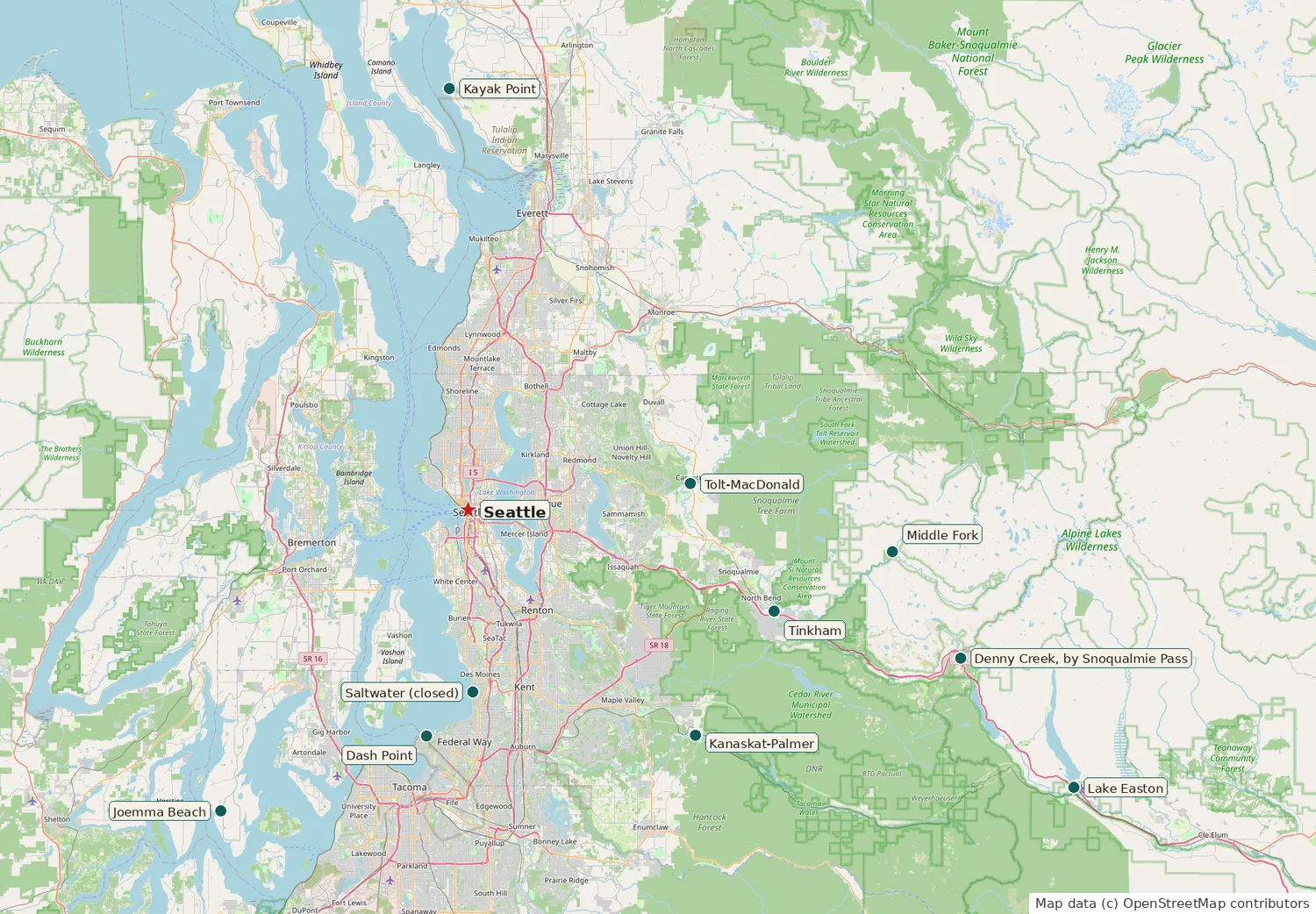
Here is every campground in this guide, grouped by the sections below. South of the city holds Saltwater and Dash Point. East King County holds Kanaskat-Palmer and Tolt-MacDonald. The I-90 corridor covers Tinkham, Denny Creek, Middle Fork, and Lake Easton, plus the corridor roads. North to Snohomish County covers Kayak Point and the rest of the county system. The South Sound section covers Joemma Beach, Penrose Point, Millersylvania, and Capitol State Forest.
The private campgrounds and in city RV section has four entries, information about the Kent KOA closure, and a short list of the remaining private campgrounds. Across the water names campgrounds and directs you to the guides that cover them. It holds no entries of its own.
Campgrounds by drive time
This guide is organized by drive time from South Seattle. The times are planning ranges, not promises. The times cover driving only and do not include ferry waits. Friday afternoon traffic on I-5 and I-90 can make any trip in this table take longer than the stated range. Under an hour is close enough to go home if the night fails, and beginners use it exactly that way. The next range runs one hour to an hour and a half, and the one after that an hour and a half to about two hours. For campgrounds more than two hours away, this guide gives the name and directs you to the guide that covers each one in full.
| Campground | Drive time | What it is |
|---|---|---|
| Saltwater State Park | Under an hour | State park, campground closed at the November 2026 check |
| Dash Point State Park | Under an hour | State park, tent and utility sites on Puget Sound |
| Kanaskat-Palmer State Park | Under an hour | State park on the Green River |
| Tolt-MacDonald Park | Under an hour | King County park, reservation only, every kind of camping |
| Tinkham Campground | Under an hour | Forest Service, reservable and first come, no hookups |
| Flowing Lake County Park | Under an hour | County park, tent and utility sites, cabins |
| Lake Roesiger County Park | Under an hour | County group camp, groups only, no individual camping |
| Hans Jensen Group Camp | Under an hour | Group camp only at Lake Sammamish State Park, no individual camping |
| Camp Long | In the city | City of Seattle, ten rustic cabins, no tent or RV camping |
| Trailer Inns RV Park | Under an hour | Private RV park in Bellevue, full hookups |
| Vasa Park Resort | Under an hour | Private resort on Lake Sammamish, tent and RV welcomed |
| Issaquah Village RV Park | Under an hour | Private RV park in Issaquah, full hookups |
| Angle Lake RV Park | Under an hour | Private RV park in SeaTac, RV only, full hookups |
| Blue Sky RV Park | Under an hour | Private RV park in Preston, daily to monthly sites |
| Lake Pleasant RV Park | Under an hour | Private full hookup RV park in Bothell |
| Tall Chief RV Resort | Under an hour | Private membership network resort in Fall City, non-members book by phone |
| Nor’West RV Park | Under an hour | Private RV park in North Bend, all sites full hookup |
| Denny Creek Campground | 1 to 1.5 hours | Forest Service, reservable, flush toilets |
| Middle Fork Campground | 1 to 1.5 hours | Forest Service, reservable campground deep in the corridor’s forest |
| Lake Easton State Park | 1 to 1.5 hours | State park at the corridor’s east end, sites with and without hookups |
| Kayak Point County Park | 1 to 1.5 hours | County park, utility sites and yurts on Port Susan |
| Wenberg County Park | 1 to 1.5 hours | County park, tent and utility sites, dump station |
| River Meadows County Park | 1 to 1.5 hours | County park, tent sites and yurts, no utility sites |
| Wallace Falls State Park | 1 to 1.5 hours | State park, two walk in tent sites and cabins |
| Millersylvania State Park | 1 to 1.5 hours | State park south of Olympia |
| Enumclaw Expo Center RV Campground | 1 to 1.5 hours | Municipal fairground RV camping |
| Sun Outdoors Gig Harbor | 1 to 1.5 hours | Private, full hookup RV sites and rustic tent sites, from directory listings |
| American Heritage Campground | 1 to 1.5 hours | Private, RV camping year round, with the operator’s tent area stated in a notice dated 2024 |
| Columbus Park | 1 to 1.5 hours | Private, RV spaces and tent camping in season |
| Frontier Park | 1 to 1.5 hours | Pierce County, camping for large multi day rentals by preapproval only |
| Washington State Fair RV Park | 1 to 1.5 hours | Fairground RV park in Puyallup, main lot open year round |
| Joemma Beach State Park | 1.5 to 2 hours | State park, primitive, Key Peninsula |
| Penrose Point State Park | 1.5 to 2 hours | State park on the Key Peninsula |
| Capitol State Forest campgrounds | 1.5 to 2 hours | Four DNR campgrounds, first come, Discover Pass |
| Squire Creek County Park | 1.5 to 2 hours | County park, the system’s rustic campground |
| Offut Lake Resort | 1.5 to 2 hours | Private, cabins and RV sites in Tenino |
| Manchester State Park | 1.5 to 2 hours | State park on the Kitsap side |
| Belfair State Park | 1.5 to 2 hours | State park on Hood Canal |
| Tahuya and Green Mountain camps | 1.5 to 2 hours | Five DNR camps, two horse camps open weekends only when hosts are present |
| Whitehorse County Park | Over 2 hours | County park at the far edge of the county system, closed in winter |
| Porter Creek Campground | Over 2 hours | DNR campground at Capitol Forest’s west side |
| Kitsap Memorial State Park | Over 2 hours | State park on Hood Canal |
| Scenic Beach State Park | Over 2 hours | State park on Hood Canal |
| Twanoh State Park | Over 2 hours | State park on Hood Canal |
| Potlatch State Park | Over 2 hours | State park on Hood Canal |
| Dosewallips State Park | Over 2 hours | State park on Hood Canal |
| Camano Island State Park | Over 2 hours | State park at the metro’s north edge |
Blake Island Marine State Park carries no drive time in this table. It is accessible only by boat and appears in the Across the water section.
Choosing by how you camp
Drive time tells you how far away each campground is. This section lists campgrounds for RV camping, tent camping, and backpacking style trips. Each view is a short list, nothing more. Every line links down to an entry or out to the guide that covers that ground in full, and no ground appears twice.
For RV campers. Dash Point has utility sites on a public beach, Kayak Point has utility sites and yurts on Port Susan, Lake Easton has full hookup sites at the end of the corridor, and Tolt-MacDonald has pull through utility sites beside tent sites. For camping almost in the city, see the four private campground entries, Trailer Inns, Vasa Park, Issaquah Village, and Angle Lake. Saltwater belongs on this list and is named here as unavailable while its campground is closed. For RV campers, the facts that matter most are the hookups, the maximum RV length, and access to a dump station. The entries provide those details.
For tent campers. Consider Kanaskat-Palmer on the Green River, the three corridor campgrounds Tinkham, Denny Creek, and Middle Fork, Joemma Beach for a quiet primitive stay, and Flowing Lake among the county campgrounds. Saltwater’s campground is closed. If it reopens, it remains our first choice for a first tent camping night. Some campgrounds near the city accommodate both tents and RVs. Vasa Park states in its own material that tent campers are welcome. Where it is unclear whether a private campground accepts tents, this guide says so rather than guessing.
For a backpacking style night close to town. This list is short because there are few backpacking style camping options close to Seattle. The Palouse to Cascades trail camps named in the corridor section offer walk in and ride in camping in the corridor. Wallace Falls appears among the county campgrounds with two walk in tent sites and a short mention. The Morning Star and Blanchard lake camps north of the city are mentioned here only, by name. Dispersed camping on the forest roads is a separate practice with its own rules, and this guide does not present it as a simple free alternative anywhere.
Booking near Seattle
Campgrounds near Seattle take bookings through five different systems, and no two of them work the same way. When one fills up, your next move depends on which system runs that campground. Washington State Parks takes reservations up to nine months in advance of the first night of a trip, online or by phone at (888) 226-7688, and since March 24, 2025 every reservable state park campground also takes same day reservations until 2 p.m. on the arrival day, with sites still unreserved after 2:30 p.m. going first come, first served. The corridor’s three Forest Service campgrounds take reservations through Recreation.gov for most sites. The rest are first come, first served, and Tinkham has the most first come sites of the three.
King County’s one campground is reservation only, needs at least five days of notice, and books up to a year ahead. Snohomish County books online or through its call center. At Kayak Point, the county campground covered in a full entry in this guide, reservations open in January for the first six months of the year and in February for the rest. A booking needs at least three days of notice, and unreserved sites are sold as drop-ins at the park. DNR campgrounds take no reservations at all.
Here are the five systems side by side.
| Reservation system | Campgrounds in this guide | How booking works | If you arrive without a reservation |
|---|---|---|---|
| Washington State Parks | Saltwater, Dash Point, Kanaskat-Palmer, Lake Easton, Joemma Beach, and the other state parks named in this guide | Book online or by phone up to nine months ahead. Same-day reservations are available until 2 p.m. The reservation fee is $8 online or $10 by phone, and non-residents pay $5 more. | Sites still unreserved after 2:30 p.m. are first come, first served. |
| U.S. Forest Service, through Recreation.gov | Tinkham, Denny Creek, and Middle Fork | Most sites can be reserved through Recreation.gov. The rest are first come, first served. Recreation.gov charges $8 per reservation online, $9 by phone. | Try the first come sites. Tinkham has the most of the three. |
| King County Parks | Tolt-MacDonald Park | Reservations only. Book up to a year ahead, at least five days before arrival. | There is no first come option. |
| Snohomish County Parks | Kayak Point and the other Snohomish County campgrounds named in this guide | Book online or through the county call center. At Kayak Point, reservations open in January for the first six months of the year and in February for the rest, and a booking needs at least three days of notice. The county adds an $8 transaction fee per site, plus $2 when the call center handles the booking. | Unreserved Kayak Point sites are sold at the park as drop-ins. |
| Washington DNR | The DNR campgrounds in Capitol State Forest | The DNR campgrounds in this guide take no reservations. | Every site is first come, first served. |
Pets follow the system that runs the campground. In state parks, pets are welcome at campsites on a leash no longer than eight feet, kept out of designated swimming areas and park buildings. The only pet fee in the state system is $15 a night in a pet friendly cabin or yurt, and only one Dash Point cabin and one Kanaskat-Palmer yurt take pets. Forest Service campgrounds allow pets, restrained or on a leash in developed sites, with no pet fee. At Tolt-MacDonald, King County keeps pets on an eight foot leash under control at all times, and states no pet fee. Snohomish County allows pets on an eight foot leash in the campground, but not on the beaches, docks, or swim areas, and not in the yurts. DNR campgrounds allow pets on a leash no longer than eight feet in developed areas.
Arrival rules differ by system, and they matter as much as the booking window. At state parks, check-in begins at 2:30 p.m. and check-out is 1 p.m. Campers may enter until 10 p.m. A camper who arrives after the gate closes may enter through the gate on its slider bar, close it behind them, and register the next morning. If a camper has not arrived by 1 p.m. the day after the scheduled arrival day, the state parks reservation is considered a no-show and the whole stay is forfeited. If you are starting late, it is worth calling the park on the arrival day.
At Denny Creek, check-in is at 2 p.m. and check-out is at noon. At Kayak Point, drop in campers buy the first night at the entrance fee machine and take restroom codes from a ranger.
When everything reservable is booked, try these in order. First, look for same day openings. State parks accept same-day reservations until 2 p.m. on the arrival day, and sites still unreserved after 2:30 p.m. become first come, first served. A weekday afternoon arrival gives you different chances from a Saturday arrival. Second, the corridor’s campgrounds on Recreation.gov, where Denny Creek and Middle Fork hold most of the reservable sites. Third, try the county systems. King County accepts bookings up to a year ahead and requires at least five days of notice. Snohomish County’s Kayak Point requires at least three days of notice.
Fourth, try the DNR campgrounds in Capitol State Forest, which take no bookings and are entirely first come, first served, or Tinkham’s first come sites alongside its reservable ones. Fifth, try private campgrounds, which sell sites night by night that the public booking systems never list. Dispersed camping, or camping outside a developed campground, is not on this list, on purpose. It is undeveloped and unreservable, and it is not the answer to a sold out Friday.
At first come campgrounds, your arrival day affects your chances of getting a site. Campers report the same pattern often enough to plan around it. Arriving on Thursday or another weekday gives you a different chance of finding a site than arriving on Friday evening. By Friday evening, campgrounds in the corridor fill from the freeway outward, and the unreserved sites at campgrounds that take reservations are what remain. At first come campgrounds, the time when sites become available matters, so plan to be at the gate by early afternoon rather than at dusk. If you leave the city after work on Friday, plan to have a reservation rather than rely on a first come site. None of this guarantees a site. These steps give you the best chances we know of finding a site.
South of the city
Saltwater State Park
Quick facts: Campground closed as of the November 10, 2026 check, and the trailer dump closed with it; the park itself is open for day use, 8 a.m. to dusk year round; day use parking takes a Discover Pass, $45 a year or $10 a day; two reservable picnic shelters and 147 unsheltered picnic tables; restrooms and accessible restrooms open for day use.
Saltwater State Park is closed to camping, and this guide quotes the agency’s own wording, because summaries of it have misled people. Washington State Parks carries an alert on the park’s page, posted June 22, 2026 and unchanged at our November 10, 2026 check, stating that a number of projects are in development in the campground area, some resulting from flooding and erosion impacts, and that while the campground is closed the agency is taking the opportunity to reevaluate camping within the park. No reopening date exists in the agency’s material. The state’s winter schedule puts it briefly. The campground and trailer dump are closed. Check the live park page before you plan any trip to this park, because this entry will become outdated faster than any other in the guide: Saltwater State Park, Washington State Parks.

The park itself remains open and worth the drive. It is a 137 acre park in Des Moines, about two miles from Interstate 5, with a sandy beach, tide pools, and McSorley Creek with its seasonal salmon spawning, and the only underwater artificial reef in the state park system. Day use amenities include restrooms, fire pits and grills, picnic shelters and tables, playgrounds, concessions, and trails. Wood fires are not allowed in the park at any time, a park rule that surprises campers who arrive expecting a beach fire. The campground is closed, but the park remains open for day use.
The old park page described the campground as follows. An older version of the park’s page described 15 standard campsites with restrooms and showers nearby, a dump station nearby, and a maximum site length of 50 feet. That description no longer applies because the campground is closed. The description appears here only so readers with an old printout or outdated listing can see what changed. Do not use it for current trip planning.
This is the guide’s one recommendation based on a visit rather than an overnight stay, and the campground is closed. We have visited Saltwater, and it is the park we would recommend to a family for a first night of camping. It is close to the city, small in scale, and a short trip home. We have not stayed overnight there, so our recommendation is based on a visit, not a camping stay. While the campground is closed, the substitute is Dash Point State Park, the next entry in this guide. It is twenty minutes farther on, with an open campground on the same shore. If Saltwater reopens, this entry will return to a full entry. Until its status settles, check the park page before any trip.
Dash Point State Park
Quick facts: Standard and utility sites plus cabins; the state parks reservation system lists 114 tent spaces and 27 utility spaces; RVs and combinations of 32 feet or less per the park page, with the reservation system stating a maximum site length of 40 feet that may have limited availability; a group camp for up to 96 people in 12 sites around a central gathering area; reservable on the state parks system to nine months; open year round, with the upper loop closed September 15 to May 15; drinking water; restrooms; showers; a trailer dump station; nightly fee per the State Parks fee schedule, standard sites running $31 to $43 in the peak season of May 15 to September 15, $20 to $30 in the shoulder seasons, and $20 in winter; check in 2:30 p.m., check out 1 p.m.; park phone (253) 661-4955. Book through Washington State Parks reservations. Groceries and fuel in Federal Way, about 15 minutes away.
While Saltwater is closed, Dash Point State Park is the open saltwater campground for the south end of the city. It is a 461 acre camping and day use park in Federal Way with 3,301 feet of saltwater shoreline on Puget Sound. We have not camped here. The practical details below come from the park’s own pages and reservation system, and claims from camper reports are identified as such.
Book through the state parks system described in the booking section. Reservations are available all year, with the upper loop closed in winter as noted above. Late arrival follows the state parks rule. Entry runs until 10 p.m., and a camper arriving after the gate closes uses the slider bar, closes the gate, and registers the next morning. The group camp takes up to 96 people across 12 smaller sites around a central gathering area, with three potable water stands and no electricity, at fees that vary with group size.
The park offers the full run of state park facilities. The park’s amenities list includes drinking water, restrooms, showers, fire pits, firewood, a ranger station, a trailer dump, accessible campsites and restrooms, an automated pay station, and an amphitheater. Interpretive programs take place in the amphitheater on Fridays and Saturdays from June through August. Alcohol is prohibited by law in the day use area, and registered campers of legal age may have it at their campsite only. The park rules say clamming is not recommended here, without giving a reason, so do not plan a clam dinner on this beach.
Two practical notes come from camper reports, labeled as such. Campers report that many sites share driveways, which can affect how a site feels when both are occupied. They also report that the park is in the Sea-Tac flight path and that aircraft noise is part of a night here. The park’s own pages do not assess the noise. Neither statement comes from the park operator. Camper reports are consistent enough on both points to plan around them. The noise section below also discusses the reported pattern of aircraft noise.
East King County river campgrounds
Kanaskat-Palmer State Park
Quick facts: Standard and partial hookup sites, maximum site length 50 feet with limited availability; one group camp for up to 80 people; yurts; reservable on the state parks system to nine months; park hours 8 a.m. to dusk year round, with winter camping among the park’s listed activities; drinking water; restrooms; showers; partial hookups and a trailer dump; nightly fee per the State Parks fee schedule, standard sites $31 to $43 at peak and partial utility sites $41 to $51 at peak, with shoulder and winter rates below those bands; check in 2:30 p.m., check out 1 p.m.; the park charges an overnight unattended vehicle fee of $10 a night. Book through Washington State Parks reservations. Groceries and fuel in Enumclaw, about 9 miles away.
Kanaskat-Palmer State Park is a campground in the Green River gorge, with campsites above the river. We have not camped here. When campers in the region’s forums and groups ask for the closest real camping to the city, experienced campers recommend this campground to beginners. Its booking rules matter for that reason.
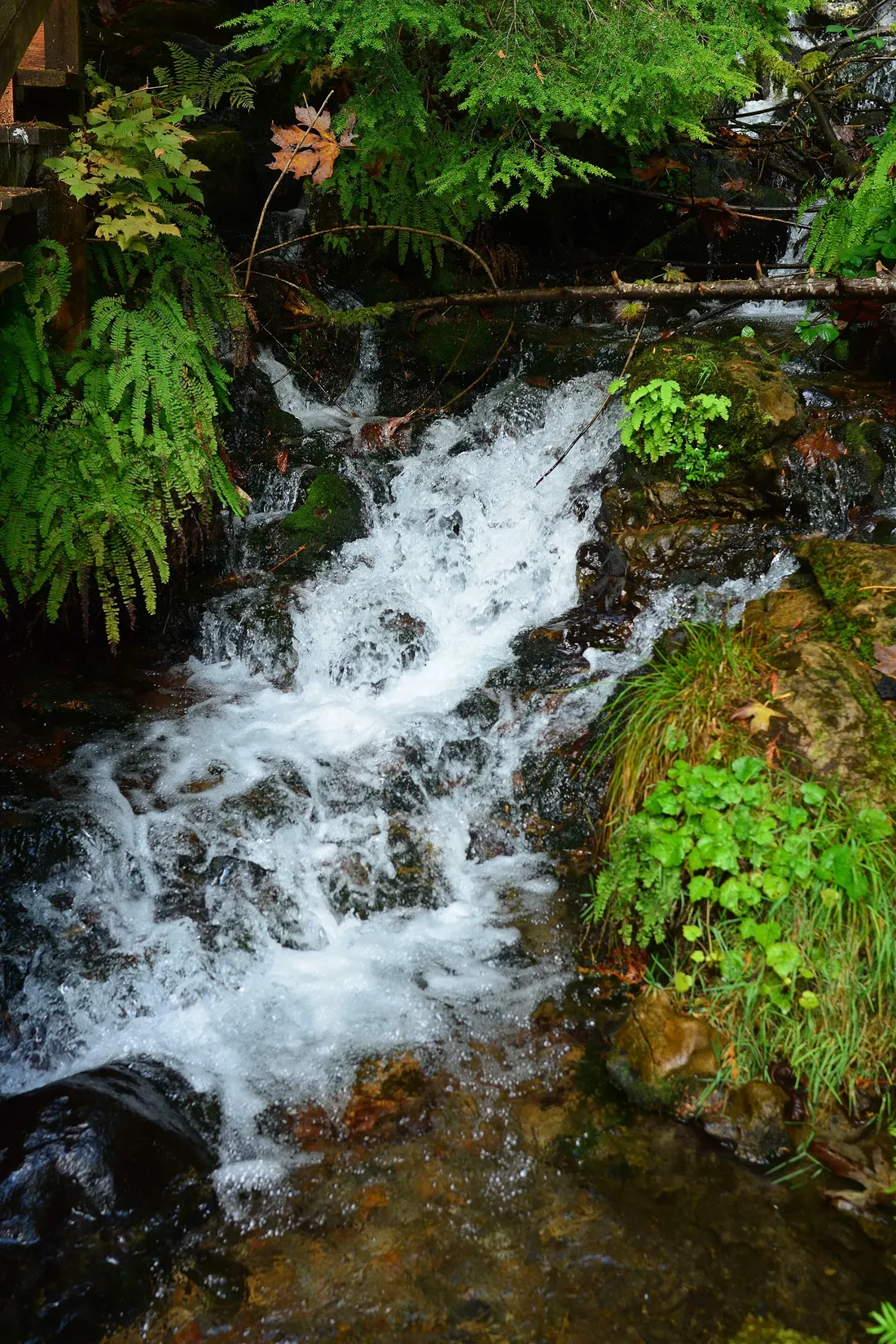
The Green River is the park’s main attraction, but its gorge water is not for beginners. The park says rafting and kayaking here are for experts only, and hand launching is free. The park’s amenity list also includes a kitchen shelter, picnic shelters, a ranger station, accessible restrooms, and firewood. The group camp takes up to 80 people, and the yurts sit with accessible restrooms and showers nearby.
Book through the state parks system up to nine months in advance, with same-day reservations and first come sites as described in the booking section. The park page does not say how many sites are reservable and how many are first come, first served, so this guide gives no share. Plan to reserve for summer weekends and treat any walk-up space as a bonus. Getting supplies is relatively easy from this campground. Enumclaw and Black Diamond are the named towns for groceries, fuel, and a meal. They are close enough that a forgotten item means a short drive rather than a lost trip.
Tolt-MacDonald Park
Quick facts: 16 pull through utility sites with water and electrical hookups at $35 a night, maximum RV or trailer length 36 feet; 17 drive up tent sites at $25; 11 hike in tent sites at $20; six yurts at $55 in April and October and $65 from May to September, sleeping up to six; one camping container at the same seasonal prices, sleeping up to four; a large group site at $140 for up to 60 people and a small group site at $110 for up to 40 people; reservation only, with at least five days of notice, up to one year in advance, two nights minimum and seven days maximum; campground open April 1 to October 31, with the group sites unavailable until Memorial Day weekend; water hookups at the utility sites and water spigots in the campground; restrooms in the main campground; alcohol prohibited. Book on the King County camping page. Groceries and fuel in Carnation, about a mile away.
Tolt-MacDonald Park is King County’s one campground, a county park on the Snoqualmie River at Carnation. It holds every kind of camping the metro offers in a single place, including RV sites, drive up tent sites, hike in tent sites, yurts, a camping container, and two group sites. We have not camped here. Its booking rules differ sharply from the state parks rules described alongside them in this guide.
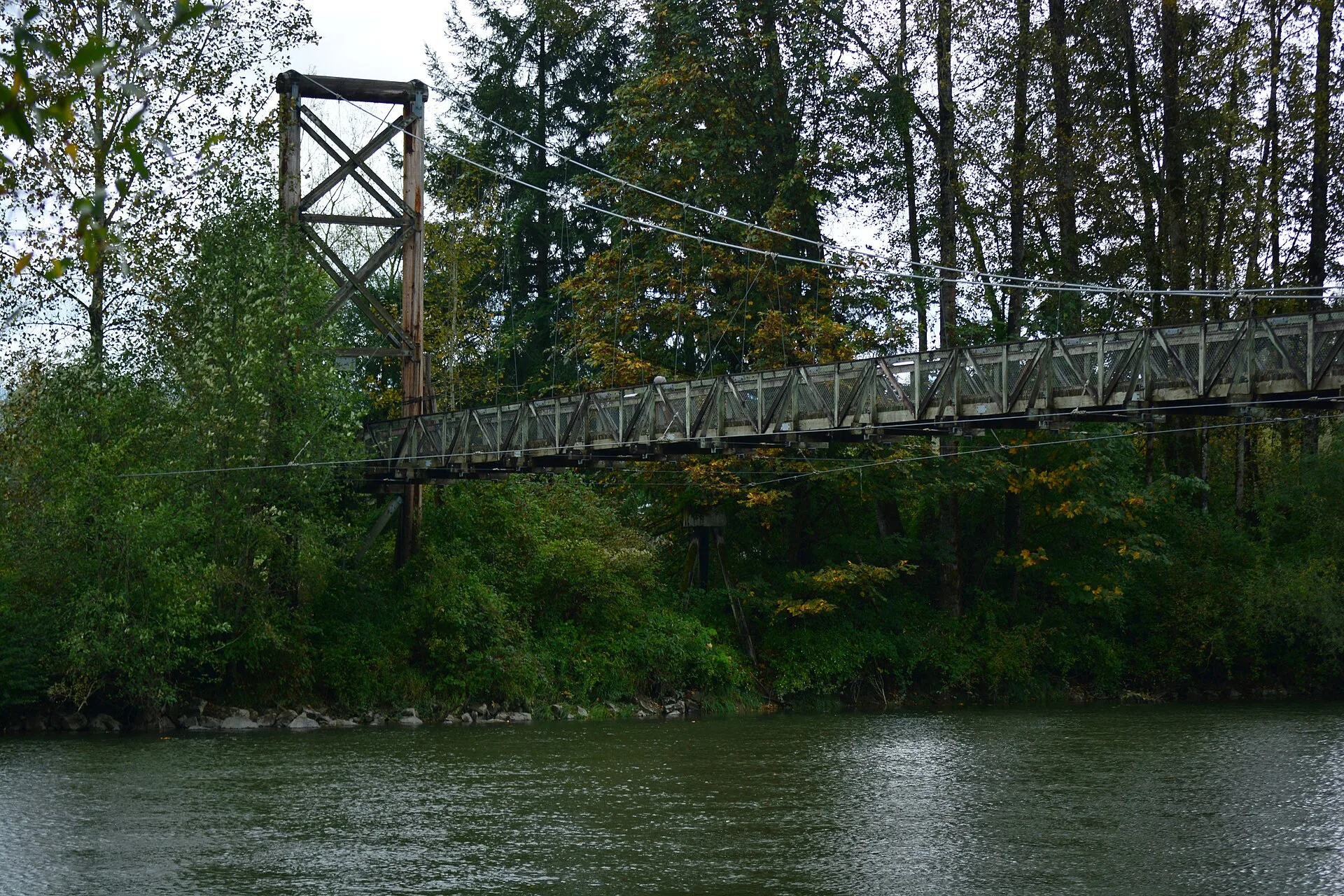
How you reach the sites is an important part of camping here. The yurts, the camping container, and both group sites are walk in only, reached across the park’s 500 foot suspension bridge over the Snoqualmie River, and the hike in tent sites sit on the far side of the same bridge. Wagons may be available from the campground host for the crossing. The large group site is primitive, a half mile hike downriver, with no running water and sani-cans only. Plan a group night there as a backpacking style trip rather than a car camping trip. Each RV and tent site has a picnic table and fire ring. Occupancy is limited to four adults with up to four additional children under 18. The limits are one camping unit and one tent per RV site and two tents per tent site. In spring and fall weather, drive in campsites 18 to 29 and hike in sites A to E may become hike in only.
The county’s camping page and park documents do not state whether this campground has showers or an in-park dump station. This guide therefore makes no claim about either, and RV campers should plan to use a dump station outside the park during the trip. Pets are not allowed in the camping container. They are allowed with pre-authorization in yurts 4 and 6 only. The county’s camping page states no leash rule of its own for tent and RV sites, but the county code keeps pets on a leash no longer than eight feet and under control at all times, so that rule governs a stay. The county’s camping page also does not state check-in, check-out, or quiet hours. This guide does not substitute the state parks hours.
The I-90 corridor
Tinkham Campground
Quick facts: Roughly four dozen sites, all without electrical hookups, a few of them accessible, with picnic tables, food storage lockers, and campfire rings with grills; most sites reservable through Recreation.gov with the rest first come, first served; seasonal, and closed for the season at the November 2026 check; the Forest Service publishes no opening or closing dates for this campground; drinking water; vault toilets; nightly fee from $30 on Recreation.gov for the current season, with next season’s published rates, May 21 to September 11, 2027, at $32 a night standard and $34 premium, plus a $12 a night extra vehicle fee payable on arrival by cash or check only. Book on Recreation.gov, linked from the Forest Service campground page. Groceries and fuel in North Bend, about 12 miles west.
Tinkham Campground is a Forest Service campground about a mile south of I-90 exit 42 on Tinkham Road. It is the corridor’s first campground from the city and close enough to the freeway to hear it. We have not camped here. The federal campground database counts 45 reservable sites, and the Forest Service’s own filings describe 46 sites in all, which is why this guide calls it roughly four dozen rather than printing a count the sources do not quite agree on.
Campgrounds on the corridor have different booking arrangements. Reserve the majority of sites through Recreation.gov. For first come sites, consider arrival timing as described in the booking section, including a weekday or Thursday arrival rather than a Friday evening arrival. The Forest Service publishes no check in and check out times for this campground in the material we read, so this guide gives none.
The road information below comes from reports and has not been verified. Directories and camper reports describe about a mile and a half of unpaved Tinkham Road with significant potholes and slow going for trailers. This is reported information, not a Forest Service statement, because the forest’s own page does not rate the road. I-90 noise is the other constant. Noise is part of a stay at the corridor’s closest forest campground, and the noise section below describes it as a reported pattern. Dispersed camping exists on the forest roads around this campground, but this entry does not direct campers to it. It is undeveloped, cannot be reserved, and requires a different plan from a night at a campground.
Denny Creek Campground
Quick facts: A small reservable campground with one group site and, per the Forest Service’s own page, one first come, first served site; reservations through Recreation.gov; season May to September per the Forest Service, with exact open season dates carried on Recreation.gov; drinking water; flush toilets; no showers in the campground’s stated facilities; electrical hookups at a handful of sites, ten sites plus the group site in the Forest Service’s amenity count; picnic tables and food storage lockers; nightly fee from $38 for the current season, with next season’s published rates, May 21 to September 11, 2027, at $38 standard nonelectric, $40 premium, $54 standard electric, $76 to $80 for double sites, and $140 for the group area, plus a $12 extra vehicle fee payable on arrival by cash or check only; check in 2 p.m., check out noon; quiet hours 10 p.m. to 6 a.m. in the campground’s general information. Book on Recreation.gov, linked from the Forest Service campground page. Groceries and fuel in North Bend, about 20 miles west; fuel and convenience items at Snoqualmie Pass.
Denny Creek Campground is a reservable Forest Service campground near the South Fork Snoqualmie River, about three miles from I-90 exit 47. Its campsites are under forest canopy, with a few on the banks of Lodge Creek. We have not camped here. The sources disagree on its site count, so this guide describes the campground rather than printing a number. The Forest Service’s campground page, its facility description, and its site records give three different totals. This guide describes it as a small campground and leaves the reservation system to show which sites are available to book.
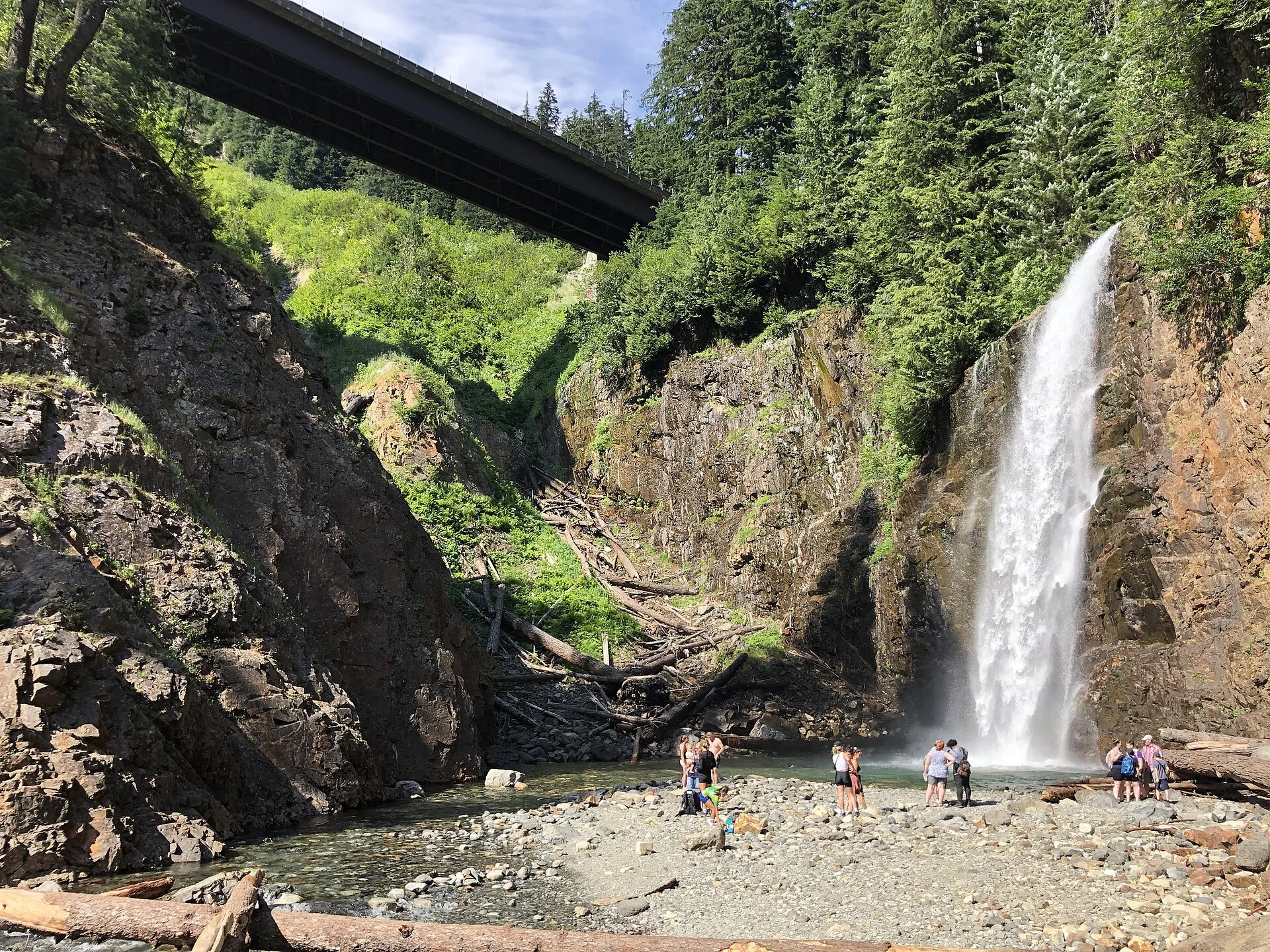
Day use traffic affects a stay here. The Denny Creek Trailhead sits just beyond the campground on the same road. Trailhead parking requires a recreation pass costing $5 a vehicle a day or $30 a year, and the Discover Pass is not valid at federal fee sites. The trailhead’s vault toilet is permanently closed, per the Forest Service’s trailhead page. Camper and visitor reports describe the natural water slide on Denny Creek as a day use attraction. The trailhead, creek area, and campground share the road, so campers arriving on summer afternoons encounter day use traffic.
Of the three corridor campgrounds, Denny Creek has the strongest facilities. Flush toilets and drinking water with spigots put Denny Creek a step above its neighbours for families, and food storage lockers are provided. Stay limit is 14 days. The Forest Service’s page currently says the campground is closed for the season, consistent with a May to September campground checked in November.
Middle Fork Campground
Quick facts: 39 standard sites including two group sites by the facility description, with picnic tables and food storage lockers; the federal record set behind the listing enumerates 39 records, 35 of them reservable, and every record nonelectric; reservations through Recreation.gov; seasonal, and closed for the season at the November 10, 2026 check, with the season’s exact dates not stated on the Forest Service’s own surfaces; the campground sits at 1,100 feet, about 12 miles up SE Middle Fork Road from I-90 exit 34 and a half mile past the Middle Fork Trailhead. Book on Recreation.gov, linked from the Forest Service campground page. Groceries and fuel in North Bend, about 15 miles back, and nothing along Middle Fork Road, so stock up on the way in.
Middle Fork Campground is set in deep forest by the Taylor River, near its confluence with the Middle Fork Snoqualmie River. Douglas fir, cedar, and western hemlock grow there. We have not camped here. The personal note at the end of this entry describes a wish, not a memory. It gets the corridor’s longest entry in this guide because Middle Fork draws more camping searches than anything else in this article’s scope. Campers online also describe using it as a reservable fallback when the corridor’s nearer campgrounds fill.
Where the sources leave a gap, this guide shows the gap, because campers deserve to see it rather than discover it on the road. Neither the Forest Service’s campground page nor the federal facility record states whether water is provided, specifies a toilet type, or mentions campfire rings. Directory listings describe vault toilets and drinking water, and this guide repeats that only as a directory description, not as an operator’s fact. Until the forest’s own pages say more, plan to bring your own water and treat any listing’s facility claims as unverified. This guide gives no nightly fee either, for the same reason. The Forest Service’s pages state no nightly fee, and this guide does not take one from a directory.
Road conditions affect who can come here. The corridor section below describes the road’s segments separately. A recreation pass is required for each vehicle parked at the Middle Fork Trailhead, per the facility record, which matters to campers who plan to hike from camp. The personal note in this entry is about a place we hope to camp. Middle Fork is the campground in this guide where we would most love to camp, but we have not camped there. This entry is based on research and a wish to visit, not on a camping memory.
Lake Easton State Park
Quick facts: Sites from full hookup to non-hookup, some accommodating RV units up to 60 feet; a walk in, tent only group camp for up to 50 people with water and restrooms; reservable on the state parks system to nine months; sites 94 to 135 close September 16 to May 1, and sites 1 to 93 close November 1 to May 1 and run first come, first served from October 16 to 31; off season camping by Sno-Park permit in the day use and boat launch parking areas; Sno-Park permits required December 1 to March 31, when the park operates as a Sno-Park and the Discover Pass is not valid; drinking water, with winter water available in the day use area; restrooms including four accessible restrooms; showers; a dump station; nightly fees per the State Parks fee schedule, standard sites running $31 to $43 in the peak season and full hookup sites $46 to $56 at peak, with shoulder and winter rates below those bands; check in 2:30 p.m., check out 1 p.m. Book through Washington State Parks reservations. Groceries and fuel in Cle Elum, about 15 miles east on I-90.
Lake Easton State Park is where this guide’s corridor ends, a 697 acre camping park with 24,000 feet of freshwater shoreline on Lake Easton, east of the pass in Kittitas County. We have not camped here. Campgrounds farther east, on the Cle Elum River side, fall outside this guide’s boundary.
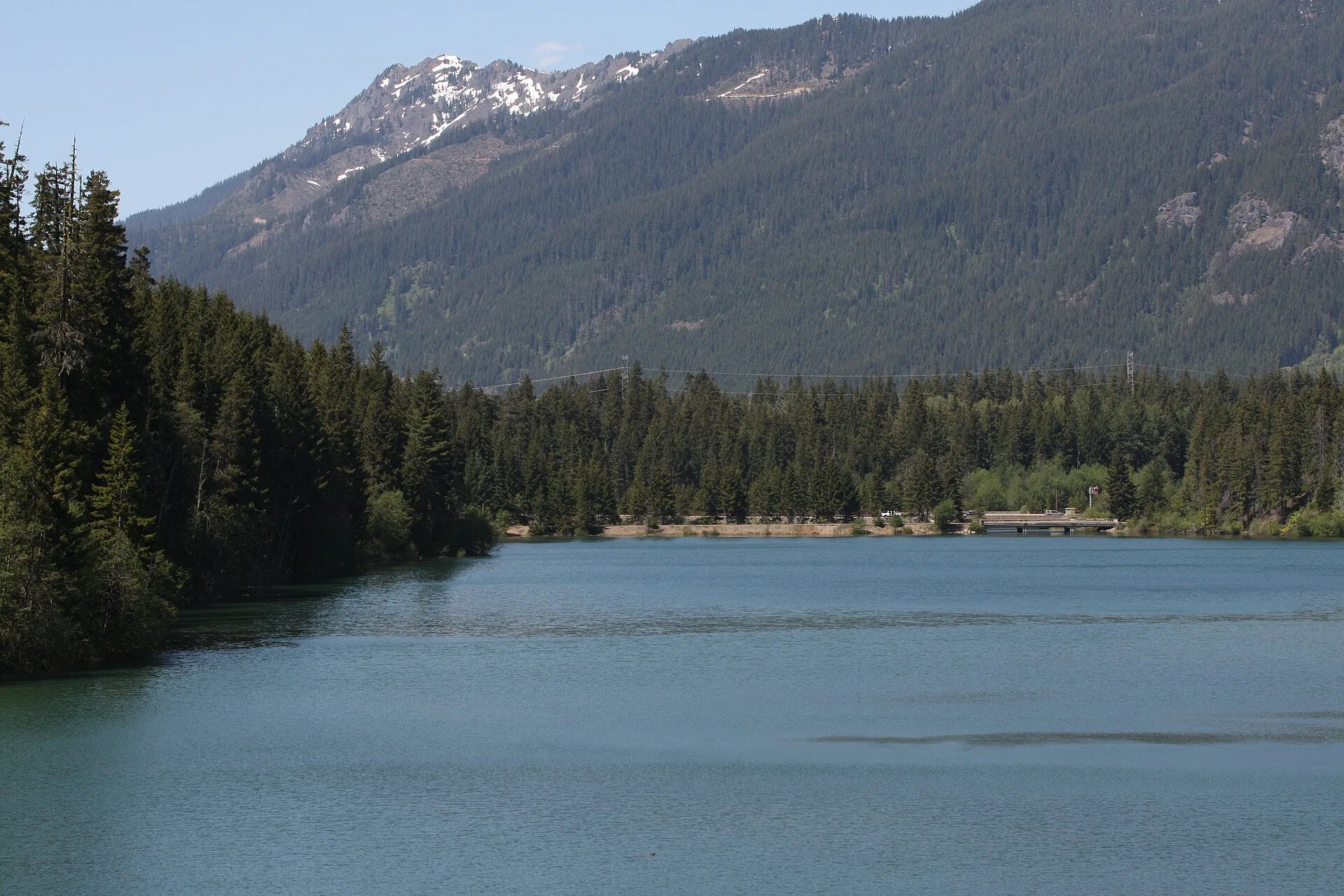
Noise is an important consideration here, and the park’s own page addresses it directly. The park’s own page says, due to the campgrounds’ close proximity to I-90 and highway noises, earplugs are recommended for light sleepers. Camper reports say the upper loops are louder because of the freeway, the lower areas are less affected, and rail noise is present at all hours. Those details are not a Parks statement. Light sleepers should consider the park’s warning when deciding whether to stay. Use the reported difference between loops to help choose a site, not as a promise of a quiet one.
The park also has the following facilities and rules. Boat motors on the lake are limited to 10 horsepower, vehicles over 20 feet park in the boat launch parking lot, and the group camp takes up to 50 people with fire pit, benches, water, restrooms, and parking, at fees that vary with group size. Winter camping there means camping in snow. During the Sno-Park permit season, December 1 to March 31, camping moves to the day use and boat launch areas and requires a Sno-Park permit. This is the corridor’s only winter campground option in this guide. It is for campers equipped for snow, rather than for the May to September season the rest of the guide assumes.
Corridor roads and the trail camps
Two roads serve the corridor’s campgrounds, and conditions vary along each road. Middle Fork Road runs paved to Middle Fork Campground, and campers report gravel, potholes, and a high clearance need beyond the Taylor River bridge. Tinkham Road runs unpaved for about a mile and a half to its campground, with significant potholes reported and slow going for trailers. These road descriptions come from camper reports and directories, because the Forest Service’s own pages do not rate the roads. Campers driving a car or pulling a trailer should plan for the reported conditions rather than discover the actual conditions at dusk. This section puts both roads side by side to help campers make those decisions.
The Palouse to Cascades State Park Trail follows an old railroad route through the corridor. Parks’ trail brochure names four small camps along its western section, Alice Creek, Carter Creek, Cold Creek, and Roaring Creek, all west of Lake Easton on the trail. Each camp has three to four campsites, one picnic table, and a vault toilet. A backcountry camping fee applies, registration is at the trailhead kiosk, and sites are first come, first served. Untreated water is available in nearby streams, and the brochure’s own instruction is to bring water filters. These are the closest backpacking style camps to the city, reached on foot or by riding in. They take no reservations, have no treated water, and leave no margin for arriving unprepared.
You can camp dispersed on the corridor’s forest roads, including Tinkham Road and the South Fork area, but this guide does not treat it as a campground option. It is undeveloped, and this guide does not recommend it as a fallback when campgrounds are full. A family that planned a campground night should not be sent to an unfamiliar forest road shoulder at dusk. Dispersed camping requires its own preparation and has its own rules.
North to Snohomish County
Kayak Point County Park
Quick facts: 30 partial utility campsites with water and power at every site, and 10 yurts; no non-utility tent sites and no RV dump station at the park; reservable through the Snohomish County system online or by call center, with reservations opening in January for the first six months of the year and in February for the rest, booked at least three days ahead, and drop in camping for unreserved sites with the first night bought at the entrance fee machine; open year round; water at every site, year round; a bathroom and shower building for campers, with drop in campers taking restroom codes from a ranger; three minute showers free with camping; 50, 30, and 20 amp electrical outlets at every campsite; campsites $44 a night including the first vehicle’s parking and boat launch permit, yurts $75 on weekdays and $85 on weekends, yurt 10 with its campsite $90 and $100, plus tax, and an extra vehicle $10; weekend reservations require both Friday and Saturday nights, and yurt stays require two nights. Book on the Snohomish County campgrounds page. Groceries and fuel in Stanwood, about 8 miles away.
Kayak Point County Park is a Snohomish County park at the north end of the metro area, on Port Susan, with saltwater frontage, a wooded utility campground, and a row of yurts. We have not camped here. The campground’s utility sites affect RV and tent campers differently. Every campsite is partial utility, which serves RV and trailer campers well. There are no non-utility tent sites, so this guide’s tent list does not direct tent campers here for a tent site. Tent campers with a vehicle they can sleep beside are a different question. The county offers utility sites, priced as utility sites.
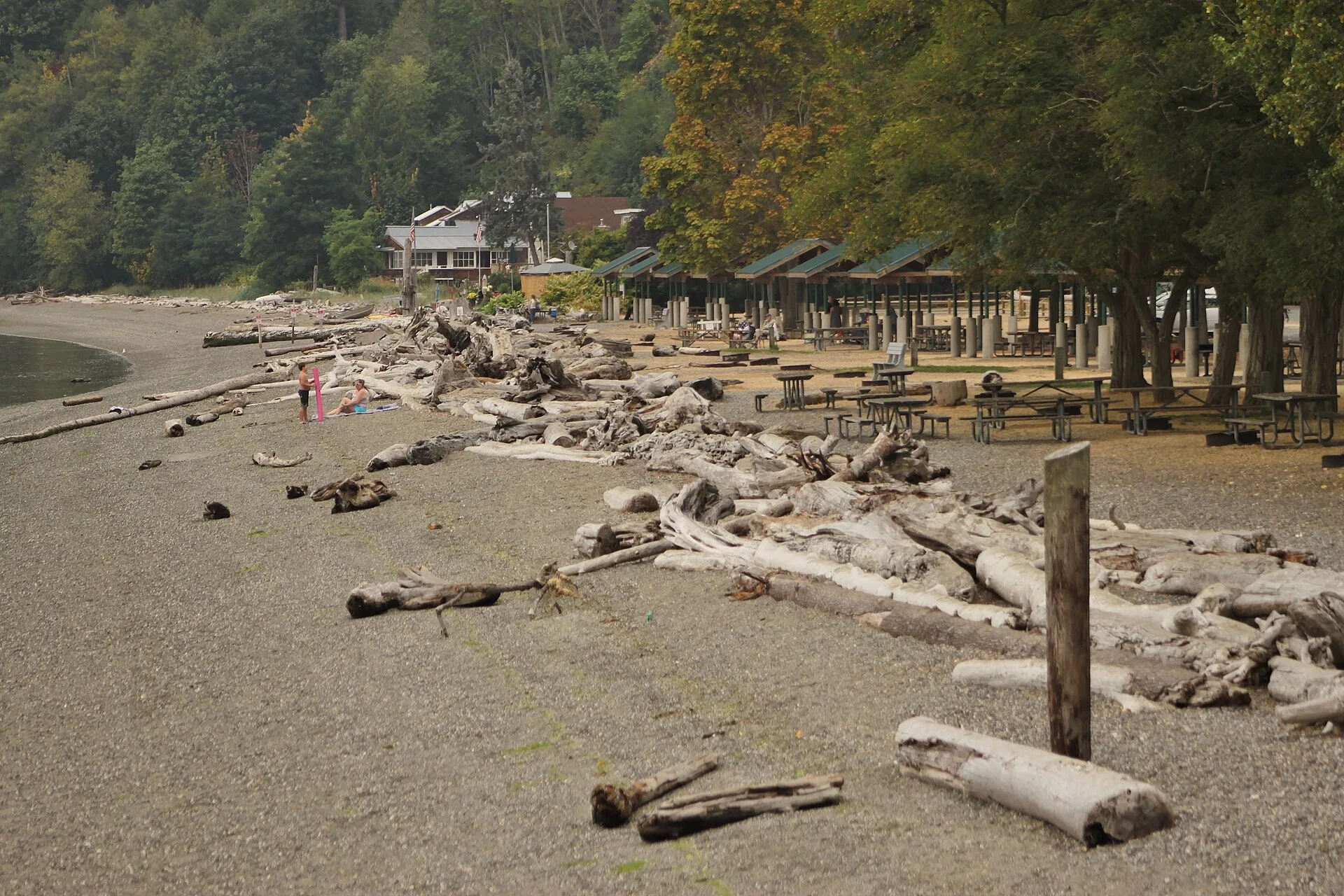
Check the county’s site details carefully. Pad sizes vary, and some sites cannot take larger RVs. The county instructs campers to check each site’s RV pad size in the reservation system rather than assume a park wide maximum, because none is published.
System rules bind every Snohomish County campground, and they appear once, in the Kayak Point entry above, rather than repeating in each entry below. Quiet hours run 10 p.m. to 7 a.m., and generators may not run during them. Alcohol is not permitted in any Snohomish County campground, and stays are limited to 14 nights in a 30 day period. A Discover Pass does not work here. This county park accepts the county’s own access pass for day use, at $10 a day or $75 a year. The campsite fee includes parking for the first vehicle.
One dated construction notice also matters. At our November 10, 2026 read, the county flagged that sections of the park’s day use area are closed for construction, with a project page linked from the county’s campgrounds page. This dated notice concerns the day use area, not a campground closure. Recheck the county’s pages close to any trip rather than treating it as a standing condition.
The rest of the Snohomish County system
Snohomish County runs other campgrounds, described briefly below using facts from the county table. The rules in the Kayak Point entry also apply below. They cover quiet hours, the alcohol ban, the stay limit, and the Friday and Saturday weekend requirement.
Flowing Lake County Park has non-utility and utility sites, showers, and cabins, but no RV dump station. Electrical service varies by site. A listed set of sites has 50, 30, and 20 amp service, and the remaining sites and cabins 2, 3, and 4 have 30 and 20 amp service. Fifth wheels longer than 35 feet are not allowed because of road limitations. The park has limited operations in winter, November to February.
Wenberg County Park pairs non-utility and utility sites with showers and a dump station, with 30 and 20 amp service at sites 11 to 29, 45, and 47. It also runs limited operations in winter. River Meadows County Park has non-utility sites and yurts, but no utility sites or dump station. Its showers serve yurt campers, and drop in campers get a restroom code from a ranger. Squire Creek County Park is the system’s rustic campground, near the two hour edge of the area this guide covers. It has only non-utility sites, with no showers, dump station, cabins, or yurts. It appeals to campers who want the county system without those amenities. Whitehorse County Park has non-utility and utility sites, showers, a dump station, and horse corrals. Sites 1 to 15 have 50, 30, and 20 amp service. The park is at the far edge of this area and closes in winter, November to February. Lake Roesiger County Park is groups only, a non-utility group camp with no individual camping of any kind, booked through the county’s reservation system.
One state park also belongs in this section. Wallace Falls State Park has two walk in tent sites that are first come, first served, backcountry sites at Jay Lake and Wallace Lake by permit, and five reservable cabins. Its walk in tent sites are at the metro area’s north end.
The South Sound
Joemma Beach State Park
Quick facts: Reservable primitive campsites, plus two hiker and biker sites and two Cascadia Marine Trail sites that are first come, first served, the marine trail site open all year; reservations on the state parks system to nine months; reservable primitive season May 15 to October 1, with the campground closed October 1, 2026 to May 15, 2027 on the state’s winter schedule and buoy moorage open all winter; drinking water; restrooms; no showers in the park’s listed amenities; primitive sites $12 a night per the State Parks fee schedule; check in 2:30 p.m., check out 1 p.m. Book through Washington State Parks reservations. Groceries and fuel in Key Center, about 12 miles away, so stock up before you come.
Joemma Beach State Park sits at Longbranch on the Key Peninsula, on the Case Inlet side, reached by the Tacoma Narrows crossing and the peninsula’s own roads, an hour and a half to two hours from South Seattle. It is a small, primitive state park campground on salt water, and it is the one campground in this guide where we have camped, in the summer of 2017. That one summer stay is this article’s only firsthand camping experience. Everything else in this entry rests on the park’s own pages.
The campground rewards the drive. The reservable primitive sites run a defined season, May 15 to October 1, and outside it the campground closes while the marine trail campsite stays open all year for water arrivals and the moorage buoys stay open all winter. The two hiker and biker sites are first come, first served. Joemma is one of the few campgrounds in this guide where a cyclist or walker has an option that a driver cannot reserve. Facilities are primitive, as described by the park. The park lists drinking water and restrooms, but showers do not appear in its amenities record, so plan on no showers. The bathroom type is not stated on the park’s page and this guide does not state it as a park fact.
This entry rests on that stay. Writing about a campground where we have stayed differs from writing about one we have only researched. Here, the difference is modest but real. This is a quiet park at the end of the road, where the trip is the point. The drive across the Narrows puts it far enough out that it does not feel like the metro area it serves. This entry claims nothing more. The State Parks guide covers this park in full alongside other state parks.
Penrose Point and Millersylvania
Penrose Point State Park is Joemma’s Key Peninsula neighbour. It has a short entry here and a full entry in the State Parks guide. The State Parks guide records the following facts. The group camp has a vault toilet. There is no boat launch in the park, the marine pumpout is no longer in service, the nearest public launch is in Home, three miles away, and the nearest state park launch is Joemma Beach, 4.8 miles away. Junior Ranger programs run on Saturdays in summer. Campers considering the Key Peninsula can look at both parks, Joemma in the entry above and Penrose Point for day use and group camping nearby.
Millersylvania State Park, south of Olympia, gets only a short entry in this guide, despite demand that would justify more. It draws 2,400 camping searches a month and had 59,829 overnight stays in 2024. This short entry is based on research, not experience. The full entry is in the State Parks guide. One important detail here concerns firewood. Boy Scout troops sell firewood at the woodshed near campsite 132 from Memorial Day through Labor Day, with pre-order and campsite delivery. Firewood is also sold by the camp host and at the ranger station and gift shop. Gathering firewood in the park is prohibited.
One park may still appear on outdated camping lists. Kopachuck State Park, on the Gig Harbor side, has had its campground permanently closed since 2011, and its marine trail campsite is closed as well. The park is day use only, whatever stale listings still show.
Capitol State Forest
Capitol State Forest, west of Olympia, has the closest DNR forest camping to the South Sound suburbs. Its four campgrounds all operate under the same basic rules. All four are first come, first served, take no nightly fee beyond the Discover Pass, and sit inside a forest season of May 1 to November 30, with a forest stay limit of seven days in a 365 day period. Fall Creek Campground has eight campsites, a horse corral, and a restroom, and is an equestrian favourite in the department’s own description. Porter Creek Campground, at the forest’s west side, more than two hours from South Seattle, has sixteen campsites on the department’s count and is popular with motorcycle and ATV riders.
The other two are closed as this guide is written, and their status can change. Margaret McKenny Campground and Middle Waddell Campground were closed for the summer of 2026 for hazard trees, with laminated root rot named as the cause in the Department of Natural Resources’ April 15, 2026 news release, and their day use areas and trailheads were closed with them. Their reopening status is not settled in the department’s material on file. Even their size is unsettled in the department’s own record. The forest page counts 24 sites at McKenny, while the April release counts 20. At Middle Waddell, the same two sources give 24 and 33, respectively. This guide shows the conflict rather than choosing one count. Before any trip toward either campground, check the department’s current Capitol State Forest page. A closure carried from a 2026 release is a starting point, not a current status: Capitol State Forest, Washington DNR.
Private campgrounds and the in city RV question
Some campers want a full service campground with hookups and laundry close enough to the city to sleep in their RV and work, visit, or tour in the city by day. The Kent KOA, a leading option for these campers, closed. The four entries below remain within an hour’s drive. These entries are shorter than the full entries but include the complete RV facts. Rates and amenities for these entries come from Good Sam, Campendium, The Dyrt, and the operators’ own booking channels, checked November 10, 2026. The guide relies on these sources because private campgrounds publish less of their own information than public campgrounds do.
Trailer Inns RV Park
Quick facts: Full hookups, power, water, and sewer, at 30 and 50 amp; pull through and back in sites, the largest pull through class taking RVs up to 45 feet; about 90 sites; open all year; restrooms, showers, laundry, an indoor pool, and WiFi in directory amenity lists; rates from $48 a night, with a directory rate table mirroring the operator’s site classes listing small pull through sites to 35 feet at $48, regular back in sites to 30 feet at $51, large back in sites to 34 feet at $55, and the 45 foot pull through at $74, each plus taxes, with 10 percent discounts for military members, first responders, and hospital stay guests; 15531 SE 37th Street, Bellevue.
Trailer Inns RV Park is an Eastside option for campers looking to stay close to the city, with the full service amenities they seek. This guide leaves its tent camping status unsettled. One directory lists tent sites, but the park appears to be RV only in all other sources. Until the operator’s own material settles the question, this entry treats Trailer Inns as an RV park. RV campers get everything they need. Site classes are priced by length, and pull through sites are available. Discounts for military members, first responders, and hospital stay guests suggest that the park serves people on working stays as well as travelers.
Vasa Park Resort
Quick facts: Tent, car, and RV camping welcomed in the operator’s own summary; full hookup RV sites with electric, water, and septic, and partial hookup spaces, with all sites carrying 30 amp electrical and water; prices disagree across the operator’s booking channel and the directories, Campspot listing from $55 and The Dyrt listing $65 to $125 a night across site types; short term reservations through Campspot, with long term stays by request; a 15 acre Lake Sammamish waterfront park, with day use open to the public or by membership.
Vasa Park Resort, on the Lake Sammamish shore in Bellevue, is the one campground near the city in this guide whose own material welcomes tent campers alongside RVs. It appears in both camper type views above because tent campers who want a serviced site near a lake within an hour’s drive have very few legal options, and this is the clearest of them. Those prices disagree, and this guide does not reconcile them. The operator’s booking channel starts at $55, and directories run to $125 across site types. Site type decides the bill here more than season does.
Issaquah Village RV Park
Quick facts: Full hookups, water, electric, and sewer, at 30 and 50 amp; about 30 spaces; rigs up to 60 feet, with two pull through sites at 24 by 60 feet; a shower house, laundry, a dump station, and WiFi in directory amenity lists; rates from $78 a night in Good Sam’s listing; 650 1st Ave NE, Issaquah; no source read for this guide states tent camping, and the entry is RV in form.
Issaquah Village RV Park is a small full hookup park in town in Issaquah that takes rigs up to 60 feet. Its noise situation is the clearest among the private campgrounds. The park sits roughly 200 feet from I-90, and reviewers consistently mention freeway noise. The campground offers a location near the freeway and hookups, but freeway noise is a tradeoff for light sleepers. Choose it for its in town location and RV facilities, not for quiet.
Angle Lake RV Park
Quick facts: RV only; full hookups with 30 and 50 amp electrical service, water, sewer, and garbage; daily rates of $100 on weekdays and $120 on weekends, weekly $650, and monthly rates from $1,000 to $1,400, in the operator’s rates as mirrored by directory listings; reservations required; check in times vary by season, with early and late check out options for an additional fee; 200 feet of private waterfront on Angle Lake with a dock, swimming not permitted within the park; showers, WiFi, and a dump station in directory amenity lists; in SeaTac, across from a light rail station.
Angle Lake RV Park is the closest this guide covers to an in city RV park. It is an RV only campground on Angle Lake in SeaTac, with a light rail station across the road. Of the entries here, it is the one whose main attraction is access to the city itself. Its daily rates, $100 on weekdays and $120 on weekends, are the highest nightly rates among this guide’s private entries. A full hookup site a train ride from downtown differs from a $30 forest site. The seasonal check in variation is worth a phone call before a late arrival, since the park states its check in times by season rather than by a single hour.
The Kent KOA and what closed with it
The Seattle Tacoma KOA Journey in Kent, for years the default answer to where an RV stays near this city, is permanently closed on the operator’s own record. KOA’s own listing states its operating status as permanently closed, checked November 10, 2026, and the campground’s page address on koa.com now redirects to KOA’s Washington state index, which no longer carries it as a bookable campground. Third party directories still list it as open and bookable, but those listings are out of date. The guide records the same pattern at Kopachuck. It was the main option for that kind of camping. The four entries above and the short entries below are the remaining options for campers seeking a site close to the city. If a successor ever reopens the Kent site, this guide will say so.
The remaining private campgrounds have short entries based on what we could verify.
| Campground | What it is and what to know |
|---|---|
| Maple Grove RV Resort, Everett | RV only, 87 numbered sites in pull through, perimeter back in, and split forms, full hookups including 20, 30, and 50 amp power, water, and sewer, from the operator’s own sites page |
| Lakeside RV Park, Everett | RV only, more than 150 sites with 20, 30, and 50 amp full hookups. The operator’s page emphasizes long term stays and currently accepts long term reservations. It does not state whether nightly stays are offered, so this guide does not list them |
| Twin Cedars RV Park, Lynnwood | An RV park on Highway 99, listed from directories only. No operator website was found, and its booking terms are not established, so this guide lists only its existence and location |
| Roney River Ranch, Duvall | Private drive in campground on the Snoqualmie River with tent sites and RV sites at $45 to $50 a night according to directories, reservations available. The only tent camping option found in the Duvall and Carnation area beyond Tolt-MacDonald |
| Lake Sawyer RV Resort, Black Diamond | Year round resort with full hookup RV sites, tent camping and cabin rentals among the operator’s listed amenities, and short term stays bookable by the public through the operator’s own booking engine. Good Sam lists from $57 a night |
| Blue Sky RV Park, Preston | Private RV park with daily, weekly, and monthly sites in its own description. Tent status not established, so this guide lists it for RVs only |
| Lake Pleasant RV Park, Bothell | Private full hookup RV park, 50 amp service and big rig friendly in directory listings. Tent status not established |
| Tall Chief RV Resort, Fall City | A Thousand Trails network resort. The operator has separate reservation lines for members and non-members and lists tent sites for booking. The only membership condition it states is that seasonal and annual stays require membership or a Camping Pass |
| Nor’West RV Park, North Bend | Private, all sites full hookup in its own description, and no tent camping stated. RV only |
| Enumclaw Expo Center RV Campground | Municipal fairground RV camping. Tent status not established, and this guide lists no fee |
| Sun Outdoors Gig Harbor | Full hookup RV sites and rustic tent sites in directory and search summaries. The tent area comes from directory listings |
| American Heritage Campground, Tumwater | RV camping year round according to the operator. Its page mentions a tent area in a notice about a Memorial Day weekend opening in 2024. The tent area is seasonal, and that notice is dated, so it is not confirmed for the current season |
| Columbus Park, Olympia | Private despite the name, with RV spaces and tent camping in season in its own description, plus monthly and yearly RV spaces |
| Offut Lake Resort, Tenino | Private, cabins and RV sites in its own description. Tent status not established |
| Majestic Manor RV Park, Puyallup | 88 sites, full hookup, year round, with a pool and laundry, from directory listings |
| South Prairie Creek RV Park, South Prairie | 110 sites, full hookup, year round, creek frontage, and direct access to the Foothills Trail, from directory listings |
| Riverbend Campground, Olympia | On the Nisqually River, with 31 RV sites, four full hookup and 27 partial hookup with power and water, including eight pull through sites. Of the 40 tent sites, three are group sites and 15 have direct river access. Figures are from the operator’s own site. More private tent sites than any other campground in the South Sound set |
| Olympia Campground and Fuel, Olympia | Open to the public all year for RV sites and seasonally for tent sites, with pull through sites, 30 amp full hookups, and 20 amp electric and water sites, from the operator’s own site |
| Nisqually RV and Commercial Park, Olympia | RV only, $58 a day and $525 a month plus metered power. The operator requires RVs to be 2010 or newer and requires background checks for each adult on longer stays |
| Deep Lake Resort, Olympia | A gated, adults only facility with 20 RV sites with metered electrical hookups plus water and waste. It is not the Deep Lake at Millersylvania State Park, and the two should never be confused |
Two more places readers may look for are listed here. Camp Long, the City of Seattle’s own overnight park in West Seattle, offers ten rustic cabins and nothing else overnight. The city states that Camp Long does not offer tent or RV camping and that no tenting, RVs, or camper trailers are allowed overnight. Hans Jensen Group Camp, at Lake Sammamish State Park in Issaquah, is a group camp only. Individual camping is not permitted at the park. The group camp is a single private area with a picnic shelter, tables, fire rings, and vault toilets. Reserve it online or through the state parks reservation line at (888) 226-7688. Its season runs May 19 through Labor Day. We have camped there as a group in the group camping area. We are not claiming to have camped there individually.
Frontier Park, Pierce County’s fairground in Graham, allows camping only for large, multi day rentals and requires preapproval, so it is not a walk up or reservable public campground. The Washington State Fair RV Park in Puyallup has a main RV park in the Orange Lot, open year round. Overnight RV parking requires an advance reservation. Off season rates start at $42 a night with water, power, and sewer, and event rates are higher. A seasonal Green Lot operates only for select events, including the fairs.
Five campgrounds with membership or eligibility requirements are listed here to show what is not available to everyone. Thousand Trails Thunderbird in Monroe is a gated membership preserve where tent camping is allowed and camping requires a Camping Pass or full membership. Tall Chief, the network’s other preserve in this area, differs as its short entry above explains, because non-members can book there. Port Susan Camping Club in Tulalip is a private membership club where members purchase a membership, pay an enrollment fee and annual dues, and hold an assigned site. The club’s own material lists more than 2,500 sites. It does not offer nightly public camping in any form. Jim Creek Navy Community Recreation Area in Arlington serves active duty, reservists, retired military, Department of War civilians, and sponsored guests at a 100 percent ID check installation, and the general public cannot camp there. Pleasant Forest Camping Club in Olympia is members only in its operator’s own words. Washington Land Yacht Harbor in Lacey is an Airstream club harbor where camping is a member benefit, and its event center is a rental facility rather than a campground.
Across the water
This section covers parks across the water together because getting there involves a choice of routes. West of Seattle the choice is a ferry or the long way around. You can reach Kitsap on the Seattle to Bremerton, Seattle to Bainbridge, Edmonds to Kingston, or Fauntleroy to Southworth ferry when a sailing fits your plans. The drive route takes I-5 south and crosses the Tacoma Narrows Bridge on SR 16. It covers more miles but avoids ferry waits. This guide counts driving time only and does not count ferry waits, so treat an hour and a half to two hours as a best case. Each park named below is covered in full in the State Parks guide or its regional entry in the Washington campgrounds by region hub. This section names the parks and points you to those guides rather than covering them again.
Fay Bainbridge Park and Campground, on Bainbridge Island, is important to note because it is a full public campground run by a park district rather than a county. Lists based on counties and state parks miss it. The Bainbridge Island Metro Park and Recreation District runs it as a general public campground, reservable online, by phone, and in person. Tent sites run $25 a night, RV sites with water and electricity $45 a night, and five cabins run $105 a night with a two night weekend minimum. Some tent sites are held for same day, first come arrivals, giving that shore a public campground where campers can arrive without a reservation. It is the only full public tent and RV campground on Bainbridge Island this guide could find.
The Kitsap and Hood Canal state parks are named in drive time order. Manchester State Park is an hour and a half to two hours away on the Kitsap side. Belfair State Park is the same distance away, where Hood Canal bends. Beyond two hours away are Kitsap Memorial, Scenic Beach, Twanoh, Potlatch, and Dosewallips State Parks, each covered in full in the State Parks guide. Between them are Department of Natural Resources campgrounds on the Tahuya Peninsula. You can drive into Tahuya River Horse Camp and Green Mountain Horse Camp on weekends only, from Memorial Day through Labor Day, and only when camp hosts are present. Tahuya River is a non-motorized campground with no off-road vehicle trail access from the campground. Camp Spillman is a year round recreation site with sites that accommodate RVs up to 30 feet. Kammenga Canyon is primarily motorized and rustic.
Three private campgrounds serve the same shore. Eagle Tree RV Park in Poulsbo is RV only with 93 full service sites. Directory listings say the Suquamish Clearwater Casino Resort RV Park has 19 full hookup sites behind the resort, reservable online only. Use requires a casino Players Club card, which is free and issued at the Players Club desk. Directory listings also say The Point Casino and Hotel’s RV area at Kingston offers electric, water, and WiFi for self contained RVs only. There is no dump station on site, the maximum stay is five consecutive days, and reservations are available by phone or at the front desk.
Blake Island Marine State Park carries no drive time because there is no drive. It is accessible only by boat, and camping there remains a wish for us. We would love to camp on Blake Island, but we have not. We have never visited or crossed to the island. We include it only as a place we aspire to camp, and readers with a boat can find its full entry in the State Parks guide. At the north edge of the metro area, Camano Island State Park has a full entry in the State Parks guide. Cama Beach Historical State Park is mentioned here only for its cabins at a preserved fishing resort. This guide could find no tent or RV campground there.
Noise and picking a site
Noise reaches every part of the metro, but not evenly. In the corridor, freeway noise is a concern. Lake Easton’s operator recommends earplugs for light sleepers, the strongest noise statement any operator in this guide makes. Campers report that the upper loops are louder because of I-90, the lower ground is less exposed, and rail noise is present at all hours. Campers report that I-90 noise is a regular presence at Tinkham, which is close to the freeway. At Denny Creek, the creekside sites are on the banks of Lodge Creek. Issaquah Village is roughly 200 feet from I-90, and reviewers consistently mention freeway noise. Campers report aircraft noise at Dash Point, which is in the Sea-Tac flight path. Saltwater is also in the flight path, but its campground closure makes that a day use concern rather than a camping concern for now.
Quiet hours also matter, and they differ by park system. State parks run quiet hours from 10 p.m. to 6:30 a.m., with engine driven generators allowed only between 8 a.m. and 9 p.m. Snohomish County runs quiet hours from 10 p.m. to 7 a.m. and bars generators outright during them. Denny Creek’s general information states quiet hours of 10 p.m. to 6 a.m.
Those quiet hours do not control freeway, railway, or aircraft noise. Choosing a site is the one way a camper can control exposure to that noise. Choose a creekside site or one on the far side of the loop where the campground offers that choice. Put your RV or tent between you and the road where the site allows it, and take an operator’s recommendation to bring earplugs seriously.
A first night out from Seattle
Community discussions suggest beginners ask one question when choosing a first campground, could they go home if the night did not work out? That option to leave is sensible, and this guide uses it to choose first trip campgrounds. Campgrounds under an hour away are the first night choices, close enough to drive home at midnight if needed. A first night should also test the tent, stove, and sleeping arrangement somewhere the consequences of a problem are low. First timers often look for camping at two mountains where it is not allowed. Cougar Mountain and Tiger Mountain, the Issaquah Alps at the city’s edge, have no overnight camping, and no amount of searching will find a legal site on either.
While Saltwater is closed, Dash Point is the first night choice. It is a full service state park campground on a beach, within an hour’s drive and close enough for a short trip home. Its reservation system has a same day release. Kanaskat-Palmer is the first campground choice for a family that wants a river and big timber. Its entry above has the booking details. Saltwater returns to the head of this list if and when it reopens, on the basis recorded in its entry.
The choices also depend on trip length. One night means staying under an hour out. A weekend allows you to consider campgrounds up to an hour and a half away and the whole corridor. A long weekend adds campgrounds an hour and a half to two hours away, the Key Peninsula and the far side of the county system. It also allows a trip to a campground across the water that this guide only names, provided you count the ferry time.
Security and emergency readiness
This guide offers vehicle security advice for corridor trailheads and campgrounds, not crime rates. No operator publishes rates, and this guide does not invent them. The advice follows the standard guidance used at trailheads and park kiosks. Leave nothing visible in a parked vehicle, take valuables with you or leave them at home, lock the vehicle, and report a break in to the park or the sheriff’s non-emergency line so the record exists where managers can act on it. The Denny Creek and Middle Fork trailheads are busy day use access points in the corridor. The same guidance applies in their lots, where a recreation pass is required for parking.
Emergency readiness starts with knowing where the nearest hospital towns are. The nearest hospital towns to this guide’s grounds are Federal Way for the south shore parks, Enumclaw for the Green River and Carnation reach, North Bend for the corridor, Cle Elum for Lake Easton, Marysville and Everett for the county system’s saltwater side, and Olympia for the South Sound and Capitol Forest. Before a trip, sign up for the relevant county alert system. These include ALERT King County, Pierce County ALERT, the Snohomish County emergency management alerts, Thurston County’s emergency alerts, and the Kittitas County Sheriff’s alerts. Each county’s fire marshal notices provide burn restrictions that apply in addition to park rules in dry months. This guide also lacks information about carrier coverage. This guide’s research did not collect carrier coverage reports for these campgrounds, so it does not name a carrier for any campground in the article. Treat coverage as unknown, download maps and reservation confirmations before leaving, and do not plan an overnight trip around a signal this guide has not verified.
Frequently asked questions
Everything reservable near Seattle is booked. What do I do?
Follow the fallback steps in the booking section. State parks sites can be booked on the arrival day itself until 2 p.m., and unreserved sites go first come, first served after 2:30 p.m. Recreation.gov holds the corridor’s reservable Forest Service campgrounds. County systems have their own booking schedules. Capitol State Forest campgrounds are entirely first come, first served. Tinkham has some first come sites alongside its mostly reservable sites. Private campgrounds sell sites night by night that the public systems do not list.
What are my chances arriving first come on a Friday afternoon?
Your chances are lower than on any other day of the week, and the honest advice is to change your arrival day rather than the campground. Campers report that success with first come sites depends on the day. Arriving on Thursday or another weekday is a different experience from arriving on Friday evening, when campgrounds in the corridor fill from the freeway outward. Where your chance depends on campers leaving, be at the campground gate by early afternoon. If a reservation is available for your dates in any system, take it instead of risking a family’s Friday on an unreserved site.
How loud is I-90 at Denny Creek and Tinkham, and does site choice change it?
The corridor runs beside the freeway, and light sleepers should expect road noise rather than hope to avoid it. Lake Easton is the reference point, because the park itself recommends earplugs for light sleepers. At Denny Creek, the creekside sites are on the banks of Lodge Creek. At Tinkham, campers report a pattern of I-90 noise throughout the campground.
Will a car or a trailer manage Tinkham Road and Middle Fork Road?
Conditions vary by road segment, as described in the corridor section. Middle Fork Road is paved to Middle Fork Campground. Campers report needing a high clearance vehicle only beyond the Taylor River bridge, past the campground. Tinkham Road is more challenging. About a mile and a half is unpaved, with significant potholes reported. Travel is slow for trailers, and the road is passable with patience rather than speed. Those road descriptions come from reports, because the Forest Service does not grade its own roads in the material this guide read.
Is Saltwater State Park open for camping, and what is the nearest saltwater alternative?
No. Washington State Parks posted the campground’s closure alert in June 2026 while it reevaluates camping in the park, with flooding and erosion projects in the campground area, and no reopening date exists. The park itself is open for day use. The nearest saltwater alternative with a working campground is Dash Point State Park, twenty minutes farther south in Federal Way, and its entry above covers it in full. Check Saltwater’s current park page before relying on any listing that shows it open, including older versions of other guides.
Where should a family take a first night close enough to go home if it fails?
Choose somewhere within an hour’s drive. Right now, Dash Point State Park is the choice, for the reasons given in the first night section. This guide recommends Saltwater State Park for a first family night based on a visit, not a stay. It returns to the top of the list if it reopens. Kanaskat-Palmer is the first night choice for a family that wants a river under big timber instead of a beach.
How risky is leaving a vehicle at a corridor trailhead, and what do operators recommend?
This guide gives guidance, not rates, because no operator publishes rates. Leave nothing visible in the vehicle, take valuables along or leave them home, lock up, and report any break in so the record reaches the managers. The trailhead lots on the Denny Creek and Middle Fork roads are busy access points in the corridor. Parking there requires a recreation pass, and the Discover Pass is not valid at those federal fee sites.
Where can a van or a small RV overnight near the city with hookups, and what happens on a late arrival?
Four private campgrounds offer full hookups. They are Trailer Inns and Vasa Park in Bellevue, Issaquah Village near the corridor, and Angle Lake in SeaTac. Each entry lists its rates. Late arrival rules differ by place. At state parks a camper may enter until 10 p.m., and after the gate closes may use the slider bar, close the gate, and register the next morning, with a reservation becoming a no show at 1 p.m. the day after the scheduled arrival. At Angle Lake, directory listings restating the operator’s terms say check in times vary by season. Call ahead if you expect to arrive late.
Sources
Washington State Parks park pages for Saltwater, Dash Point, Kanaskat-Palmer, Lake Easton, and Joemma Beach State Parks, the Winter Schedule, the fees page, the camping rules and arriving at the park guidance, the reservations guidance, the Palouse to Cascades State Park Trail brochure, and the Lake Sammamish State Park page for the Hans Jensen Group Camp, all read November 10, 2026.
US Forest Service campground pages for Middle Fork, Denny Creek, and Tinkham, with the federal facility records for all three held through the Recreation Information Database, read November 10, 2026. Recreation.gov’s Mt. Baker-Snoqualmie National Forest page for the corridor’s current season minimum rates, and its rules and reservation policies page for the reservation fees.
King County Parks camping page, the county’s Tolt-MacDonald campground map, and the county’s Tolt-MacDonald park brochure, and King County Code 7.12.225 for the county pet rule, read November 10, 2026. Snohomish County Parks campgrounds page, the county’s 2025 fee schedule, the Kayak Point Regional County Park facility page, and the county’s rules, policies, and regulations page for its pet rules, read November 10, 2026.
Washington Department of Natural Resources, the Capitol State Forest page and the department’s April 15, 2026 news release on the Capitol State Forest campground closures. KOA’s own listing record for the Seattle Tacoma KOA Journey, checked November 10, 2026. Seattle Parks and Recreation for Camp Long, and Pierce County Parks for Frontier Park. The pet rule for DNR campgrounds comes from WAC 332-52-140.
Operator material for Vasa Park Resort and its Campspot booking channel, Thousand Trails for Tall Chief RV Resort, American Heritage Campground, Sunrise Resorts for Lake Sawyer RV Resort, Riverbend Campground, Olympia Campground and Fuel, Maple Grove RV Resort, the Washington State Fair for its RV park, and the Bainbridge Island Metro Park and Recreation District for Fay Bainbridge Park and Campground, read November 10, 2026. Good Sam, Campendium, The Dyrt, and RV Life directory listings for the private entries and short entries, used as listing level evidence and named in the text wherever one carries a rate or an amenity. County emergency management and fire marshal sources for King, Pierce, Snohomish, Thurston, and Kittitas Counties, for the alert and burn restriction routes named in the emergency section.
Camper reported material comes from forums and community groups. Where it supports a claim, this guide paraphrases it and labels it in the text.