Leave No Trace and Beyond

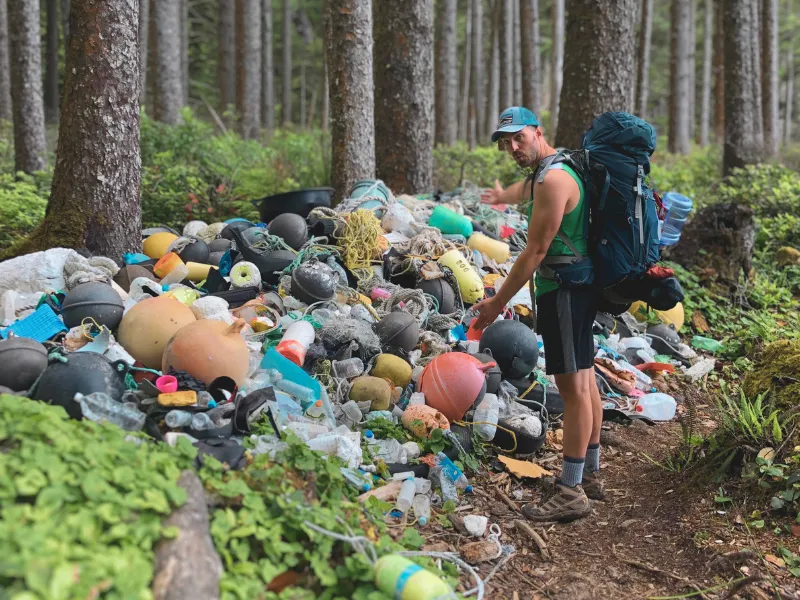
Heaps of trash on WA trail hike

A record 181.1 million Americans (58.6%) participated in outdoor recreation, according to the Outdoor Foundation’s 2025 Outdoor Participation Report [1]. Leave No Trace guides responsibly enjoy and protect the outdoors, whether hiking, car camping, backpacking, or even at home.

I am an outdoor enthusiast who took the Leave No Trace course [2], read multiple research articles, blogs, and books, and spent well over 15+ hours researching not only Leave No Trace but also general environmental philosophy, wilderness management theory, and various outdoor ethic recommendations that extend beyond the Leave No Trace seven principles. 

Leave No Trace Seven Principles

#1 Plan Ahead And Prepare

  • Keep your group small to reduce impact.
  • Know the rules and get a permit if needed.
  • Check the weather forecast.
  • Bring appropriate gear and clothing.
  • Test gear at home.
  • Schedule arrival 2 hours before sunset to set up camp.

#2 Travel And Camp On Durable Surfaces

  • Hike on designated trails.
  • Hiking in the middle of the trail, including walking through mud puddles to reduce trail widening.
  • Walk spread out on barren dirt, gravel, sand, rock, snow, or leaf litter in low or no-trail areas.
  • Avoid stepping on living soil or cryptobiotic crusts found especially in desert areas.
  • Avoid trail shortcuts.
  • Find a great campsite,preferably at an established site.

#3 Dispose Of Waste Properly

  • Biodegradable soap doesn’t mean it’s good for fish or plants.
  • Wash dishes in a large container rather than directly in streams or lakes.
  • Strain out food bits from dishwater or gray water and dispose of them in the trash rather than on the ground or in the water.
  • If disposal facilities aren’t available, scatter gray water widely >200 ft from the camp and water sources. This includes using your camp shower.
  • Pee on durable surfaces such as rocks or pine duff >200ft from trails, campsites, high-traffic areas, and water sources [3].
  • Poop in an outhouse if available; otherwise, dig a hole and bury at least 200ft from the trail, camp, or water sources.
  • Always pack out or bury dog poop.
  • Pack out all trash, including peels, diapers, and eggshells. 

#4 Leave What You Find

  • Take a picture instead of taking it or carving it.
  • Leave all rocks, flowers, and other natural objects.
  • Leave archaeological objects, including arrowheads, as these are federally protected [4].
  • Follow all foraging guidelines [5].
  • Leave areas as you find them, including avoiding digging trenches or building forts.
  • Clean outdoor gear before and after your trip to reduce invasive species.

#5 Minimize Campfire Impacts

  • Use stoves for cooking.
  • Check regulations before starting a campfire.
  • Never leave a fire unattended.
  • Supervise young children around the fire.
  • Only use sticks that are dead, down, and can be broken by hand without tools.
  • Put out fires safely by letting it burn down, drowning it with water, stirring it up, and checking it for heat.

#6 Respect Wildlife

  • Observe wildlife from a distance.
  • Never feed wildlife.
  • Store food and trash securely using a bear canister.
  • Take binoculars or zoom lenses for maximum wildlife enjoyment.
  • Avoid wildlife during sensitive times: mating, nesting, raising young, or winter.

#7 Be Considerate Of Others

  • Share the trail with uphill hikers with the right of way and use caution when passing.
  • Reduce noise, both your voice and music, while camping and hiking.
  • Limit entertainment and communication tech while outdoors.
  • Show respect and care for all – No shaming/bullying. 
  • Be a responsible pet owner who knows the rules, picks up poop, and keeps your pet on a leash.
  • Make outdoors welcoming, especially for minority communities.
    • Often with a fear of outdoor spaces due to historical reasons
    • Often with a lack of knowledge of how to get to and enjoy the outdoors
    • Often experience a lack of an invitation to get outdoors (but they don’t need permission either)
    • For more info, check out Black Folks CampToo.

Beyond Leave No Trace 

Photo: ©Kamchatka via Canva.com

Leaving no trace is truly impossible. The Leave No Trace Center, the US Forest Service, and various other groups have advocated for going beyond Leave No Trace by moving towards a sustainable lifestyle every day [6,7,8,9]. Here are several tips recommended by various experts to go beyond Leave No Trace towards a better, more sustainable outdoor lifestyle: 

#8 Beyond Leave Not Trace Starts at Home

  • Reuse equipment and clothing if possible.
  • Buy only the necessary equipment and clothing you need.
  • Minimize single-use items.
  • Take care of your equipment and clothing, including properly caring for your sleeping bag, boots, tent, backpack, and other outdoor gear.
  • Use responsible geo-tagging on social media.
  • Make responsible food and lifestyle consumption choices.
  • Decrease overall energy consumption, including the use of alternative transportation. 
  • Get involved in outdoor communities advocating for sustainability.
  • Start today in your green space areas.

#9 Beyond Leave No Trace Continues with a Broader Awareness

  • Learn about the ecological processes and conditions in the areas you both live and enjoy outdoors,such as the prior indigenous cultures, local weather patterns, geology, native plants, trees, and animals.
  • Learn basic primitive woodcraft skills such as reading animal tracks, foraging, building a survival shelter, and other basic survival skills.
  • Learn about the manufacturing process of your outdoor gear and clothing.
  • Seek and find hidden, local outdoor opportunities, reducing travel while increasing your opportunities for outdoor enjoyment.

Enjoy your connection to the outdoors in a responsible, sustainable way. Take your first step and look at our guide on finding a great campsite.

FAQs

Are there any additional educational resources or programs for ‘Leave No Trace’?

There are tons of educational resources and programs available for those interested in learning more about ‘Leave No Trace,’ including:

– The Sourcesbelow are a great start.
– Workshops and training courses offered by the Leave No Trace Center for Outdoor Ethics.
– Educational materials provided by the National Parks Service and other outdoor organizations.

What does ‘Beyond Leave No Trace’ mean?

‘Beyond Leave No Trace’ refers to practices that minimize your impact and contribute positively to the environment. This includes:

– Picking up litter left by others.
– Participating in conservation efforts.
– Educating yourself and others about sustainable practices

Can ‘Leave No Trace’ principles be applied in everyday life?

Yes, ‘Leave No Trace’ principles can be applied daily by:

– Reducing waste and recycling.
– Conserving water and energy.
– Supporting conservation efforts and organizations

Sources

  1. 2022 Outdoor Participation Trends Report by the Outdoor Foundation
  2. Leave No Trace 101 Course
  3. How to Pee Outside Leave No Trace Center via Youtube
  4. Archeological Resources Protection by U.S. Forest Service
  5. How to Leave No Trace When Foraging by Leave No Trace Center
  6. Beyond Leave No Trace by Gregory Simon and Peter Alagona
  7. Managing for Wilderness Experiences in the 21st Century by Joseph Roggenbuck
  8. Leaving ‘Leave No Trace’ Behind by Green Teacher
  9. ASAP 2.0: As Sustainable as Possible by multiple authors at Northland College

How to Choose a Campsite: a Guide to Finding the Perfect Camping Spot

how to choose a campsite feature image

Choosing a great campsite can make or break your camping trip. Throughout my almost four decades of camping, I’ve tent-camped, hammocked, backpacked, and car-camped in horrible, incredible, and many in-between campsites. Good situational awareness is key when choosing a campsite. Here are five guidelines with tips and questions to help you choose a good campsite. 

1) Plan ahead.

Photo: ©Yaroslav Shuraev via Canva.com

What do you want out of your camping experience?

Do you primarily want a good night’s sleep? Do you primarily want to have a great time with friends? Maybe you value a convenient campsite near the bathrooms, showers, or other amenities. Or maybe you want to go fishing, off-roading, or to the beach. Cost is usually at least a secondary consideration. What you want is personal and likely a combination of factors. 

Gather good intel.

Identify a few potential campsite options.

Identify a few possible campsite options within a certain distance in case you want to stop sooner or go on further if you’re stuck in traffic, get a late start, or find that you have the energy to go further than originally expected. 

Test gear at home before your trip. 

Testing your gear helps you visualize the size of your tent, RV, or hammock in a camp spot. It also helps you estimate how long setup and breakdown takes. Gear testing at home helps you determine what pieces and parts you have or are missing. 

Schedule your arrival at least 2 hours before sunset. 

You can set up camp in the dark, but I guarantee you’ll enjoy the camping experience much more if you get there in the daylight to avoid campsite surprises such as scenery, pests, and gear difficulties. 

2) Look for a comfortable campsite.

Photo: ©Vitalalp via Canva.com

Look for a level area. 

Are you comfortable lying down? This is critical for a good night’s sleep. Consider a slightly inclined spot for water drainage in case of rain. Avoid low campsites to avoid dampness and coldness.

Look for plush, dry ground.

Is the ground soft and porous? Look preferably for a campsite covered in natural materials like leaves, moss, or sand to help with sleep padding, warmth, and water drainage.  

Look for enough space and seating

Is the campsite roomy enough for sleeping, cooking, sitting, and cleanup areas? I value finding comfortable sitting places, such as logs or rocks nearby. Sometimes this isn’t always possible, but you at least need enough space to set up your tent. 

Look for water. 

Is there water nearby for hydration and cooking? Camp near a water source but not too close. Camp at least 200 feet away from streams and lakes to reduce the impact on the native plants and animals. Camping near a water source is sometimes not an option.  

Look for privacy. 

Is the campsite generally peaceful, and is there anything that might attract animals or people to your campsite? Avoid camping on either human or animal trails. Also, look for some separation between campsites. Privacy is not always available.  

Look for naturally protected and sheltered areas.

Is the campsite exposed to sun, wind, and potential rain? Forested campsites are often best for natural shelter. Also, consider the sun exposure. Morning sun and afternoon shade usually work best. Practically, this means southeastern-facing campsites are preferable. 

3) Look for a safe campsite.

Photo: ©Oleksandr Filon via Canva.com

Anticipate potential rain and wind.

Would this campsite be a good location in a storm? 

  • Avoid low campsite spots and potential puddle areas. 
  • Anticipate how rain might drain out of your campsite. 
  • Know the potential weak spots of your camping gear.
  • Consider the wind direction and forecast. 
  • Look at the bent of trees, which may indicate the direction of common wind. 
  • Utilize forested or boulder areas for weather protection. 
  • Try to place the foot of the tent facing the wind so that the wind blows over your tent instead of catching it. 

Avoid potential deadfall.

Are any dead trees, limbs, or loose rocks above or nearby? Look up and around.Situational awareness is critical to avoiding widow-makers. 

Avoid low spots.

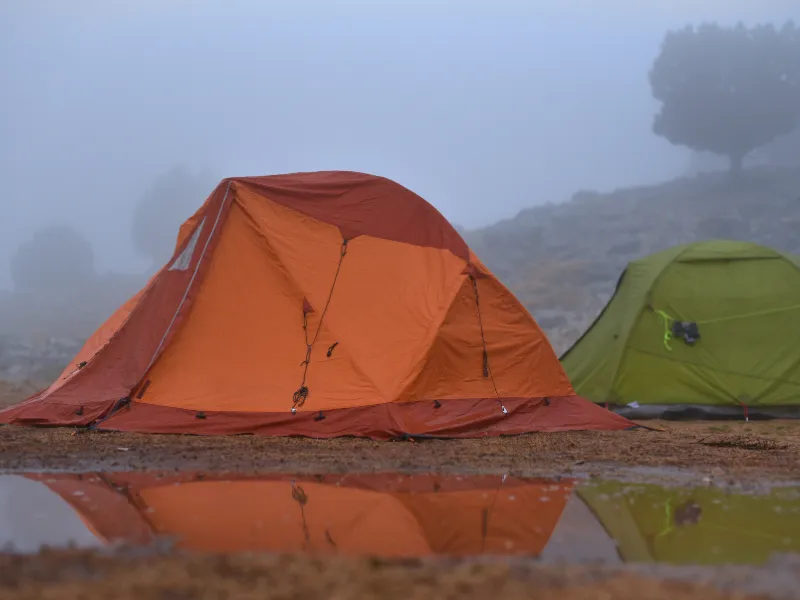
Does it look like a puddle was here? Low spots are cold and potentially wet. Try to find a campsite with higher ground that is not exposed. 

Avoid pests and poisonous plants.

Is there evidence of animal droppings, food bits, ants, or other bugs?There’s nothing worse than setting up camp in a beautiful spot only to find you’re sitting on an ant nest. Pests looking for food, including mice, rats, raccoons, chipmunks, and bears, are attracted to larger, popular campsites. Look for animal holes or nests nearby. Be aware of poisonous plants in your areas, especially with kids. 

Avoid danger zones.

Is this a spot at risk for a major natural disaster?Consider tides on the beach, avalanches in snowy areas, and flash floods in desert/dry areas. Use common sense to avoid exposed campsites such as high points, wide-open areas, and lone trees. 

4) Look for an environmentally friendly campsite.

Photo: ©Westhoff via Canva.com

Use established campsites when possible.

Where have others previously camped? The best campsites are found, but they are not made. Consider a campsite with durability and leave no trace principles:

  • Previous hikers, campers, or rangers have created designated spots for a reason, such as a tent platform, gravel pad, or other marked areas.
  • Keep campsites small, even with a large group. 
  • Avoid large flat areas to avoid the creation of crowded, noisy mega-sites.
  • Avoid lightly used sites, as even a single night can reverse natural recovery and potentially create an unwanted established campsite.
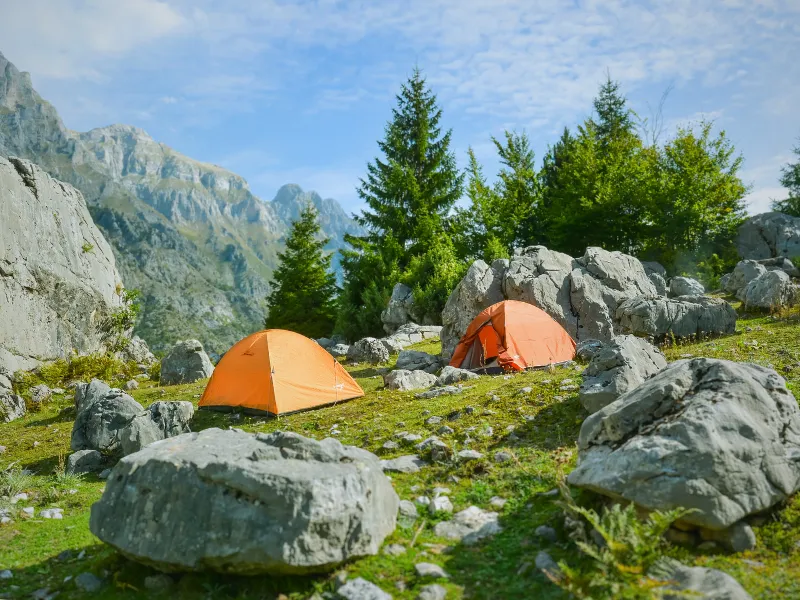
  • If no established campsite is available, follow Leave No Trace durable-surface guidance: prefer rock, gravel, or bare dirt; in pristine areas, disperse use and minimize trampling of vegetation; always follow local regulations. Shaded areas with non-vegetated leaf litter or flat, bare rock are also good choices. Avoid camping on broad-leaf plants or lightly used sites.

Follow the 200 ft rule.

Is the campsite at least 200 feet from the nearest water source? Both people and animals highly use these areas. Many smaller, fragile wildlife live within this 200-foot zone. Avoid camping in this zone, especially if established sites are outside this fragile impact zone. 

Consider responsible hammock camping in wilderness areas to reduce impact.

Can you use a hammock here? My favorite way to wilderness camp for over a decade is with a hammock. You can also be part of the solution to reduce impact while enjoying the outdoors. Hammocks reduce your environmental footprint if used correctly [1]. They have the added bonus of making campsite selection much easier. Uneven, rocky, root-covered, muddy ground with tall weeds and sticks everywhere is no longer a concern. 

5) Look for a beautiful campsite.

Photo: ©alsem via Canva.com

A good campsite is often not the most beautiful. If a beautiful spot is a priority, you might have to consider reasonable compromises. Nothing is wrong with wanting that awe-inspiring view or a campsite that feels just right!

Start dreaming of your next ideal campsite. What does it look like? Then, put together your ultimate camping gear list or start planning delicious camping meals.

FAQ

What is the best age to go camping with kids?

Camping can be a fun and rewarding experience for people of all ages as long as you are prepared and comfortable. However, some factors that may influence your decision are the type of camping, the location, the season, the amenities, and the activities available.

What should I consider when camping with infants and toddlers?

Babies are somewhat easier to camp with if you keep them warm or cool, depending on the weather. You may want to choose a campground with amenities like water, electricity, and camp showers or camp close to home in case of emergencies. Also, babies and toddlers can be fussy, especially when tired, so camping in a trailer or RV might work better than a tent.

Camping with toddlers can be challenging, as they may be curious and adventurous but also prone to eating stuff they shouldn’t or wandering off. You may want to find a campsite with grassy or sandy areas or bring a playpen or a play tent for them. Avoid campsites near water, cliffs, or other hazards, and keep an eye on them at all times.

What about camping with preschoolers and elementary-age kids?

This is a great age to start camping, as they can enjoy nature and learn new skills. You may want to involve them in the planning and packing process and let them help with simple tasks like setting up the tent or collecting firewood. You may also want some fun outdoor activities ready for them, like hiking, fishing, or playing games.

How about camping with older kids and teens?

Camping can be more adventurous and exciting with older kids and teens, as they can explore new places and try new things. You may want to choose a campsite that offers more challenging outdoor activities, like backpacking, canoeing, or rock climbing. You may also want to give them some independence and responsibility, like letting them choose their tent or cook their meal.