Rainier’s campgrounds sit low on the mountain, in old growth forest and river valleys, and what they offer is not a view of the summit. It is a night inside the park, with the trailheads minutes away and the day crowds still down the road. The park has four campgrounds. Most have a short camping season, from late May to late September. Campgrounds outside the gates provide more camping options. This guide covers the four park campgrounds and the Forest Service campgrounds on the entrance roads. It also covers utility district parks on the US-12 reservoir lakes, the state park on Mayfield Lake, and private campgrounds near the gates. It is organized by the four entrances a Rainier camper actually chooses between.
Three facts shape any 2027 trip, and each one can change, so check it against the park’s own pages before you drive. Ohanapecosh Campground is in old growth forest in the park’s southeast corner. It is closed for a rehabilitation project that runs through February 2027. It is expected to reopen for the summer 2027 season. The Fairfax Bridge on State Route 165 is closed. The closure cuts road access to the park’s northwest side, including Carbon River and Mowich Lake. And the park ran no timed entry reservation system in 2026; whether one runs in 2027 has not been announced.
We have visited Rainier many times over the years and have never camped there. The park campgrounds book out faster than we have ever managed to plan around. We built this guide using campground operators’ and land managers’ own pages, which we checked in November 2026. You can recheck changing facts in one click. When sources gave conflicting numbers for a campground, we used the figure on the operator’s own page. Rainier’s campgrounds are one region in the Washington campgrounds by region guide, which gathers the state’s camping regions in one place.
In this guide
- Mount Rainier camping at a glance
- Booking Rainier
- Choosing your entrance
- The Nisqually entrance
- The Stevens Canyon entrance
- The White River entrance
- The Carbon River entrance
- The US-12 reservoir lakes
- The eastern boundary
- Wilderness permits and backcountry camps
- Camping with an RV near Rainier
- A first Rainier camp
- Weather and road readiness and emergencies
- Frequently asked questions
Mount Rainier camping at a glance
| Campground | Corridor | How you get a site | One key fact |
|---|---|---|---|
| Cougar Rock | Nisqually | Reservations, some first come | The park’s largest campground, two miles from Longmire |
| Big Creek | Nisqually | Reservations and first come | Forest Service campground about six miles south of the gate |
| Alder Lake Park | Nisqually | Tacoma Power reservations | Year round main loop, full hookup sites |
| Ohanapecosh | Stevens Canyon | Reservations, reopening 2027 | Old growth forest, closed for rehabilitation |
| La Wis Wis | Stevens Canyon | Reservations and first come | A southeast camping option while Ohanapecosh is closed |
| White River | White River | First come only | The Sunrise base, no cell service at the campground |
| Silver Springs | White River | Reservations | Old growth on the White River outside the gate |
| The Dalles | White River | Reservations and first come | Riverside sites under old growth on SR 410 |
| Mowich Lake | Carbon River | Wilderness permit | No road access while the Fairfax Bridge is closed |
| Cowlitz Falls | US-12 reservoir lakes | Campspot, online only | Lewis County PUD park on the Cowlitz River |
| Taidnapam Park | US-12 reservoir lakes | Tacoma Power reservations | The largest utility park, on Riffe Lake |
| Mossyrock Park | US-12 reservoir lakes | Tacoma Power reservations | Year round camping above Mossyrock Dam |
| Mayfield Lake Park | US-12 reservoir lakes | First come at the beginning and end of the season | Small utility park on Mayfield Lake |
| Ike Kinswa State Park | US-12 reservoir lakes | State Parks reservations | Full hookups and a 60 foot site length on Mayfield Lake |
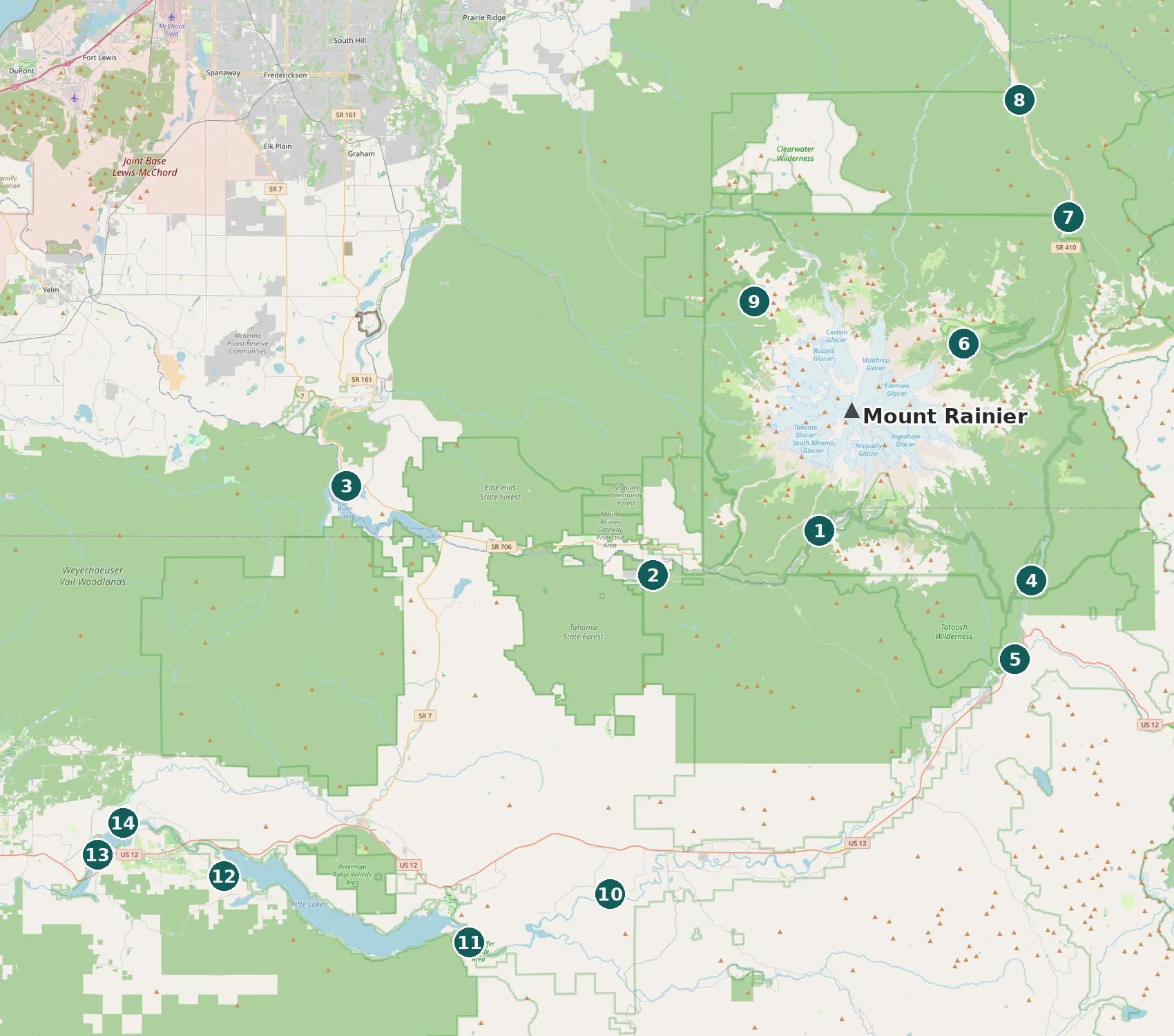
Short answers
- Best first Rainier camp: Cougar Rock, if you book it the week reservations open.
- Best base for Paradise: Cougar Rock.
- Best base for Sunrise: White River, if you arrive early enough to claim a site.
- Best lakeside camping: Taidnapam Park, on Riffe Lake.
- Best when the park is full: Alder Lake Park, reservable, with a main loop open all year apart from a short holiday closure.
Booking Rainier
Rainier has no single booking system, and that is the first thing to understand. The park campgrounds, Forest Service campgrounds, utility parks, state park, and private campgrounds each have their own booking arrangements and calendars. Knowing how to book one campground does not mean you know how to book another.
| Where | System | How far ahead | First come sites |
|---|---|---|---|
| Cougar Rock | Recreation.gov | Six months | Some sites, paid at the campground office |
| Ohanapecosh | Recreation.gov | Opens late spring or early summer 2027 for its reopening season | None in recent seasons |
| White River | Recreation.gov app, Scan and Pay at the kiosk | None, first come only | All sites |
| Mowich Lake | Wilderness permit, Recreation.gov | Permit windows below | Walk up permits at the park’s wilderness centers |
| Big Creek, La Wis Wis | Recreation.gov | Six months | Every Gifford Pinchot campground keeps some first come sites |
| Silver Springs | Recreation.gov | Six months | None, every site is reservable |
| The Dalles | Recreation.gov | Six months | Booked ahead on the same system; check its listing for any first come sites |
| Alder Lake, Taidnapam, Mossyrock, Mayfield Lake | Tacoma Power’s own system | Nine months, for the May 15 to September 15 reservation season | First come outside it, in each park’s open season |
| Ike Kinswa | Washington State Parks | Nine months | Some sites outside the reservation season |
| Cowlitz Falls | Campspot, online only | When the season’s dates post | None stated |
| Private campgrounds | Each business direct | Varies | Varies |
Cougar Rock is the campground most campers want. Cougar Rock sites become available on Recreation.gov six months ahead. Summer weekends are claimed soon after they become available. Some Cougar Rock sites are first come, first served. Pay for these sites at the campground office window. This is the step that has beaten us for years, and it is worth saying out loud, because the park’s own pages will not. We have driven to Rainier for day trips many times and never once camped, not for lack of trying, but because a summer weekend inside the park asks for a decision six months earlier. Make your reservation the week your dates become available. If that does not work, use the other options in this guide as a backup plan.
White River uses a different system. Every site is first come, first served. To pay, scan the code at the campground kiosk using the Recreation.gov phone app. The campground has no cell service. Download the app and set up your account before you leave home. The payment completes when your phone finds service again. You can also pay by card at the campground’s payment kiosks. For a first come, first served site at Rainier, plan to arrive in the morning. The campgrounds can fill by late morning on a summer weekend, and weekday arrivals do better than weekend ones. Arrive early, and come midweek if you can. Review the backup options below before you need them.
Timed entry is separate from camping, and campers ask about it every year. The park ran no timed entry reservation system in 2026. No 2027 system has been announced as of this writing in November 2026. A campsite reservation and an entry reservation are different things. If a timed entry system runs in 2027, the park’s pages will explain how it relates to campsite reservations. Check the park’s campgrounds and alerts pages when you book and again the week you go.
When the park is full
Consider these options in order. The gateway Forest Service campgrounds come first, at public campground prices. Big Creek is near the Nisqually entrance, and La Wis Wis is near the southeast entrance. Both have some first come, first served sites. Silver Springs and The Dalles, on SR 410, take reservations for the northeast side. The utility parks come next because they take reservations well into the season. Alder Lake’s main loop stays open through winter, apart from a short holiday closure. Third, consider private campgrounds near the gates. Mounthaven is half a mile from the Nisqually entrance, and the Packwood and Mineral campgrounds are along their respective routes. These campgrounds charge private campground prices. The last option is to seek a first come, first served site on a weekday morning. Try White River in the park, or Big Creek or La Wis Wis on the entrance roads.
Pets
The park’s stricter rule applies to all four park campgrounds. Dogs are allowed in campgrounds, parking lots, and on roads. They must be on a leash no longer than six feet. Dogs are never allowed on trails or in wilderness areas. That one rule shapes dog trips at Rainier, because a dog at this park is a campground companion, not a hiking partner. The Forest Service campgrounds allow leashed dogs at sites and on their trails. Ike Kinswa allows dogs on leash. Cowlitz Falls allows no more than two pets per site. Pets must be leashed. The utility parks and private campgrounds each post their own pet terms on their booking pages.
Choosing your entrance
The four entrances serve different campgrounds and trailheads, and they do not open and close on the same dates. Nisqually, below Paradise, is the only entrance open all year.
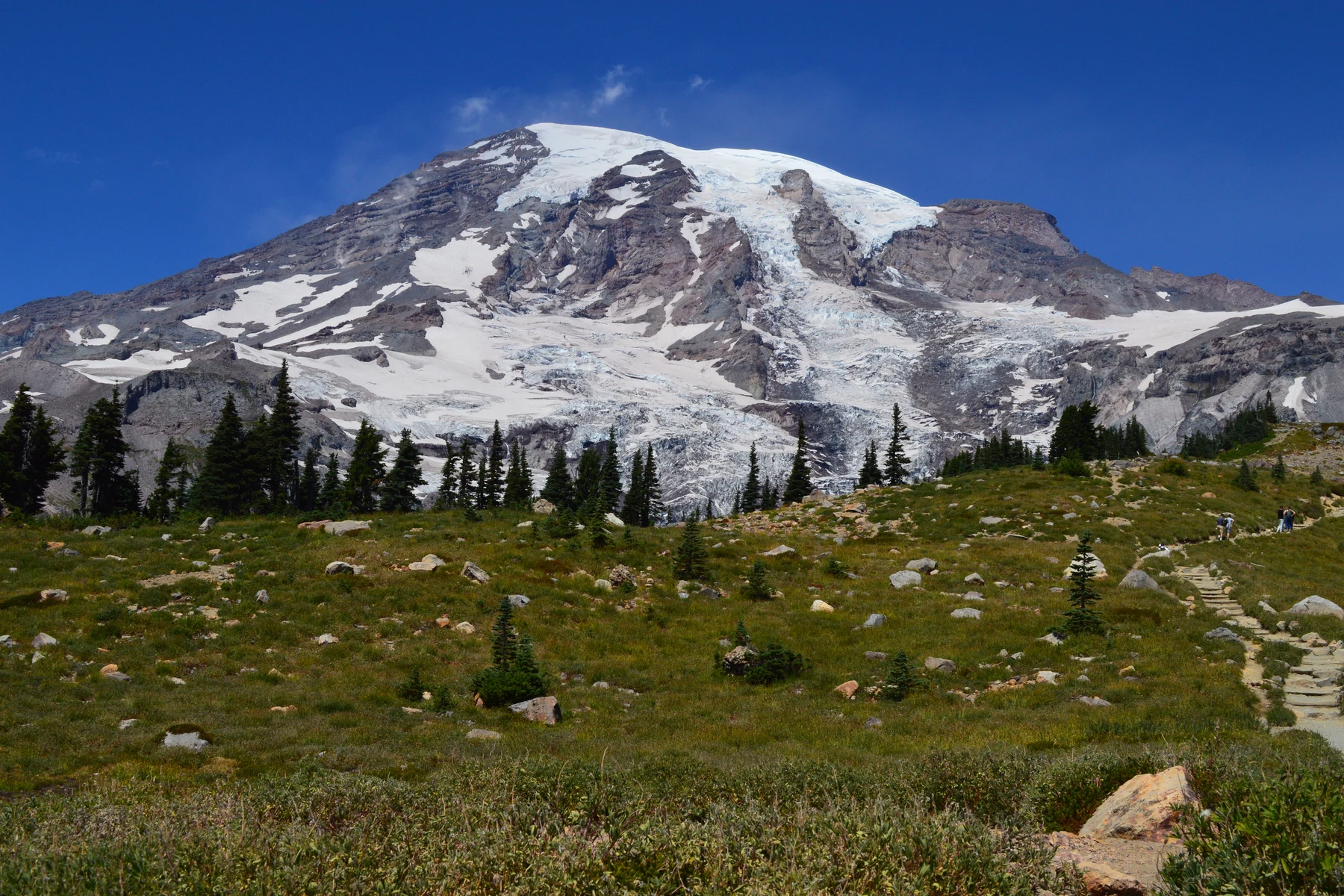
Paradise is the Rainier of the postcards. Wildflower meadows under the summit, the Skyline Trail climbing from the visitor center, waterfalls on every side. For many families this is the first Rainier day they ever take, and even a few hours in the meadows carry the mood and focus effects that the research on being outside describes. It is also the park’s busiest campground, and the crowds are the price of the classic scene. Cougar Rock, below it, is the only campground on this side that takes reservations, and the Nisqually entrance is open all year.
Sunrise is the high, dry side. Alpine tundra at the end of the road, the Emmons Glacier across the valley, and trails on Burroughs Mountain that feel like mountaineering country rather than meadow walks. It draws fewer people than Paradise, and its season is the park’s shortest. White River Campground is first come only, and in 2027 the Sunrise Road fire closure decides how much of this side a stay can reach.
The Stevens Canyon side is the forest park. Old growth around Ohanapecosh, the river, Silver Falls, and the through road to Paradise when Stevens Canyon Road is open. Its campground is closed until summer 2027, so a 2027 trip on this side camps at La Wis Wis outside the gate and drives in.
The Carbon River side is the rainforest corner, the park’s wettest and quietest country, big trees and green quiet instead of the summit scene. While the Fairfax Bridge is closed, no car reaches this side or Mowich Lake at all. Both are foot access only until the crossing is restored, so on a 2027 driving trip this side is a promise, not a plan.
The US-12 reservoir lakes are not the mountain at all. Swimming, boat launches, hookups, and large reservable sites, with Rainier as a day trip. Choose them when the trip is a lake weekend with a mountain day inside it, or when the park campgrounds are full.
The Nisqually entrance
The Nisqually entrance is the park’s only entrance open all year. The road from the entrance leads to Longmire and Paradise. Campgrounds near the entrance serve visitors to Paradise and Longmire, the park’s busiest area.
Cougar Rock Campground
Quick facts: 178 individual sites and 5 group sites; reservations on Recreation.gov six months ahead, with some first come sites paid at the campground office; late May to late September; drinking water, with the RV fill station closed; flush toilets; no showers; no hookups and no open dump station; $20 a night, group sites $60; check out at noon; motorhomes to 35 feet and trailers to 27 feet; quiet hours 9 p.m. to 7 a.m., generators only from 8 to 10 a.m., noon to 2 p.m., and 5 to 7 p.m., and never in Loop E.
Cougar Rock Campground sits two miles east of Longmire at 3,180 feet, among large trees along the Nisqually River. With 183 sites, it is the park’s largest campground. It is one of only two park campgrounds that take reservations, so campers can book a summer site before they leave home. The road to Paradise climbs from the campground entrance. Longmire’s trails, museum, and inn are minutes away in the other direction.
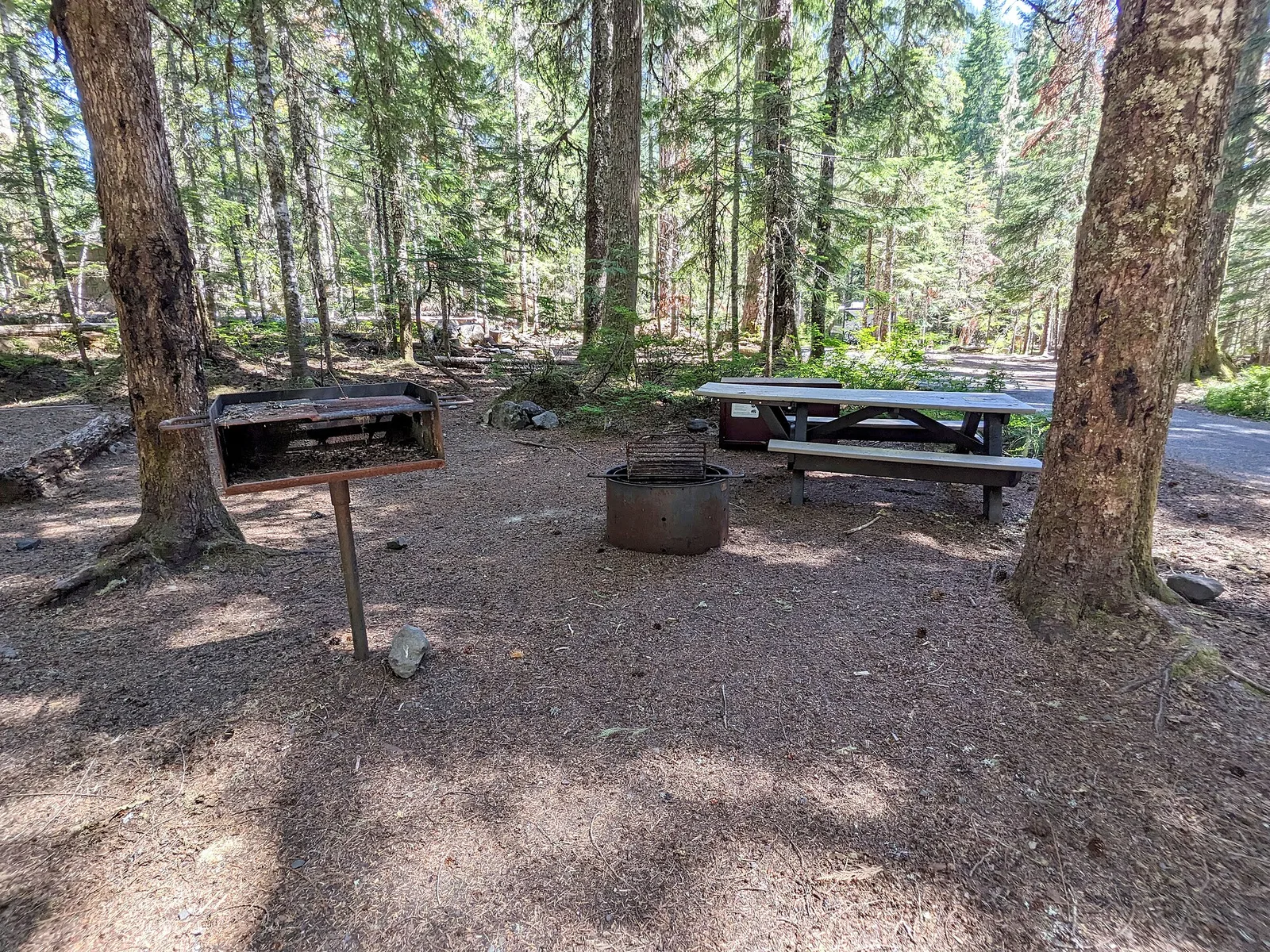
The campground has individual tent and RV sites arranged in loops. It also has five group sites for tents only. Each group site holds 25 to 40 people, depending on the site. Groups of twelve or more must use the group sites. Group sites require reservations. Generators are not allowed in Loop E. Ask for a site there if avoiding generator noise matters more to you than the site’s location. Firewood is sold at the campground, and the Longmire general store sells it too.
Two RV services are unavailable. The RV fill station is closed. The campground’s dump station is closed until further notice. No dump station in the park is open. If you are bringing an RV, arrive with empty waste tanks and a full fresh water tank, or use a campground outside the park first. There are no showers anywhere in the park. Laundry is in Ashford and Packwood, outside the gates.
Sunshine Point, the small campground that once sat by the Nisqually entrance, closed after the November 2006 flood and has never reopened. Old listings still show it. There is no campground there, and the park’s own list of campgrounds does not include it.
Big Creek Campground
Quick facts: 26 single sites and 3 double sites; reservations on Recreation.gov with first come sites held in the mix; mid May to mid September; drinking water from a hand pump; vault toilets; no showers; no hookups and no dump station; $25 a night for a single site and $45 for a double, extra vehicles $8; check in at 2 p.m. and check out at noon; vehicles to 22 feet; quiet hours 10 p.m. to 6 a.m.; dogs on leash.
Big Creek Campground is a Forest Service campground about two and a half miles east of Ashford and then up Forest Road 52. Its sites are arranged in a single loop under Douglas fir, hemlock, alder, and maple. It is about six miles from the Nisqually entrance, close enough for a day trip to the park. It is an option when the park campgrounds fill. The Forest Service describes it as an alternative when the park campgrounds get crowded.
The loop has 26 single sites and 3 double sites. Each site has a picnic table and a fire ring. The double sites suit two families traveling together, each family in its own tent, and our family tents guide works out how much tent each family needs. The maximum vehicle length is 22 feet, which limits this campground to tents, vans, and small trailers. Drinking water comes from a hand pump. The toilets are vault toilets, which collect waste in sealed tanks and have no plumbing. A business operating for the Forest Service runs the campground. Campers praise the camp host’s care of the vault toilets.
Elbe and Ashford, the state land layer
Two state campgrounds on Department of Natural Resources land mainly serve off-road vehicle users and horseback riders rather than park campers. Elbe Hills ORV Campground has 20 sites for off road vehicle (ORV) users only. It has 13 miles of motorized trails behind it. Reservations are required. To reserve, email the DNR recreation address on the department’s Elbe Hills page. Sahara Creek Camp has 30 sites on the Nicholson Horse Trail System. It has hitching rails and water for horses. The water is not treated for people. Reserve sites 1 to 8 using the same email address. Sites 9 to 20 are first come for horse campers. Sites 21 to 30 are first come for everyone except ORV users. Neither campground charges a nightly fee. A valid Discover Pass covers the camping. A third DNR campground, Anderson Lake, has a single site above the lake. It will not reopen for the 2026 season under the department’s budget reductions. Check the department’s page for information about whether Anderson Lake will reopen in 2027.
Bruni’s Snow Bowl Hut, Copper Creek Hut, High Hut, and the Yurt are huts on the Mount Tahoma trail system south of Ashford. You can reserve them and ski in. They are lodging booked by the night, not campgrounds. This guide does not cover them elsewhere.
Alder Lake Park
Quick facts: 145 individual sites, 35 full hookup, 48 water and electric, 62 tent, plus 7 summer group camps; Tacoma Power reservations up to nine months ahead in season, first come outside it; main loop open all year except December 19 to 30; water at hookup sites; restrooms with showers; full hookups at 35 sites; $56 a night for a full hookup site in season and $45 outside it, water and electric $51 and $40, tent sites $35 and $25; check in from 2:30 p.m. and check out at 1 p.m.; eight people at most per site; extra vehicles $15 a night.
Alder Lake Park is Tacoma Power’s park on its Alder Lake reservoir. It is about ten miles south of Eatonville on State Route 7 and a half hour’s drive from the Nisqually entrance. Its main loop is open all year except a short holiday closure in late December. Its sites with hookups can serve RVs that the park campgrounds cannot. Reservations can be made nine months ahead.
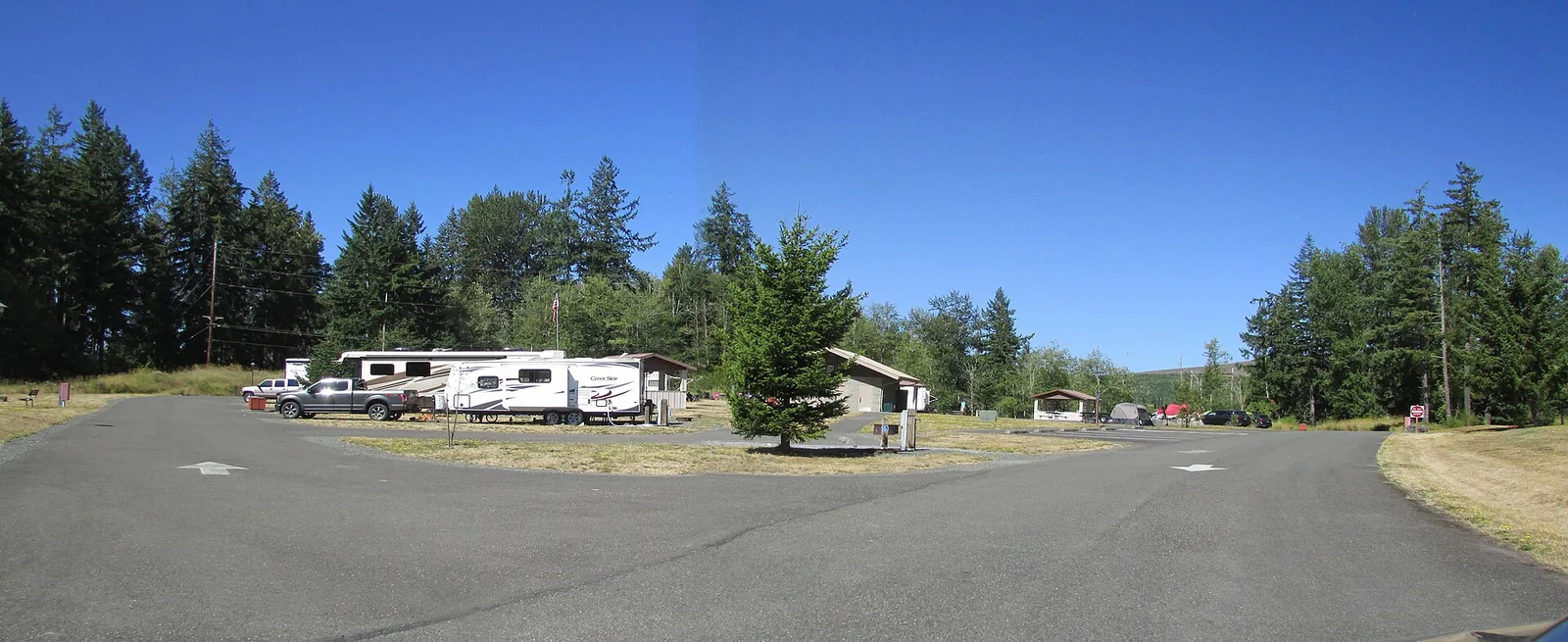
The 162 acre park on the lake’s shore has 145 individual sites. Of these, 35 have water, electric, and sewer hookups, 48 have water and electric hookups, and 62 are tent sites. The park has seven group camps, each made up of five sites with full hookups. These are open April 15 to October 15 by reservation only. The park also has more RV sites at its Elk Plain area and walk in tent sites at Osprey. The main loop closes only for the holidays, December 19 to 30. Rocky Point Campground is part of Alder Lake Park and is four miles east on Highway 7. It has 25 sites with water and electric hookups and uses the same reservation system.
Tacoma Power runs its own reservation system, separate from the state parks system, online and by phone. In the reservation season, May 15 to September 15, individual sites book up to nine months ahead. Outside the reservation season, sites are first come, apart from the holiday closure. During the reservation season, unreserved sites may be available for one night walk in stays. A Discover Pass is not required here.
Rocky Point Campground is paired with Alder Lake Park. It has 25 sites with water and electric hookups about four miles east of the main park on Highway 7. Book through the same Tacoma Power reservation system. When Alder Lake’s main loops fill on a summer weekend, Rocky Point is another campground to check in the same reservation system.
Private campgrounds near the southwest gate
Mounthaven Resort is the closest private camping to the park, half a mile from the Nisqually entrance at Ashford, on seven wooded acres with creeks and a pond. Its RV sites have full hookups with 30 amp power, water, and sewer. The sites are back in only and take RVs up to 36 feet. Its tent sites sit in a cedar grove. One camping cabin stands near the restroom and laundry building. Book RV sites by phone or email, not online. In summer, the resort requires minimum stays of three to five nights. It takes no one night reservations from June 1 to September 30. Quick facts: 16 RV sites and 4 tent sites by the regional visitor guide’s count; full hookups; $98 a night plus tax for an RV site, rising to $106 from late May 2026; tent sites $69 per tent for up to four guests.
Elkamp Eastcreek at Mineral spreads 25 sites through old growth about 15 minutes from the Nisqually gate. Sites with hookups have 30 and 50 amp power and fresh water. Sites without those services are separate. Every site has a fire ring and picnic table. Complimentary WiFi is available across the campground. A heated bathroom and shower building includes a dishwashing station. The season runs mid March to November 1.
Mineral Lake Lions Den Campground is on the south shore of Mineral Lake, 19 miles from the Nisqually entrance. The Mineral Lake Lions Club has run it since 1952. It has 94 campsites for tents and RVs across 12 acres. It takes RVs up to 60 feet. Some sites have water and electric hookups. The camper dump station costs $30 per use. Showers cost $2 for five minutes. The campground also has a boat launch and dock. Rates start at $35 a night. The season runs mid April through fall. Book online.
The Stevens Canyon entrance
The Stevens Canyon entrance serves the park’s old growth, its waterfalls, and the road over to Paradise. Ohanapecosh Campground is being rebuilt. La Wis Wis Campground remains open near this entrance.
Ohanapecosh Campground
Quick facts, on the campground's normal planning basis: 179 individual sites and 2 group sites; reservations on Recreation.gov, with the reopening season’s reservations opening in late spring or early summer 2027; late May to late September; drinking water; flush toilets; no showers; no hookups and no open dump station; $20 a night, group sites $60; check out at noon; motorhomes to 32 feet and trailers to 27 feet; quiet hours 9 p.m. to 7 a.m. with the same generator windows as the rest of the park, and never in Loop E.
Ohanapecosh Campground is on the Ohanapecosh River in the park’s southeast corner, at 1,914 feet. Its 179 individual sites and 2 group sites sit under Douglas fir, western red cedar, and western hemlock. Campers come here for the old growth itself, the green shade, the river, and the trails that run from the campground into the old growth.
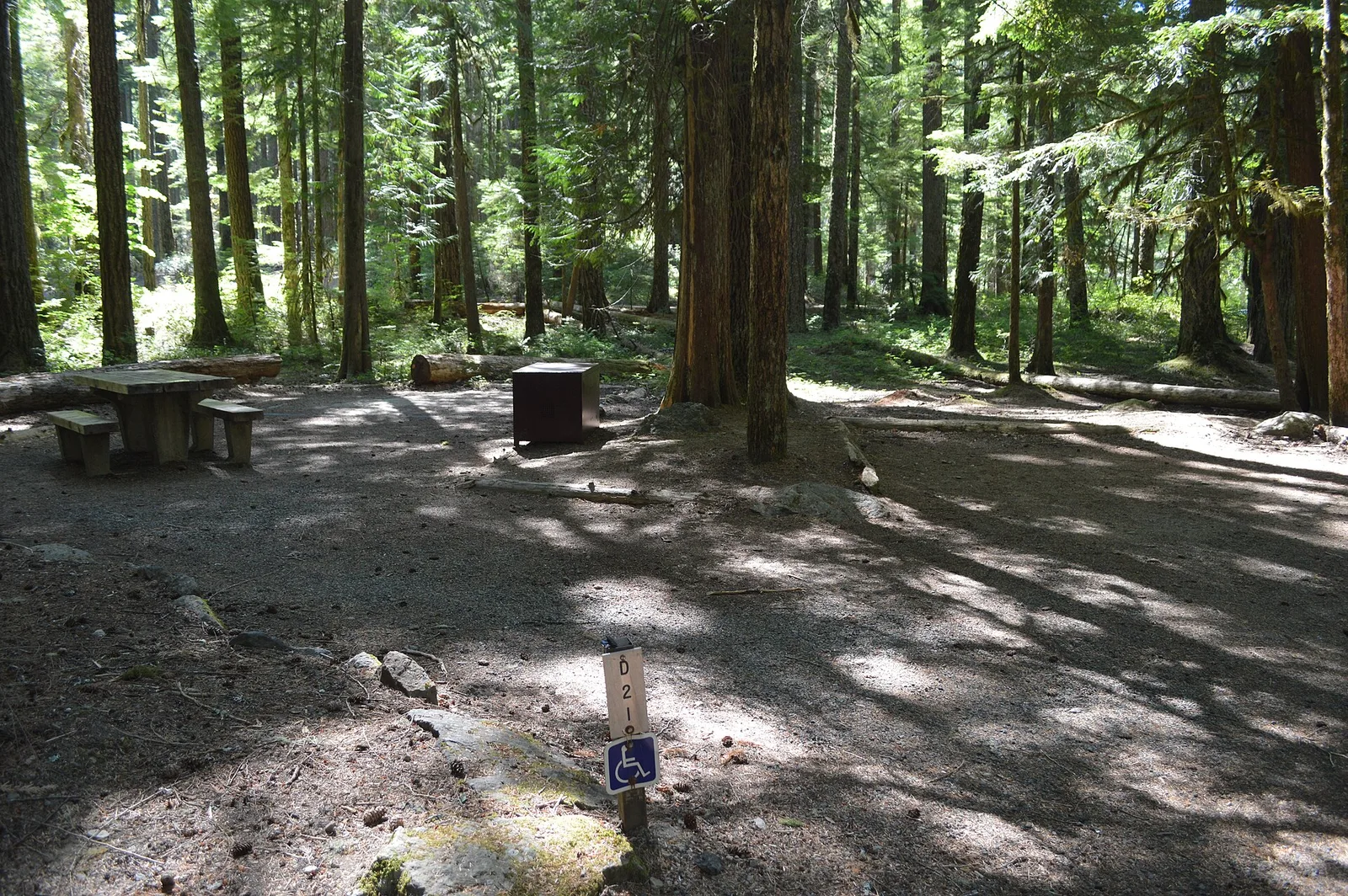
The campground is closed for a rehabilitation project covering its campsites, restroom buildings, utility systems, and roads. The park expects the work to run through February 2027 and the campground to reopen for the summer 2027 season. Reservations are expected to open on Recreation.gov in late spring or early summer 2027. Those are the park’s current estimates, not guaranteed dates. Check the park’s campgrounds page before you plan around them, and check it again when the reservation window opens.
The rest of this entry describes the campground for the season when it reopens. Sites take motorhomes to 32 feet and trailers to 27 feet. Each group site holds 25 people. Group sites require reservations. Groups of twelve or more must use them. Loop E is generator free, as it is at Cougar Rock. Firewood is sold at the campground. There are no showers or hookups. No dump station in the park is open.
La Wis Wis Campground
Quick facts: 122 sites including walk in tent sites and a group site; reservations on Recreation.gov with first come sites in the mix; vault toilets only; no water in 2026 under a Forest Service alert, with the fee discounted while it lasts; no showers; no hookups; check in at 2 p.m. and check out at noon; firewood $10 a bundle at the host site; extra vehicles $8 a night.
La Wis Wis Campground is the Forest Service campground four miles east of Packwood on US Highway 12, where the Ohanapecosh River, the Cowlitz River, and Purcell Creek come together. With Ohanapecosh closed, La Wis Wis offers 122 sites in old growth forest a short drive from the Stevens Canyon entrance.
The campground has tent and RV sites and walk in tent sites. The Coho Group Site takes five vehicles and 25 to 30 people. Two trails start at the campground, to the Blue Hole and to Purcell Falls. Paradise’s visitor center is 28 miles away. All toilets are vault toilets, which collect waste in sealed tanks and have no plumbing. Firewood costs $10 a bundle at the camp host’s site. The nightly fee covers one RV or trailer and its tow vehicle, or the first two cars. Extra vehicles run $8 a night.
The Forest Service advises that there is no water at La Wis Wis. It expects the situation to last the entire 2026 season. The nightly fee has been discounted because of the lack of water. The main campground normally has water. The Hatchery Loop does not have water, even in a normal year. Bring all the water you need. Before you go, check the campground’s Recreation.gov page for the current alert. Expect the discounted fee rather than any printed figure, including figures in our other guides. We do not list a base fee for La Wis Wis until the booking calendar shows the discounted rate.
Packwood RV Park and Campground
Packwood RV Park and Campground is a private campground on US Highway 12 in Packwood. It has 70 sites and laundry facilities. Rates start at about $38 a night. The campground has hookups and is in town near Packwood’s groceries and gas. Packwood Park, the county park in town, is a day use park. It has no campsites.
The White River entrance
The White River entrance serves Sunrise, the highest point in the park a car can reach, and the park’s northeast trails. State Route 410 runs through Greenwater, and the area’s campgrounds are along that road.
White River Campground
Quick facts: 88 sites; first come only, paid by Scan and Pay in the Recreation.gov app or by card at the kiosk; late June to late September; drinking water; restrooms; no showers; no hookups and no open dump station; $20 a night; check out at noon; motorhomes to 27 feet and trailers to 18 feet; no cell service at the campground; quiet hours 9 p.m. to 7 a.m. with the park’s generator windows.
White River Campground has 88 sites at 4,400 feet on the White River. It is 12 miles from the Sunrise visitor center. It is the park’s only campground where all sites are first come, first served. Snow at the campground’s elevation limits its season to late June through late September, one of the park’s shortest.
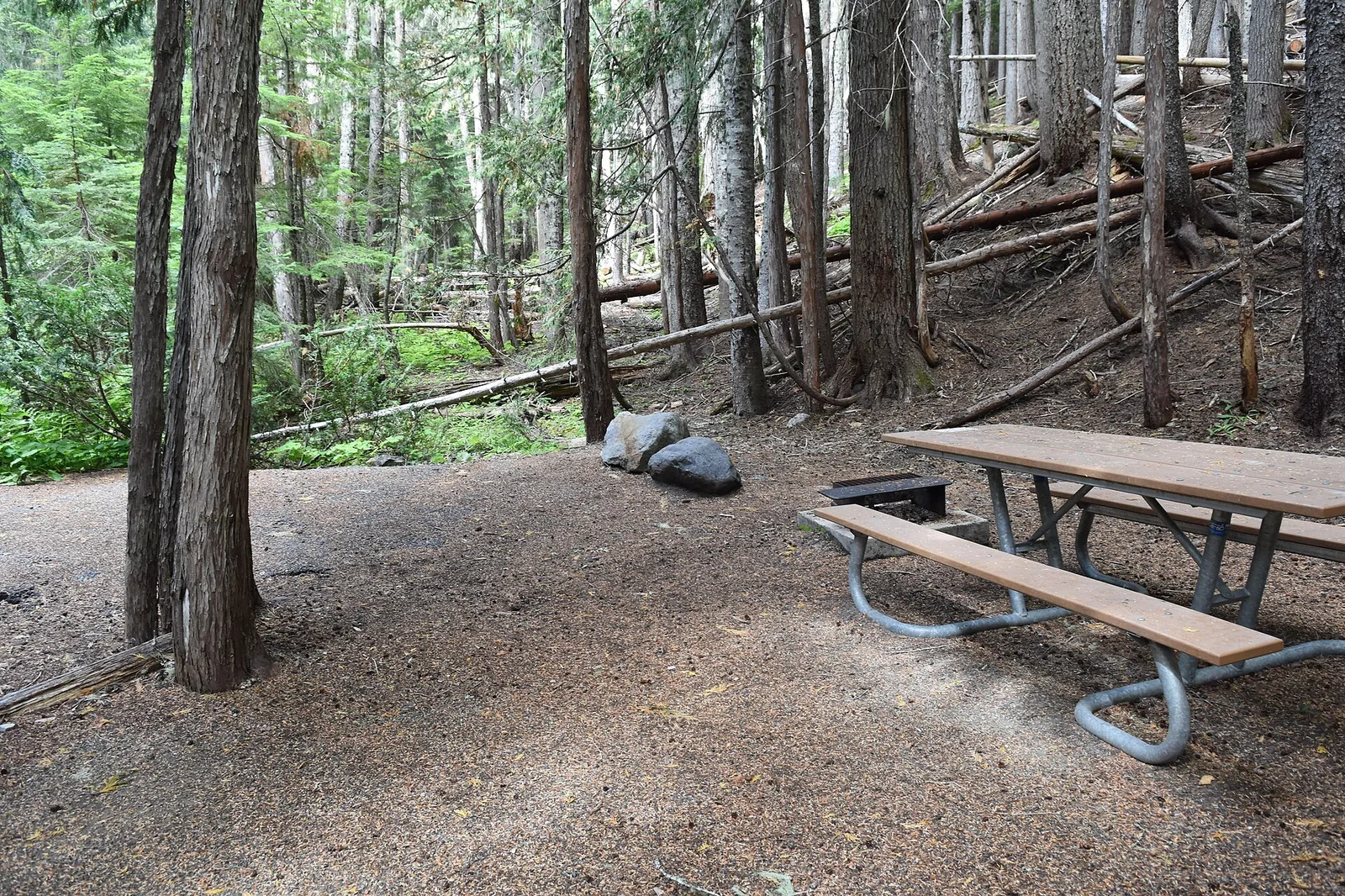
Pay using Scan and Pay in the Recreation.gov app. Find an open site and set up. Then scan the QR code at the campground kiosk to pay. The app completes the payment when your phone next has service. The campground has no cell service, so download the app and create your account before you leave home. You can also pay by card at a kiosk. Try to arrive early in the morning and midweek rather than in the afternoon. Sites can accommodate motorhomes up to 27 feet and trailers up to 18 feet. These are the tightest limits in the park.
Silver Springs Campground
Quick facts: 51 sites, 46 single and 5 double; every site reservable on Recreation.gov; restrooms; tables and fire rings at every site; no hookups; check in at 2 p.m. and check out at noon; stays to 14 days; posted 2027 rates $40 to $82 a night.
Silver Springs Campground is in an old growth forest just outside the White River entrance, 32 miles east of Enumclaw on State Route 410. Its sites can be reserved, unlike those at White River Campground. It stands on the White River. A campground host is on site, and firewood is sold at the host’s site.
The campground has 51 sites: 46 single and 5 double. All are standard sites without hookups, and each has a table and fire ring. The sites accommodate tents, and select sites accommodate RVs up to 42 feet. Every site is reservable. A group picnic shelter holds up to 50 people. Reserve it separately. The river is the main sound at most sites. There is no wireless service. Posted 2027 rates range from $40 to $82 a night, depending on site type. Online reservations have an $8 fee.
The Dalles Campground
Quick facts: 45 tent and trailer units, 5 of them accessible; booked on Recreation.gov; no hookups; garbage service; the CCC shelter reservable; elevation 2,200 feet.
The Dalles Campground is 26 miles east of Enumclaw and 7 miles west of the park entrance, at 2,200 feet. It sits among some of the largest old growth trees remaining along the White River. The campground has 45 sites for tents and trailers. Five sites are accessible, and many are at the water’s edge. A covered Civilian Conservation Corps picnic shelter stands at the center of the campground. Groups can reserve it; otherwise, it is first come, first served. The accessible half mile John Muir Nature Trail begins at the shelter.
The numbered sites on the river side of the bluff fill first. Sites along the highway have road noise. The river runs too fast for swimming. Riverside sites sit closest to a fast river, and the campground’s Recreation.gov listing has carried flood advisories for them after high water. Check the listing before you book a river site, and treat the bluff sites as the safer pick in a wet spring.
Sunrise Walk-In Campground
Sunrise Walk-In Campground is a wilderness camp near Sunrise that you reach on foot. You need a wilderness permit to stay there. See the permits section below. Fire activity on the park’s northeast side has closed Sunrise Road to vehicles. The road is open to pedestrians and cyclists. Check the park’s status page for current vehicle access to Sunrise. Check it before building a trip around either the camp or the visitor center.
Crystal Mountain Resort is on its own boulevard off State Route 410. It offers overnight RV and tent camping with 30 and 50 amp hookups. According to the regional guide, it has 47 RV sites in summer and winter and 13 tent sites in summer. It is a ski resort parking area rather than a campground, but it offers hookups on the White River side. Federation Forest State Park and Nolte State Park, both toward Enumclaw, are day use only. Neither allows camping, and both are picnic stops. Nolte’s park page states its day use rule.
The Carbon River entrance
The Carbon River area includes low elevation old growth rainforest and a lake campground higher up. Cars cannot reach the area until the crossing is restored.
Mowich Lake Campground
Quick facts: 13 tent pads; wilderness permit required; early July to early October; no potable water; vault toilet; no showers; fires prohibited; no road access while the Fairfax Bridge closure stands.
The Fairfax Bridge on State Route 165 closed in 2025. The closure cut off all road access to the Carbon River and Mowich Lake area. No vehicles, bicycles, or pedestrians can cross. The park’s Carbon River Wilderness Information Center is closed until further notice for the same reason. As of this writing, backpackers already walking the Wonderland Trail, the park’s long loop, can reach Mowich Lake’s campsites only on foot from the trail. Check the state Department of Transportation’s bridge page and the park’s campgrounds page for current information during the week of your northwest trip.
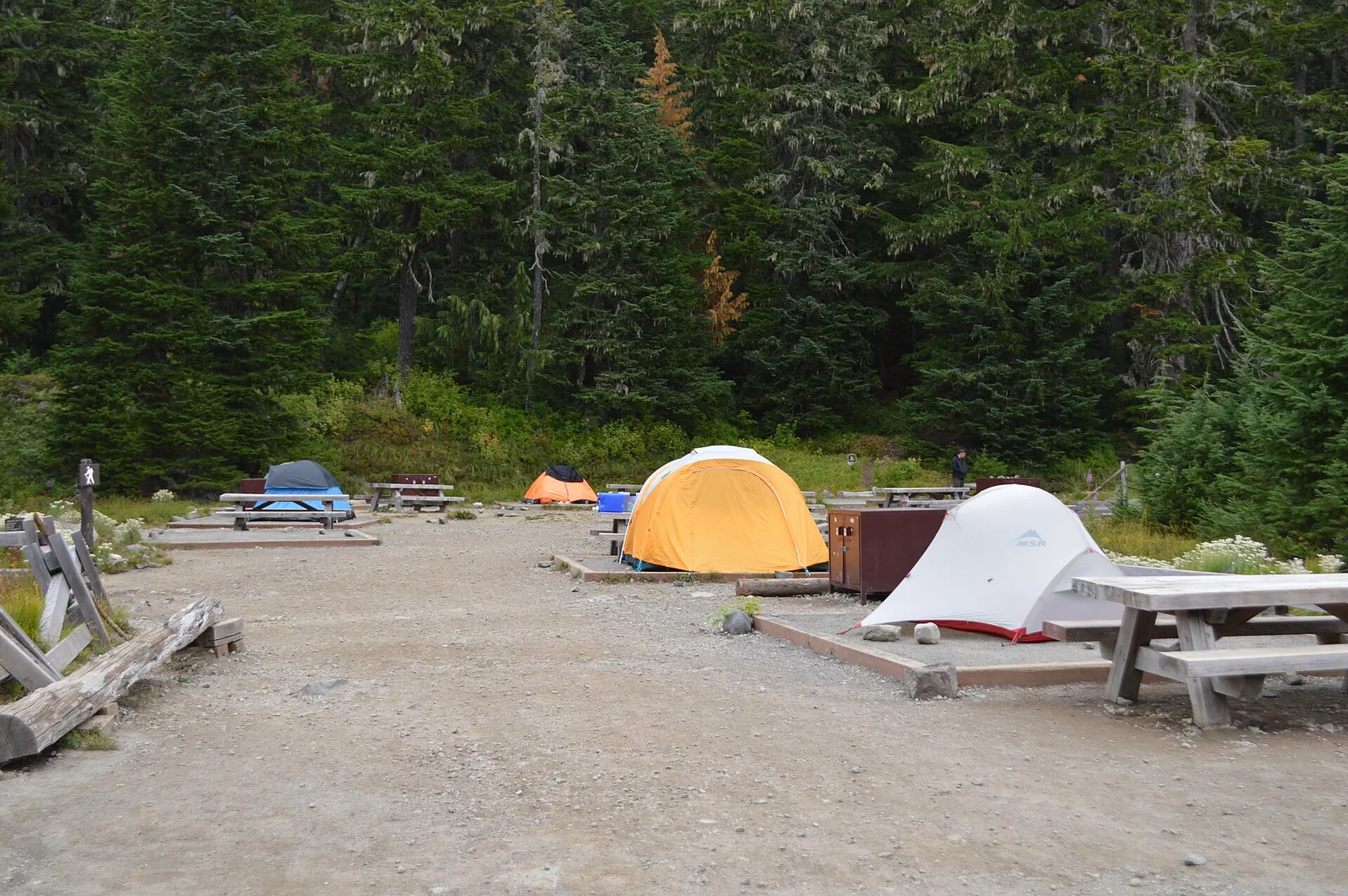
The information below is for when access changes. Mowich Lake Campground is the park’s highest drive-in campground, at 4,929 feet on the shore of its largest lake. It has 13 tent pads. Walk in from the trailhead at the end of the Mowich Lake road. A wilderness permit is required instead of a campground reservation. There is no drinking water. The toilet is a vault toilet, and fires are prohibited. Snow on the road and the lake’s elevation limit the season to early July through early October, among the park’s shortest. When the road is open, the tents-only campground is on the shore below the Spray Park trails, at the end of the park’s roughest campground road. Until then, backpackers can camp there. See the permits section below.
Ipsut Creek Campground
Ipsut Creek Campground was accessible by car before washouts turned the Carbon River road into a trail. It is now a hike-in campground about five miles along the Carbon River Road from the old entrance. A wilderness permit is required to stay there. The bridge closure cuts off car access to its trailhead, as it does for Mowich. It is included as the northwest side’s second campground for when the Carbon River valley can be reached again.
Evans Creek Campground
Evans Creek Campground is the area’s only Forest Service campground. It has 41 sites at 3,600 feet inside the Evans Creek ORV Area. About 40 miles of motorized trails run through the forest behind the sites. Each site has a picnic table and fire ring. The toilets are vault toilets. There is no drinking water and no hookups. The Forest Service’s campground page currently lists it as closed because there is no access under the Fairfax Bridge emergency closure at milepost 11.5. The campground serves ORV users as well as Rainier visitors. It is closed until the road reopens.
The US-12 reservoir lakes
South of the park, US Highway 12 runs through a chain of reservoir lakes built for power, and their shores hold some of the largest campgrounds in this guide. These campgrounds sit on lakes and offer reservable sites near a gate, at prices the gateway towns cannot match.
Cowlitz Falls Campground
Quick facts: 41 RV sites with water and electric hookups, 21 tent sites, 6 group tent sites, and 1 group RV site; reservations online only through Campspot; mid May to mid September, with the 2026 season running May 15 to September 13; restrooms with showers; a dump station for registered campers; RV sites $38 a night, tent sites $20 including one vehicle, group tent sites $50 and $60, the group RV site $160; check in at 2 p.m. and check out at noon; gates open 7 a.m. to 9 p.m. and locked outside those hours; quiet hours 10 p.m. to 7 a.m.; generators from 8 a.m. to 8 p.m.; eight people at most per site; two pets at most, on leash.
Cowlitz Falls Campground is in Lewis County PUD’s Leonard “Bud” Allen Park in Randle. The park covers 110 acres on the Cowlitz River, 15 miles east of Morton. The utility recommends the park as a Mount Rainier base. The drive to the Stevens Canyon entrance takes under an hour, and the drive to Packwood is shorter. A tent site costs $20, matching the park’s tent price. Hookup sites cost well below those at the private parks.
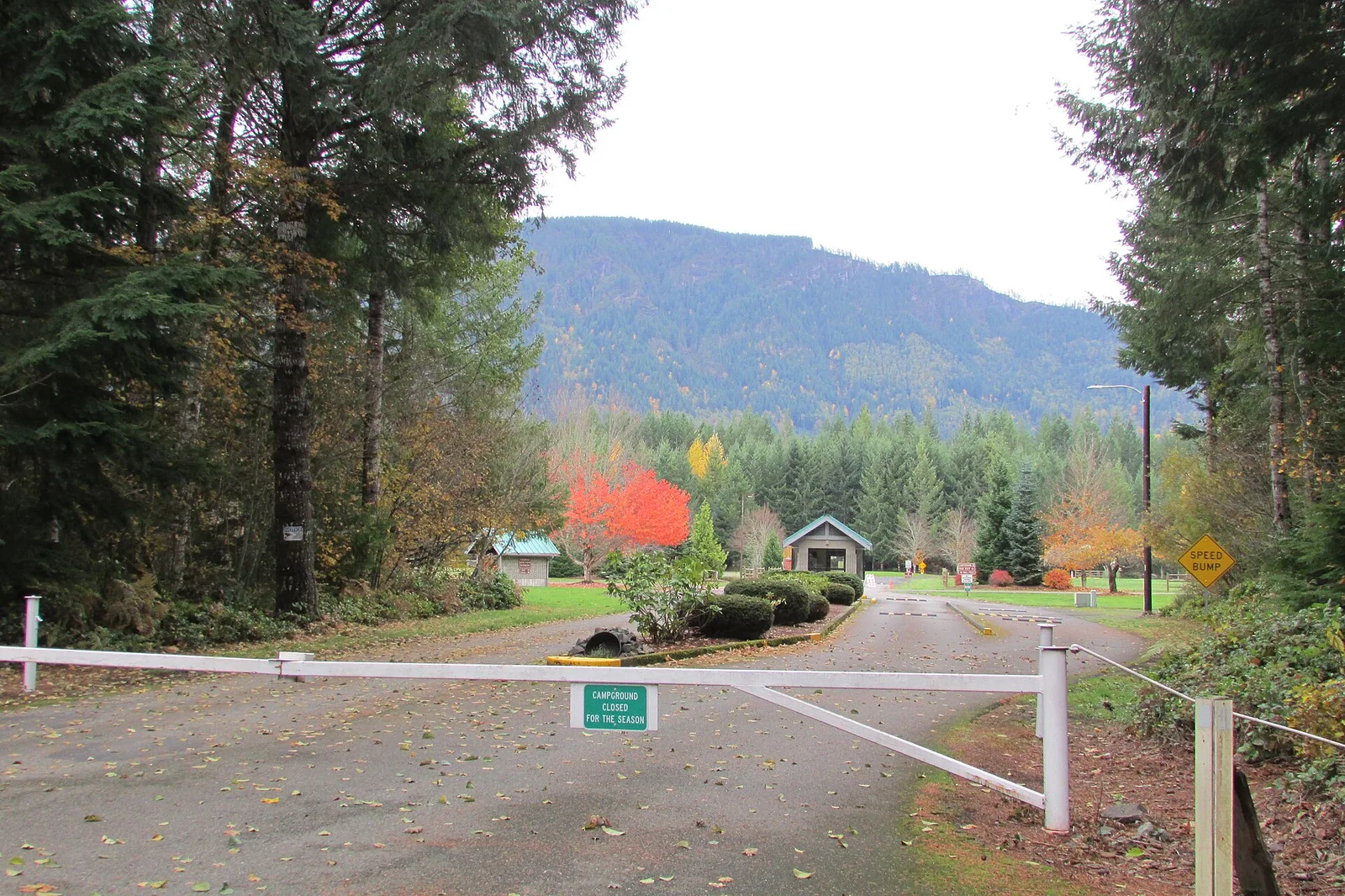
The itemized count lists 41 single RV sites with electric and water hookups, 21 single tent sites, 6 group tent sites, and 1 group RV site. The utility’s own page headlines the total as over 100 campsites without itemizing the difference. Reservations are online only through Campspot. Every site has an $8 reservation fee. The gates open at 7 a.m. and lock at 9 p.m. Plan accordingly if you expect to arrive late on Friday. The dump station is for registered campers only. Restrooms have showers. Fees include state sales tax and the county lodging tax. A disability discount takes 25 percent off.
Taidnapam Park
Quick facts: 163 individual sites, 96 full hookup, 43 water and electric, 24 walk in tent, plus group camps of 22 and 12 sites; Tacoma Power reservations up to nine months ahead in season, first come outside it; coin operated showers; full hookup sites $56 a night in season and $45 outside it, water and electric $51 and $40, walk in tent sites $35 and $25, the group camp with hookups $915 in season and the primitive group camp $250; check in from 2:30 p.m. and check out at 1 p.m.; closed December 20 to January 1.
Taidnapam Park is Tacoma Power’s largest campground in this guide, on the upper end of Riffe Lake near Glenoma, about five miles past Morton. It has 163 individual campsites: 96 with water, electric, and sewer hookups; 43 with water and electric hookups; and 24 walk-in tent sites. It has the most hookup sites in this guide. The park also has a group camp with 22 sites with hookups, a primitive group camp with 12 sites and no hookups, and four group sites with water and electric.
Every site has a table and a fire ring. The showers are coin operated. Groups can reserve a kitchen shelter. The day use shore and boat launch are open all year when the lake level allows. The utility warns drivers about heavy log truck traffic on Champion Haul Road, the road into the park. Day use parking costs $10 on Fridays, Saturdays, Sundays, and holidays between Memorial Day and Labor Day. Visitors are turned away when the day use area fills. Use the same Tacoma Power reservation system as for Alder Lake. Reservations cover the May 15 to September 15 season, up to nine months ahead. Outside that season, sites are first come, first served. The entire Tacoma Power system closes December 20 to January 1.
Mossyrock Park
Quick facts: 152 individual campsites including 76 with water and electric; Tacoma Power reservations in season, first come outside it; open all year except December 20 to January 1; water and electric sites $51 a night in season and $40 outside it, no hookup sites the same, walk in tent and S’mores Loop sites $35 and $25, the primitive group camps $315 in season; check in from 2:30 p.m. and check out at 1 p.m.; laundry and showers on site.
Mossyrock Park covers 275 acres above Mossyrock Dam at the west end of Riffe Lake, minutes from the town of Mossyrock. It holds 152 individual campsites, 76 of them with water and electric hookups, plus two primitive group camps of 12 sites between them with no hookups. Camping runs all year here, with the same December 20 to January 1 closure as the rest of the Tacoma Power system. The park has laundry, showers, a swim area, a boat launch, and two kitchen shelters. No other campground among the US-12 reservoir lakes has the same set of amenities.
Mayfield Lake Park
Quick facts: 54 individual campsites with water and electric; reservations in the May 15 to September 15 season, first come in the shoulder weeks; camping April 15 to October 15; water and electric $51 a night, waterfront water and electric $59, the 12 site group camp $270; check in from 2:30 p.m. and check out at 1 p.m.
Mayfield Lake Park is a small Tacoma Power park on Mayfield Lake at Mossyrock. It has 54 individual campsites with water and electric hookups and a 12-site group camp. Camping runs April 15 to October 15. The day use area and boat launch are open all year. From mid April to mid May and mid September to mid October, sites are first come, first served. Stays during those weeks are limited to ten days. Waterfront sites 42 to 55 cost more than the other sites.
Ike Kinswa State Park
Quick facts: 103 campsites, 41 full hookup, 31 water and electric, 31 standard, plus 9 cabins; Washington State Parks reservations up to nine months ahead; camping all year, with Loop A closed in winter; showers and drinking water, with the spigot off in winter; a dump station open all year at $5 per trailer dump; maximum site length 60 feet; Discover Pass required.
Ike Kinswa State Park covers 454 acres of forest on Mayfield Lake’s north shore at Silver Creek. It shares the lake with Mayfield Lake Park. It holds 103 campsites, 41 with full hookups, 31 with water and electric, and 31 standard sites, plus nine cabins. Loop A has the full hookup sites and is closed in winter. Loop B has water and electric sites and is open all year. Loop D has the sites without hookups. The longest sites can accommodate RVs up to 60 feet, as large as at any campground in this guide.
The park’s dump station stays open all year, with a $5 trailer dump fee. Showers and drinking water are available in season. The water spigot is turned off in winter. A Discover Pass is required and costs $45 a year or $10 a day. The boat launch charges $7 for watercraft. The park’s page gives the following boat launch warning. The boat launch ends abruptly at a washout at the base of the ramp, with a drop of about ten inches. Launch carefully, and look before you back down.
Harmony Lakeside RV Park
Harmony Lakeside RV Park, now signed as Harmony Lakeside RV and Cabins Resort, is on Mayfield Lake at Silver Creek. It takes RVs only. In its own words it has no tents or tent sites. Its sites have full hookups for water, electric, and sewer, with 20, 30, and 50 amp electrical service. It has pull-through sites for large RVs and cabins behind the RV sites. Tent campers should book at one of the two parks above. RV campers get another full hookup option on the same lake.
The eastern boundary
This guide stops at Chinook Pass and White Pass. The campgrounds beyond those points are named below. East of Chinook Pass on State Route 410 and up the Bumping River, the Okanogan-Wenatchee National Forest runs Lodgepole, Pleasant Valley, Hells Crossing, American Forks, Cedar Springs, Bumping Crossing, Sawmill Flats, Bumping Lake, Cougar Flat, and Soda Springs campgrounds. These campgrounds are on the Naches and Yakima side of the Cascades and are included in our Eastern Washington coverage. East of White Pass on US Highway 12, Dog Lake, Clear Lake North, Clear Lake South, Indian Creek, and Hause Creek campgrounds serve the Rimrock Lake and Tieton River area. They are included in our Eastern Washington coverage. Iron Creek Campground is on the Cispus River south of Randle, in the Mount St. Helens area rather than the Rainier area. Lewis and Clark State Park is southwest of the lakes and outside this guide’s boundary.
Wilderness permits and backcountry camps
Rainier’s backcountry camps are not accessible by road. An overnight stay anywhere in the park’s backcountry requires a wilderness permit, in every season. Designated backcountry camps are located along the Wonderland Trail, a 93 mile loop, and the park’s other long trails. Each camp has cleared tent pads and a vault toilet. Each also has a bear pole for hanging food out of a bear’s reach, or other food storage. A permit names the camps you will sleep in, night by night.
About two thirds of the permits for the June to September season can be reserved on Recreation.gov. The remaining third are issued at the park’s Wilderness Information Centers on a first come, first served basis. You can request one no more than one day before your trip starts. Reservations open in stages. An early access lottery runs in February. Reservation windows follow in March and April. One reservation is allowed during early access. The general sale opens April 25 for trips from June 1 to October 10. A reservation must be made at least two days ahead. The remaining permits are available at wilderness centers on a first come, first served basis.
The fee is $6 per confirmed reservation plus $12 per person per night. Walk up permits cost the same. Payment is by card only. You must activate your reservation in person at a wilderness center before it becomes a permit. Bring photo identification, an emergency contact, and your vehicle details. The reservation is canceled if the holder has not arrived by noon on the first day of the trip. Permits can be picked up one day before departure and no sooner. Bear poles at the camps are taken down on October 4. After that date, food must be carried in a hard sided canister. Food caches are available at set points along the Wonderland Trail in summer for hikers walking the whole loop.
Check these two current conditions before your trip. A fire closure on the northeast side of the Wonderland Trail, between the Carbon River and Summerland, has stopped permits for the full loop while the closure remains in effect. The Carbon River Wilderness Information Center is closed until further notice because of the Fairfax Bridge closure. Check the park’s wilderness permits and trail conditions pages for current information on both closures. The Washington Trails Association provides trail by trail details that this guide does not. This section covers permit requirements. Consult those sources for details about where you can walk.
Camping with an RV near Rainier
Campers in the park must plan without hookups. No park campground site has hookups. No dump station in the park is open. The Cougar Rock RV fill station is closed. At Cougar Rock, the limit is 35 feet for motorhomes and 27 feet for trailers. At Ohanapecosh, it is 32 feet for motorhomes and 27 feet for trailers. At White River, it is 27 feet for motorhomes and 18 feet for trailers.
Campgrounds outside the park offer hookups. This guide lists the hookups available at each campground. Alder Lake Park holds 35 full hookup sites and 48 more with water and electric. Taidnapam holds 96 full hookup sites, the most in the guide. Mossyrock holds 76 with water and electric. Ike Kinswa has 41 full hookup sites and 31 sites with water and electric. It has sites that accommodate RVs up to 60 feet and a dump station open all year. Cowlitz Falls has RV sites with water and electric. It also has a dump station for its campers. Mounthaven has full hookups half a mile from the Nisqually gate. Mineral Lake’s Lions Den has a camper dump station that costs $30 per use. Both are private campgrounds.
Generators may be used in the park from 8 to 10 a.m., noon to 2 p.m., and 5 to 7 p.m. Quiet hours are 9 p.m. to 7 a.m. Loop E at both Cougar Rock and Ohanapecosh is generator free at all hours. RV campers who want power at their site, a dump station, and a reservation should book a gateway or utility campground and take day trips into the park.
A first Rainier camp
Three campground options for a first Rainier trip are Cougar Rock, La Wis Wis, and Alder Lake. The choice depends mostly on booking. Cougar Rock is inside the park, under the trees, and a short drive below Paradise. Make a reservation six months ahead, during the week your dates open. La Wis Wis is a Forest Service campground in the same forest, near the southeast entrance. It uses the same booking system, with less competition. While Ohanapecosh is closed, La Wis Wis is the main campground option in that area rather than an alternative when Ohanapecosh is full. Alder Lake is a large utility park with reservable campsites and hookups. Its main loop stays open all year apart from a short holiday closure. It is about thirty minutes from the Nisqually gate.
The season shapes the trip as much as the campground does. In June, snow remains on the high trails and the camping season has barely begun. In July, the park is more fully open. Campers who work a season at Paradise and camp on weekends report that early August is the best time. In late September, expect fewer crowds, colder nights, and more empty campsites. A gateway campground is a practical option for a first camping trip. Most campgrounds in this guide are outside the park, where more camping is available. You can visit the park on a day trip from any of them.
Weather and road readiness and emergencies
Snow affects the length of Rainier’s camping season. The high campgrounds open late and close early. White River and Mowich Lake campgrounds are open for roughly three months. Conditions can close the roads to Sunrise and the northwest side within a single week. This guide links to current road status information. Check the park’s alerts and conditions pages and the state Department of Transportation’s pass and road pages for current information. Check them during the last week before every trip, even if you checked earlier.
Keep these two readiness facts in mind. Paradise’s parking lots fill by mid morning on peak summer days. If you are visiting from a gateway campground, leave early or expect to walk from farther down the road. Do not count on cell service. White River Campground has no cell service, and the northwest side has little usable service. Coverage across much of the park is patchy. Download the Recreation.gov app, your maps, and this guide’s essentials before you leave the last town with signal.
The nearest hospital town depends on which side of the park you are visiting. Enumclaw is the nearest hospital town for the northeast side. Puyallup and Tacoma are the nearest hospital towns for the southwest and the Alder Lake area. Morton is the nearest hospital town for the southern lakes and the Packwood side. Depending on cell coverage, you may need to call from the entrance station or the first town rather than the campground. Save the park’s emergency instructions from its website. This section does not replace the park’s current alerts.
Frequently asked questions
Which entrance should a first visit use? The Nisqually entrance, in the southwest. It is open all year and provides access to Longmire and Paradise. The park’s largest campground and its greatest number of gateway campgrounds are in this area.
How far ahead do the park campgrounds book? Cougar Rock and Ohanapecosh reservations open on Recreation.gov six months ahead. Summer weekends fill soon after reservations are released. White River takes no reservations at all.
What do I do when the park campgrounds are full? Follow the order in the booking section. Try the gateway Forest Service campgrounds first, then the utility parks, then the private campgrounds near the gates. Plan to look for a first come campsite on a weekday morning.
Is Ohanapecosh Campground open? Not yet. According to the park, it is closed for rehabilitation through February 2027. Reopening is expected for the summer 2027 season. Reservations are expected to open in late spring or early summer 2027. Check the park’s campgrounds page for current information.
Can I drive to Mowich Lake? Not while the Fairfax Bridge closure stands. The bridge on State Route 165 is closed to vehicles, bicycles, and pedestrians. The lake’s campsites are reachable only from the Wonderland Trail. Check the park and the Department of Transportation for current information.
Can an RV stay inside the park? Yes. Motorhome limits are 35 feet at Cougar Rock, 32 feet at Ohanapecosh, and 27 feet at White River. Trailer limits are 27 feet at Cougar Rock, 27 feet at Ohanapecosh, and 18 feet at White River. No site has hookups, and no dump station in the park is open. RV campers who need hookups or a dump station can stay at the gateway and utility campgrounds in this guide.
Is timed entry running at Rainier? The park ran no timed entry reservation system in 2026, and no 2027 system has been announced. Check the park’s site when you book.
When is the camping season? In a normal year, the lower campgrounds are open from late May to late September. White River is open from late June to late September. Mowich Lake is open from early July to early October. Snow determines when the park’s camping season begins and ends. Gateway and utility campgrounds have longer seasons. Alder Lake and Mossyrock offer camping all year.
Where can I camp with a dog? At any campground in this guide, on a leash. Inside the park, dogs are allowed at campsites, in parking lots, and along roads. They are not allowed on any trail. The Forest Service campgrounds outside the park are the dog friendlier base for hikers, since leashed dogs can join you on their trails.
Sources
Checked November 2026. Mount Rainier National Park campgrounds and wilderness permits pages, nps.gov/mora. Gifford Pinchot and Mt. Baker-Snoqualmie National Forest campground pages for Big Creek, La Wis Wis, Silver Springs, The Dalles, and Evans Creek, fs.usda.gov, with facility records on recreation.gov. Tacoma Power park pages and its reservations and fees page for Alder Lake Park and Rocky Point, Taidnapam Park, Mossyrock Park, and Mayfield Lake Park, mytpu.org. Lewis County PUD campground page for Cowlitz Falls, lcpud.org. Washington State Parks pages for Ike Kinswa and Nolte, parks.wa.gov. Washington Department of Natural Resources recreation pages for Elbe Hills, Sahara Creek, and Anderson Lake, dnr.wa.gov. Washington State Department of Transportation, Fairfax Bridge closure release. Washington Trails Association, car camping reservations guide. Mounthaven Resort, Elkamp Eastcreek, and Packwood RV Park business pages, with Visit Rainier listings for Mineral Lake Lions Den and Crystal Mountain Resort.