The North Cascades hold some of the most dramatic mountain camping in Washington. The campgrounds cluster on two reservoir lakes along the North Cascades Highway, on Baker Lake west of the highway, and up the side roads that leave both. A camper choosing here chooses among campgrounds and camps run by six different agencies and operators, the National Park Service, the Forest Service, Washington State Parks, Skagit County, Whatcom County, and Puget Sound Energy, each with its own fees, booking system, and season.
Almost none of that camping sits inside the national park itself. No drive-in campground sits inside North Cascades National Park proper. Every drive-in campground on Highway 20 sits in Ross Lake National Recreation Area, the recreation area that wraps the highway and the reservoirs. The park proper takes campers only at backcountry camps, under a permit.
The choice runs from reservable lakeside sites at Colonial Creek to a first come campground reached only from Canada. It runs from serviced county sites to a roadless valley where every campground is a walk in from the ferry landing, the airstrip, or a trail. The roster below keeps each campground’s own record separate.
In this guide
- North Cascades camping at a glance
- Passes, fees, booking, and permits
- Highway 20 campgrounds in Ross Lake National Recreation Area
- Baker Lake campgrounds
- Mount Baker Highway campgrounds
- Cascade River Road campgrounds
- Rasar State Park and Skagit County campgrounds
- Campgrounds east of Washington Pass
- Stehekin and Lake Chelan campgrounds
- Hiking from the campgrounds
- Boat-in camps and the backcountry
- Fire restrictions and emergencies
- Frequently asked questions
- Sources
North Cascades camping at a glance
The boat-in camps and the trail camps carry no row here, and their own sections below treat them in their own form.
| Campground | Agency | Sites | Booking | Water | Nightly cost |
|---|---|---|---|---|---|
| Colonial Creek North Campground | National Park Service | 38 sites | Reservable in season | Yes, in season | $24 |
| Colonial Creek South Campground | National Park Service | 93 sites, 10 of them walk-in | Reservable in season, walk-in sites first come all year | Yes, in season | $24 in season |
| Newhalem Creek Campground | National Park Service | 107 sites | Reservable in season | Yes, in season | $24 |
| Goodell Creek Campground | National Park Service | 19 sites | First come | In season only | $20 in season, free outside it |
| Lower Goodell Creek Group Campground | National Park Service | 2 group sites | Reservation only | Not stated on the facility record | $75 |
| Gorge Lake Campground | National Park Service | 8 tent sites | Reservable in summer, first come in winter | None | $20 in summer, free in winter |
| Hozomeen Campground | National Park Service | 75 sites | First come | Yes | Free |
| Swift Creek Campground | Forest Service | 42 sites on the booking listing | Reservable in season | Yes | $40 to $80, group sites $200, yurts $70 to $75 |
| Horseshoe Cove Campground | Forest Service | 39 sites including 3 group sites on the facility record, 40 listings on the booking list | Reservable in season | Yes | $40 to $80, group sites $105 |
| Park Creek Campground | Forest Service | 12 sites on the booking listing | Reservable in season | None | $36 |
| Panorama Point Campground | Forest Service | 9 standard sites on the facility record, 14 listings on the booking list | Reservable in season | None | $40 to $120 |
| Shannon Creek Campground | Forest Service | 19 numbered sites on 18 booking listings | Reservable in season | Yes | $36 to $72 |
| Boulder Creek Campground | Forest Service | 9 sites on the booking listing, including 1 group site | Reservable in season | None | $36 to $38, group site $100 |
| Kulshan Campground | Puget Sound Energy | 103 sites | First come only | At the hookup sites | $30 |
| Bayview Campground and Bayview North Group Site | Forest Service | Tent and RV sites, plus group sites | Reservable in season | None | $36 to $72, group site $100 |
| Lower Sandy Campground | Forest Service | 12 sites | First come | None | $27 |
| Douglas Fir Campground | Forest Service | 26 single sites | Mixed reservable and first come | Yes | $36 to $38 |
| Silver Fir Campground | Forest Service | 17 sites | Mostly reservable | Not stated on the facility record | $36 to $72 |
| Excelsior Group Camp | Forest Service | 2 group sites | Not published | Not stated on the facility record | No fee published |
| Silver Lake Park | Whatcom County | 90 sites in three campgrounds, plus a group camp | Reservable, booking opens December 1 | Yes | $25 to $40 |
| Marble Creek Campground | Forest Service | 28 sites including 1 group site | Mixed reservable and first come | None | $36 to $70, group site $96 |
| Mineral Park Campground | Forest Service | 21 sites | Mostly reservable | None | $30 to $60 |
| Rasar State Park | Washington State Parks | About 49 sites, plus shelters, cabins, and a group camp | Reservable | Yes | Statewide rates in the fees section below |
| Howard Miller Steelhead Park | Skagit County | RV sites, tent sites, shelters, and cabins | Reservable | At the RV and cabin sites | $30 tent, $45 RV, cabins $80 to $90 |
| Grandy Lake Campground | Skagit County | Primitive sites, 32 with South Grandy | Not published | Conflicted on the county record | $15 |
| Sauk Park Campground | Skagit County | 16 primitive sites | Not published | Not stated on the county record | $15 |
| Klipchuck Campground | Forest Service | 46 sites | First come | Not published for the current season | $20 |
| Lone Fir Campground | Forest Service | 27 sites | First come | None | $20 |
| Early Winters Campground | Forest Service | About 12 sites | First come | Not stated on the facility record | $15 |
| Harlequin Campground | National Park Service | 7 sites | Reservable mid-July to mid-September, first come otherwise | Not stated on the park record | $20 in its reservable season, free otherwise |
| Lakeview Campground | National Park Service | 9 tent sites, walk-in | First come | Yes, in the 2026 season form | $20 system rate, free in the 2026 season form |
| Purple Point Campground | National Park Service | 6 tent sites, walk-in | First come | Yes, in the 2026 season form | $20 system rate, free in the 2026 season form |
North Cascades National Park proper holds no drive-in campground. Its camping is backcountry camping, reached on foot under a permit. Ross Lake National Recreation Area holds every Highway 20 drive-in campground in this guide, and Lake Chelan National Recreation Area holds Stehekin.
Highway 20 itself sets the territory’s season. The North Cascades Highway closes for winter between about milepost 134 and milepost 171, a segment of about 37 miles that takes in Washington Pass at 5,477 feet. Snow usually closes it in late November or early December, and it usually reopens in April or early May. The WSDOT North Cascades Highway pass report and the Park Service road conditions page carry the current year. Any trip that depends on the pass starts with those two pages.
Three absences shape every plan inside the park complex. No campground in the complex has showers. No site in the complex has hookups. The complex charges no entrance fee, and it allows no dispersed camping.
The Park Service sells no firewood, ice, or gas inside the complex either. Marblemount, west of the complex on Highway 20, is the nearest services point, and campers stock up there.
East of the crest, Mazama, then Winthrop, carry the services role for the three campgrounds below Washington Pass. Winthrop also holds Pearrygin Lake State Park, a large state park campground. This guide carries no entry for it. Its east side campgrounds are the three Forest Service campgrounds on the highway itself, the bases for the pass trailheads.
Rockport State Park, near Rockport on Highway 20, is day use only. The Stehekin frontcountry campground at the landing is Purple Point Campground. Purple Creek is a backcountry camp name in the same valley, not a campground at the dock.
Baker Lake Resort is not a current campground. The name belongs to Swift Creek Campground’s past, and its cabins are gone.
The entries in this guide rest on what the National Park Service, the Forest Service, Washington State Parks, Skagit County, Whatcom County, and Puget Sound Energy publish about their own campgrounds and on the county fee schedules and booking records. One firsthand stay stands behind them, a group camp stay at Rasar State Park. The hiking section rests on firsthand trips as well. They are the Maple Pass hike in 2014, the Heliotrope Ridge hike in 2014, and two backpacking trips from Artist Point, Ptarmigan Ridge in 2016 and the Chain Lakes Loop. Everything else here is research.
Passes, fees, booking, and permits
Six agencies and operators run the campgrounds in this guide: the National Park Service, the Forest Service, Washington State Parks, Skagit County, Whatcom County, and Puget Sound Energy. Each sets its own fees and takes its own bookings.
National Park Service campgrounds
The park complex charges no entrance fee, and no pass is needed anywhere on its lands. Its campgrounds take reservations in their operational seasons, which open in May and close in September on dates that vary by campground. Newhalem Creek, Colonial Creek North, and Colonial Creek South take reservations on Recreation.gov, and Lower Goodell Creek Group takes them for groups. Goodell Creek and Hozomeen take no reservations in any season.
Gorge Lake takes reservations in its summer season and runs first come and free the rest of the year. Three campgrounds hold a year-round first come form, Goodell Creek, Gorge Lake outside its reservation season, and the walk-in tent sites at Colonial Creek South. Each entry below carries what that form costs and which services run in it. In Stehekin, Harlequin Bridge takes reservations from mid July to mid September and runs first come with limited services the rest of the year.
The nightly fees are $24 at Colonial Creek North, Colonial Creek South, and Newhalem Creek, and $20 at Goodell Creek, Gorge Lake, and the Stehekin campgrounds. The Lower Goodell Creek group sites are $75, and Hozomeen is free. Harlequin Bridge charges its $20 only in its reservable season and is free outside it. Camping in the complex is limited to 30 nights in a calendar year in total, and to 14 nights from July 1 through September 1. RV dump stations stand at Newhalem Creek and at Colonial Creek South, and nowhere else in the complex.
Forest Service campgrounds
The reservable Forest Service campgrounds book on Recreation.gov, individual sites six months ahead on a rolling basis and group sites twelve months ahead. For the 2027 season, availability at the Baker Lake, Mount Baker Highway, and Cascade River Road campgrounds releases on November 21, 2026 at 7:00 a.m. Pacific. Check-out at those campgrounds is noon, and a second vehicle costs $12 a night, paid on arrival. The Mount Baker Highway and Cascade River Road site pages state a 2 p.m. check-in.
Four Forest Service campgrounds take no reservations at all. Lower Sandy on Baker Lake Road and the three east of Washington Pass, Klipchuck, Lone Fir, and Early Winters, are first come. The east side campgrounds take payment by Scan and Pay. The stay limit at the Forest Service campgrounds is 14 days where the Forest Service publishes one.
No pass is needed to camp at a Forest Service campground. A Northwest Forest Pass is a trailhead parking pass, and it applies at the Forest Service trailheads named in the hiking section. A pass discount on the camping fee applies only where a campground’s own page carries one. Lower Sandy’s page and Lone Fir’s page each carry the 50 percent discount for pass holders.
Washington State Parks campgrounds
Quiet hours run from 10 p.m. to 6:30 a.m. on one statewide form and to 6 a.m. on another. An extra vehicle costs $10 a night.
The statewide rate table runs from $12 for a primitive site in every season to $31 to $43 for a standard site in the peak season. The peak season runs from May 15 to September 15. Partial utility sites run $41 to $51 and full utility sites $46 to $56 in peak season. Shoulder and winter standard sites run $20 to $30. Those ranges are the system’s, not any one park’s, and they do not print as Rasar’s own prices anywhere in this guide.
The reservation fee is $8 online and $10 by phone, non-refundable, with a $5 non-resident reservation fee on top. A Discover Pass covers day use parking at state parks, and a registered camper’s vehicle is covered for the stay. Showers take 50 cents for three minutes. A trailer dump costs $5 with a Discover Pass, and campers who paid for camping are not charged for it.
Skagit County campgrounds
Skagit County publishes its park fees in an adopted fee schedule, most recently the schedule effective October 1, 2025. The entries below print the county’s own rates from that schedule. Guests at the county parks pay a 2.9 percent card transaction fee on top.
Whatcom County campgrounds
Whatcom County runs its reservations on its own booking system. Reservations for the 2027 season at Silver Lake Park open on December 1, 2026 at 9:00 a.m. on the county’s new system. That opening is the final annual opening day. After it, sites book up to six months ahead, with new windows opening daily at 9:00 a.m. Pacific. Silver Lake Park charges a $13 non-refundable reservation fee on each continuous reservation.
Puget Sound Energy campgrounds
Puget Sound Energy runs one campground in this guide, Kulshan Campground at the Baker Lake Dam. It takes no reservations, and every site is first come. The nightly fee is a flat $30, with discounts for campers 55 and older and for veterans. Its 80 hookup sites carry water and sewer hookups and no power, and no site there has electricity.
Backcountry permits
A backcountry permit is required year-round for every overnight stay in the park complex backcountry, covering the trail camps and the Ross Lake and Diablo Lake boat-in camps alike. It does not cover the Lake Chelan boat-in camps, which need no permit. The dock permit on Lake Chelan belongs to motorboats using the docks, and the boat-in section below carries it.
The permit costs $10 per person for campers 16 and older, and campers 15 and under are free. A $6 non-refundable fee is charged on top, whether the permit comes through the spring lottery, the general on-sale, or a walk-up request. Payment is by card only. The Park Service releases a reservable share of each season’s permits through a spring lottery and a general on-sale, and the rest stay walk-up, picked up in person.
Food storage is part of the permit, and the permit itself states the storage a camp requires.
Highway 20 campgrounds in Ross Lake National Recreation Area
Every drive-in campground on the North Cascades Highway sits in Ross Lake National Recreation Area. The seven below stand in the order a driver meets them along the highway. They run from the two campgrounds on Diablo Lake to the one at the end of the Ross Lake road in Canada. None has hookups, and none has showers.
Colonial Creek North Campground
Quick facts: sites, 38, with 6 tent only; booking, reservable in the operational season; season, the Park Service operational season, closing September 15; potable water, yes, in season; restrooms, flush toilets; showers, none; hookups, none; nightly fee, $24; stay limit, 30 nights per calendar year in the complex, 14 nights from July 1 to September 1; dump station, none at this campground, with stations at Newhalem Creek and Colonial Creek South; RV length, up to 25 feet; bear lockers at the sites; boat launch on Diablo Lake; Thunder Creek trailhead at the campground.
Colonial Creek North Campground is the smaller of the two Colonial Creek campgrounds, on the north shore of Diablo Lake at about milepost 130 of Highway 20. The Park Service splits the Colonial Creek name across the highway. The North campground holds 38 sites in the trees above the lake, and the South campground holds the rest on the far shore.
The North campground is the smaller of the two, 38 sites against the South campground’s 93, and the tighter for rigs, at 25 feet against 36. It has no dump station. Campers who need one cross to the South campground or drive west to Newhalem Creek. What it has is the lake at close range, a boat launch, and the Thunder Creek trailhead near the amphitheater.
Thunder Creek is the campground’s own day hike, treated in the hiking section below. The Colonial Creek pair is the base for Diablo Lake’s three boat-in camps, which launch from here under a backcountry permit. In season the North campground’s sites are reservable.
Colonial Creek South Campground
Quick facts: sites, 93, with 19 tent only, 10 of them walk-in tent only sites numbered 64 to 73; booking, reservable in the operational season, and the walk-in sites first come all year; season, the Park Service operational season, with the walk-in sites open year-round; potable water, yes, in season, and none at the walk-in sites outside the season; restrooms, flush toilets; showers, none; hookups, none; nightly fee, $24 in season, with the walk-in sites free outside the season; stay limit, 30 nights per calendar year in the complex, 14 nights from July 1 to September 1; dump station, yes; RV length, up to 36 feet; boat launch on Diablo Lake; Thunder Creek trailhead across the highway.
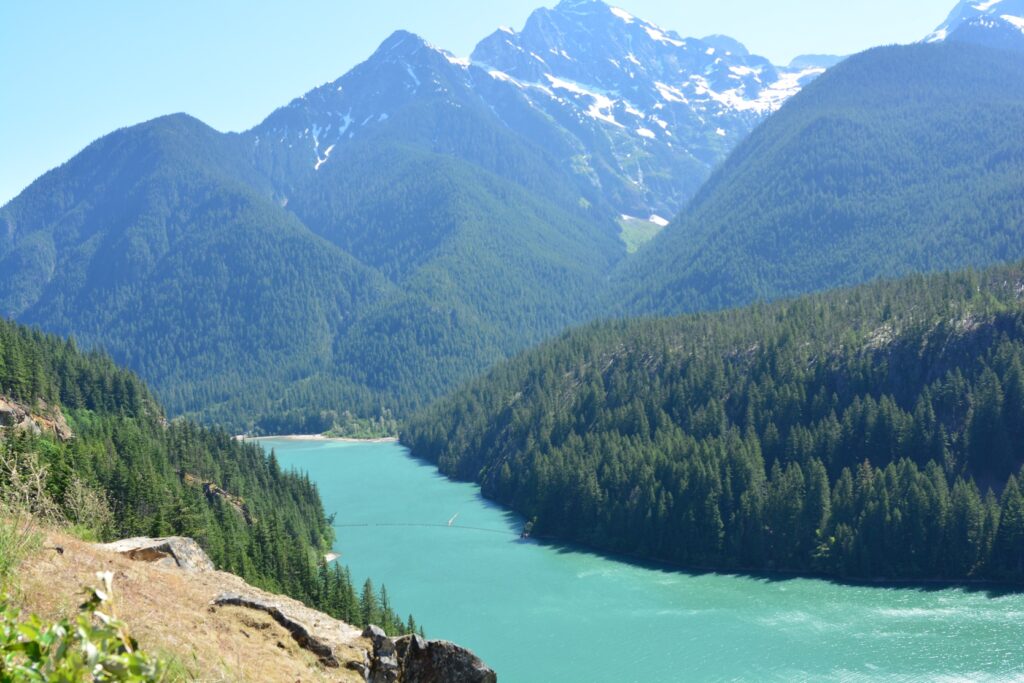
Colonial Creek South Campground is the large campground on the south shore of Diablo Lake. Its 93 sites run in loops above the lake at about milepost 130. Ten of its sites, numbered 64 to 73, are walk-in tent sites open all year on a first come basis.
The South campground carries the pair’s services, the dump station the North campground lacks, the boat launch for Diablo Lake, and sites that take RVs to 36 feet. The walk-in sites are its winter form. Outside the operational season they are free, with no water service and no trash service, so a winter camper hauls water in and packs everything out.
The campground is the launch point for the Diablo Lake boat-in camps, and Thunder Creek’s trail starts across the highway at the North campground. In season it takes reservations, and its walk-in sites stay first come all year.
Newhalem Creek Campground
Quick facts: sites, 107 on the Park Service roster, with 111 in one published rundown, 13 of them tent only, plus 2 group sites; booking, reservable in the operational season; season, the Park Service operational season, closing September 29; potable water, yes, in season; restrooms, flush toilets; showers, none; hookups, none; nightly fee, $24; stay limit, 30 nights per calendar year in the complex, 14 nights from July 1 to September 1; dump station, yes; RV length, up to 50 feet; three loops in old growth forest on the Skagit River.
Newhalem Creek Campground is the western campground of the complex, in old growth forest on the Skagit River at Newhalem, the Seattle City Light town at milepost 120. Its 107 sites run in three loops under big cedars. The roster count is the Park Service’s own, and one published rundown gives 111, and neither page explains the difference.
Newhalem is the complex’s big-rig campground, with sites that take RVs to 50 feet, the longest limit in the complex, and one of the complex’s two dump stations. Newhalem itself holds the North Cascades Visitor Center, and Marblemount, the last full services stop before the high country, lies west on Highway 20.
The campground suits campers who want an old growth base near the visitor center, with the high trailheads east along the highway.
Goodell Creek Campground
Quick facts: sites, 19; booking, first come, all year; season, open year-round, with water and trash service in the operational season only; potable water, yes, in season; restrooms, vault toilets; showers, none; hookups, none; nightly fee, $20 in season, free outside it; stay limit, 30 nights per calendar year in the complex, 14 nights from July 1 to September 1; RV length, up to 20 feet.
Goodell Creek Campground is the small first come campground on the Skagit River west of Newhalem, at about milepost 119. Its 19 sites sit in forest where Goodell Creek meets the river, and it is the campground the Park Service keeps open all year without a reservation system.
The year-round form has two halves. In the operational season the campground charges $20, and water and trash service run. Outside the season the sites are free, the water and trash service stop, and a winter camper here is self-contained.
Goodell Creek suits small rigs and tents, and its 20 foot RV limit is the tightest in the complex. It is the small year-round first come campground on this stretch of the highway. Its first come form means a summer Friday arrival is a gamble.
Lower Goodell Creek Group Campground
Quick facts: sites, 2 group sites; booking, reservation only, on a 12 month rolling window; season, reservable from mid-May to early September; nightly fee, $75; on the Skagit River west of Newhalem.
Lower Goodell Creek Group Campground is the group campground on the Skagit River below Goodell Creek, west of Newhalem. It holds two group sites.
The group sites are reservation only, on Recreation.gov, on the 12 month rolling window the booking system gives group sites. The reservable season displayed for 2027 runs from May 17 to September 5. The fee is $75 a night. A group planning a summer weekend here books early, because two sites is the whole inventory.
Gorge Lake Campground
Quick facts: sites, 8, tent only; booking, reservable in summer, up to 6 months ahead, and first come in winter; season, open year-round; potable water, none; showers, none; hookups, none; nightly fee, $20 in the summer reservation season, free from mid-September to Memorial Day weekend; stay limit, 30 nights per calendar year in the complex, 14 nights from July 1 to September 1; on Gorge Lake near Diablo.
Gorge Lake Campground is the smallest campground in the complex, eight tent sites on Gorge Lake, the small reservoir between Diablo and the town of Diablo. The Park Service’s own page for the campground carries it as open, and open year-round. An older closure story follows this campground in secondary write-ups, and the park’s current pages do not carry it.
Its year runs in two forms. From late May to mid-September the sites are reservable, up to six months ahead, at $20 a night. From mid-September to Memorial Day weekend the campground is first come and free, with no water service and no trash service. It has no potable water in any season, and every camper here hauls water in, in summer as in winter.
Gorge Lake suits tent campers who want the Diablo Lake country without the Colonial Creek crowds. The summer reservation is the reliable way to hold one of its eight sites. It does not suit RVs, and it does not suit any camper who counts on campground water.
Hozomeen Campground
Quick facts: sites, 75; booking, first come; season, while the border gate and the Silver Skagit Road allow, checked before the trip; potable water, yes; restrooms, pit toilets; showers, none; hookups, none; nightly fee, free; fire grates at the sites; campers pack out their trash; at the north end of Ross Lake, reached by road only from Canada.
Hozomeen Campground is the campground at the north end of Ross Lake, and the only campground in this guide that no American road reaches. The drive-in route comes from Canada. From the United States, Hozomeen is a boat-in or trail destination at the lake’s far end.
The campground itself is a full frontcountry campground, 75 sites with potable water, pit toilets, and fire grates, and it is free, and campers pack out their trash. Hozomeen Lake closes from April 1 to May 31 each year for nesting loons, and the East Bank trail starts at its trailhead on Highway 20.
The border is the campground’s standing condition. The gate on the Silver Skagit Road has closed for long stretches in recent years, for fire and for road damage. The park’s fire closures page listed the whole Hozomeen area among its closures when checked on November 18, 2026. No Hozomeen trip is planned without the park’s alerts and fire closures pages. Campers who reach it find a frontcountry campground at the far end of the lake.
Baker Lake campgrounds
Baker Lake Road runs the west shore of Baker Lake past eight Forest Service campgrounds. A ninth campground, Kulshan, stands by Baker Dam at the lake’s south end, run by Puget Sound Energy. Seven of the Forest Service campgrounds book on Recreation.gov, and the eighth, Lower Sandy, is first come. Kulshan takes no reservations.
Swift Creek Campground
Quick facts: sites, 42 on the booking listing, 38 numbered standard sites, 2 yurts, and 2 group sites; booking, reservable in season, individual sites 6 months ahead and group sites 12 months ahead; season, mid-May to mid-September, with the 2027 season running to September 18; potable water, yes; restrooms, vault toilets; showers, none; hookups, none; nightly fee, $40 to $80 for standard sites, $200 for a group site, $70 to $75 for a yurt; check-out, noon; extra vehicle, $12 a night; boat ramp and marina at the campground; day use area; swimming.
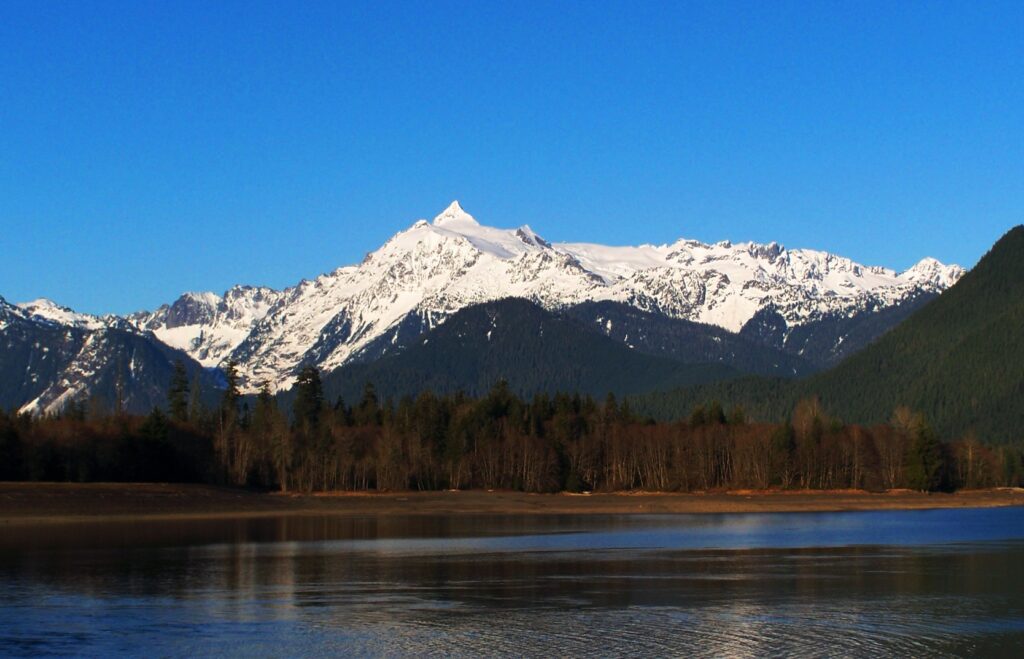
Swift Creek Campground is the Baker Lake campground with the most in it, on the west shore at about the midpoint of Baker Lake Road. The campground stands where Baker Lake Resort stood, and the resort’s cabins are no longer available, whatever older write-ups say. What stands now is a Forest Service campground with standard sites, two yurts, two group sites, a boat ramp, and a marina.
The booking listing carries 42 sites, and this entry prints that composition because the facility publishes no single total. Standard sites run $40 to $80 a night, group sites $200, and yurts $70 to $75. The ramp and marina put boats on the water at the campground, and the day use area and swimming water draw the campers who are not fishing.
Swift Creek is the Baker Lake choice for a group, a yurt stay, or a boat that launches where it camps. Its season runs a week longer than the lake’s other reservable campgrounds, into mid-September, and a second vehicle costs $12 a night, as at every Recreation.gov campground on the lake.
Horseshoe Cove Campground
Quick facts: sites, 39, including 3 group sites, on the facility record, with 40 listings on the booking list; booking, reservable in season, individual sites 6 months ahead and group sites 12 months ahead; season, mid-May to mid-September; potable water, yes; restrooms, vault toilets; showers, none; hookups, none; nightly fee, $40 to $80 for standard sites, $105 for a group site; check-out, noon; extra vehicle, $12 a night; swimming beach; gravel boat launch.
Horseshoe Cove Campground is the family campground on Baker Lake’s west shore, south of Swift Creek. Its facility record carries 39 campsites including three group sites. The sites take tents and trailers with two double units among them, and a swimming beach and a gravel boat launch stand at the campground.
The cove is the campground’s character. The sites sit in a cove on the lake, and the campground has a swimming beach. Its group sites run $105 a night against Swift Creek’s $200, and standard sites run $40 to $80.
Horseshoe Cove suits a family that wants to swim where it camps and launch a small boat from the same shore. Our family tents guide works out how much tent a family needs for a drive in shore camp like this one. The launch is gravel, and the campground has drinking water. Swimming where you camp is the family form of a well-documented pattern, long unstructured hours outside, the input behind the sleep and mood benefits of being outside in children.
Park Creek Campground
Quick facts: sites, 12 on the booking listing; booking, reservable in season, 6 months ahead; season, May to September; potable water, none at the campground, with the nearest water at Swift Creek Campground; restrooms, vault toilets; showers, none; hookups, none; nightly fee, $36; check-in, 2 p.m.; check-out, 12 p.m.; tent and RV sites in old growth on Park Creek.
Park Creek Campground is the old growth campground on Baker Lake Road, just south of Swift Creek, where Park Creek comes down through big trees to the lake. The Forest Service page carries it as a tent and RV campground in old growth forest, open May to September. Its booking listing carries 12 sites at $36 a night.
The campground’s one hard limit is water. It has no potable water. A Park Creek camper hauls water in, and the nearest water is at Swift Creek Campground. Everything else is in place, vault toilets, a 2 p.m. check-in, and a noon check-out on the Forest Service page’s own times.
Park Creek suits campers who want the old growth stand and the creek rather than the open lake shore, and who plan their water before they arrive.
Panorama Point Campground
Quick facts: sites, 9 standard sites on the facility record, 14 listings covering 15 numbered sites on the booking list; booking, reservable in season, 6 months ahead; season, mid-May to mid-September; potable water, none; restrooms, vault toilets; showers, none; hookups, none; nightly fee, $40 to $120 across the site rows; check-out, noon; extra vehicle, $12 a night; day use picnic area; parking for the Baker Lake boat launch.
Panorama Point Campground is the small campground on the lake’s west shore at mid lake, where Baker Lake Road meets the water, with a day use area beside it. The facility record carries nine standard sites, and its booking list carries 14 listings covering 15 numbered sites. The parking for the Baker Lake boat launch stands on the same point.
The sites run $40 to $120 across the booking rows, and the campground has no drinking water, so campers haul it in. Panorama Point suits a small party that fishes or boats by day, with the launch parking on the same point.
Shannon Creek Campground
Quick facts: sites, 19 numbered sites on 18 booking listings; booking, reservable in season, 6 months ahead; season, mid-May to mid-September; potable water, yes; restrooms, vault toilets; showers, none; hookups, none; nightly fee, $36 to $72 across the site rows; check-out, noon; extra vehicle, $12 a night; at the north end of Baker Lake.
Shannon Creek Campground is the campground at the north end of Baker Lake, where Shannon Creek comes in. The Forest Service page calls it a few campsites at the lakeshore. Its booking listing carries 18 listings covering 19 numbered sites.
Shannon Creek has drinking water, and its sites run $36 to $72. The campground stands by the north end of the Baker Lake Trail, and it is the last campground on the road.
Boulder Creek Campground
Quick facts: sites, 9 on the booking listing, including 1 group site; booking, reservable in season, individual sites 6 months ahead and the group site 12 months ahead; season, mid-May to mid-September; potable water, none; restrooms, vault toilets; showers, none; hookups, none; nightly fee, $36 to $38, with the group site at $100; check-out, noon; extra vehicle, $12 a night; elevation, 1,020 feet; about 17.8 miles up Forest Road 11.
Boulder Creek Campground is the campground up Boulder Creek, off the lake on Forest Road 11, at 1,020 feet. The Forest Service carries it as a tent and RV campground with a group site. Its booking listing is small, nine sites in all, one of them the group site at $100 a night and the rest at $36 to $38.
Boulder Creek is the Baker Lake campground for campers who do not need the lake at the site. The creek runs by it, the elevation takes the edge off a hot valley day, and the lake’s boat launches are a drive back down the road. It has no drinking water, and campers haul it in.
The group site is the campground’s distinction. At $100 a night it matches the lowest group price on the lake, on the 12 month group window.
Kulshan Campground
Quick facts: sites, 103 on the operator’s count, 23 dry sites and 80 hookup sites; booking, first come only, no reservations; season, the dry sites open in the second half of April and the hookup sites in late May, and both close in late September; potable water, at the hookup sites; hookups, water and sewer at the hookup sites, with no power at any site; nightly fee, $30; discounts for campers 55 and older and for veterans; 2 vehicles at most per site; operated by Puget Sound Energy at the Baker Lake Dam; the Kulshan boat launch by the campground is open year-round.
Kulshan Campground is Puget Sound Energy’s campground at the Baker Lake Dam, at the south end of the lake near Concrete. It is the largest campground on Baker Lake, 103 sites on the operator’s count, and the only one with hookups. It takes no reservations. Every site is first come.
The hookup form needs care, because it is not the usual one. The 80 hookup sites carry water and sewer hookups and no power, and no site at Kulshan has electricity. An RV camper who needs power runs a generator or goes elsewhere. Silver Lake Park, treated in its own section below, runs water and electric hookups at its RV sites.
The 23 dry sites open first in spring, in the second half of April on the operator’s 2026 schedule. The hookup sites follow in late May, and both close in late September.
The flat $30 fee and the senior and veteran discounts make Kulshan the working campground of the lake. It suits anglers and RV campers who value a sewer hookup over a reservation, and it does not suit anyone whose rig needs shore power.
Bayview Campground and Bayview North Group Site
Quick facts: sites, tent and RV sites with a group site in the campground, and the Bayview North Group Site about a quarter mile north; booking, reservable in season, individual sites 6 months ahead and group sites 12 months ahead; season, mid-May to mid-September; potable water, none; restrooms, vault toilets; showers, none; hookups, none; nightly fee, $36 to $72, with the group site at $100; check-out, noon; extra vehicle, $12 a night; elevation, 730 feet; a day use area at the campground is reservable.
Bayview Campground stands on Baker Lake Road south of Park Creek, at 730 feet. The Forest Service rebuilt it in 2017, and it carries tent and RV sites with no hookups, a group site in the campground, and a reservable day use area. The Bayview North Group Site stands a quarter mile north and books as its own site.
The campground has no drinking water, and campers haul it in. Sites run $36 to $72, and the group sites run $100, on the 12 month window. Bayview suits a party that wants a newer campground layout on the lake road and a group site that does not carry Swift Creek’s price.
Lower Sandy Campground
Quick facts: sites, 12, including 1 double site; booking, first come only, with no host on site; season, fees required from May 15 to September 13, and the access road open mid-April through November and closed December 1 to April 15; potable water, none; restrooms, vault toilets; showers, none; hookups, none; nightly fee, $27 for a single site, with a second vehicle at $12; stay limit, 14 days; check-in, 2 p.m.; check-out, 12 p.m.; quiet hours, 10 p.m. to 6 a.m. in the page’s general information and 10 p.m. to 8 a.m. in its regulations; dogs on a leash; payment is cash only at the fee station from May to September; a 50 percent discount for pass holders is printed on this campground’s own page.
Lower Sandy Campground is the small first come campground near the south end of Baker Lake Road, on Sandy Creek. Its own Forest Service page governs its record. Twelve sites, one of them a double, vault toilets, no drinking water, and no host on site. The fee is $27 for a single site, paid in cash at the fee station during the fee season, May 15 to September 13.
A camper drives in, takes an open site, and pays cash, and the access road closes from December 1 to April 15. Fees run from May 15 to September 13. Its page prints the 50 percent pass holder discount that this guide prints for no other Baker Lake campground, because no other campground’s page carries it. It suits a tent camper or a small rig that wants the lake’s south end without a reservation.
Mount Baker Highway campgrounds
The Mount Baker Highway, State Route 542, climbs from Bellingham through Maple Falls and Glacier to Artist Point. Two Forest Service campgrounds stand along it, one group camp stands up a side road, and Whatcom County’s Silver Lake Park stands north of Maple Falls. Glacier is the last services town, and the campgrounds are the bases for the Heliotrope Ridge and Artist Point country.
Douglas Fir Campground
Quick facts: sites, 26 single campsites on the Forest Service page, 9 of them first come, with 29 overnight sites on the booking listing; booking, mixed reservable and first come, individual sites 6 months ahead and the group picnic area 12 months ahead; season, mid-May to mid-September, with the 2027 season running May 21 to September 18; potable water, yes; restrooms, vault toilets; showers, not published; hookups, none; nightly fee, $36 to $38, with the group picnic area at $85; check-in, 2 p.m.; check-out, noon; extra vehicle, $12 a night; on the North Fork Nooksack River near Glacier; the Heliotrope Ridge trailhead is up the road.
Douglas Fir Campground is the first campground on the Mount Baker Highway past Glacier, on the North Fork Nooksack River. The Forest Service page carries 26 single campsites. The booking listing shows 29 overnight sites, 9 of them first come, and the two counts stand side by side.
The campground is the Heliotrope Ridge base, and the hike is treated in the hiking section below. It also holds a reservable group picnic area at $85. Sites run $36 to $38, check-in is 2 p.m., and check-out is noon.
Douglas Fir suits hikers bound for the ridge and campers who want the river and the big trees of the Nooksack valley floor.
Silver Fir Campground
Quick facts: sites, 17 overnight sites, 16 single and 1 double, plus a group picnic day use area; booking, mostly reservable, 6 months ahead; season, mid-May to mid-September, with the 2027 season running May 21 to September 11; restrooms, not published; showers, not published; hookups, none, and no electrical hookups anywhere at the campground; nightly fee, $36 to $72, with the double site at $72 and the group picnic area at $65; check-in, 2 p.m.; check-out, noon; extra vehicle, $12 a night; elevation, 2,000 feet, near milepost 46; in winter the campground is a non-motorized Sno-Park.
Silver Fir Campground stands higher on the Mount Baker Highway than Douglas Fir, at 2,000 feet near milepost 46, in the last forest before the road climbs to Artist Point. Its facility record carries 17 overnight sites, 16 single and 1 double, one of them first come in the opening booking grid and the rest bookable ahead.
It sleeps a party on the highway below Artist Point, in a campground rather than a trailhead parking lot. Campers here drive the last miles to Heather Meadows and Artist Point in the morning and return to a site, with a group picnic shelter reservable at $65. Sites run $36, the double site runs $72, and there are no electrical hookups.
In winter the campground becomes a non-motorized Sno-Park.
Excelsior Group Camp
Quick facts: sites, 2 group sites; no fee published; no page on Recreation.gov; on the Mount Baker Highway just below milepost 40, near Douglas Fir Campground.
Excelsior Group Camp is a Forest Service group camp on the Mount Baker Highway, just below milepost 40, near Douglas Fir Campground. It holds two group sites.
No fee for it is published, and it has no page on Recreation.gov.
Silver Lake Park
Quick facts: sites, three campgrounds with 90 sites between them, plus a group camp for up to 90 people; booking, reservable on the county system, with a $13 non-refundable reservation fee on each continuous reservation, and named first come sites in each campground; season, April to October, with the county’s 2026 season running April 10 to October 26; potable water, yes; restrooms, vault toilets at each campground, with flush toilets in season at Maple Creek and Red Mountain; showers, at Red Mountain and Maple Creek, open 24 hours in season at no extra cost; hookups, water and electric at the RV sites, none at the tent sites; nightly fee, $25 for residents and $33 for non-residents at the tent campground, $32 and $40 at the RV campgrounds, with double sites at twice the standard rate and the group camp at $362 for residents and $385 for non-residents; check-in, 2 p.m.; check-out, 11 a.m.; stay limit, up to 14 days in a 30 day period; extra vehicle, $12 a day; quiet hours, 10 p.m. to 8 a.m.; dogs on a leash of 8 feet at most, and not on the swimming beach; a dump station near the Maple Creek entrance, free to guests with a camping receipt; no cell service and no Wi-Fi anywhere in the park, on the county’s own statement.
Silver Lake Park is Whatcom County’s campground park on Silver Lake, north of Maple Falls. The county runs three campgrounds in the park. Cedar Campground holds 15 tent sites, 12 standard and 3 double, with no hookups.
Maple Creek Campground holds 47 sites, 45 standard RV sites with water and electric and 2 double sites. Red Mountain Campground holds 28 standard RV sites with water and electric and 2 horse stables. A group camp takes up to 90 people and books by phone only.
The county’s two price columns run through the campsites and the group camp. Residents pay $25 a night at Cedar and $32 at the RV campgrounds, and non-residents pay $33 and $40. Double sites cost twice the standard rate, the group camp is $362 for residents and $385 for non-residents, and Washington residents with a disability pay half the campsite fee. Named sites in each campground are first come. Cedar site 3, Maple Creek sites 22, 32, 35, and 45, and Red Mountain sites 1 and 28 never take a reservation.
The park is the full service campground of the Mount Baker Highway. It has showers at Red Mountain and Maple Creek, a dump station, boat rentals on the lake, and a park office that sells firewood and snacks. It also has no cell service and no Wi-Fi anywhere, on the county’s own statement. The nearest stores and gas are in Maple Falls, 3.5 miles south.
Silver Lake Park suits families and RV campers who want services and a lake, and Mount Baker day trips from a serviced base. Its 2027 season opens for booking on December 1, 2026, on the county’s calendar in the system section above.
Cascade River Road campgrounds
Cascade River Road leaves Highway 20 at Marblemount and climbs the Cascade River toward Cascade Pass. Two Forest Service campgrounds stand on it, both of them trailhead bases for Cascade Pass. The road closes in winter at the Eldorado trailhead, about milepost 21, when snow comes, and the campgrounds’ seasons end before it.
Marble Creek Campground
Quick facts: sites, 27 standard overnight sites, 25 single and 2 double, plus 1 group site for 18 people; booking, mixed reservable and first come, with 5 sites, FF1 to FF5, first come, individual sites 6 months ahead; season, mid-May to mid-September, with the 2027 season running May 21 to September 11; potable water, none; restrooms, not published; showers, not published; hookups, not published; nightly fee, $36 to $70, with the group site at $96; check-in, 2 p.m.; check-out, noon; extra vehicle, $12 a night; elevation, 900 feet; 8.6 miles up Cascade River Road; no cell phone coverage, on the campground’s own page.
Marble Creek Campground is the first campground up Cascade River Road, 8.6 miles from Marblemount at 900 feet, where Marble Creek meets the Cascade River. It holds 27 standard sites and a group site for 18 people, at $36 to $70 a night and $96 for the group site. Five sites at the entrance stay first come.
It stands 8.6 miles up the road, the first campground a Cascade Pass party reaches. The campground has no water and no cell coverage, and Marblemount, 8.6 miles back down the road, is the nearest services point. What the campground gives back is the morning, an early start up the road to the trailhead and a site to return to.
Mineral Park Campground
Quick facts: sites, 21 overnight sites, 19 single and 2 double, in East and West sections of one campground, plus a day use picnic site; booking, mostly reservable, 6 months ahead, with 1 site first come; season, mid-May to mid-September, with the 2027 season running May 21 to September 11; potable water, none; restrooms, not published; showers, not published; hookups, not published; nightly fee, $30 to $60, with the picnic site at $10; check-in, 2 p.m.; check-out, noon; extra vehicle, $12 a night; elevation, 1,360 feet; better suited to tent and small trailer camping, on the Forest Service’s own description.
Mineral Park Campground is the second campground up Cascade River Road, at 1,360 feet. It is one campground with two sections, East and West, and one booking record. The 21 overnight sites run $30 to $60, the cheapest standard sites on the road, and a day use picnic site books at $10.
Mineral Park is the smaller of the road’s two campgrounds, and the Forest Service describes it as better suited to tent and small trailer camping. It has no potable water, like Marble Creek below it, and a party here hauls water from Marblemount. It suits tent campers who want the upper valley at the road’s lowest price, with the Cascade Pass trailhead a morning drive up the road.
Rasar State Park and Skagit County campgrounds
The Skagit River runs west from the park complex through Rockport and Concrete, and its valley holds the territory’s state park and county campgrounds. Rasar State Park stands on the river west of Concrete. Skagit County runs three campgrounds in the valley, at Rockport, at Grandy Lake on Baker Lake Road, and on the Sauk River. All four sit at low elevation, and Rasar camps through the winter.
Rasar State Park
Quick facts: sites, about 49, with standard, partial utility, walk-in, and primitive sites, plus Adirondack shelters, cabins, and group camps; booking, reservable on the State Parks system; season, open year-round, with winter camping; potable water, yes; restrooms, yes, with accessible restrooms; showers, yes; hookups, partial utility sites; nightly fee, the statewide State Parks rates in the fees section above, carried as system ranges; check-in and check-out, not stated on the park’s own page; quiet hours, 10 p.m. to 6:30 a.m. on one statewide form and 10 p.m. to 6 a.m. on another; trailer dump, yes; Wi-Fi, yes; 180 acres with 4,000 feet of Skagit River shoreline, at 38730 Cape Horn Road, Concrete; trails to 3.7 miles, including a one mile accessible trail.
Rasar State Park is the state park on the Skagit River, 180 acres with 4,000 feet of river shoreline, on Cape Horn Road west of Concrete. It is the only camping state park in this guide’s territory, and Rockport State Park, down the highway, is day use only.
Rasar is the roster’s full amenity campground. Its own amenity list carries drinking water, showers, a trailer dump, Wi-Fi, firewood, a playground, and an amphitheater, with accessible campsites and restrooms. The park’s trails run to 3.7 miles, including a one mile accessible trail through the old growth, and a reservable kitchen shelter stands in the day use area.
The park’s inventory runs to about 49 sites across standard, partial utility, walk-in, and primitive sites, with Adirondack shelters, cabins, and group camps beside them. The count is approximate, because the park publishes no single inventory of its sites. The statewide rate table in the fees section above carries the system’s ranges, and no per-site price for Rasar stands in this guide.
This guide’s one firsthand stay in its whole roster is a group camp stay at Rasar, with friends, a good stay as far as group camping goes. The rest of the park’s record here is the park’s own published record. Rasar is the valley’s base for families, for groups, and for campers who want a serviced campground below the snow line while the high country is closed.
Howard Miller Steelhead Park
Quick facts: sites, RV sites numbered 1 to 50, tent sites T1 to T10, an ADA site, H1, 2 Adirondack shelters, and 2 cabins, on the county’s own brochure, which publishes no single total; booking, reservable on the county system; season, year-round, with a winter RV rate from November 1 to the last day of February; potable water, at the RV sites, shelters, and cabins; hookups, power and water at the RV sites, shelters, and cabins; nightly fee, $45 for an RV site, $30 for a tent site, $45 for a shelter, and $90 for a cabin for one night or $80 a night for a multi-night stay, with the winter RV rate at $35; reservation fee, $10; extra vehicle, $5; showers, $1; 110.5 acres on the Skagit River at 52804 Rockport Park Rd, Rockport; boat launch on the river.
Howard Miller Steelhead Park is Skagit County’s campground on the Skagit River at Rockport, 110.5 acres where the Sauk River country meets the upper valley. It is named for the steelhead fishing that built the Rockport season, and the park’s boat launch stands on the river. The county’s brochure publishes the campground by category rather than by total. It lists RV sites 1 to 50, tent sites T1 to T10, an ADA site, H1, two Adirondack shelters, and two cabins. This entry prints the county’s categories and no total the county does not publish.
The county’s fee schedule prices each form separately. An RV site with power and water is $45, a tent site $30, and a shelter with power $45. A cabin is $90 for one night or $80 a night across a multi-night stay. From November 1 to the last day of February the RV rate drops to $35, holidays aside. The reservation fee is $10, an extra vehicle $5, and the showers $1.
Howard Miller is the working fisherman’s campground of the upper Skagit. It sits at river level and takes the big RVs the high campgrounds cannot.
Grandy Lake Campground
Quick facts: sites, primitive sites, 32 across Grandy Lake and South Grandy on the county’s brochure, with no separate Grandy Lake count published; booking, not published on the county record; potable water, conflicted on the county record; nightly fee, $15, with the whole South Grandy campground at $100; 22 acres at 43200 Baker Lake Rd, Concrete.
Grandy Lake Campground is Skagit County’s primitive campground on Grandy Lake, on Baker Lake Road south of the lake. The county park covers 22 acres at 43200 Baker Lake Road. The county’s brochure gives 32 primitive sites for Grandy Lake and South Grandy together, and it publishes no separate count for Grandy Lake alone. This entry prints the combined figure as the county gives it.
The fee is $15 a night. South Grandy, the companion campground, rents as a whole campground for $100, the valley’s group answer for a party that wants a campground to itself. The county’s park inventory carries public water for the park. A second county line gives no water, and the county record does not reconcile the two.
It gives a party a $15 site on a lake of its own, down the road from the Baker Lake campgrounds. It is a primitive campground, and it asks its campers to bring the rest.
Sauk Park Campground
Quick facts: sites, 16 primitive sites on the Sauk River, on the county’s brochure; nightly fee, $15; on State Route 530 south of Rockport.
Sauk Park Campground is Skagit County’s small campground on the Sauk River, on State Route 530 south of Rockport. The county’s brochure carries 16 primitive sites on the river, at $15 a night. The county publishes no split of the sites by RV and tent, and this entry prints none.
Sauk Park’s own county record is short, and this entry stays close to it. It is a real county campground on a steelhead river, at the roster’s lowest fee, and campers take its current terms from Skagit County Parks before they go.
The Skagit County campgrounds run on the county’s adopted fee schedule, and the county’s brochures carry the three parks’ own forms. Whatcom County, north of Skagit, runs exactly two campgrounds. Silver Lake Park, treated above, is the one in this guide’s territory. The other, Lighthouse Marine Park, stands at Point Roberts, outside the territory.
South of the Sauk River, the Mountain Loop Highway camping guide covers the byway campgrounds between Granite Falls and Darrington.
Campgrounds east of Washington Pass
Washington Pass, at 5,477 feet, is the crest of the North Cascades Highway. East of it the road drops into the Methow Valley, and three Forest Service campgrounds stand along it between the pass and Winthrop. All three are first come. All three close with the highway, because the highway is their only road. Mazama and Winthrop carry their services, and the pass trailheads, Cutthroat, Blue Lake, and Maple Pass from the Rainy Pass side, are their day country.
Klipchuck Campground
Quick facts: sites, 46; booking, first come, with payment by Scan and Pay; season, May 1 to November 1 on the facility record, inside the highway’s own open season; potable water, not published for the current season; restrooms, vault toilets; showers, not published; hookups, none; nightly fee, $20 for a standard site; stay limit, 14 nights; elevation, 2,900 feet; 17.6 miles west of Winthrop on Highway 20, then about 1.3 miles on Forest Road 300; the facility page flags major cell coverage issues; with the Driveway Butte Trail nearby.
Klipchuck Campground is the largest of the three east side campgrounds, 46 sites in the ponderosa and fir forest along Klipchuck Creek. It stands 17.6 miles west of Winthrop, a mile and a third off the highway on Forest Road 300, at 2,900 feet. Its facility page carries its season as May 1 to November 1.
The campground runs first come, at $20 a night, paid by Scan and Pay. Its facility page publishes no water status for the current season. A party checks the water status with the Methow Valley Ranger District before the trip. Its facility page flags major cell coverage issues.
Klipchuck’s best use is the pass country, with the pass trailheads west up the highway and Winthrop’s services a shorter drive east.
Lone Fir Campground
Quick facts: sites, 27; booking, first come, with payment by Scan and Pay; season, while Highway 20 is open, and not accessible in winter when the highway is closed; potable water, none; restrooms, vault toilets; showers, not published; hookups, none; nightly fee, $20 for a single site and $10 for an additional vehicle; a 50 percent discount for pass holders is printed on this campground’s own page; occupancy, 2 vehicles at most, and 2 tents or 1 RV and 1 tent; elevation, 3,600 feet; on Highway 20 along Early Winters Creek, 27 miles northwest of Winthrop; the Lone Fir Trail and the Cutthroat Creek Trail are nearby.
Lone Fir Campground stands on Highway 20 along Early Winters Creek, 27 miles northwest of Winthrop, at 3,600 feet. It is the highest of the three east side campgrounds and the closest to Washington Pass. The Forest Service page states no site count, and the listings that carry the campground agree on about 27 sites. The fee is $20 a night, with a second vehicle at $10.
It has no potable water, vault toilets serve it, and campers haul water in. Its page also prints the 50 percent pass holder discount, one of only two campgrounds in this guide whose own page carries it, and payment is by Scan and Pay.
Lone Fir suits campers who want the pass at first light. The Lone Fir Trail climbs from the campground area, and the Cutthroat Creek Trail is nearby. When the highway closes for winter the campground is not accessible at all. A fall party here watches the pass report the way a west side party watches the rain.
Early Winters Campground
Quick facts: sites, about 12, split across the highway; booking, first come, with payment by Scan and Pay; season, May 19 to November 1 on the facility record, inside the highway’s own open season; showers, not published; hookups, none; nightly fee, $15 for a standard site; elevation, 2,200 feet; 15 miles west of Winthrop, where Early Winters Creek meets the Methow River; the Cedar Creek Trail and the Driveway Butte Trail are within 4 miles, and the Methow Community Trail runs toward Mazama.
Early Winters Campground is the lowest and cheapest of the three east side campgrounds, at 2,200 feet where Early Winters Creek meets the Methow River, 15 miles west of Winthrop. The highway divides it. Sites stand on both sides of Highway 20, about 12 in all, at $15 a night.
The split is the campground’s character, and a party picks its side of the highway when it picks its site. The campground is the closest of the three to Mazama and Winthrop, and the Methow Community Trail connects it toward Mazama. The Cedar Creek Trail and the Driveway Butte Trail are within four miles.
Early Winters suits a party that wants the Methow Valley floor, the river at the door, and the lowest fee on the east side. The pass trailheads are a morning drive west. Its facility record runs the first come season from May 19 to November 1.
Stehekin and Lake Chelan campgrounds
Stehekin is the roadless community at the head of Lake Chelan, in Lake Chelan National Recreation Area. No roads lead into it. Every way in is a boat ride up the lake, a floatplane, or a trail over the crest. Every campground in the valley is a walk from the ferry dock, the airstrip, or a trail.
Two ferry companies run the lake. The Lake Chelan Boat Company’s Lady Express makes the run from Chelan in about 2.5 hours at $43 per adult each way. Its slower Lady of the Lake runs on Sundays from mid May to September at $25, and Lady Liberty is $49.
The Stehekin Ferry runs from Fields Point Landing, about 90 minutes to Stehekin at $39 per adult and $20 for a child under 12. Its summer season runs from May 6 to October 10, with a winter schedule of Tuesday to Thursday sailings. Fares here are the operators’ fares as checked in November 2026, and both fare and schedule change by season, so check them with the operator before the trip.
Harlequin Campground
Quick facts: sites, 7, 6 standard sites and 1 group site, walk-in; booking, reservable from mid-July to mid-September, and first come with limited services the rest of the year; nightly fee, $20 in the reservable season, and free on the first come form outside it; 4.5 miles up the Stehekin Valley Road from the landing; the largest campground in the Stehekin Valley.
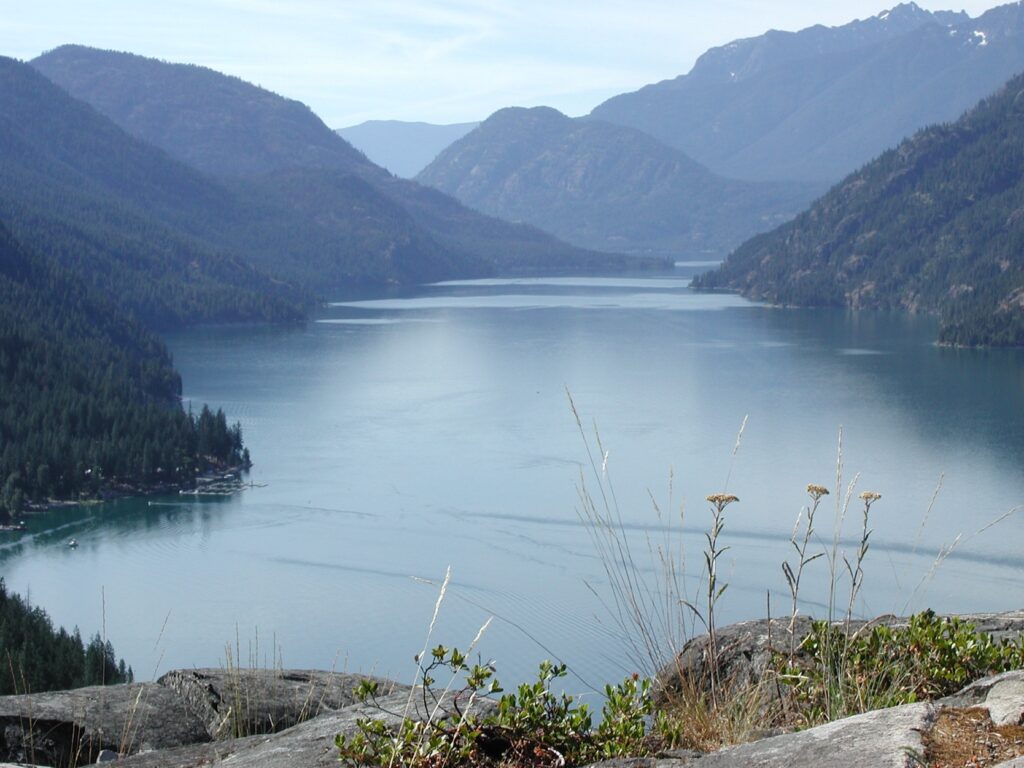
Harlequin Campground is the largest campground in the Stehekin Valley, seven sites 4.5 miles up the valley road from the landing. Six are standard sites and one is a group site. All are walk-in. A Harlequin party carries its gear up the valley on foot.
Harlequin runs two forms across the year. From mid-July to mid-September it is reservable, at $20 a night, and the 2026 reservable season ran July 1 to September 6. The rest of the year it is first come and free, with limited services.
Harlequin suits a party that wants the upper valley, the Stehekin River and the trailheads toward the crest, with the landing’s services 4.5 miles behind it. A party that wants the dock at its door camps at Lakeview or Purple Point instead.
Lakeview Campground
Quick facts: sites, 9, tent only, walk-in; booking, first come; nightly fee, $20 on the Park Service fee schedule, carried free in the 2026 season form below; a five minute walk from the boat dock at the landing.
Lakeview Campground is the campground at the Stehekin landing, nine tent sites a five minute walk from the boat dock. It is the first campground a ferry passenger reaches and the base with the shortest carry in the valley.
The campground’s 2026 season ran in a changed and dated form. Flooding and debris flows in December 2025 damaged the landing’s wastewater treatment plant. Through the 2026 season Lakeview and Purple Point ran with water and vault toilets only, Lakeview’s sites open first come and free. The Park Service fee schedule carries the campground at $20. Which form the next season takes is the park’s Stehekin page’s record to give, and a party checks it there before counting on either the fee or the services.
Lakeview suits a party that packs light and wants the valley from the dock, where the visitor center, the ferry, and the valley road all start. It does not suit a party that needs to drive to its site, because no camper in Stehekin does.
Purple Point Campground
Quick facts: sites, 6, tent only, walk-in; booking, first come; nightly fee, $20 on the Park Service fee schedule, carried free in the 2026 season form below; an eight to ten minute walk from the boat dock.
Purple Point Campground is the second campground at the Stehekin landing, six tent sites an eight to ten minute walk from the boat dock. It is the frontcountry campground at the dock. Purple Creek, up the trail, is a backcountry camp, a different place, and a permit for one is not a site at the other.
Purple Point ran in the same dated 2026 form as Lakeview, its sites open first come and free through the 2026 season, with water and vault toilets only. The landing’s wastewater plant was out of service. The park’s fire closures page also carried site 1 at Purple Point as closed. The Park Service fee schedule carries the campground at $20 in a normal season, and the park’s Stehekin page is the check for the current form.
Purple Point suits the same light party as Lakeview, with a slightly longer carry. The two landing campgrounds are small and both run first come, so a summer party that can plan around the form arrives on a morning boat.
Lake Chelan boat-in camps
Lake Chelan’s boat-in camps line the upper lake’s shores between the ferry landings, and three of them are treated here from their published records. Weaver Point holds 16 sites. Flick Creek holds 2 sites and a shelter. Manly Wham holds 1 site. Each camp has a vault toilet and bear-proof food lockers.
The Chelan camps run on a different system from the Ross Lake camps. No backcountry permit applies to the camps themselves, and the camps themselves need no reservation. What a boating party needs is the Federal Dock Permit for a motorboat using the docks between May 1 and October 31.
Hiking from the campgrounds
The campgrounds above earn their keep as trail bases. The Baker Lake base hike is Park Butte, 7.5 miles round trip and 2,200 feet of gain to a 1932 lookout at 5,450 feet. Its trailhead is the Schriebers Meadow trailhead off Baker Lake Road. WTA carries its full record, and the Baker Lake campgrounds are its base.
Maple Pass and Lake Ann
The Maple Pass loop climbs from Rainy Pass on Highway 20, 7.2 miles round trip with 2,020 feet of gain to a high point of 6,650 feet, on WTA’s figures. A Northwest Forest Pass or an interagency pass covers the trailhead.
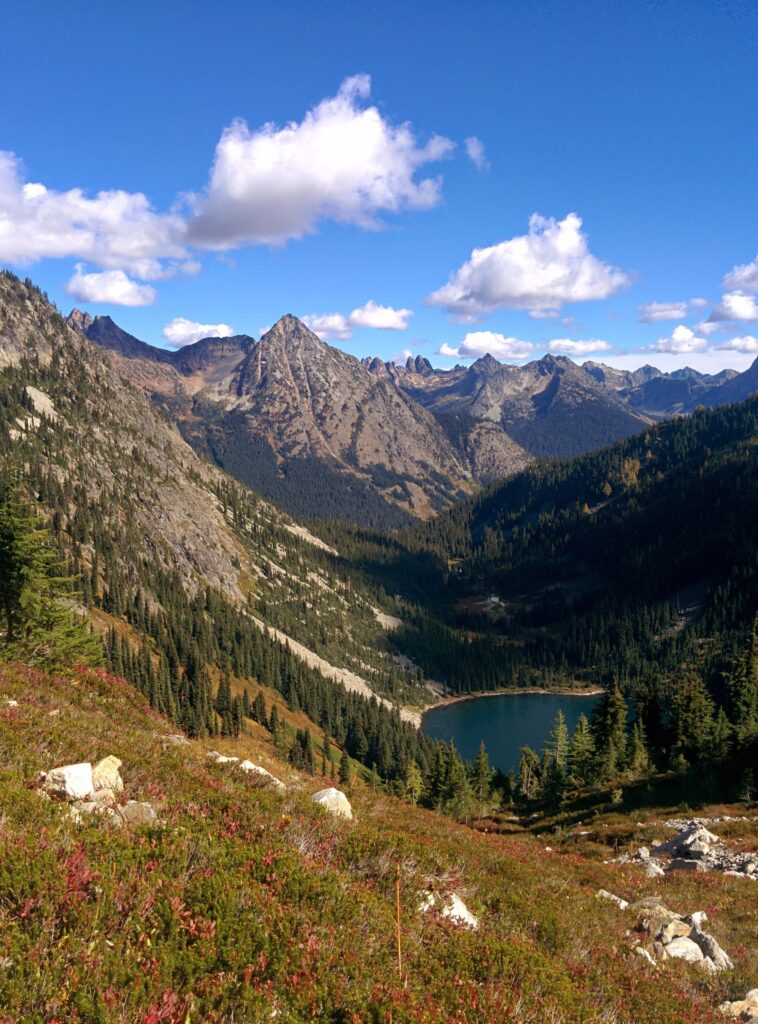
The dog rule here runs in two parts. Leashed dogs are allowed on the Forest Service trail. The ridge at Maple Pass follows the national park boundary, inside which pets are allowed only on the Pacific Crest Trail. Camping is prohibited within a quarter mile of Rainy Lake, Lake Ann, Heather Pass, and Maple Pass.
The bases are Klipchuck, Lone Fir, and Early Winters to the east and the Highway 20 campgrounds to the west. This guide’s author hiked Heather and Maple Pass as a day hike on September 27, 2014.
Cascade Pass
Cascade Pass is the classic hike at the end of Cascade River Road. It runs 7.0 miles round trip with 1,800 feet of gain to the pass at 5,392 feet, on WTA’s figures. The pass is a viewpoint and a junction, the trail continuing down toward Stehekin.
The pass stands inside the national park, where dogs are not allowed on trails, and the road sets the season. Cascade River Road closes in winter at the Eldorado trailhead, about milepost 21, and the trailhead sits past the closure. Marble Creek and Mineral Park campgrounds are the hike’s bases.
Cutthroat Pass and Blue Lake
Two trailheads near Washington Pass carry names that campers merge, and the merge causes real mistakes. Cutthroat Lake is one hike and Blue Lake another. Cutthroat Pass is a separate and harder climb from its own trailhead, on the Pacific Crest Trail side of the ridge. The lake and the pass are never the same trip.
The trailheads take a Northwest Forest Pass, and the bases are the three campgrounds east of Washington Pass.
Heliotrope Ridge
Heliotrope Ridge is the Mount Baker climb view hike from the Mount Baker Highway, 5.5 miles round trip with 1,400 feet of gain, on WTA’s figures. The trail climbs through forest from the trailhead above Glacier to the moraine edge, where Coleman Glacier fills the view. The crux is a stream crossing. Heliotrope Creek runs unbridged just past the Climbers Trail junction, and the water runs higher and faster in the afternoon, after the day’s melt. Parties cross early, or turn at the creek without shame.
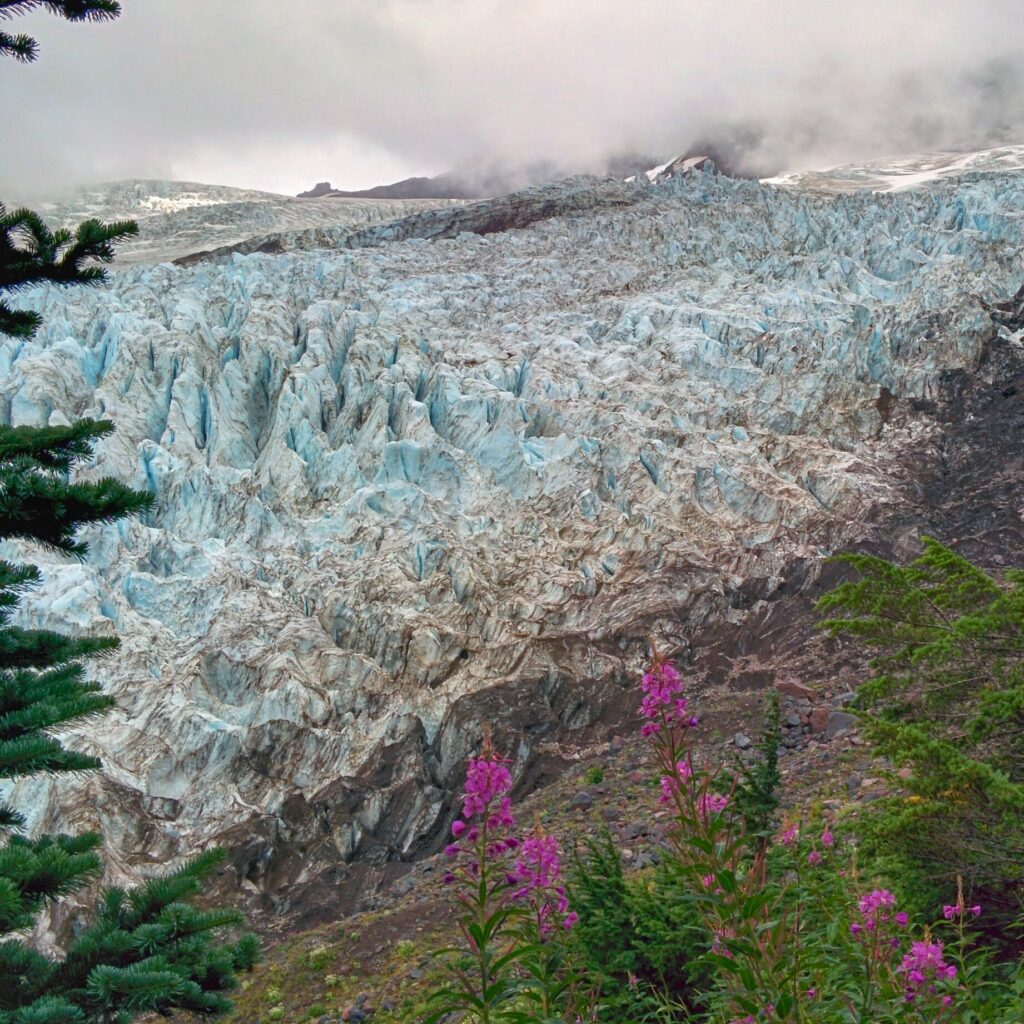
The bases are Douglas Fir and Silver Fir campgrounds on the highway. This guide’s author hiked Heliotrope Ridge on August 30, 2014, and remembers the crossing under the name his party used for the creek, Kulshan Creek, as a bit scary. WTA’s page names the crossing Heliotrope Creek, and the water is the same water.
Thunder Creek
Thunder Creek is the Colonial Creek campgrounds’ own trail, starting at the North campground near the amphitheater. The full trail runs 12.0 miles round trip with 1,300 feet of gain to a high point of 1,900 feet, on WTA’s figures. Day hikers turn earlier, at Thunder Camp at about 2 miles or at the Fourth of July Pass junction at 2.1 miles. McAllister Camp stands up the valley.
The trail takes no parking pass, and a morning to Thunder Camp and back is the campground day. The camps up the creek are backcountry camps under the permit system, treated in the section below.
Artist Point and Ptarmigan Ridge
Artist Point, at the end of the Mount Baker Highway at 5,160 feet, is a road-end viewpoint, and two hikes start from it. The Chain Lakes Loop runs about 6.5 miles on WTA’s figure, through the lakes below Table Mountain. The Forest Service gives the route by its starts, about 6 miles with 1,700 feet of gain and loss from Heather Meadows or Austin Pass. From Artist Point it is 5 miles with 700 feet to Iceberg Lake and back. Ptarmigan Ridge shares the start and runs the ridge toward Coleman Pinnacle.
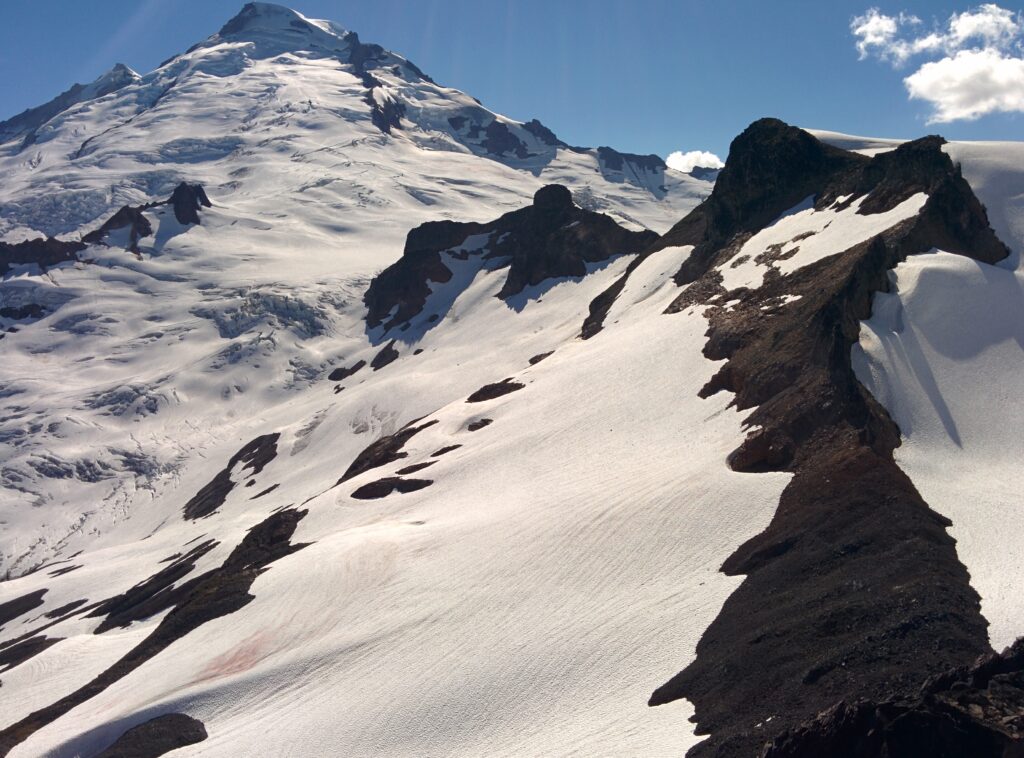
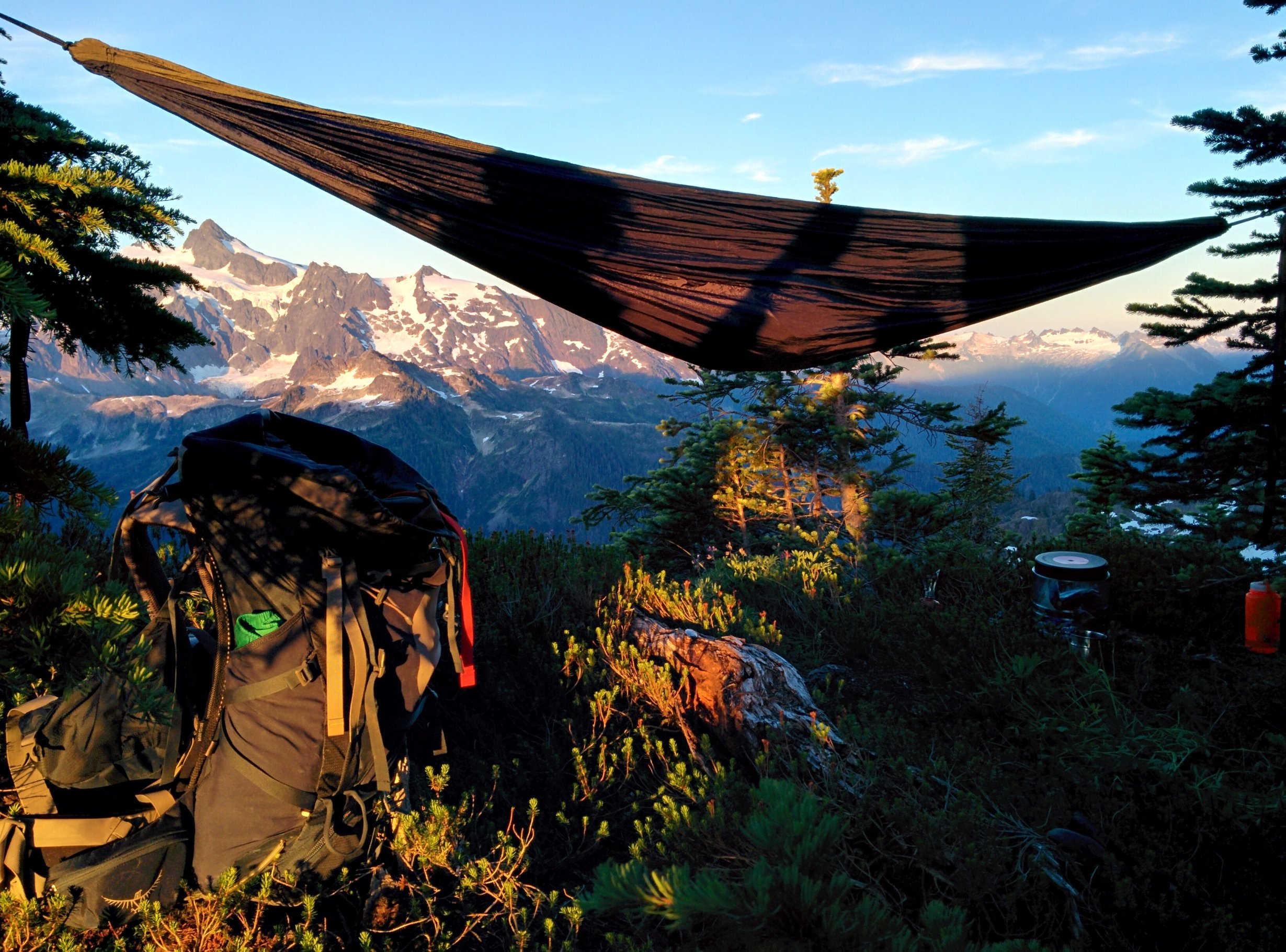
This guide’s author backpacked the Chain Lakes Loop from Artist Point. He camped one night at Hayes Lake and one night on a butte he thinks was called Happy Bunny Butte. In August 2016 he backpacked Ptarmigan Ridge from Artist Point and camped in a hammock on the ridge. The bases are Silver Fir and Douglas Fir campgrounds and Silver Lake Park, and Artist Point’s own season is the highway’s, its last miles opening latest of all.
Boat-in camps and the backcountry
The park complex’s second camping system floats. Nineteen boat-in camps stand on Ross Lake, three stand on Diablo Lake, and the Baker Lake Trail camps and one road-end camp carry the walk-in side. The backcountry permit system from the fees section above governs the trail camps and the Ross Lake and Diablo Lake boat-in camps. The Lake Chelan boat-in camps stand outside it.
Ross Lake boat-in camps
Ross Lake holds 19 boat-in camps with 58 sites between them, on the Park Service’s own table, running south to north. From the south the camps run Green Point with 5 sites, Cougar Island with 2, Roland Point with 1, McMillan with 3, Spencer’s with 2, and Big Beaver with 7. Then come May Creek with 1, Rainbow Point with 3, Devil’s Junction with 1, Ten Mile Island with 3, Dry Creek with 4, and Ponderosa with 2.
Then Lodgepole with 3, Lightning Creek Stock Camp with 2, Lightning Creek Boat Camp with 5, and Cat Island with 4. The last camps are Little Beaver with 5, Boundary Bay with 3, and Silver Creek with 2. Every camp requires a backcountry permit.
Fire closures change this inventory by the season. The park’s fire closures page carried Boundary Bay and Little Beaver boat-in camps among its closures when checked on November 18, 2026. It is the page a boating party checks before choosing a camp.
Diablo Lake boat-in camps
Diablo Lake holds three boat-in camps, all launched from Colonial Creek Campground. Thunder Point holds 3 sites at 2.0 miles from the launch, Hidden Cove holds 1 site at 2.6 miles, and Buster Brown holds 3 sites at 2.8 miles. All three require a backcountry permit, and none has a dock. A party lands on the shore and carries its gear up to the sites.
The Diablo camps are the short paddle version of the Ross Lake system.
Baker Lake Trail camps
The Baker Lake Trail runs the lake’s east shore from the South Baker Lake Trailhead, and four Forest Service camps stand on it. Anderson Point holds 7 sites at 2 miles, Maple Grove holds 7 at 4 miles, Silver Creek holds 1 at 8.5 miles, and Noisy Creek holds 6 at 9.5 miles. Each camp has picnic tables, fire pits, and bear boxes for food storage.
The trail camps are first come walk-in camps, outside the Recreation.gov system that governs the road campgrounds across the lake. A party hikes or paddles in, takes an open site, and stores food in the bear box. The Baker Lake road campgrounds are the bases for the trail and for Park Butte, up the same road.
Hannegan Camp
Hannegan Camp stands on the Hannegan Pass Trail, reached from the Hannegan trailhead, in the Mount Baker country east of Glacier. Hannegan is a backcountry camp, with no campfires allowed and a party limit of 12.
The camp crosses a boundary, and the portion inside the national park takes a backcountry permit, issued at the Glacier Public Service Center. A party that camps at Hannegan plans it as a backcountry night, with a permit for the park portion, and not as a drive-up campground night.
Fire restrictions and emergencies
Fire restrictions
Fire restrictions in this territory stack, with more than one system in force at once. The agency or operator that runs the campground sets its fire rule, and the county sets a burn ban for the land around it. The strictest rule in force on a given night governs.
The campground’s own page, on its agency or operator’s site, is the check for its current fire status, and the county fire marshal and emergency management pages carry the county’s current ban. Skagit County posts through its Fire Marshal’s Office and Emergency Management, and Whatcom County through its emergency management pages. The east side counties, Chelan and Okanogan, post through their own emergency management channels. During fire season, check that page and the county’s page on the day of the trip, because a ban can land between the booking and the night.
Emergencies
An emergency in this territory starts with 911, as it does everywhere in Washington. What changes by valley is where the ambulance goes. The hospital towns are Sedro-Woolley, with PeaceHealth United General Medical Center, a critical access hospital with emergency services. Mount Vernon has Skagit Valley Hospital and its Level III Emergency Department.
Bellingham, with PeaceHealth St. Joseph Medical Center, serves the Mount Baker Highway. Chelan, with Lake Chelan Community Hospital, serves the Stehekin and lake country.
Winthrop has no hospital, and the nearest hospital care from the Methow campgrounds is down the Methow Valley at Brewster. Cell coverage is the territory’s standing limit. Marble Creek Campground’s own page states it has no cell phone coverage, Klipchuck’s page flags major coverage issues, and Silver Lake Park states it has no cell service anywhere.
Skagit County Emergency Management and Whatcom County’s alert system post their counties’ emergencies, and on the east side, Chelan and Okanogan counties run their own emergency alert systems. A party camping in a county it does not live in can sign up for that county’s alerts before the trip.
Frequently asked questions
Can you camp inside North Cascades National Park?
Not in a vehicle. North Cascades National Park proper has no drive-in campground. Every drive-in campground on Highway 20 is in Ross Lake National Recreation Area, which wraps the highway. Inside the park proper, camping is backcountry camping on foot, at designated camps under a backcountry permit. The Highway 20 entries above are the drive-in roster.
Do I need a reservation for camping in the North Cascades?
It depends on the campground and the month. The reservable Park Service campgrounds take reservations on Recreation.gov in their operational seasons, which open in May and close in September on dates that vary by campground. They are Newhalem Creek, Colonial Creek North, and Colonial Creek South, and Lower Goodell Creek Group takes them for groups. Goodell Creek and Hozomeen take no reservations in any season, and Gorge Lake takes them in its summer season only.
The Forest Service campgrounds on Baker Lake, the Mount Baker Highway, and Cascade River Road are reservable in season, with first come exceptions. Kulshan Campground and the three Methow Valley campgrounds, Klipchuck, Lone Fir, and Early Winters, are first come only.
How much does a North Cascades backcountry permit cost?
Campers 16 and older pay $10 per person, and campers 15 and under are free. A $6 non-refundable fee is charged on top of each permit transaction, for a lottery application, a general on-sale reservation, or a walk-up permit. Payment is by card only. The permit is required year-round for overnight backcountry camping in the park complex, including the Ross Lake and Diablo Lake boat-in camps.
When does Highway 20 close for winter?
The North Cascades Highway closes between about milepost 134 and milepost 171 when snow and avalanche conditions require it. It usually closes in late November or early December, and it usually reopens in April or early May. The WSDOT pass report carries the current status, and the campgrounds east of Washington Pass are reachable only while the highway is open.
Are there showers or hookups at North Cascades campgrounds?
Inside the park complex, no, no complex campground has showers and no site has hookups. Outside the complex the picture changes by campground. Rasar State Park carries showers on its own amenity list, and Silver Lake Park has showers at two of its campgrounds and water and electric at its RV sites. Kulshan Campground’s hookup sites carry water and sewer and no power. A camper who needs a shower or shore power camps outside the complex.
Can I camp at Stehekin without a car?
Stehekin has no road in, so every Stehekin camper camps without a car. The ferries land at the dock, and the valley’s campgrounds are walk-in from it. Lakeview Campground is a five minute walk from the dock, Purple Point is eight to ten minutes, and Harlequin Campground stands 4.5 miles up the valley road. Parties carry their gear.
Where can I dump an RV tank in the North Cascades?
Inside the park complex, at two campgrounds only, Newhalem Creek and Colonial Creek South. Colonial Creek North has none. Outside the complex, Rasar State Park has a trailer dump, and Silver Lake Park has a dump station near its Maple Creek entrance, free to guests with a camping receipt. None of the Baker Lake campgrounds in this guide lists a dump station on its record. A Baker Lake RV party plans its dump at one of the stations above.
Which Colonial Creek campground should I choose, North or South?
Choose South for services and size. Colonial Creek South holds 93 sites, the dump station, the boat launch, sites that take RVs to 36 feet, and the 10 walk-in tent sites that stay open all year. Choose North for its 38 sites, RVs only to 25 feet, no dump station, and the Thunder Creek trailhead at the campground. Both charge $24, and both are reservable in season. The full entries are Colonial Creek North Campground and Colonial Creek South Campground above.
How do I camp on Ross Lake?
By boat, under a backcountry permit. Ross Lake holds 19 boat-in camps with 58 sites, and every camp requires the permit. There is no drive-in campground on Ross Lake itself. Hozomeen Campground, at the lake’s north end, is a drive-in campground reached by road only from Canada. The boat-in section above carries the camp inventory and the permit mechanics.
Is Pearrygin Lake State Park in this guide?
No. Pearrygin Lake State Park, outside Winthrop, is a large state park campground, and it belongs to the Eastern Washington camping country rather than to the North Cascades Highway campgrounds. This guide’s east side roster is the three Forest Service campgrounds on the highway itself, the bases for the pass trailheads. A party that wants Pearrygin camps there on the State Parks system and drives to the trailheads.
When is the best time to camp in the North Cascades?
The high country’s season is set by the highway and the snow. The Park Service campgrounds open their operational seasons in May, the reservable campgrounds run to mid-September, and July and August bring the full roster and the crowds. September brings the larches at the pass trailheads and thinner campgrounds. The low valley campgrounds, Rasar, the Skagit County parks, and Silver Lake Park, run longer seasons below the snow.
Winter camping inside the complex is the year-round first come campgrounds, Goodell Creek, Gorge Lake outside its reservation season, and the walk-in sites at Colonial Creek South. Each carries the services its entry lists.
Sources
The campground records in this guide come from the managing agencies’ own pages and booking systems, from the two counties’ adopted fee schedules and park brochures, and, for a few campgrounds whose agencies publish no figure, from the convergent public listings. The National Park Service’s camping, backcountry permit, boat-in, Stehekin, and fire closures pages for North Cascades National Park, and its facility records, carry the park complex campgrounds. The USDA Forest Service’s Mt. Baker-Snoqualmie and Okanogan-Wenatchee National Forest campground pages, and the Recreation.gov facility pages for the reservable campgrounds, carry the Forest Service campgrounds. Puget Sound Energy’s Kulshan Campground page carries Kulshan.
Washington State Parks’ Rasar State Park page, camping page, and fees page carry Rasar and the statewide system. Skagit County’s adopted fee schedule and park brochures carry Howard Miller Steelhead Park, Grandy Lake, and Sauk Park. Whatcom County’s Silver Lake Park pages carry Silver Lake Park.
The Washington Trails Association hike pages carry the hiking figures. Ferry fares are the Lake Chelan Boat Company’s and the Stehekin Ferry’s published fares, checked in November 2026. Fire and emergency information comes from the land managers’ fire pages, from the Skagit and Whatcom county fire marshal and emergency management pages, and from the Chelan and Okanogan county emergency management agencies.