Oregon State Parks takes campsite reservations from the same day of arrival through six months in advance. At the busy parks, summer weekends go early in that window.
I traveled it in 2014 and again in 2016, for roughly four to six nights each time, visiting most of the same campgrounds on both runs. One trip took place in May and the other in July, but I did not record which month belonged to which year. The first trip was solo, sleeping on an air mattress in a truck bed under a topper. The second was with my wife, in our Kingdom 6 tent, out of a Toyota Yaris carrying an inflatable kayak and all our gear.
I know a specific set of parks from those trips, but not every campground on this coast. I stayed at five Oregon parks and two more in the California redwoods; the other campgrounds here rest on the parks' own pages and other campers' accounts. I visited most areas along this coast on those runs, many of them on day stops, even where I never camped. The south is the most scenic part of this coast in my assessment.
Readers touring both states will also want Washington campgrounds by region. Use the camping checklist to pack for a coast trip. Four Forest Service campgrounds and one private campground on this coast are profiled too, from their operators' pages and other campers' accounts, and they are labeled federal or private wherever they appear.
In this guide:
At a glance
Reservations run from the same day as arrival through six months in advance. New sites come online at 6 a.m. daily, and same day online reservations have run statewide since January 1, 2024, at most campgrounds. Same day bookings have no reservation fee. Some campgrounds are first come, first served either year-round or seasonally; check each park's page for its season and booking arrangements.
Older advice still circulating gives this system a nine month booking window; the window is six months.
The coast divides into three parts, and this guide follows them: the north coast from Astoria to Lincoln City, the central coast from Lincoln City to Florence, and the south coast from Reedsport to the California border. Both of my trips ran south to north. In my experience, the south is quieter and, in my assessment, the most scenic part, though Harris Beach and Honeyman are exceptions to that quiet. The north sits closer to the Portland and Washington drive market and holds the two most searched campgrounds on this coast.
Cape Lookout State Park, one of the parks I camped, is closed from August 3, 2026 through spring 2027 for park improvements. Construction closures will be adjusted as the timeline becomes clearer.
| Trip type | Park | The catch | Read more |
|---|---|---|---|
| First family overnight | Beverly Beach State Park | A large, popular campground, so book as soon as the six month window opens | Beverly Beach |
| Quietest ground | Cape Blanco State Park | The headland and beach are wind exposed even where sites are sheltered | Cape Blanco |
| Beach at a short walk | Beachside State Recreation Site | Seasonal camping only, March 15 to October 31, weather permitting | Beachside |
| Hardest to book | Fort Stevens State Park | The coast's largest campground, and first on this coast in camping searches | Fort Stevens |
| The dunes trip | Jessie M. Honeyman State Park | No beach access from camp, and dune vehicle noise in season | Honeyman |
Count back six months from the first night. Be ready at 6 a.m. when new sites release. If that fails, use same day booking and watch for cancellations.
Choosing among the coast's parks
A camper has to choose more than a location, including a part of the coast, beach access, how busy the park gets, and a site that fits their tent or rig.
First, choose a part of the coast. The north holds the two most searched campgrounds on this coast, Fort Stevens and Cape Lookout, and sits closest to the Portland and Washington drive market. The heaviest overnight use in the system sits farther south, at South Beach and Honeyman, so busy does not belong to one end of the coast. The central coast mixes town adjacent parks with forest campgrounds an hour apart, and two central coast campgrounds also rank among the busiest in the system on overnight use. Pick the park rather than the stretch when quiet is the point.
The south is quieter in my experience, and it is where I would spend most of a next trip's time. Harris Beach is the southern exception to that quiet, with demand to match the busier parks farther north.
On both trips, I started in the redwoods below the state line and traveled up the whole coast rather than staying in one part. In 2014, I started by camping at Del Norte Coast Redwoods State Park in California, which I highly recommend. In 2016, I started by camping at Jedediah Smith Redwoods State Park, which I also highly recommend. Both redwood campgrounds close this guide in their own section, and the itineraries section that follows turns these runs into routes a reader can copy.
Next, consider beach access. Most of the campgrounds I used put the beach a short walk or a trail away, and the more inland ones made it a drive. Check the distance to the beach at each park rather than relying on descriptions.
Beachside sits seconds from the sand, and Sunset Bay is a short walk from its beach. Loeb sits eight miles inland, and Bullards Beach asks a mostly paved walk of just over a mile to its dunes. Honeyman has no beach access from camp at all.
I did not keep tide notes on either trip, so I relied on the parks and other campers for tide information. Check a tide table for day plans at rocky and tidepool beaches, and treat the campground choice itself as a distance question.
Next, consider popularity. Fort Stevens and Cape Lookout lead this coast on camping searches, at 8,100 and 6,600 searches a month, though Cape Lookout is closed through spring 2027 whatever its demand. On camper nights, South Beach leads the whole system, ahead of Fort Stevens and Honeyman. Campers report Beverly Beach and South Beach filling completely on summer weekends, and Honeyman filling with families in peak summer. Midweek and shoulder season stays are the release valve at all of them.
Among the parks I used, Cape Blanco felt private and quiet, while the parks farther north felt much more crowded and noisy.
Camper reports add two busy exceptions in the south, Harris Beach and Honeyman in summer, and one noise exception that is not about crowds at all, Humbug Mountain beside Highway 101. Judge each park by its own season and loop rather than by its place on the coast alone.
Campers report Harris Beach, in the far south, filling quickly and drawing crowds more like a northern park, and Honeyman runs busy in summer for reasons its entry gives. Umpqua Lighthouse was the one park I used that felt crowded.
Finally, consider site fit. Every site I used fit our tent, and none felt too small, too exposed, or too sloped. That is what I found on my trips, not a promise about any park's sites today. Campers report small, closely spaced sites at Umpqua Lighthouse and close spacing at Nehalem Bay, against strong privacy at Cape Blanco. At Bullards Beach and Loeb the roomier reports depend on the site, with screened and spacious sites sitting beside open or crammed ones at both parks.
For a first trip with kids, start with Beverly Beach or Bullards Beach, and book either one on the six month window for a summer weekend. Both fill on the strength of the same family facilities that make them good first parks. For quiet, start with Cape Blanco in the south.
For the dunes, choose Honeyman, book it early for summer, and expect a busy family campground with daytime vehicle noise in season. Use a different park for beach days, because no trail from camp reaches the ocean. Check the parks' own pages for seasons, closures, and facilities; their information takes precedence when other accounts disagree.
Three county parks also take campers on this coast. This guide names them without profiling them, at the ends of the north coast and south coast sections where they stand.
Oregon coast itineraries
The entries in this guide run down the coast from north to south, but a trip can run in either direction. The two full coast runs below are the shapes of my own two trips and of the one I want to take next. The three shorter runs are planning shapes built from this guide's geography, and each is labeled as a suggestion where it is one rather than a trip I took. Distances below are the ones this guide's entries establish, town to town, so judge driving by the map rather than by any time promised here.
The full coast run south to north
Four to six nights, the shape of both my completed trips. Drive the freeway down from Washington and start with a redwood night at Del Norte Coast Redwoods or Jedediah Smith Redwoods. Then work up Highway 101 through a run of parks to Fort Stevens at the top.
My own runs mixed camped and visited ground the whole way, sleeping at Harris Beach, Cape Blanco, Bullards Beach, Cape Lookout, and Umpqua Lighthouse across the two trips. A reader copying the shape can weight the bases the same way. Honeyman or Washburne breaks the central coast, and Beverly Beach or South Beach breaks the run to Nehalem Bay and Fort Stevens. Between Tillamook and Pacific City, the Three Capes Scenic Route is the scenic alternative to the highway.
The full coast run north to south
The same skeleton in reverse, and the direction I would run it next time: Fort Stevens first, the redwoods last, and most of the nights weighted to the south. That weighting follows my judgment that the southern part of this coast is the most scenic, and it is also the part I know best from camp. This run is an intention, not a trip I have taken, and its booking shape is the same six month window worked from the other end. A southbound run also reaches the busy northern grounds first, while a trip is fresh, and saves the quieter southern grounds for the end.
The south coast scenic run
Three to four nights as a suggestion: base at Harris Beach for the Samuel H. Boardman State Scenic Corridor, then at Bullards Beach or Cape Blanco for Bandon, Port Orford, and the middle south coast. The corridor itself holds no campground in this guide, and the itinerary says so plainly. Its coves and arches are day range from the Harris Beach end, which is how I saw them on both trips. Three of my five Oregon camps stand on this run, and the Boardman corridor is my favorite part of the coast, photographed on both trips. Loeb, eight miles inland from Brookings on the Chetco River, is the run's one inland night if a river camp sounds better than a third beach camp.
The dunes run
Two to three nights as a suggestion. Honeyman, at the dunes' northern end by Florence, pairs with one southern dunes ground, Eel Creek, Tugman, or Umpqua Lighthouse, for a Florence to Winchester Bay shape. This run is a plan built from this guide's research rather than a trip I took, because I wanted to stay at Honeyman for the dunes and never did.
Budget for the pass surprise the fees section of this guide teaches. The dune trailheads behind these parks sit on federal land and run on a federal day use pass, not on the state reservation. Eel Creek camps on the dunes' edge with sites on open sand, and Tugman sits less than a mile from the recreation area on Eel Lake.
A family long weekend on the central coast
Two to three nights as a suggestion: one base at Beverly Beach, or South Beach if Beverly Beach is full. Newport is the town at hand, and the Yachats shore is day range. Beverly Beach is this guide's standing first trip recommendation for a family, on the strength of its sheltered creek setting and the beach path. A single base also means the tent goes up once.
Cape Perpetua Campground stands three miles south of Yachats for a family that wants one quieter night inside the weekend instead. Treat the run as a suggestion built on the guide's family facilities judgments, not as a trip my family took, because my Oregon trips predated my daughter.
Reservations
Count back six months from the first night of the trip, not from its middle. New sites come online at 6 a.m. daily, so if you want a July weekend, log in and be ready for the January release. Campers report that popular summer weekend sites can go within minutes.
You pay a $10 reservation fee for each site, whether you book by phone or online. Full payment is due at booking, and only the person named on a reservation can change or cancel it. Online reservations are prepaid by card, Visa, MasterCard, or American Express, and phone bookings can also take gift certificates when the arrival date is 10 or more days out. Yurts and cabins are not tent sites, and reservations are required for them system wide.
I booked these parks multiple months ahead because they fill up quickly. I base that on my own experience booking for two coast runs. The rest of this section is the current system as the agency states it, and parts of it are newer than my trips.
Campers who book summer weekends describe being logged in and ready before the 6 a.m. release and checking back for cancellations in the weeks before a trip. Released weekend nights can go again within minutes, so a cancellation is a chance to act at once rather than a hold.
Most campgrounds statewide have offered same day online reservations since January 1, 2024, and they waive the $10 reservation fee for same day reservations. At a reservable campground, you can book an available site the same day online from home, or at the park through a digital device or a park ranger if space is available.
You need a phone and a connection, and coverage varies by park. That makes booking at the park less certain at the quieter parks, where a camper might need that fallback most. Same day booking works best on weekdays and in the shoulder season. It is not a plan for a summer weekend.
Under rule changes effective April 6, 2026, canceling on or after 12 a.m. on the day of arrival brings no refund. A reservation you do not claim by 1 p.m. the day after arrival is also canceled with no refund. For earlier cancellations, refunds vary with how long you held the reservation and how close to arrival you cancel. Changing a reservation carries an $8 change fee, and the reservation and transaction fees are non-refundable. The agency refunds hazard closures in full, and unauthorized resale of campsites is barred, with no transfer or resale workaround recommended in any form.
Booking speculatively and canceling later now costs money under the current rules.
Check in is after 4 p.m. at every state park campground in this guide, and check out is by 1 p.m. The reservation itself holds until 1 p.m. on the day after the scheduled arrival date, the same deadline the cancellation rules state from the other side. No separate after hours check in procedure is published for reserved sites, and park brochures direct campers who arrive after hours to the park hosts at the campground entrance. At a first come site, self registration applies, with site and vehicle fees due within 30 minutes of arrival, paid in a self registration envelope at a kiosk, which is where cash still routinely matters in this system.
Stays have a cap of their own. A camper may stay no more than 14 nights in a 30 night span at any one park. One campsite holds at most eight people overnight and two vehicles, with the extra vehicle fee applying.
First come camping is scarce on this coast. It survives mainly at hiker and biker camps, and in off season arrangements stated on each park's own page.
Carl G. Washburne shows why the park page outranks the memory of the park. Older descriptions still circulating call Washburne's campsites first come, first served in full, with only its yurts reservable. Its current park page says campers can reserve campsites up to six months in advance and dates that change to 2021.
Washburne's campsites require reservations, while its hiker and biker camp remains first come, first served. Reservation rules can change at any park, so check the park page close to your trip.
What a site costs
The agency publishes one rate schedule for the whole system, as ranges rather than per park prices, and the reservation system gives the exact rate for a park and a night.
| Site type | Oregon resident | Nonresident |
|---|---|---|
| Full hookup | $31 to $60 | $39 to $70 |
| Electric | $29 to $55 | $36 to $70 |
| Tent | $20 to $33 | $25 to $42 |
| Primitive and walk-to | $0 to $17 | $0 to $21 |
| Hiker and biker | $7 to $15 | $9 to $19 |
Rates are the agency's ranges effective May 1, 2026, checked November 2026, and they include lodging tax. Nonresidents pay 25 percent more on campsites, and the ranges in that column are the agency's own published nonresident ranges. An extra vehicle costs $10 a night, payable on site.
RVs and trailers
Hookups on this coast are a state park story first, and on the published record every state park on the roster runs electric sites with water. Eleven of the seventeen also run full hookup sites. The six without full hookup sites are Loeb, Nehalem Bay, South Beach, Tugman, Beachside, and Humbug Mountain, where the choice is electric or tent. Fort Stevens carries the largest hookup inventory on the coast, with 174 full hookup sites and 302 electric sites, and Bullards Beach follows with 103 full hookup sites. Tent sites stand beside the hookup loops at most of these parks, so mixed groups are rarely split up.
Pull through sites are the roster's least published number. Only three parks publish a count: Fort Stevens, with 36 full hookup and 11 electric pull throughs; Beverly Beach, with 32 in its electric class; and Humbug Mountain, with five. At every other park the reservation portal marks pull through entry site by site, and no park level count exists to print; length lives on the same portal, site by site. No park publishes a campground wide maximum, and every vehicle, including the towed unit, must fit inside the paved driveway. Loeb holds the roster's one park page length figure, five electrical sites at 20 feet.
Dump stations follow the same pattern of a settled fee at some parks and silence at others. At Fort Stevens, Beverly Beach, Nehalem Bay, South Beach, Harris Beach, and Honeyman, the published fee is $10 per use, paid by QR code at the station, and registered campers pay only once per stay. Bullards Beach, Cape Lookout, Tugman, and Washburne all list a station and publish no fee, so the honest position at those four is that the fee is not published.
Loeb and Cape Blanco state the negative on their own profiles: no dump station. The profiles for Umpqua Lighthouse, Sunset Bay, and Devils Lake list no station at all. Humbug Mountain's station rests on its 2015 brochure alone, with the current profile silent.
Quiet hours are a rule across the system, 10 p.m. to 7 a.m. at every state park campground. The agency does not advertise generator use; its guidance allows generators only between 8 a.m. and 6 p.m., with exhaust and noise open to staff refusal. Devils Lake displaces that guidance with a ban, stated in its own campground brochure: no generators anywhere in the campground. The same brochure bars camping trailers from C Loop, the roster's one loop level trailer restriction.
An extra vehicle costs $10 a night, payable on site, and every vehicle must park on pavement. Beverly Beach, South Beach, and Sunset Bay each cap it at one extra vehicle per site. Beachside goes further: its site lines allow one vehicle per site, and no extra vehicle is provided for. At Nehalem Bay the campground map allows a second vehicle at the site for the fee and sends every further vehicle to registered overflow parking.
The federal four and Wright's run leaner. Tillicum Beach has electric hookup sites, but the hookups are never the waterfront sites, and Cape Perpetua has no hookups of any kind. Eel Creek has no hookups and no dump station listed, and Sutton's electric sites carry electric hookups only. Wright's for Camping, the private entry at Cannon Beach, has no hookups of any kind either, and its maximum RV length is 25 feet, applied site by site.
Camping on the north coast
The north coast runs from Astoria and the mouth of the Columbia River down to Lincoln City. It is the end of this guide closest to the Portland and Washington drive market. Cannon Beach, the coast's most searched camping town, stands on this stretch, and the roster's only campground there is the private Wright's for Camping. Between Pacific City and Tillamook, the Three Capes Scenic Route is the slow alternative to Highway 101, passing Cape Meares, Cape Lookout, and Cape Kiwanda.
I camped at Cape Lookout, currently closed, and visited along this coast on day stops on both runs. The other entries here rest on the parks' own pages and other campers' accounts.
Fort Stevens State Park
Quick facts. 174 full hookup sites with 36 pull through, 302 electrical sites with water with 11 pull through, six tent sites, nine primitive hike in sites, 15 yurts, 11 deluxe cabins, and a hiker and biker camp. Open year round, with the South Loops closed for utility work and no dates stated. Water stands at the full hookup and electrical sites, and nearby for the tent and primitive sites. Reservations are required and bookable to six months, and fees run in the agency's system ranges across the full hookup, electric, and tent classes. The campground holds 47 pull throughs in total, and its dump station charges $10 per use, paid once per stay by registered campers.
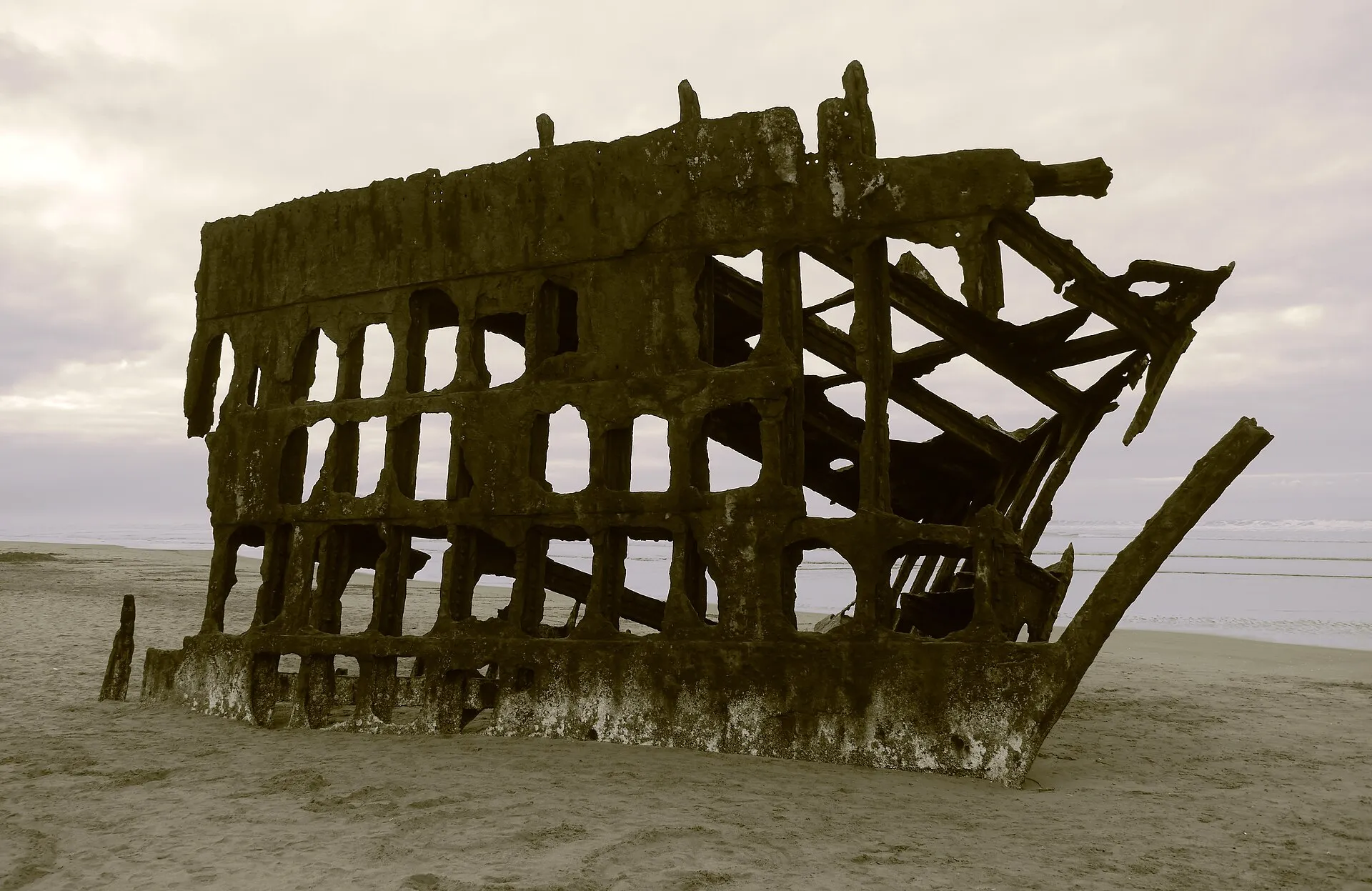
Fort Stevens is the largest of these campgrounds and draws the most camping searches on this coast. Its park page calls it one of the nation's largest public campgrounds, in a 4,300 acre park with freshwater Coffenbury Lake and an ocean beach. The Peter Iredale shipwreck sits on that beach, and the historic fort grounds stand in the park, with 15 miles of multi use trails. The Historic Area's military museum and information center holds displays open year round, and the gift shop there sells firewood to campers.
The campground runs year round and requires reservations, which campers can book up to six months in advance. It holds 174 full hookup sites, 302 electrical sites with water, six tent sites, 15 yurts, 11 deluxe cabins, and nine primitive hike in sites, plus a hiker and biker camp. Flush toilets and hot showers serve the campground. Its South Loops are currently closed for utility upgrade work, with a new tent camping loop planned and no dates stated. Thirty six of the full hookup sites and eleven of the electrical sites are pull through, and the dump station costs $10 per use, paid once per stay by registered campers.
Until that closure lifts, the hookup sites in those loops cannot be booked.
In summer the park runs programs of its own. Rangers lead guided kayak tours of Coffenbury Lake, with sign up by asking at the ranger station. Underground tours of a World War II gun battery command center also run in summer, booked through the Friends of Old Fort Stevens.
One camper calls it arguably the busiest campground in Oregon but says a midweek January visit felt empty; others describe congestion in season and post Labor Day stays that never felt crowded for the park's size. Loop choice and timing matter at Fort Stevens, because camper reports show that bathrooms and crowds vary by loop. Camper reports name bicycles as the main family use at the campground. Its only playground sits in the north campground, and families coming from the south must use the main road's bike lane to reach it. Campers describe the sampled loops as open and closely spaced, with little privacy between sites.
Campers report mosquitoes running severe near the lake and the swamp backed sites in late spring and summer. They report cell signal fading to weak or none inside the campground across carriers, with signal returning at the beach.
Elk move through the campground at Fort Stevens. Campers report elk grazing in view of picnic tables, deer at a site, and a herd moving through the park, and they treat the animals as a presence to give room to rather than a sighting to chase.
Wright's for Camping
Quick facts. About 23 sites, numbered 1 to 23, each with a fire ring and a picnic table. The season runs from Memorial Day weekend to Labor Day, and the campground is closed September through May. Booking runs through WebReserv, with a $25 non refundable deposit per site and the balance due at the 72 hour mark. A site costs $60 for up to two people plus $4 per additional person, taxes and fees included, with a six guest cap per site. There are no hookups of any kind and no pull throughs, and RVs run to 25 feet at most on the sites that take them.
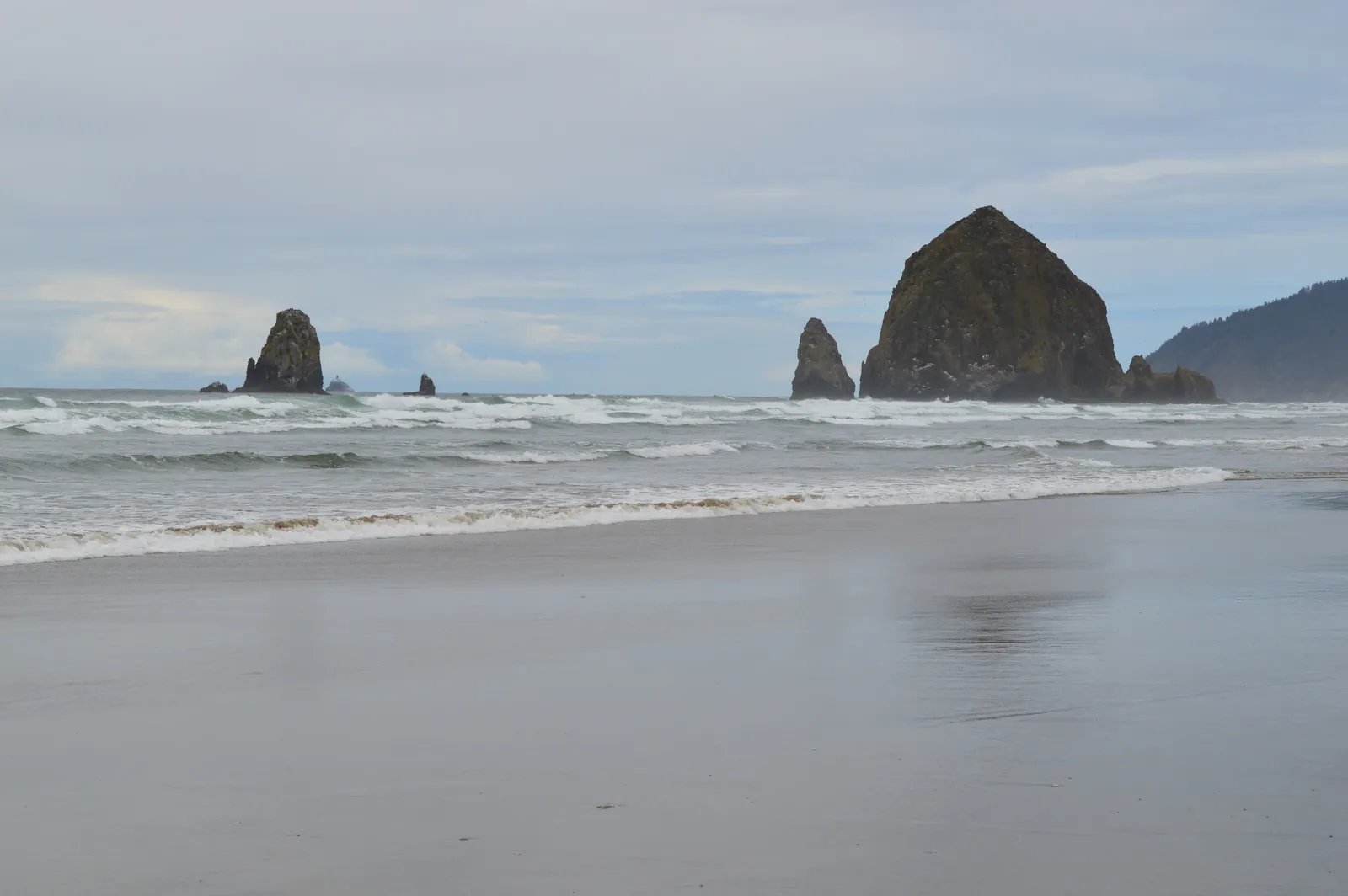
Wright's for Camping is a small campground in the woods in Cannon Beach, a few minutes from the beach, and it has been family run since 1959. Its roughly 23 sites each carry a fire ring and a picnic table, and there are no hookups of any kind at the sites, whatever some listings claim for the park. A site costs $60 for up to two people, with $4 for each additional person, and taxes and fees are included in that price. The season runs from Memorial Day weekend to Labor Day, and the campground then closes from September through May, the months the operator gives to the Cannon Beach elk herd that has reserved the ground. RVs run to 25 feet at most on the sites that take them, and booking runs online through WebReserv with a $25 deposit per site.
Check in runs from 2 p.m. to 10 p.m., and check out is at noon. Campsite 7 sits near the operator's firewood shed, and a washer and dryer and a deep sink for dishes serve a campground with no hookups at all. The operator sells the wood at $5 a box.
Nehalem Bay State Park
Quick facts. 265 electrical sites with water, 16 yurts, nine of them pet friendly, a horse camp with 17 primitive sites, an airport camp with two fly in campsites by a 2,400 foot airstrip, and a hiker and biker camp, on the park's own profile. Open year round, with reservations to six months. Water stands at the electrical sites, and nearby at the primitive horse camp and airport camp sites. Fees run in the agency's system ranges across the electric class. No full hookup site stands on the profile and no pull through count is published. The dump station costs $10 per use, and one extra vehicle may sit at the site for the system fee with further vehicles in overflow.
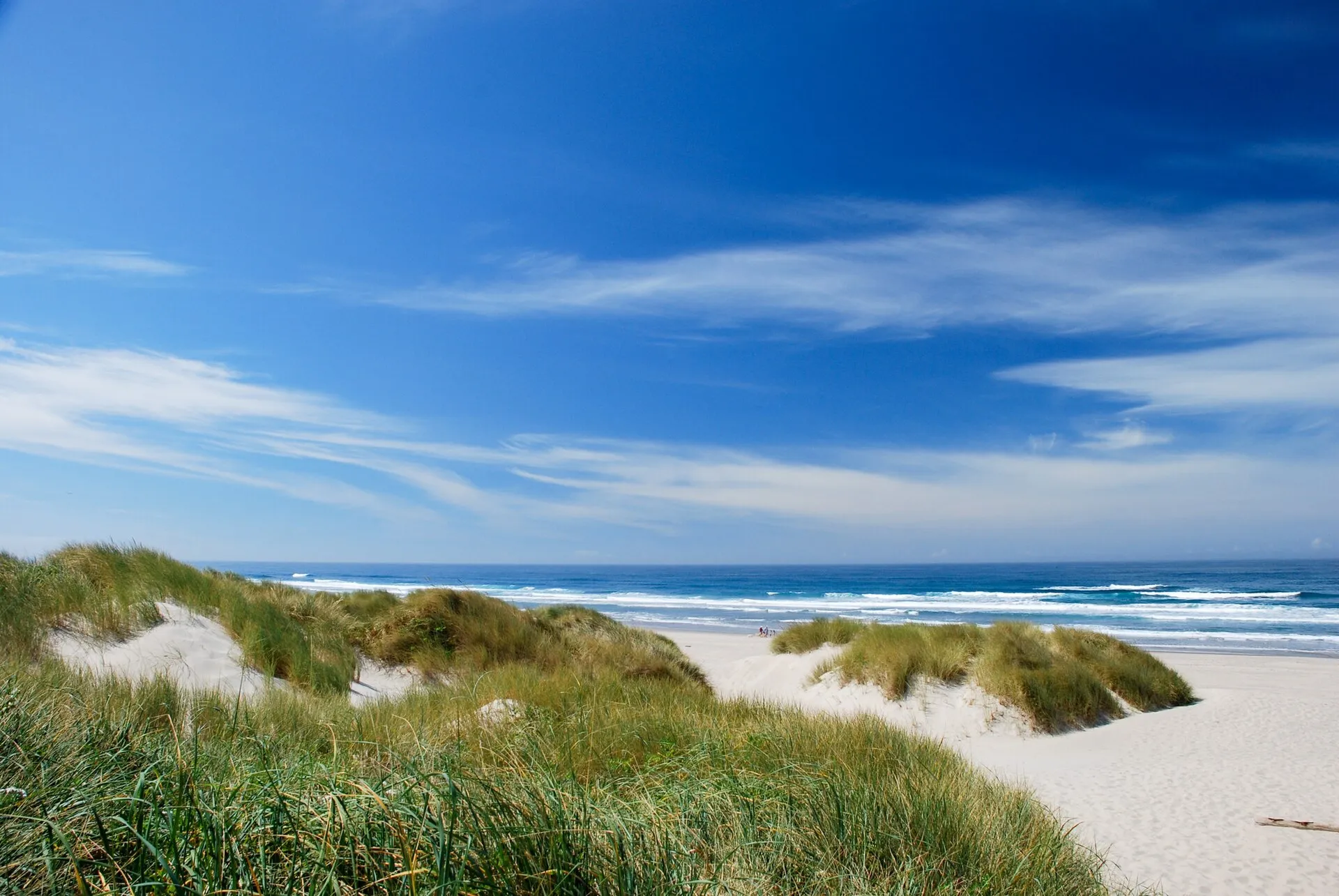
Nehalem Bay sits a sand dune away from its beach, among shore pines. Its campground is open year round and accepts reservations up to six months in advance. It holds 265 electrical sites with water and 16 yurts, nine of them pet friendly, plus a horse camp with 17 primitive sites, an airport camp with two fly in campsites, and a hiker and biker camp. The campground has flush toilets and showers for campers only, an RV dump station at $10 per use, and playgrounds.
The park's GO Bond construction is complete as of fall 2025, and the project added a restroom and shower building, utility upgrades, and accessible campsites. Campers describe sites packed closely with minimal screening, and beach access as a sandy climb over the dune that one family account found hard work with a child and gear. Campers also report some sites running first come in the off season. The park's own information does not confirm which loops offer first come sites or on what dates.
The park also carries boating access on Nehalem Bay inside the park. Its boarding docks are deployed for the summer and come out for the season starting about October 20, usually returning in May.
Campers put sites roughly 15 feet apart in one account and describe limited screening between them, so closeness is the condition to plan around at this park. The restroom and shower buildings campers meet now are new, and campers describe them as brand new single room facilities. A 40 foot fifth wheel has stayed here, and campers who brought one describe the maneuvering as tight on the narrow paved roads. Square back in sites are harder to enter than angled outer sites. Campers also report afternoon wind on the beach, running roughly from noon into the evening, while the campground itself stays sheltered behind the dune.
Cape Lookout State Park closed for camping through spring 2027
Quick facts. As built, 38 full hookup sites, one electrical site with water, 170 tent sites with water nearby, 13 yurts, six deluxe cabins, a group tent area, and a hiker and biker camp. The campground is closed from August 3, 2026 through spring 2027 for park improvements, and no booking stands while the closure holds. Fees run in the agency's system ranges in as built form only. An RV dump station is listed inside the closed campground.
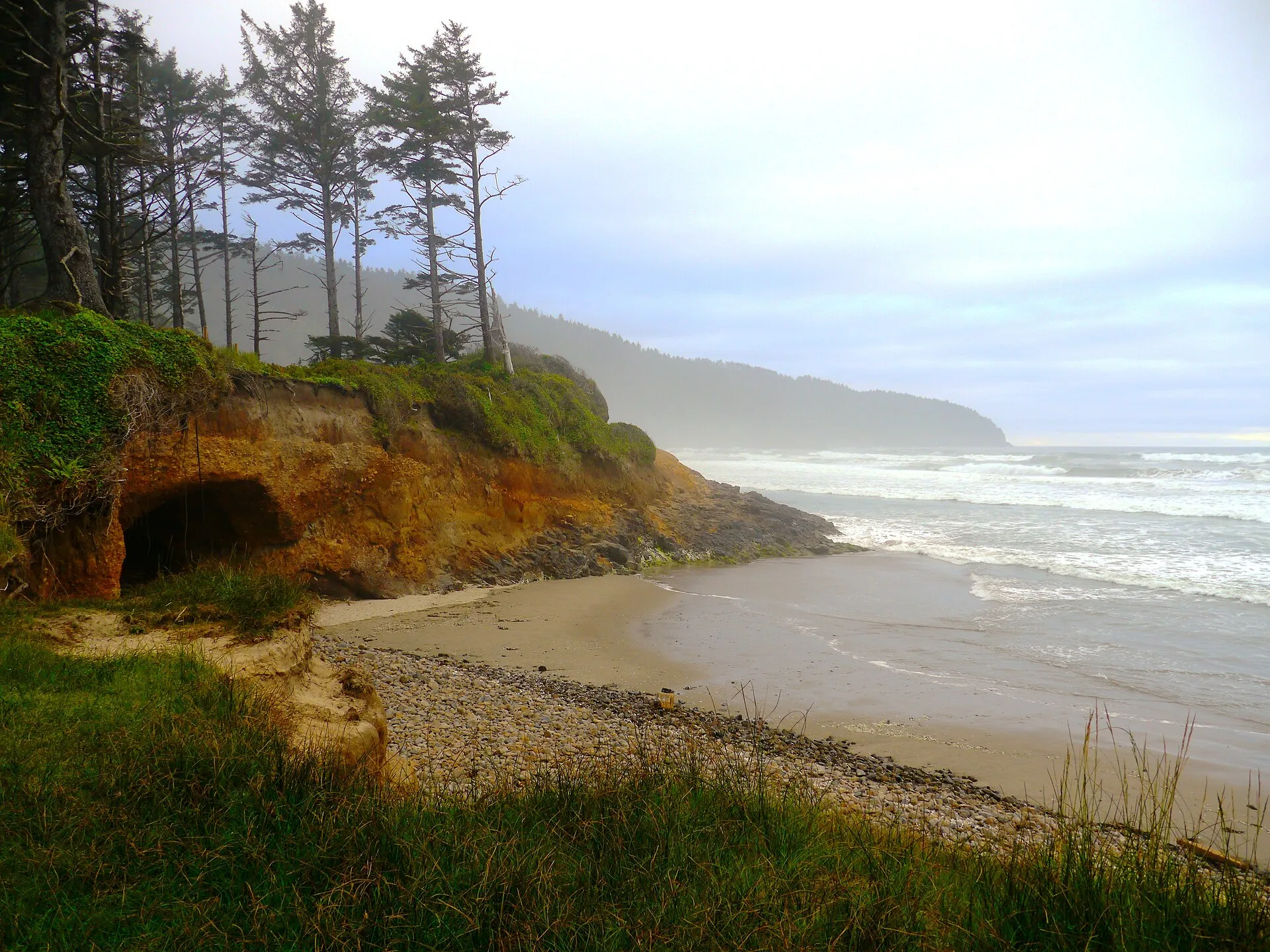
I camped there on my coast trips, and it is one of the parks I would return to. It also drew the most camping searches among my five parks.
Cape Lookout is closed for camping through spring 2027 while bond funded work rebuilds parts of the campground and the foredune. What follows describes the park as I camped it before the closure, written for a trip taken after it reopens.
The park's day use area, campground, and hiker and biker camp closed on August 3, 2026, for park improvements that Oregon-issued General Obligation Bonds fund. The agency says the park will remain closed from summer 2026 through spring 2027 and will adjust construction closures as the timeline becomes clearer. The work reinforces the foredune with a dynamic revetment. It also upgrades electrical and water service in the C and D loops, improves day use with a resurfaced parking lot and added restrooms, and repaves D Loop. Past storms breached the protective dune and flooded the A and B camp loops, prompting part of the project, and the agency has not given a more specific reopening date than after spring 2027.
The campground inventory below describes the park as it was built, for when it reopens. Its inventory is 38 full hookup sites, 170 tent sites with water nearby, and one electrical site with water. It also holds 13 yurts, six deluxe cabins, a group tent area, and a hiker and biker camp. Flush toilets, hot showers marked campers only, and an RV dump station serve the campground. Two of its campsites are accessible.
A 50-foot-wide cobble revetment protects the beach, and visitors walk through it to reach the sand; campsites do not have ocean views. Before the closure, campers described loops A and B as exposed and lacking privacy, while loops C and D sat farther back among salal, cedar, and spruce, with more shelter. When the park reopens, check whether those differences between loops remain. Firewood is sold in the campground, and the park brochure directs campers to a recycling center for trash and recycling. Two EV charging stations stand at the day use parking area.
Devils Lake State Park
Quick facts. 28 full hookup sites, all with cable TV, five electrical sites with water, four of them with cable TV, 54 tent sites with water nearby, 10 yurts, and a hiker and biker camp. The campground closes for the winter season on December 1, 2026, with a portion reopening May 1, 2027, weather depending. Reservations are required for yurts, and fees run in the agency's system ranges across the full hookup, electric, and tent classes. No generators are allowed and no camping trailers are permitted in C Loop, both in agency brochure form, and the profile lists no dump station.
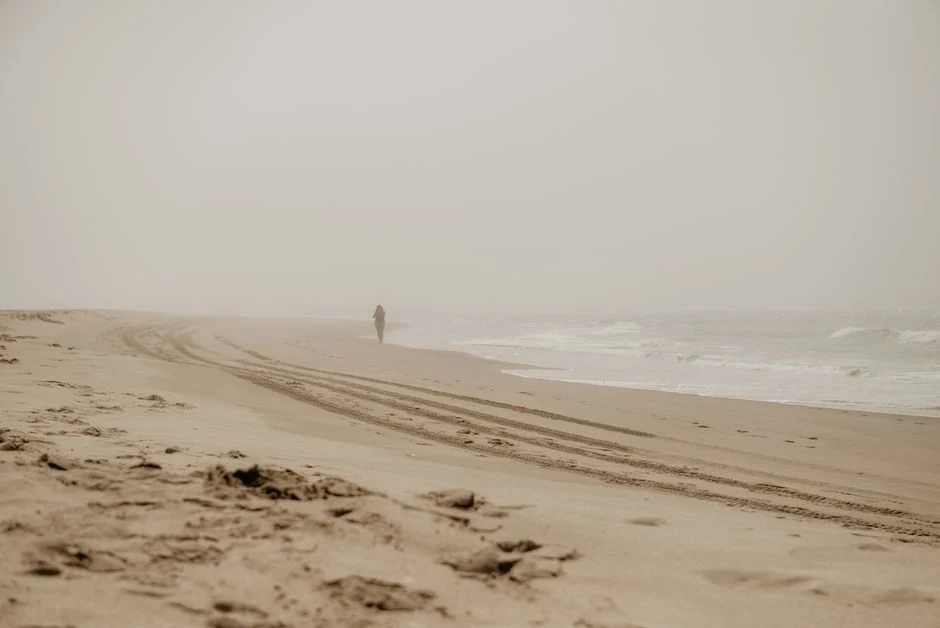
Devils Lake is the only Oregon coast campground in a city, according to its park page, and sits in Lincoln City. The campground holds 28 full hookup sites, five electrical sites with water, 54 tent sites with water nearby, and 10 yurts with reservations required, plus a hiker and biker camp. None of its campsites have a lake view. The D River beach access is a 10 minute walk over a boardwalk through the wetland and across Highway 101. One camper warns that the trail is easy to miss.
Its full hookup sites carry cable TV, and four of its five electrical sites carry it as well, a combination no other profile on this roster states.
Hot showers have limited availability. Firewood is for sale at the park.
Campers report winter and spring flooding that puts much of A Loop and the lower B Loop sites underwater or muddy after heavy rain. They report lake access from a dock only, with no shoreline and no swimming from camp, and Highway 101 noise reaching the lake side loops. The park's notices settle its season: the campground closes for the winter on December 1, 2026, and a portion of it reopens May 1, 2027, weather depending. Boats get moorage here rather than a launch, with twelve reservable moorage slips beside the campground, and no boat launch stands in the campground.
The park brochure states that no generators are allowed in this campground, which helps the nights stay quiet away from the highway side sites. That rule belongs to Devils Lake alone on this roster and does not extend to the other parks.
Two Tillamook County parks also take campers on this stretch and are named here rather than profiled. Tillamook County runs Barview Jetty County Park, a 160 acre campground at the mouth of Tillamook Bay a mile and a half north of Garibaldi. It offers full hookup RV sites, tent sites, and cabins year round. Tillamook County also runs Whalen Island County Park on an island in the Sand Lake Estuary north of Pacific City, where camping is dry camping only for RVs and tents, with no hookups.
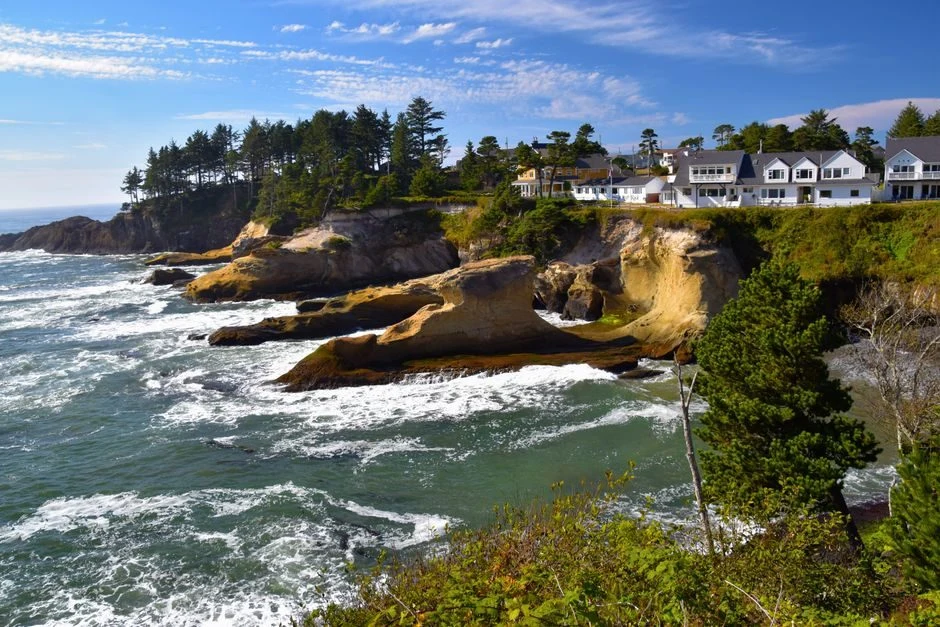
Camping on the central coast
The central coast is the working middle of the coast, from Lincoln City down to Florence. Newport's harbor town and aquarium stand at its center, and Florence's lakes at its southern end. The rocky shore at Yachats and Cape Perpetua and the lighthouse at Heceta Head stand between the two towns, and the dunes begin at Florence's edge. This stretch holds the heaviest overnight use in the system at South Beach, so busy is a central coast fact and not only a northern one.
I drove this coast on both runs and visited along it. I camped none of it, so these entries rest on the parks' own pages and other campers' accounts.
Beverly Beach State Park
Quick facts. 53 full hookup sites, 76 electrical sites with water with 32 pull through, 128 tent sites with water nearby, 21 yurts, three seasonal group tent areas, and a hiker and biker camp. Open year round, and sites book inside the system window from the same day to six months out. Fees run in the agency's system ranges across the full hookup, electric, and tent classes. The dump station costs $10 per use once per stay for registered campers, and the park allows one extra vehicle per campsite.
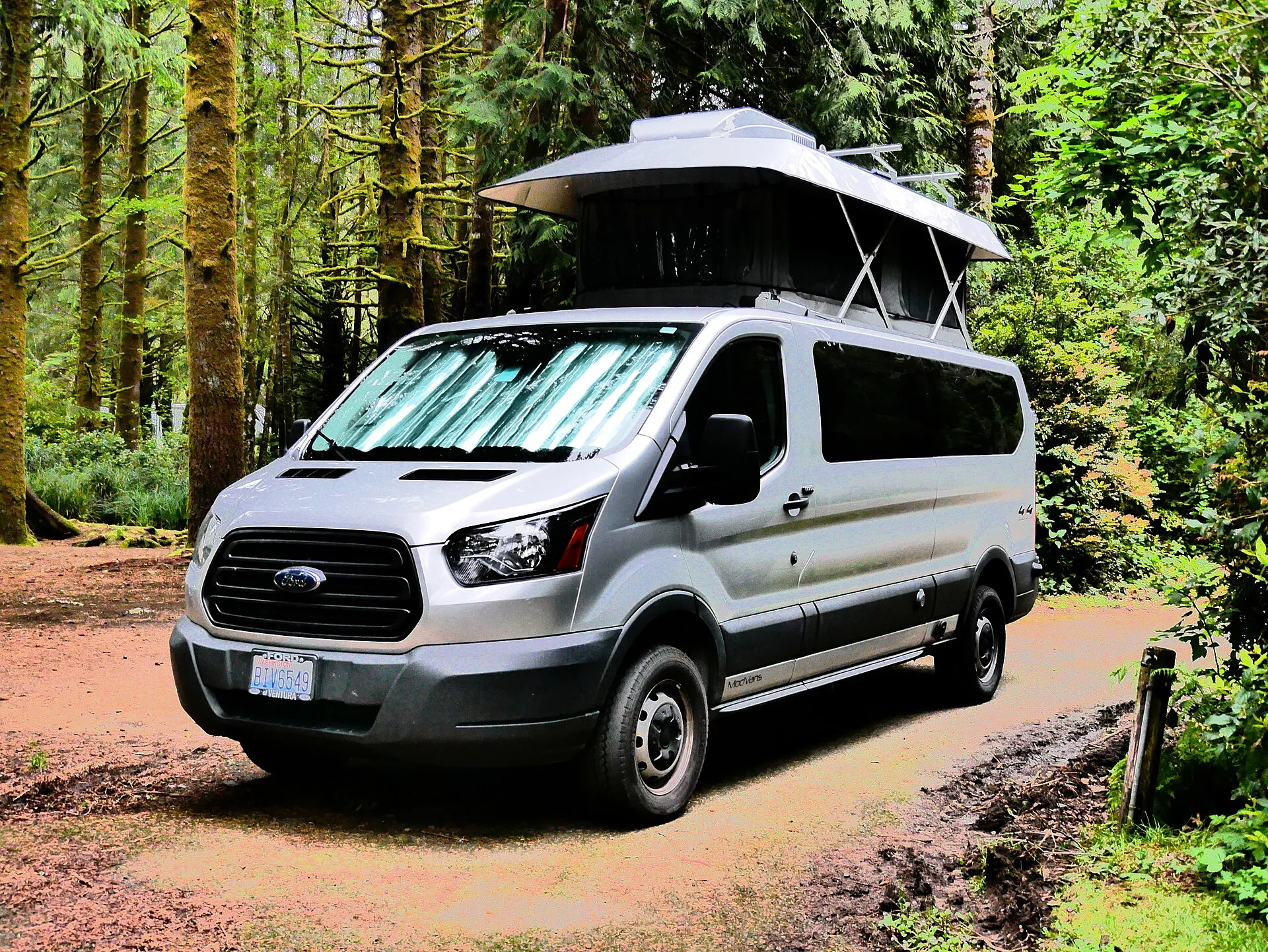
Beverly Beach is open on the central coast. Its bond funded project is complete and the park reopened in 2024, so any description of Beverly Beach as closed for 2026 bond work is wrong.
The campground runs year round. It holds 53 full hookup sites, 76 electrical sites with water, 128 tent sites with water nearby, 21 yurts, three seasonal group tent camping areas, and a hiker and biker camp. Flush toilets and showers serve the campground. Some campsites and the day use area are just steps from miles of ocean beach, and forest along Spencer Creek shelters the campground. Thirty two of the electrical sites are pull through, the dump station costs $10 per use once per stay for registered campers, and the park allows one extra vehicle per campsite.
A Welcome Center near the registration booth sells firewood and a few souvenirs, one of only two true camp stores in this guide. A playground stands next to the park's program area, and three of the campsites are accessible.
No pull through count is published for its 53 full hookup sites, so a driver who needs a pull through books from the electrical class and checks the individual site in the reservation portal.
Campers describe sites tucked into trees that buffer wind and noise, a paved beach path of about a quarter mile under the highway, and quieter sites in the rear loops. They also describe most sites as packed close together with little privacy, the shrub screened bend sites and the creekside sites standing as the exceptions.
Campers in the back loops, F, G, and H, describe the beach walk running up to about 20 minutes. They describe the showers in the open bathhouses as free and hot, where the park page itself promises showers without saying hot. A family media account made this park a first multigenerational family trip and praised the sheltered creek setting. The park's own notices close the D, E, and G loop restroom and shower buildings for the winter, from October 1, 2026 into May 2027. The park page does not list a first come option.
South Beach State Park
Quick facts. 227 electrical sites with water, no full hookup listed, 60 tent sites, 27 yurts, three group tent camps, and a hiker and biker camp. Open year round, bookable to six months, with reservations required for yurts. Water stands at the electrical sites, and nearby for the tent sites. Fees run in the agency's system ranges across the electric and tent classes. The dump station charges $10 per use, paid once per stay by registered campers, and one extra vehicle is allowed per site. No pull through count is published.
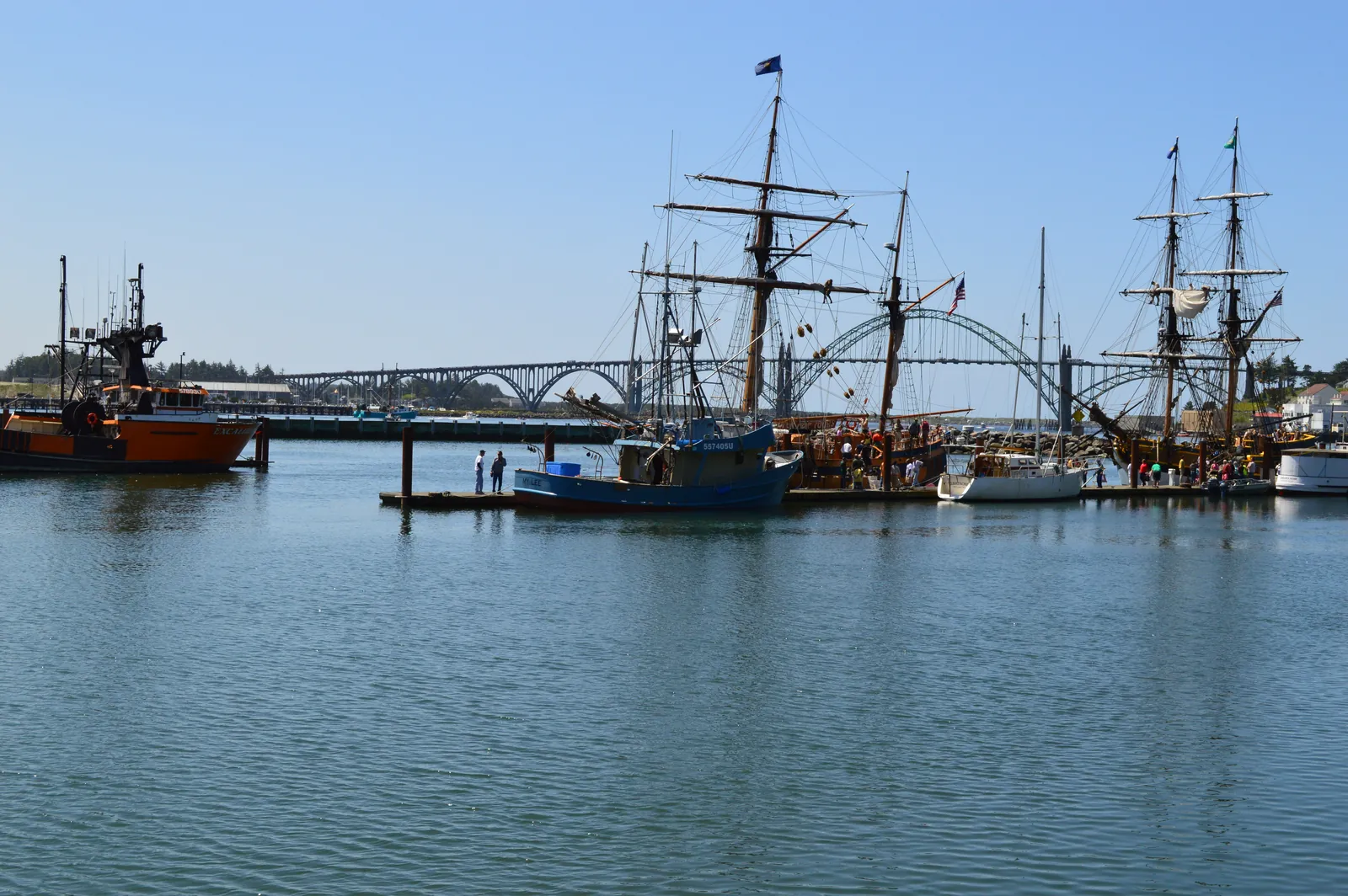
South Beach, at Newport, is a large central coast campground, and camper reports point tent campers to its rear tent loops. It runs year round and accepts bookings up to six months in advance. It has 227 electrical sites with water, 60 tent sites, 27 yurts that require reservations, three group tent camps, a hiker and biker camp, flush toilets, and showers. The park offers access to miles of broad, sandy ocean beach and begins in south Newport next to the Yaquina Bay Bridge. Campers report a trail walk of a quarter to a half mile to the beach, depending on the loop, and say wind hits hard at the entrance but eases inside.
Firewood is for sale at the park, and its Hospitality Center sells souvenirs and camp items, one of only two true camp stores in this guide. A playground, horseshoe pits, and an 18 hole disc golf course sit near the campground, and discs and horseshoes check out free at the Hospitality Center.
The dump station costs $10 per use, paid once per stay by registered campers, and one extra vehicle is allowed per site. Campers describe that single station as a bottleneck for a campground of this size, and the foghorn carrying into camp in fog. They describe the gravel tent loops at the back as bigger, more spread out, and quieter than the interior RV sites, and the shower rooms as free, hot, individual, and untimed. South Beach also holds 14 pet friendly yurts, more than any other state campground on the agency's pets page.
South Beach is the most used campground in this guide by overnight stays, with 207,000 camper nights in the agency figures, more than Fort Stevens. The Beachside park page describes the South Beach station as free. South Beach's own page controls here, and it charges $10. Five of its campsites are accessible.
Beachside State Recreation Site
Quick facts. 32 electrical sites with water, 42 tent sites with water nearby, two yurts, and a hiker and biker camp. Camping runs March 15 to October 31, weather permitting, with reservations bookable to six months. Fees run in the agency's system ranges across the electric and tent classes. No sewer hookups stand at any site and no dump station stands at the park, and one vehicle may occupy a site.
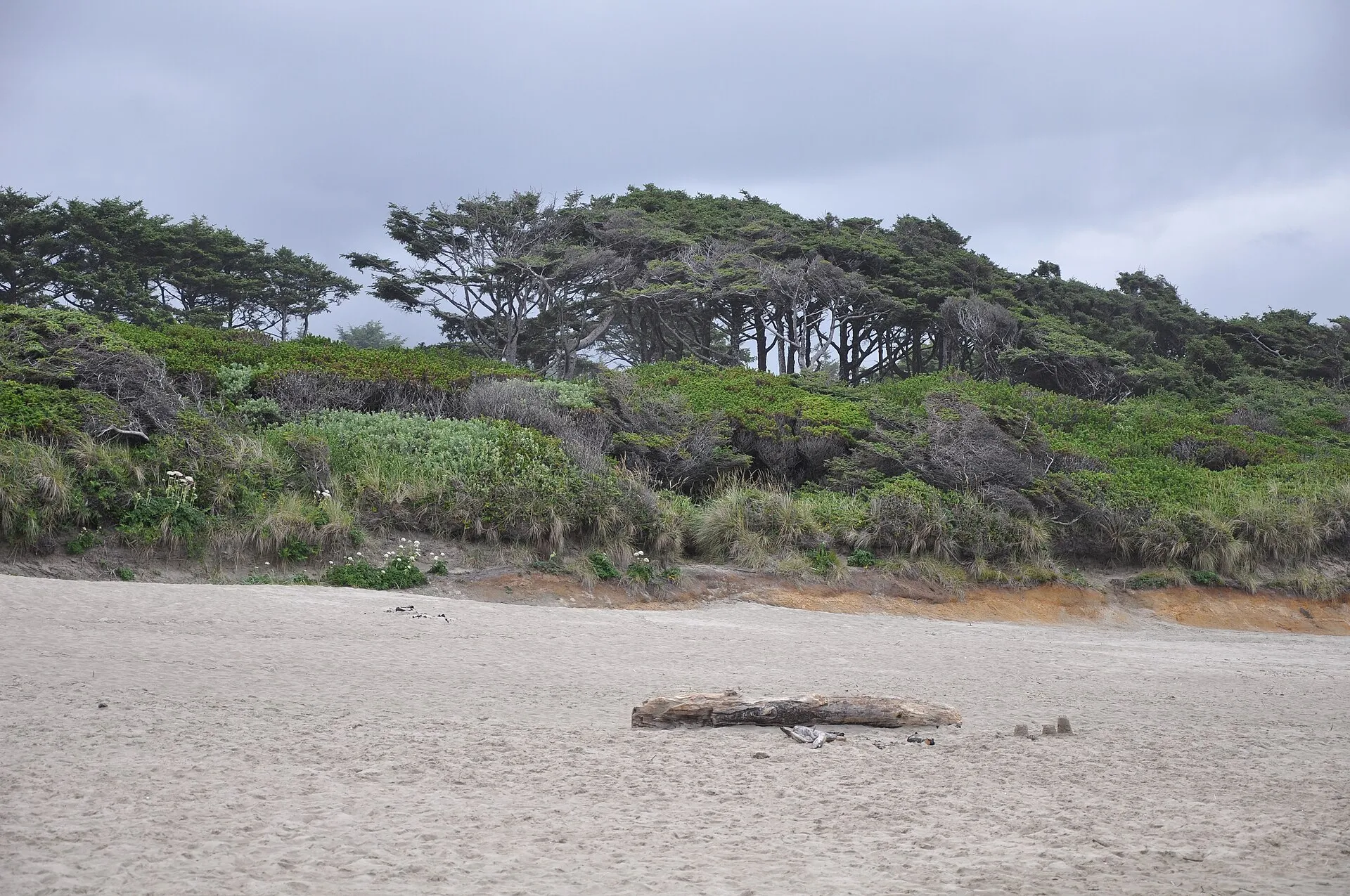
Beachside is a small seasonal campground right alongside miles of broad, sandy beach, with the shortest walk to the sand on this roster. The park page says every campsite is seconds from the beach, and a camper says most beachfront sites are under a 30 second walk from the sand. Camping runs March 15 to October 31, weather permitting, and campers can book reservations up to six months in advance. The campground holds 32 electrical sites with water, 42 tent sites with water nearby, two yurts with reservations required, and a hiker and biker camp. The park closes for winter entirely.
There is no dump station here, and the park page directs RV campers to the dump stations at South Beach and Washburne, each about 17 miles away, and only one vehicle may occupy a site. Campers report Highway 101 noise splitting the campground by position, with road side sites hearing the highway by day while beach side sites largely escape it, and paved pads that are not uniformly level. Firewood sells in the evenings at the woodshed or the park host sites, at $5 a bundle with fire starters at $1 each. Campers credit the trees between sites for privacy here, with the complaints clustering on a few specific very close sites.
Tillicum Beach Campground
Quick facts. 61 sites, 39 standard nonelectric, 19 standard electric, and three management records, all tent capable. Some loops open year round. Booking mixes reservable sites on Recreation.gov with first come, first served sites. A standard nonelectric site costs $39 and a standard electric site $51, with an extra vehicle at $12 per day. About 20 sites carry electric and water hookups away from the waterfront, and no dump station is listed.
Tillicum Beach sits directly on the beach on Highway 101, three miles north of Yachats and four miles south of Waldport, and most sites have beachfront views with beach access on site. The campground holds 61 sites in standard nonelectric and standard electric classes, and a minority of sites, about 20, carry electric and water hookups away from the waterfront. A nonelectric site costs $39 a night and an electric site costs $51, and booking mixes reservable sites on Recreation.gov with first come, first served sites, with some loops open year round. Drinking water serves the campground as a system rather than at each site, with water hookups only at the electric sites, and flush toilets serve the campground. Fishing and swimming are listed activities at the campground, the swimming in open coast water.
Check in is at 2 p.m. and check out at 11 a.m. There are no showers, and no dump station is listed for the park. The $12 extra vehicle fee is cash or check only. For crabbing and clamming, the facility page points campers to Waldport, four miles north, for Alsea Bay and the Alsea River.
The four Forest Service campgrounds in this guide, Tillicum Beach, Eel Creek, Cape Perpetua, and Sutton, book through Recreation.gov rather than the state system. Their listed rates are the facilities' published rates, before any discounts, taxes, or added charges. Pets are allowed at all four. They also share one stay limit: 14 days in any 30 day span across the whole Siuslaw National Forest rather than campground by campground, so nights at the four grounds draw on one shared count.
Cape Perpetua Campground
Quick facts. 37 individual sites and one group site, all nonelectric. The season runs March 7 to October 31, and the campground is currently in its published out of season closure. Sites book on Recreation.gov on a six month rolling basis for individual sites. A standard site costs $39 a night. There are no hookups, and no dump station stands on site, with the nearest about 12 miles away in Waldport and at Carl G. Washburne State Park. Drinking water serves the campground as a system, with no water hookup at any site.
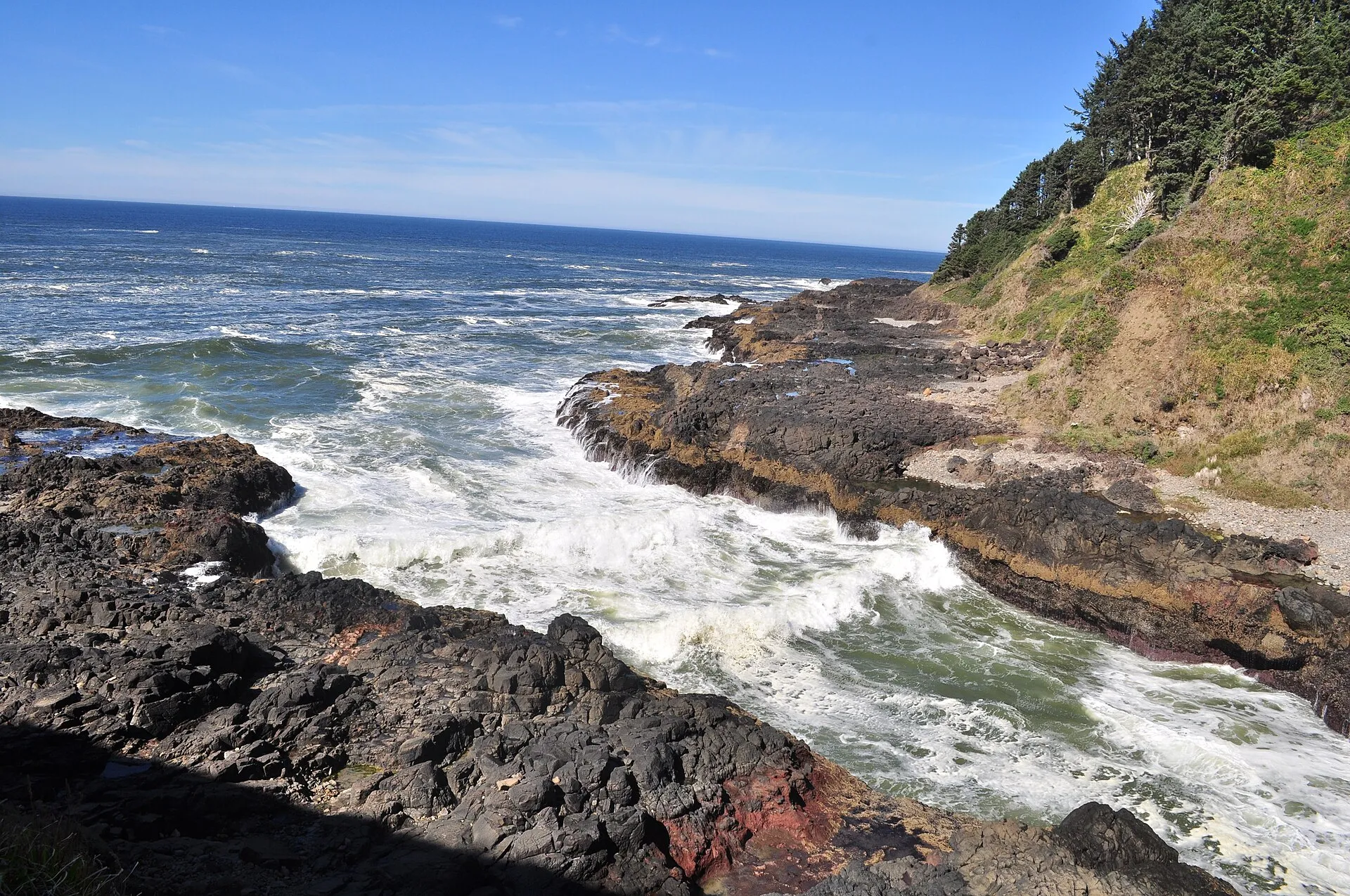
Cape Perpetua Campground runs along Cape Creek in Sitka spruce, Douglas fir, and alder forest on the east side of Highway 101, three miles south of Yachats. It holds 37 individual sites and one group site, all nonelectric, with no hookups of any kind. A standard site costs $39 a night in the published season, which runs from March 7 to October 31, and the campground is currently in its out of season closure. Individual sites book on Recreation.gov on a six month rolling basis. Drinking water and flush toilets serve the campground, there is no dump station on site, and the nearest stations sit about 12 miles away in Waldport and at Carl G. Washburne State Park.
Check in is at 2 p.m. and check out at 11 a.m. The campground is also the base for the Cape Perpetua Scenic Area's trail system, some 23 miles of trails that reach the tidepools and overlooks on foot.
The Cape Perpetua Visitor Center stands a short, moderate hike from the campground, with an ocean view and short films shown in its theater. Interpretive programs run in the area, with no standing schedule published, so the visitor center is the place to check on arrival.
Carl G. Washburne State Park
Quick facts. 50 full hookup sites, five electrical sites with water, seven walk in tent sites that close seasonally, two yurts, and a hiker and biker camp. Open year round, with campsites on the reservation system since 2021 booking to six months and the hiker and biker camp first come for arrivals on foot or by bicycle. Water stands at the full hookup and electrical sites, and nearby for the walk in tent sites. Fees run in the agency's system ranges across the full hookup, electric, and tent classes. An RV dump station stands in the day use area west of Highway 101, and no pull through count is published.
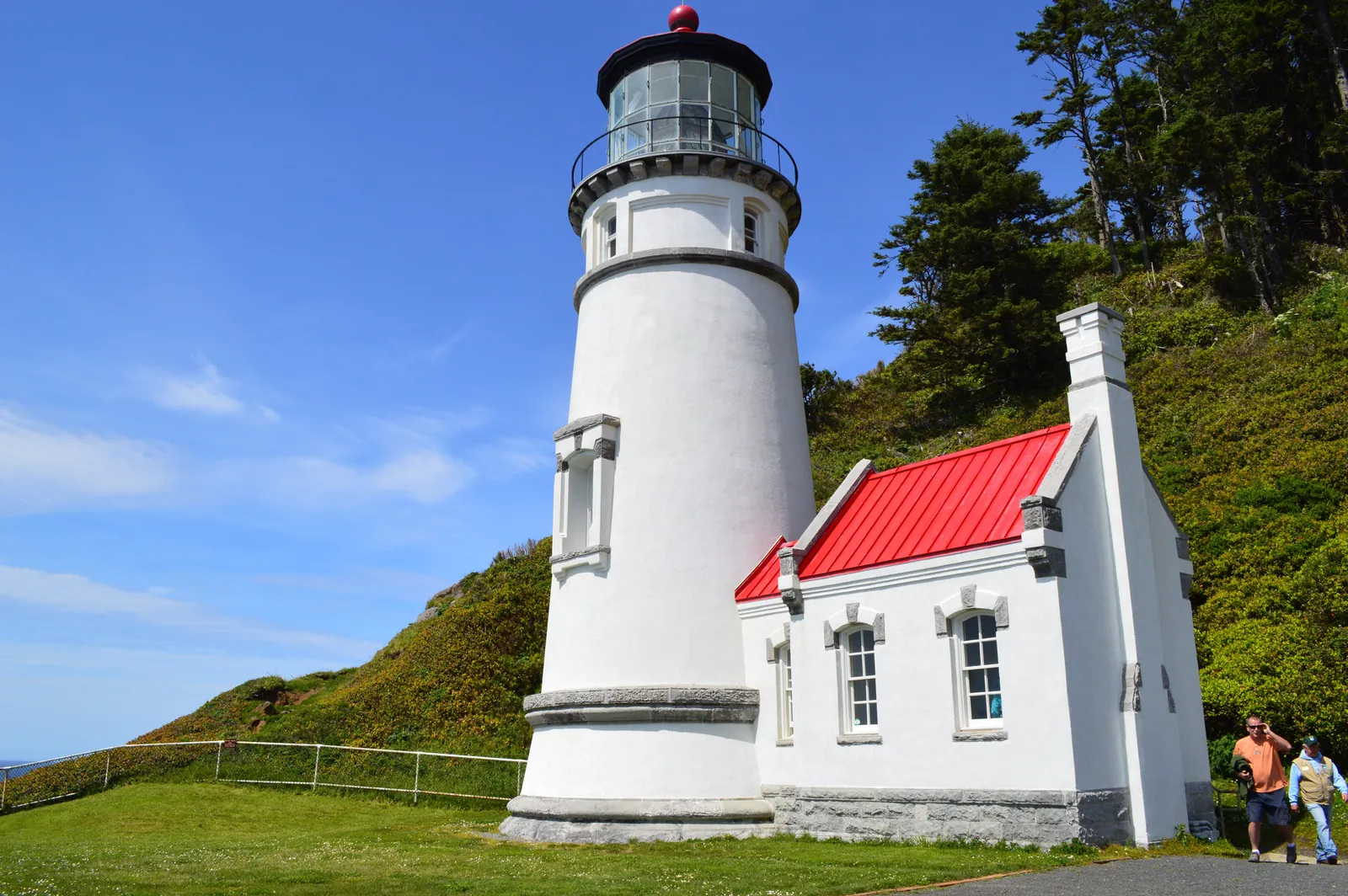
Carl G. Washburne campsites are on the reservation system, bookable up to six months in advance, a change its page dates to 2021, whatever older descriptions still say.
The campground runs year round. It holds 50 full hookup sites, five electrical sites with water, seven walk in tent sites that close seasonally, two yurts with reservations required, and a hiker and biker camp. Flush toilets and hot showers serve the campground. The RV dump station stands in the day use area west of Highway 101. Visitors need a day use parking permit here starting March 30, 2026.
Trailheads at the north and south ends lead through coastal forest to miles of sandy beach, and the Hobbit Trail descends a half mile to the beach, with the campground east of Highway 101 along China Creek. Campers describe it as quiet and buffered by trees despite the highway. Campers describe Washburne as quiet under its trees even when the campground is full, with elk sometimes moving through camp. Firewood is for sale at the park, and site 30 is an accessible site.
Campers report the sewer hookups at the full hookup sites as unreliable, with the dump station across Highway 101 in the day use area as the workaround they use. They describe the Hobbit Trail's beach as huge and near empty even when the campground is full. The sounds campers name most are surf and the creek rather than the highway. Campers describe the sites as spacious and private in the forest, with the walk in tent sites singled out for solitude.
Campers report effectively no cell service at Washburne on any carrier, with signal returning a few miles south or faintly on the beach. Download maps, reservations, and messages before arrival rather than counting on a connection in camp.
Sutton Campground
Quick facts. 80 sites, 55 standard nonelectric, 22 standard electric, two group standard area electric, and one group standard nonelectric. Loops A and B stay open year round, and the remaining loops open from mid May to early September. Booking requires a digital reservation and payment on Recreation.gov. A single site costs $31, and a single site with electric costs $41, with an extra vehicle at $10 a night. The published fee block also prints a separate $10 per night hookup fee line beside the electric rate, without stating whether it adds to that rate. Electric hookups stand only at the electric sites. Drinking water serves the campground as a system, with no water hookup at any site.
Sutton Campground stands in coastal pine, Douglas fir, spruce, wax myrtle, and huckleberry forest off Highway 101 north of Florence, a mile and a half from Sutton Beach and two miles from Sutton Lake. Its 80 sites split between standard nonelectric sites and electric sites, with group sites beside them, and the electric sites carry an electric hookup only. A single site costs $31 a night, and a single site with electric hookup costs $41. Loops A and B stay open year round, and the remaining loops open seasonally from mid May to early September. Booking requires a digital reservation and payment on Recreation.gov, and the campground provides potable water and flush toilets.
Check in is at 2 p.m. and check out at 11 a.m. Sutton Creek offers swimming at camp, and Sutton Lake, two miles away, has a boat ramp, closed at this writing until its floating docks are installed, and offers boating and fishing for yellow perch, largemouth bass, cutthroat trout, and stocked rainbow trout. Trails run from camp to Alder Dunes and the Holman Vista sunset platform, with berry picking a listed activity in the huckleberry and wax myrtle forest. The group sites take up to 100 people, the largest stated group capacity in this guide. The Holman Vista day use area, a mile west of the campground, has an accessible viewing platform.
Jessie M. Honeyman State Park
Quick facts. 47 full hookup sites, 121 electrical sites with water, 187 tent sites with water nearby, 10 yurts, six seasonal group tent areas, and a hiker and biker camp, in the second largest Oregon state park campground. Open year round, with reservations required for the listed site types to six months and no walk in sites. The whole campground and the day use area close from January 1 to February 28, 2027 for water system work, and F Loop, G Loop, and parts of B and C Loops are closed from October 1, 2026 to May 21, 2027. Fees run in the agency's system ranges across the full hookup, electric, and tent classes. The dump station costs $10 per use, paid once per stay by registered campers, and no pull through count is published.
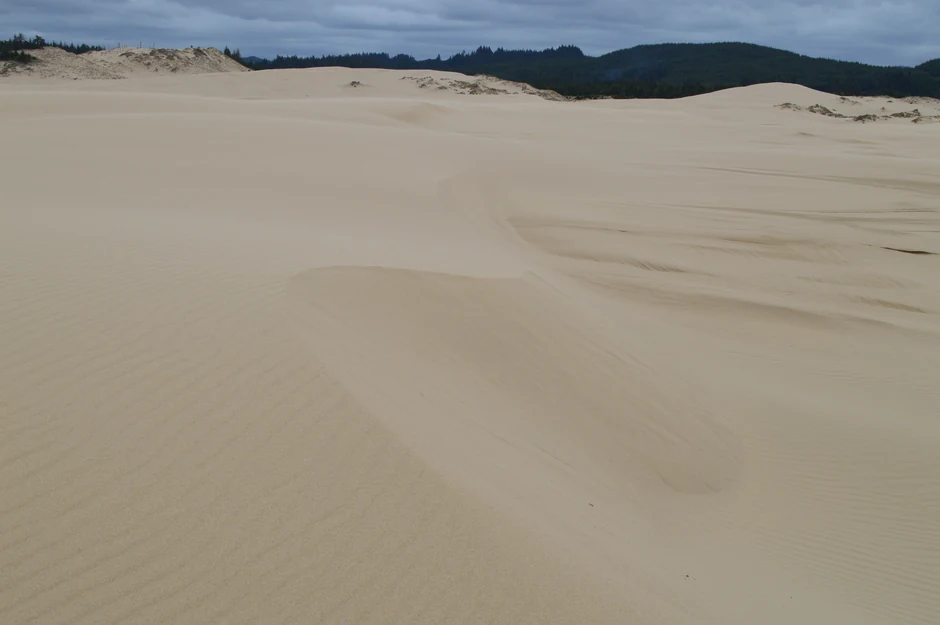
I really wanted to stay at this park for the dunes, but I have not camped here. I researched the park using its agency page and camper reports.
The park sits three miles south of Florence and two miles from the ocean, and its page calls it the second largest Oregon state park campground. It runs year round, with reservations required and no walk in sites available. It holds 47 full hookup sites, 121 electrical sites with water, 187 tent sites with water nearby, 10 yurts, six seasonal group tent areas, and a hiker and biker camp. Flush toilets and hot showers serve the campground.
A dated closure stands on the park's notices: every loop and the day use area close from January 1 to February 28, 2027, while water system utility work and tree removal run. F Loop, G Loop, B Loop sites 57 to 79, and C Loop sites 102 to 151 are closed from October 1, 2026 to May 21, 2027.
The park has two freshwater lakes, Cleawox and Woahink. Cleawox has a sandy swimming beach with no lifeguard and offers seasonal rentals. Woahink is the park's boating and fishing lake.
The dump station costs $10 per use, and registered campers pay it only once per stay. Firewood is for sale at the park.
Two miles of dunes separate Honeyman from the shoreline. No marked trails lead to the beach from the park, and the campground itself has no beach access. Honeyman is a dunes and lakes campground. The park has no visitor center of its own, and its page points visitors to the Oregon Dunes visitor center 18 miles south in Reedsport.
Its page warns that visitors may hear loud noise from May 1 to September 30. The cause is the nearby OHV management area in the Oregon Dunes National Recreation Area. From October to April, ATVs can drive directly onto the dunes from H Loop.
Campers describe every site filling with families in peak summer, large groups returning each July, and daytime loudness from vehicles, traffic, and crowd volume. The noise eases by evening, under quiet hours that run from 10 p.m. to 7 a.m. by rule at every campground. A family account praises a sand built playground while warning it has no separate small child area. Families with older children and an interest in the dunes fit this park best. Families sensitive to daytime motor noise fit it least.
Site quality varies sharply at Honeyman. Campers describe some sites as sitting on top of each other and advise choosing carefully, while other stays find room and screening in the trees, so the loop and the individual site matter more than any park wide average.
Campers report push button showers at Honeyman, and one camper notes the temperature cannot be adjusted. A family that knows about the push button setup in advance can plan around it, instead of meeting it as a surprise with a small child already undressed.
Camping on the south coast
The south coast runs from Reedsport to the California border, and it is the wild, scenic end of the coast. Sea stacks, headlands, and the Samuel H. Boardman State Scenic Corridor stand north of Brookings, my favorite part of this coast and a day stop on both trips. Its anchors are Reedsport and Winchester Bay, Coos Bay, Bandon, and Port Orford, down to Brookings at the bottom. The far south also carries a local name, the Wild Rivers Coast.
The pattern here is quieter grounds, with Harris Beach the named busy exception. Four of my five Oregon camps stand in this one region, so this is the stretch I know from inside a tent.
Umpqua Lighthouse State Park
Quick facts. 12 full hookup sites, eight electrical sites with water, 23 tent sites with water nearby, two rustic yurts, two rustic log cabins, six deluxe yurts, and a hiker and biker camp. Reservations book to six months, and fees run in the agency's system ranges across the full hookup, electric, and tent classes. The profile lists no dump station.
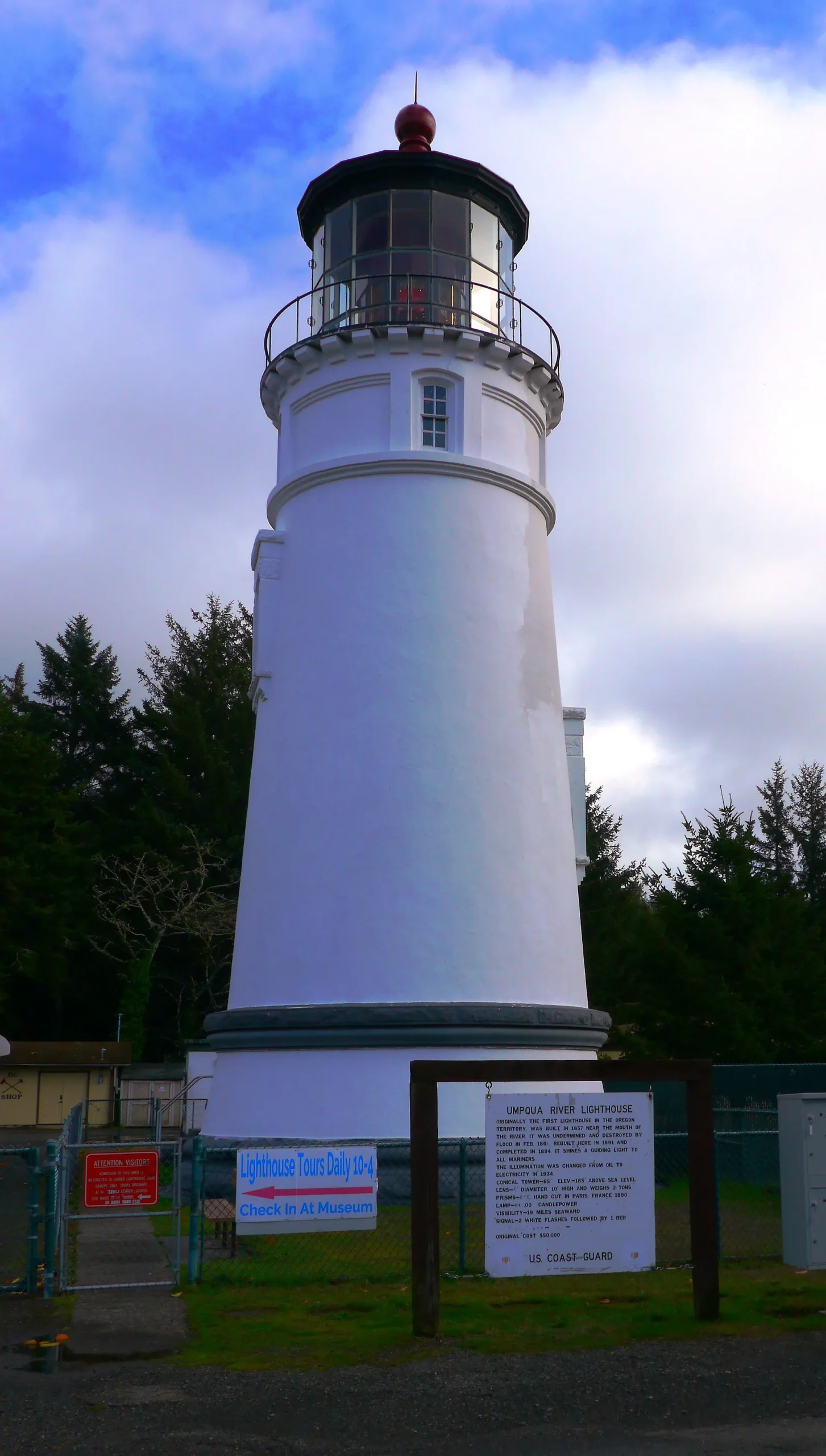
I would stay at every park I used again except maybe this one, which was very crowded. I found it crowded on my trips, in May and July across the two runs, and I cannot assign the months to particular years. Other campers say the park stays busy on summer weekends. Other campers also report a quieter off-season, though I found the park crowded during my visits.
Campers describe small sites sitting close together with minimal separation in the interior loops. A family account adds that the sites were so small, and the path down to the lake so steep, that the park was poor fun for their young children. Those are community reports, not my observations.
The campground books up to six months in advance. It holds 12 full hookup sites, eight electrical sites with water, 23 tent sites with water nearby, a hiker and biker camp, two rustic yurts, two rustic log cabins, and six deluxe yurts. Its water is freshwater Lake Marie, which has a small sandy lakeside beach, and the lighthouse is a half mile from the park. The lighthouse is operated by Umpqua Valley Museums and opens for tours from May through September. There is no direct access to the dunes from the park, and no campsite path to an ocean beach is stated on its page, so Umpqua is a drive case.
Its showers run 6 a.m. to 11 p.m. for registered campers, and a day use parking permit is required here starting March 30, 2026. Campers also report a fish cleaning station in the bathhouse, a draw for anglers.
The agency profile lists no dump station for this campground.
Eel Creek Campground
Quick facts. Standard nonelectric and tent only nonelectric sites, with no settled count. Sites book on Recreation.gov, and the facility notice states online reservation only in its preferred or phone form. Sites run $22 to $44 a night by site. No RV hookups are available, and no dump station is listed. Drinking water serves the campground, with no water hookup at any site.
Eel Creek sits in coastal shrubbery on the edge of the dunes on the west side of Highway 101 near milepost 222, ten miles south of Reedsport and near Lakeside. The ground offers standard nonelectric and tent only nonelectric sites, and it has no RV hookups of any kind. Sites run from $22 to $44 a night by site, and booking runs through Recreation.gov. Beach access is on foot, not at the campground itself. The non motorized John Dellenback Dunes Trail runs 2.7 miles one way across the dunes, and the campground provides drinking water and flush toilets, with no dump station listed.
Check in is at 2 p.m. and check out at 1 p.m., the only 1 p.m. check out among the federal four. The facility's notices state that sites must be occupied within the first 24 hours of the arrival time or they are released as a no show. They direct campers arriving later than that to call the ranger station at 541-271-6000. Each campsite is limited to two vehicles.
The same notices warn that mosquitoes are in abundance from April through August, around the lakes and wetlands by the ground. Four sites, 7, 8, 42, and 43, sit on the sand of the dunes themselves. They are the only sites on open dune sand in this guide, since Honeyman borders the dunes and camps behind them. The facility describes most of its sites as secluded and private behind dense shrubbery. For water, it points campers to boating and fishing at Tenmile Lake and Eel Lake nearby, because the campground itself is not on a lake.
William M. Tugman State Park
Quick facts. 93 electrical sites with water, no full hookup listed and no tent class listed, 16 yurts, and a hiker and biker camp. Open year round, bookable to six months, with reservations required for yurts. Fees run in the agency's system ranges across the electric class. An RV dump station is listed, and two EV charging stations stand at the day use parking area. From October 1 to May 1, its showers are open only to registered campers, from 6 a.m. to 11 p.m.
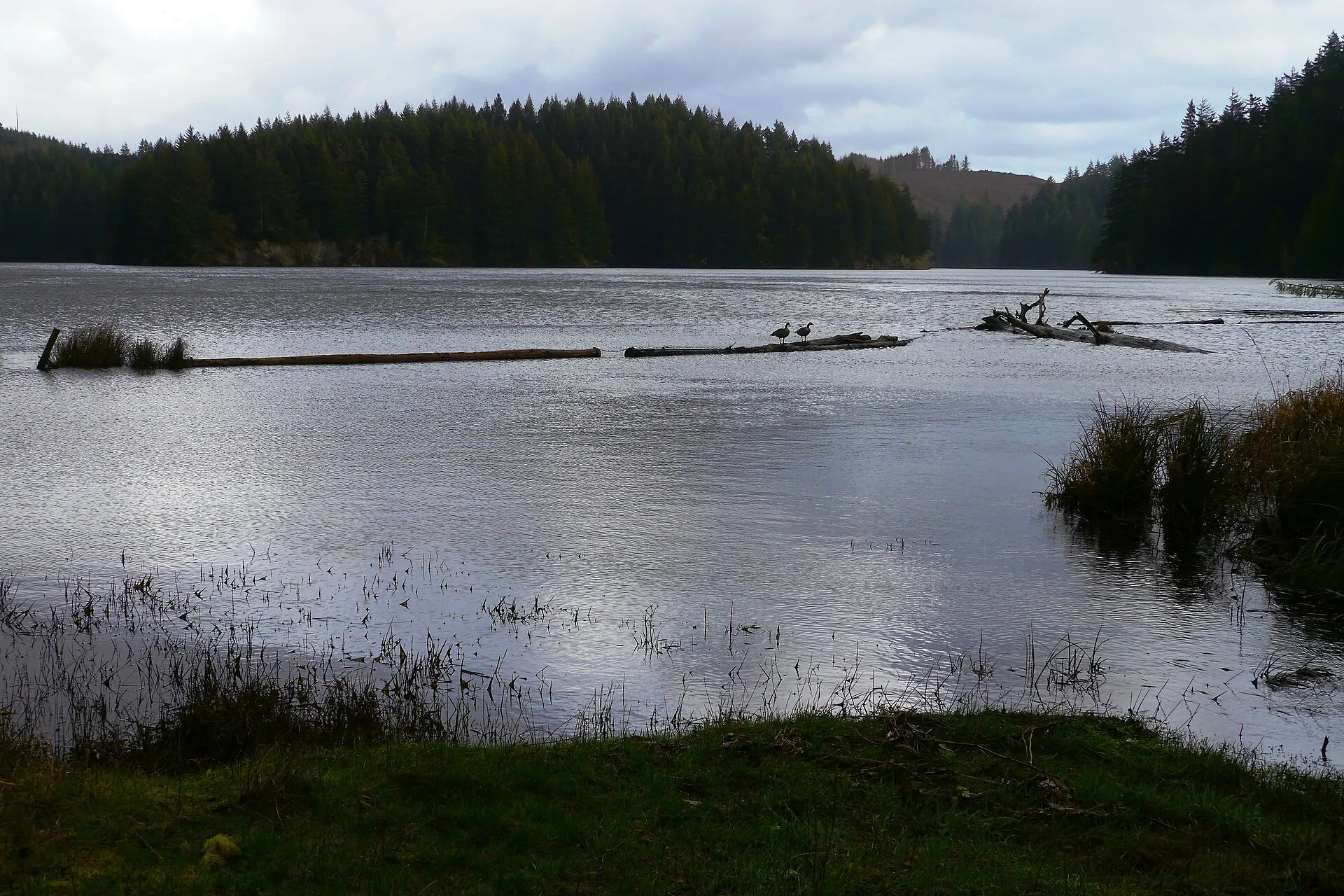
William M. Tugman State Park sits on Eel Lake near Lakeside, with the Oregon Dunes National Recreation Area less than a mile away, and its page states no ocean beach access at the park. It runs year round and accepts bookings up to six months in advance. It holds 93 electrical sites with water, 16 yurts with reservations required, a hiker and biker camp, and an RV dump station. Its page lists no tent sites. Two of its campsites are accessible.
Campers praise clean bathrooms and a swimmable lake with a shallow cove used by children, while noting sites can run small for tents among recreational vehicles. Campers also report that the asphalt pads often need leveling blocks. Tugman holds eight pet friendly yurts and an off leash dog area. Visitors need a day use parking permit here starting March 30, 2026. Firewood is for sale at the park, and campers describe good privacy from the vegetation screens even where sites sit close together.
Sunset Bay State Park
Quick facts. 30 full hookup sites, 35 electrical sites with water, 65 tent sites with water nearby, eight yurts, and a hiker and biker camp. Open year round, with two group tent camps open May 15 to October 15 and the Cape Arago group camp marked closed. Bookable to six months, with reservations required for yurts, and fees run in the agency's system ranges across the full hookup, electric, and tent classes. The profile lists no dump station, and one extra vehicle stands per site.
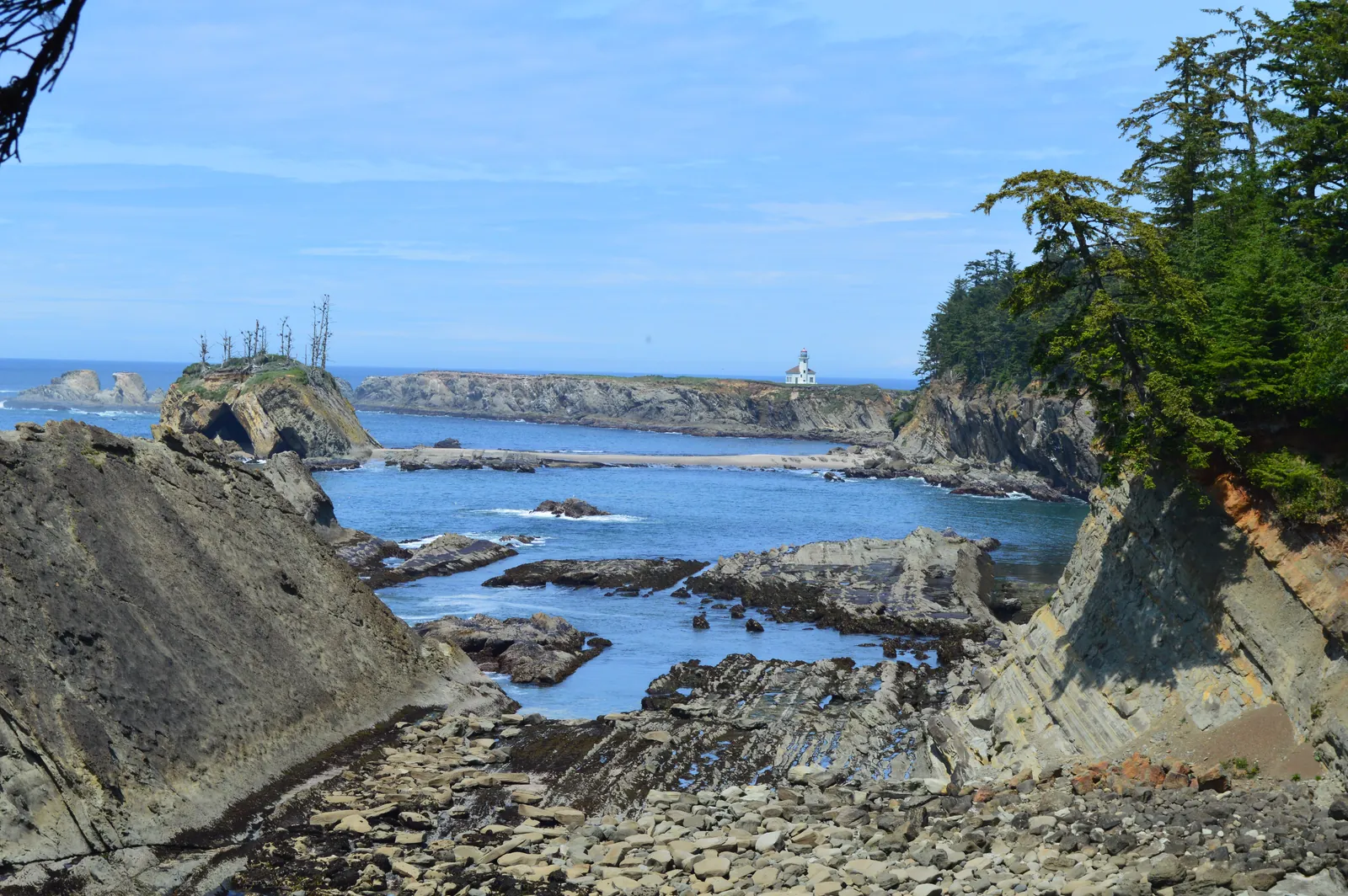
Sunset Bay's sheltered cove stands out on a coast of mostly open beaches. Its campground sits a short walk from the beach, where campers describe calmer water and tidepools at low tide. It runs year round and accepts bookings up to six months in advance. It holds 30 full hookup sites, 35 electrical sites with water, 65 tent sites, eight yurts, and a hiker and biker camp. The campground has flush toilets and hot showers for campers only.
The park allows only one extra vehicle per site, and its profile lists no dump station. Its sheltered cove is the one ocean swimming water in this guide, cold water where the claim is calm rather than warmth. Three of its campsites are accessible. Ocean water quality along this coast is sampled under the Oregon Beach Monitoring Program, and its health advisories post on the Oregon Health Authority's Current Beach Conditions page, the check to make before a swim.
Interpretive staff at the park run guided tidepool and nature walks, living history walks, and youth programs, the fullest program statement in this guide. Schedules sit at the park's Interpretive Center, or by phone at 541-888-0982.
Leave the dog in camp for a Shore Acres visit, because the adjoining day use park allows no pets anywhere, even on a leash. Campers report sites sitting close here, with limited and variable privacy from site to site.
Campers describe a campground that seemed quiet even when full, with older facilities as its caveat. Firewood and cedar fire starters are for sale at the park.
Bullards Beach State Park
Quick facts. 103 full hookup sites, 82 electrical sites with water, 13 yurts, a horse camp with eight primitive sites, and a hiker and biker camp, with no dedicated tent class listed. Open year round, and reservations run to six months. Fees run in the agency's system ranges across the full hookup and electric classes. An RV dump station is listed, and no pull through count is published.
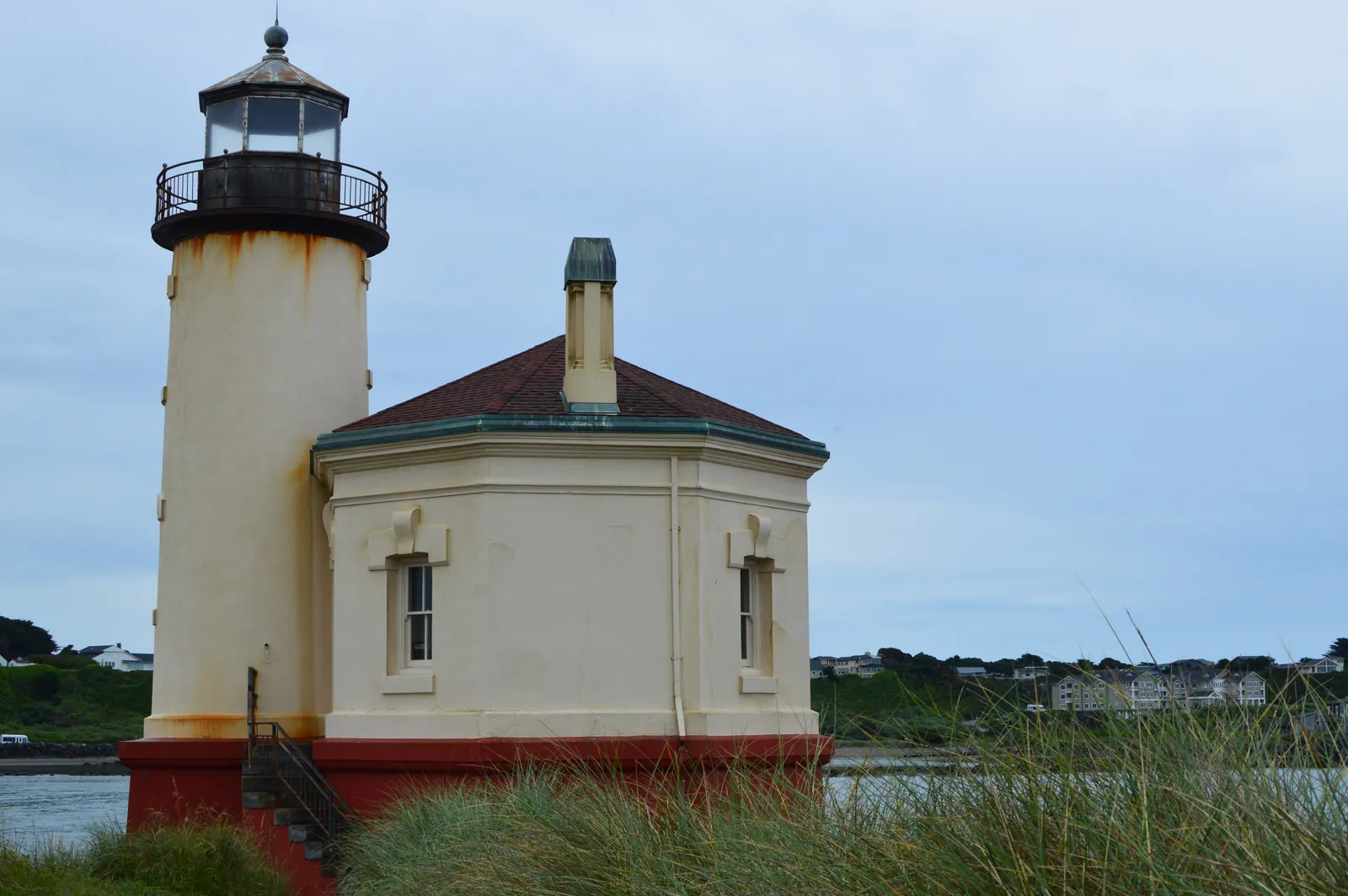
Bullards Beach, at Bandon, is farther from the beach than most of the campgrounds I visited. The park's own page puts a mostly paved path from near the registration booth at just over a mile to the sandy dunes, with 4.5 miles of beach at the end of Bullards Beach Road. Campers put the walk at about three quarters of a mile to a mile and a quarter depending on loop and trail, and many drive to the day use parking instead. Plan it as a walk of just over a mile, or a short drive. One camper reported the shorter B loop trail flooded and underwater in March, so the shortcut is a seasonal one.
The campground runs year round and accepts reservations up to six months in advance. It holds 103 full hookup sites, 82 electrical sites with water, 13 yurts with reservations required, a horse camp with eight primitive sites, a hiker and biker camp, and an RV dump station. The park lists no dedicated tent sites, so tent campers use the hookup sites; flush toilets and showers are for campers only. Six of its campsites are accessible, the highest published count at any campground in this guide. The Coquille River Lighthouse signal room is open from 11 a.m. to 5 p.m., mid May through September, with volunteers interpreting the history of the area.
A dated status advisory on the park page, effective November 2, 2026, closes A Loop for the season until May 17, 2027 and B Loop until March 15, 2027. C Loop, the yurts, the horse camp, the hiker and biker camp, the dump station, the boat ramp, and day use stay open. Limited Wi-Fi is available at the registration booth, the only Wi-Fi stated at any campground in this guide.
Bullards Beach offers sheltered, quiet sites. Shore pines protect the park from strong ocean breezes, and campers say the canopy makes sites private, dark, and quiet; one called it super quiet even when full. Campers give its bathrooms the strongest cleanliness praise among these parks, though one complained about the shower doors and warm water. Campers describe the sites as spacious and well kept, with good privacy from the trees and shrubs. Firewood is for sale at the park.
The water access here is the most complete in this guide. A boat launch inside the park reaches the lower Coquille River. The state fish and wildlife agency's south coast fishing guide names the park for beach fishing for redtail surfperch and for the Coquille River north jetty for surfperch and rockfish. The launch also gives access to fall salmon fishing on the lower river. Everywhere on this coast, fishing, crabbing, and clamming run on Oregon Department of Fish and Wildlife licenses and rules, and no campground in this guide sells a license.
Cape Blanco State Park
Quick facts. Four full hookup sites, 52 electrical sites with water, four reservable standard cabins, a horse camp, and a hiker and biker camp, with the group camp marked closed and no dedicated tent sites listed. Sites book to six months, and fees run in the agency's system ranges across the full hookup and electric classes. The park lists no dump station, and no pull through count is published.
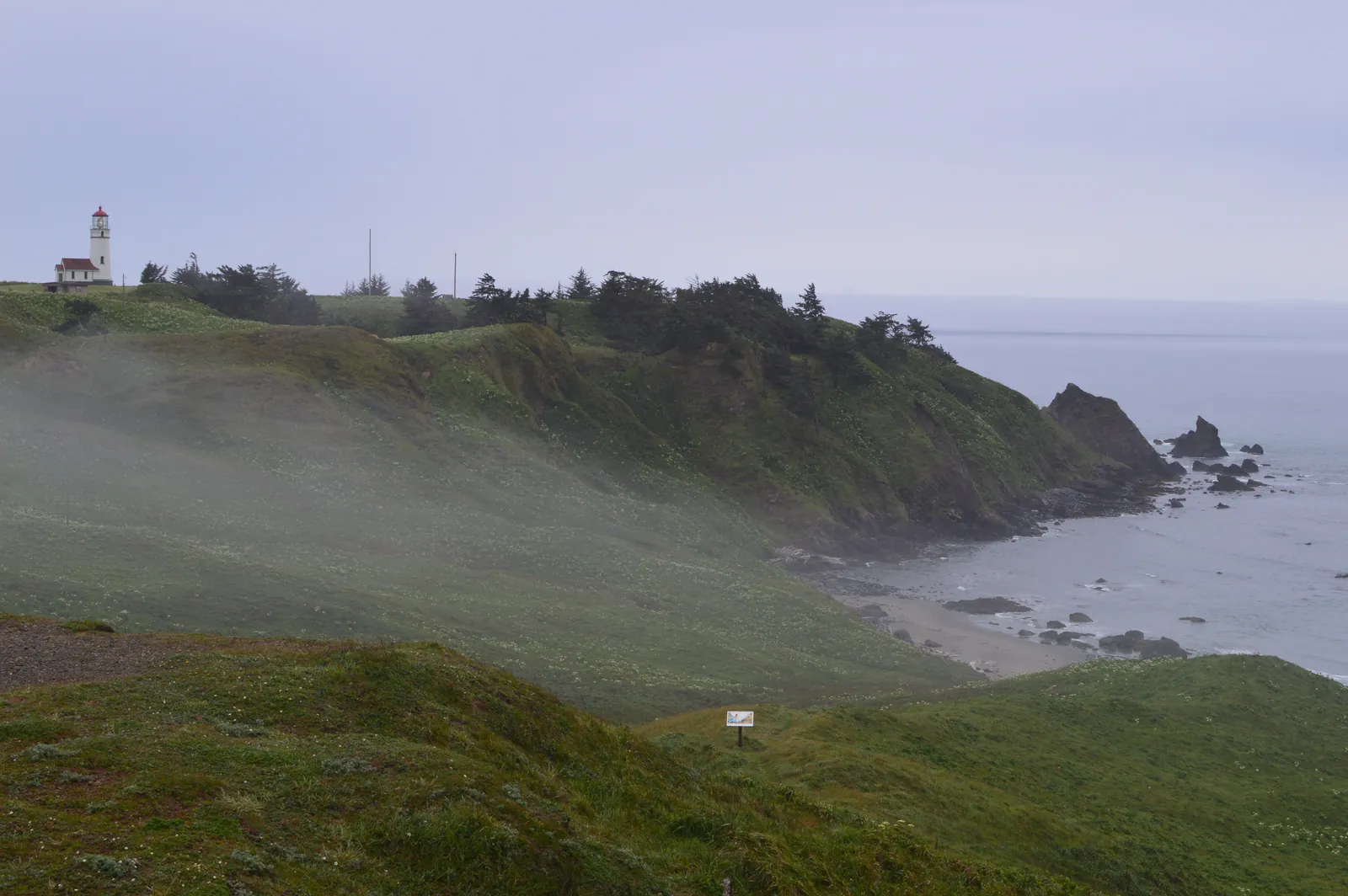
Cape Blanco was the quietest of the parks I camped on this coast. It felt private and quiet, and it sits at the south end of the coast in the part I judge the most scenic. The park occupies the state's westernmost tip, and the campsites are private and sheltered, perched over the Pacific. More than eight miles of trails lead to the beach.
The campground has four full hookup sites, 52 electrical sites with water, four reservable standard cabins, a horse camp, and a hiker and biker camp, and sites book up to six months in advance. The park page lists the group camp as closed, and there is no dump station. The park lists no dedicated tent sites, so tent campers use the electrical and full hookup sites; flush toilets and hot showers are available. Cape Blanco requires a parking permit starting March 30, 2026. Two of the campsites are accessible.
The park also holds Hughes House, a Victorian ranch house that offers tours in season. Its lighthouse offers no interior tours. Visitors walk a quarter mile from the gate to reach it, because the lighthouse road is closed to public vehicles, though the grounds and gift shop open in season. The lighthouse gift shop runs from April 1 through October 31, Wednesday to Monday, 10 a.m. to 3:30 p.m., and Hughes House tours run with volunteers from July 1 to September 30. The Port Orford Lifeboat Station Museum, nearby in Port Orford, opens from June to September.
I had no wind problems at all on these trips, and the sites I stayed at were fairly sheltered. Reviewers say to always expect wind at the westernmost point, even in summer. Dense Sitka spruce creates a natural windbreak over the sites, and campers describe sites as sheltered, private, and quiet inside the trees.
Camper reports put the hard wind on the cape, the lighthouse ground, and the beach, while sites inside the spruce stay sheltered on most nights. Expect wind out on the headland even when camp itself feels calm.
The cape, the lighthouse ground, and the beach are exposed, while the campsites sit inside the trees. Older descriptions list the electrical sites as first come, first served, but the park now accepts reservations.
Humbug Mountain State Park
Quick facts. 39 electrical sites with water, two of them accessible and five of them pull through, 56 tent sites with water nearby, and a hiker and biker camp, with no full hookup listed. Open year round and bookable to six months. Fees run in the agency's system ranges across the electric and tent classes.
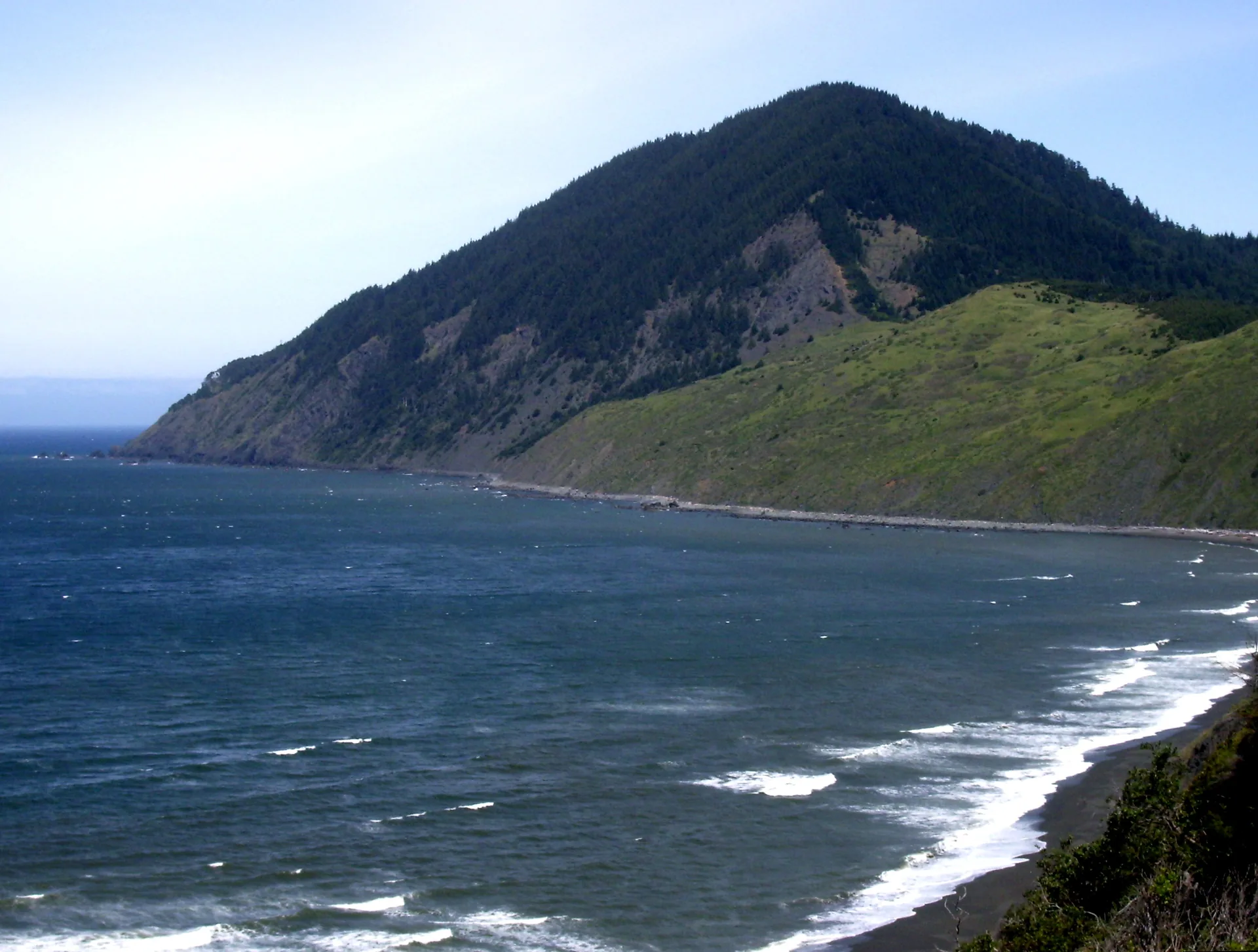
Humbug Mountain's campground sits in a sheltered canyon. The campground runs year round on its current park profile, with 39 electrical sites with water, 56 tent sites with water nearby, and a hiker and biker camp. The campground sits on Brush Creek under one of the coast's highest headlands, with a trail under Highway 101 to a sandy beach. Campers say the canyon shelters the campground from ocean winds and is often warmer than nearby exposed beaches, but consistently complain about Highway 101 noise in the lower loop.
Campers say that noise eases in the interior and upper loop and late in the evening. A trail also climbs from the park to the summit of the mountain itself. The current profile counts five of the electrical sites as pull through and two as accessible in design. Firewood is for sale at the park. Campers describe the sites themselves as nicely spaced even in the accounts that complain about the highway.
Alfred A. Loeb State Park
Quick facts. 48 electrical sites with water, 43 standard plus five with parking beside the site, no full hookup and no tent class listed, and three rustic log cabins. Open year round, and fees run in the agency's system ranges across the electric class. The five parking beside sites carry a 20 foot length, and no dump station stands at the park.
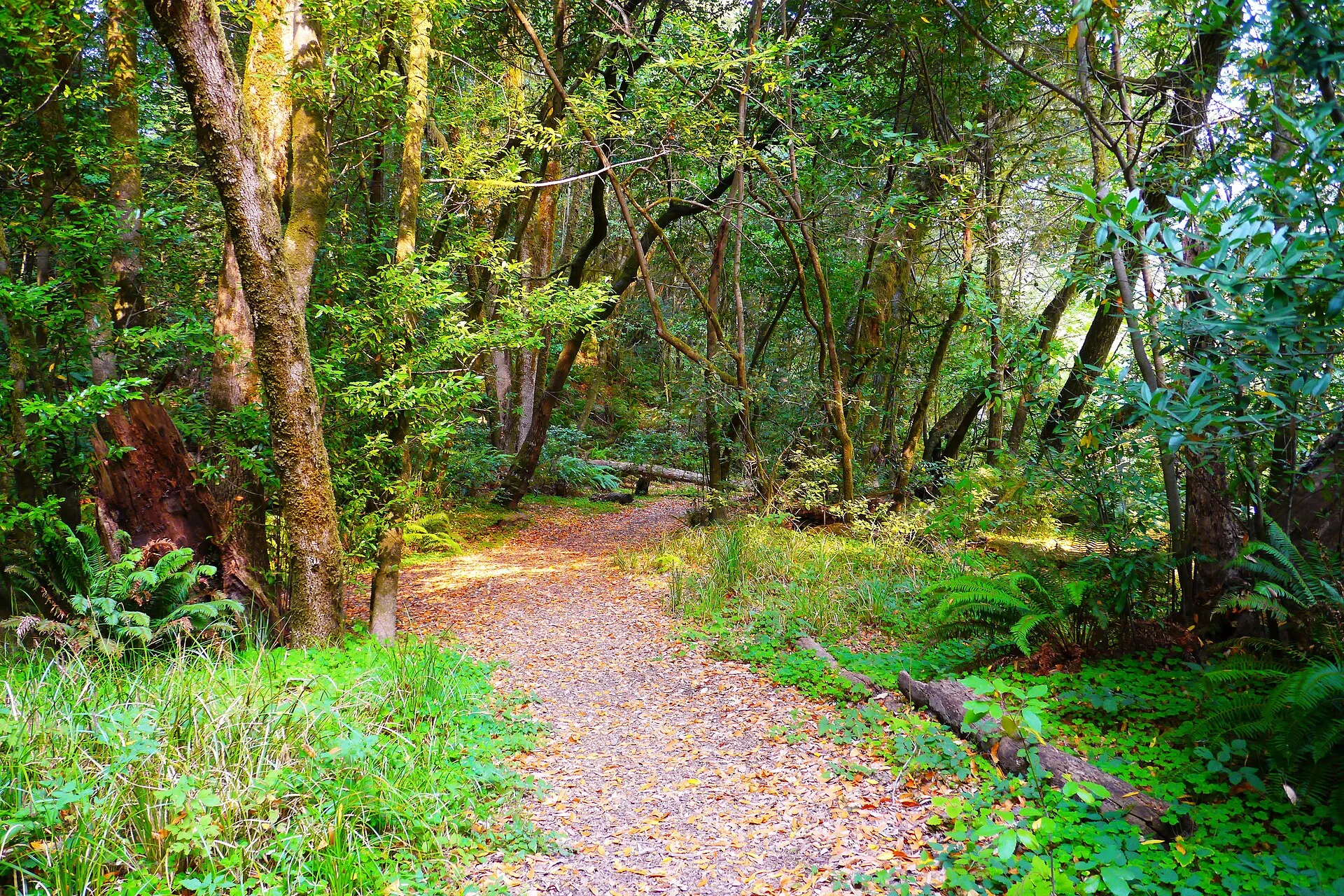
Alfred A. Loeb is the inland exception on this roster, a river park on the Chetco River eight miles inland from the coastline near Brookings. It has gravel bar access for fishing, swimming, and rafting, and no ocean beach at the park. Its sites are electrical sites with water, five of them parking the vehicle beside the site under a 20 foot length, and the park has no dump station. Quiet is the tendency here, and campers describe the park as very quiet at its best, with summer weekends as the named exception, when it fills fast and can get loud after dark. Campers also report mosquitoes heavy at times, a cost that travels with the riverbank setting.
Campers describe the sites sitting in the shade of a myrtlewood grove on the Chetco, a setting no other campground in this guide shares in their accounts. Firewood is for sale at the park, and one of its campsites is accessible.
Harris Beach State Park
Quick facts. 65 full hookup sites, 29 electrical sites with water, 54 tent sites with water nearby, six yurts, a hiker and biker camp, and a playground. Open year round, with some camp loops closing for the winter. Reservable sites book to six months, and fees run in the agency's system ranges across the full hookup, electric, and tent classes. The dump station costs $10 per use, and registered campers pay it only once per stay.
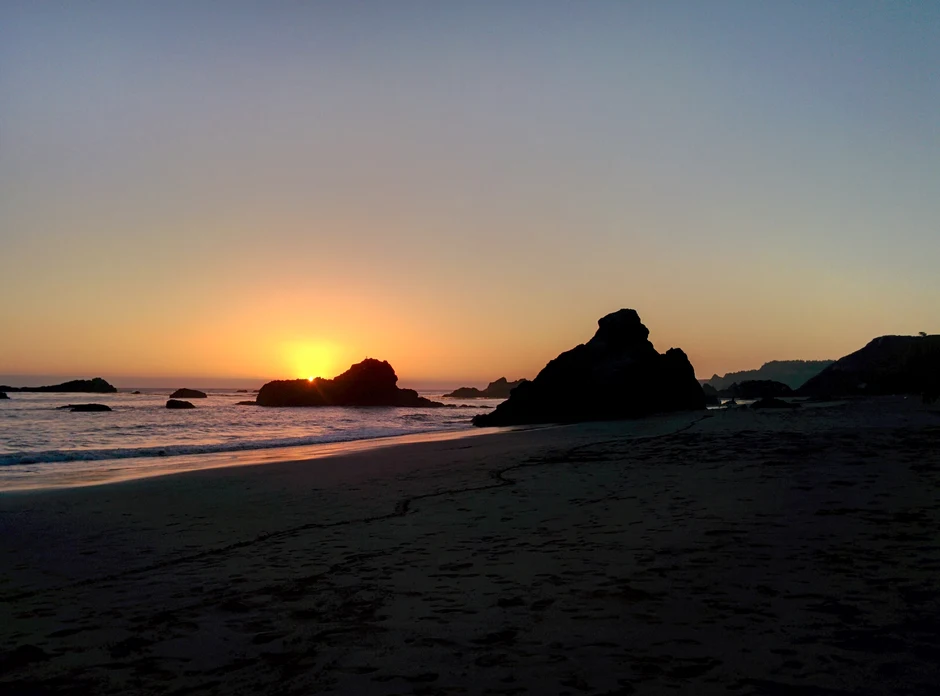
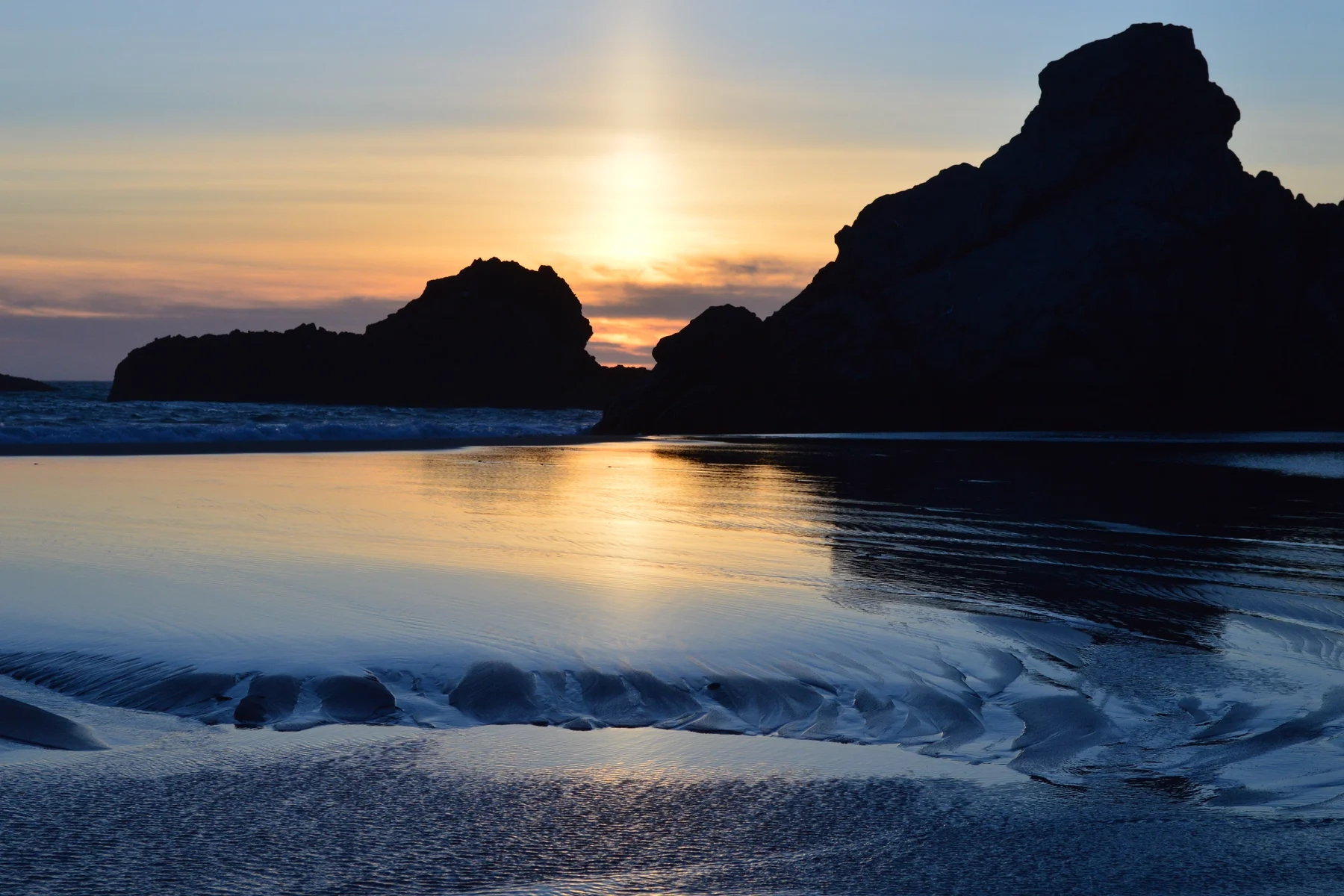
Harris Beach, at Brookings, is the southernmost park I camped on this coast. I camped there in July 2016, on the run with my wife, in our Kingdom 6 out of the Toyota Yaris. It is the night our air mattress leaked, and the beach below the campground at sunset that evening is the southern coast at its best in my judgment.
The campground runs year round, with some camp loops closing for the winter, and reservable sites book up to six months in advance. It holds 65 full hookup sites, 29 electrical sites with water, 54 tent sites with water nearby, six yurts with reservations required, a hiker and biker camp, and a playground, plus an RV dump station. Flush toilets and hot showers serve the campground. The dump station costs $10 per use, and registered campers pay it only once per stay. One of its campsites is accessible.
Its day use area offers beachside picnicking, with miles of sandy beaches and rocky outcroppings. Campers describe a short walk to the sand, with some sites facing a hike downhill, and a rocky shore with tidepools at low tide. Campers praise the showers for their pressure and heat, with no time restrictions. Firewood is for sale at the park, subject to availability.
Campers describe Harris Beach as an exception to the quieter parks I found farther south. Its sites fill quickly, family reunions and children fill the loops in summer, and Highway 101 noise reaches the loops nearest the road; campers recommend sites away from the highway. Families rate the park highly. Expect crowds like those at parks farther north, and book early. Among the parks I camped, only Cape Lookout drew more camping searches.
One Coos County park also takes campers beside the dunes and is named here rather than profiled. Coos County runs Riley Ranch County Park at milepost 227 on Highway 101, six miles north of North Bend beside the Oregon Dunes. Its 114 reservable sites carry water and electrical hookups. The park's direct dune access is built around ATV use.
The redwood start in California
Two California campgrounds stand at the end of this guide. Both of my coast runs started in their redwoods and headed north, and a run down this guide from the top finishes where they stand. I camped at both, Del Norte Coast Redwoods in 2014 and Jedediah Smith Redwoods in 2016, and I highly recommend either as the start of a coast trip. From their redwoods, Highway 101 north crosses into Oregon and the south coast section of this guide.
Jedediah Smith Redwoods State Park at the start of the 2016 trip
Quick facts. About 87 family campsites. Open all year, with campsites first come, first served from November through April. The park lists no hookups, some sites take trailers or motor homes to 36 feet, and an RV dump station stands among its listed amenities.
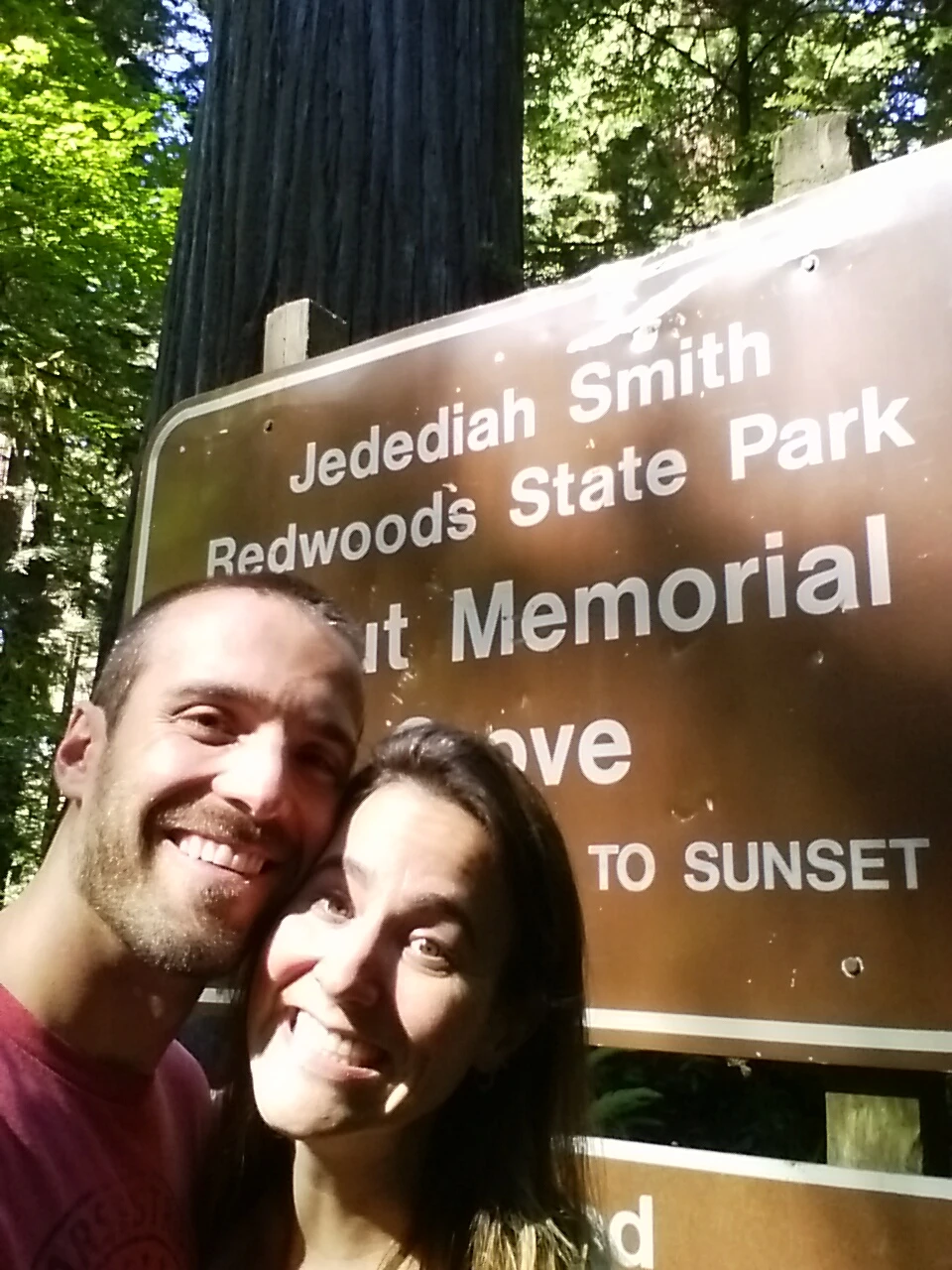
Jedediah Smith is a California park, the start of a coast run rather than part of the Oregon roster. I camped there at the start of the 2016 trip, the run I made with my wife, and I rate it highly recommended. The National Park Service and California State Parks cooperatively manage the park's 10,000 acres as part of Redwood National and State Parks.
The campground is open all year. From November through April it runs first come, first served, and its listed amenities include tent camping, hike and bike campsites, restrooms and showers, and an RV dump station. Park pages give the campground about 87 family campsites, each with a table and fire ring.
Del Norte Coast Redwoods State Park
Quick facts. Mill Creek Campground, just south of Crescent City. Reservations run from May through September, and sites are first come, first served the rest of the year.
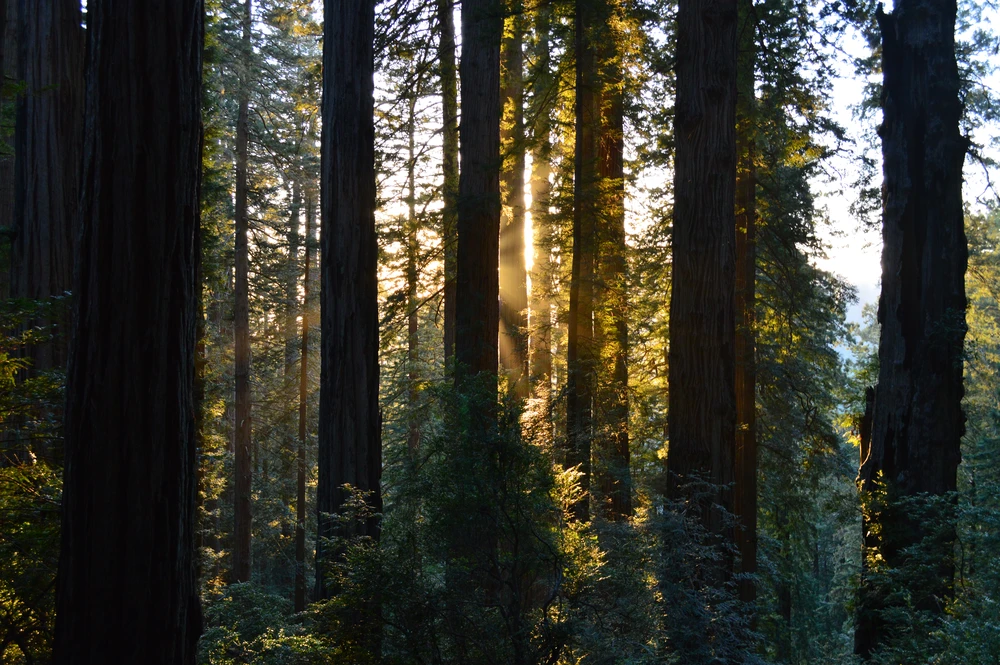
I camped at Del Norte Coast Redwoods State Park at the start of my 2014 trip, and I highly recommend it as the 2014 redwoods start, paired with Jedediah Smith Redwoods State Park, the 2016 start. Its campground is Mill Creek Campground, just south of Crescent City. The National Park Service and California State Parks manage its 33,000 acres cooperatively, as part of a group that protects 45 percent of the world's remaining old growth redwood forests. Mill Creek takes reservations from May through September and runs first come, first served the rest of the year, and its north and south loops each have accessible restrooms with showers. My photograph of sunbeams through its redwoods stands in the Choosing section of this guide, from that May 2014 trip.
Good to know before you go
Family camping on this coast
These trips predated my daughter, so she was on neither of them. As a parent who camps with a preschooler elsewhere, I can judge these parks' facilities for families. My own Oregon camping predated my daughter, so these family judgments rest on the parks’ facilities, not on having camped at each park with a child. Judged on facilities alone, each would have worked well for a family.
Beach distance is the first family criterion. From most of my campgrounds, the beach was a short walk or a trail away; from the more inland ones, it was a drive. Every site I used felt fine for the tent; none was too small, exposed, or sloped. Cape Blanco was at the quiet end, with Harris Beach and Honeyman as southern exceptions and Umpqua Lighthouse as a separate crowded exception.
Playgrounds stand at Harris Beach, Beverly Beach, South Beach, and Fort Stevens on the parks' own pages, and campers mention one at Honeyman. Families praise the bicycle friendly loops at Fort Stevens, Loeb, and Tugman.
Ranger programs run on a calendar rather than a standing schedule, and the agency publishes them park by park and date by date on its events calendar. Named programs stand at four grounds in this guide, Fort Stevens, Sunset Bay, Bullards Beach, and Cape Perpetua, at their entries. For children, the system's standing offer is the Junior Ranger program, where a child picks up an activity book, completes it, shows it to park staff, and receives the badge.
Nehalem Bay's dune climb was hard with a child and beach gear in one family account. Umpqua's small sites and steep lake path worked against young children in another. A family account of Honeyman describes its playground mixing older unsupervised children with toddlers. Family writers advise booking six months to the day and treating fall as prime time.
For a first family trip, start with Beverly Beach, Bullards Beach, or Harris Beach for sheltered sites or a short beach walk and the facilities young children use most. Treat Umpqua Lighthouse and Honeyman as older child parks, one for its small, close sites, the other for its dunes and daytime vehicle noise. At Nehalem Bay, pack for a dune climb between camp and sand.
Dogs get one bounded passage, from the agency's rules. I took no dog on either trip. Pets must be physically restrained on a leash no longer than six feet in all park areas. The exceptions are designated off leash areas, and time inside a vehicle, a tent, or a pet friendly yurt or cabin.
Pets must also stay calm during quiet hours, from 10 p.m. to 7 a.m., and pets are not allowed inside park buildings unless the building is designated pet friendly. On most ocean beaches pets may run free under direct control with a leash carried, but pets must be leashed on the beach in front of Cape Lookout State Park. Service animals stand outside these pet rules. A service dog trained to do work or perform tasks for a person with a disability may enter park buildings and designated swim areas where pets may not, needs no vest, and stays on a leash unless a task requires otherwise.
To protect western snowy plovers, parks prohibit pets on some beaches at certain times and restrict nesting areas from March 15 to September 15. Nehalem Bay's Snowy Plover Management Area has restrictions across those same dates.
Food storage runs on a vehicle rule at every ground in this guide. The park brochures tell campers not to feed wildlife and to secure all food and food containers inside the vehicle. No campground here provides bear boxes or food lockers, so the vehicle is the food storage system a camper plans around.
Trash goes in the containers the parks provide, which is the stated duty in both the state and the federal systems. Where federal land provides no receptacle, the Forest Service asks campers to pack their waste and trash out instead.
Showers and bathrooms park by park
The nice showers and nice camp spots were among the reasons I wanted Oregon state parks specifically.
Showers are part of the campground stay at these parks. Every campground's park page lists flush toilets and showers; most specify hot showers, and several say showers are for campers only. None of the agency pages I read mentions shower charges or timers for campers. Campers report that showers are free and untimed across these parks.
Umpqua Lighthouse's showers are available to registered campers from 6 a.m. to 11 p.m. Devils Lake's park page says hot showers have limited availability.
Campers and reviewers describe Oregon state park showers as free and untimed and rate Oregon ahead of Washington on that basis. Washington ties or wins at a handful of parks, including Rasar and Lake Wenatchee.
| Park | Showers | The friction | Bathrooms | Source |
|---|---|---|---|---|
| Fort Stevens | Hot showers | Bathrooms vary by loop, reported by campers | Flush toilets | Park page and camper reports |
| Nehalem Bay | Showers, campers only | None stated | Flush toilets | Park page, current profile |
| Cape Lookout | Hot showers, campers only, in a closed campground | Campground closed through spring 2027 | Flush toilets | Park page, closure in force |
| Devils Lake | Hot showers with limited availability | Limited availability, in the page's words | Flush toilets | Park page |
| Beverly Beach | Showers | D, E, and G loop restroom and shower buildings close in winter, per park notice | Flush toilets | Park page and camper reports |
| South Beach | Showers | None stated | Flush toilets | Park page |
| Beachside | Hot showers | Water runs warm at peak use, reported by campers | Flush toilets | Park page and camper reports |
| Carl G. Washburne | Hot showers | None stated | Flush toilets | Park page |
| Jessie M. Honeyman | Hot showers | Push button, not adjustable, reported by campers | Flush toilets | Park page and camper reports |
| Umpqua Lighthouse | Showers for registered campers, 6 a.m. to 11 p.m. | Timed hours, the stated exception | Flush toilets | Park page |
| William M. Tugman | Showers, campers only | Open only to registered campers from 6 a.m. to 11 p.m. from October 1 to May 1, per park notice | Flush toilets | Park page |
| Sunset Bay | Hot showers, campers only | Older facilities, reported by campers | Flush toilets | Park page and camper reports |
| Bullards Beach | Showers, campers only | One complaint on doors and warm water, against strong cleanliness praise | Flush toilets | Park page and camper reports |
| Cape Blanco | Hot showers | Pressure and temperature drop under shared use, reported by campers | Flush toilets | Park page and camper reports |
| Humbug Mountain | Showers | None stated | Flush toilets | Park page, current profile |
| Alfred A. Loeb | Hot showers | None stated | Flush toilets | Park page |
| Harris Beach | Hot showers | None stated | Flush toilets | Park page |
A family headed for Honeyman should know about its push button showers, with no temperature adjustment, before booking. Cape Blanco campers should expect pressure and temperature to drop when several showers run at once. At Tugman, campers report the opposite setup, with free showers and temperature set on standard knobs.
Camping on the sand and the forest behind the coast
Can you camp on the beach itself? An Oregon administrative rule prohibits overnight use on the ocean shore abutting park properties, and in any park property or portion of one not specifically designated for camping. Beside these parks, the sand is for day use; camp in designated campgrounds.
Beyond the parks, beach camping rules vary across the state. Legality elsewhere turns on local prohibitions by town, county, and managing agency, and on posted restrictions that include snowy plover closures.
Another rule prohibits camping on the ocean shore between the north boundary of Manzanita and the Neahkahnie Mountain headland. There, the rule defines camping to include erecting a tent, arranging bedding, or parking a vehicle to remain overnight. Legal beach camping exists in specific parts away from towns and parks, under rules that change by jurisdiction, so a camper set on sand should check the specific part and its managing agency.
The Forest Service says you can disperse camp anywhere in the sand dunes under its dispersed camping guidelines. If you reach the site by an off highway vehicle, the dunes vehicle camping rules apply instead. Designated sand camping areas exist at Sand Lake Recreation Area and in the Oregon Dunes National Recreation Area, each under its own regulations. All campgrounds and sand camping sites within that recreation area, which reaches from Coos Bay to Florence, require an electronic reservation and payment. Dune sand camping is therefore a reservable product under rules, not a free walk in.
In the Siuslaw National Forest, dispersed camping means camping anywhere in the national forest outside a designated campground, with no toilets, treated water, fire grates, or picnic tables. The Forest Service generally allows it anywhere except where signs close an area, where rules prohibit overnight parking, or within 200 feet of a developed road, trail, or facility. You can disperse camp for no more than 14 days in any 60 consecutive day period. You can camp in developed campgrounds in the forest for no more than 14 days in any 30 consecutive day period.
I have not dispersed camped on this coast myself. My own dispersed camping has been in Washington.
Campfires and firewood on this coast
At an Oregon state park, a fire belongs in the camp stove or fireplace the park provides, in a part of a beach area designated as permissible for campfires, or in a portable stove at an established campsite, picnic area, or beach area where fires are designated as permissible. Burn only paper and untreated natural wood with no metal, nails, glass, or plastic attached, in pieces no longer than 24 inches. Keep the fire attended at all times, and break it apart and put it out completely with water before leaving the immediate area. Gasoline, diesel, and other petroleum products may not start or feed it. Fireworks and explosives are not allowed in state parks or on the ocean shore, and rangers may cite significant or repeated violations, with a presumptive fine of up to $400.
The agency's own guidance keeps a campfire small, at or below knee height, about two feet. Build it in the campsite's existing fire ring, keep water close by, and douse and stir the embers when you are done. A propane fire ring belongs in an area without vegetation or overhanging branches, and its rules vary with local conditions.
Restrictions arrive park by park, as dated banner notices on the park's own page and its Special Notices page. The check before any trip is the park page itself, with the Oregon Department of Forestry restrictions page as the statewide layer beside it. When a campfire and open flame ban lands, the 2026 examples barred fires from wood, charcoal, candles, tiki torches, and other devices that emit flames or embers. Portable propane stoves and other cooking devices with a shutoff valve stayed allowed. The scope varied by park, and one ban also barred propane fire rings.
A park manager may also restrict or prohibit fires in otherwise allowed places when fire hazard runs high, and every camper must observe that restriction.
For the four federal campgrounds, the Siuslaw National Forest fire page carries the forest's restriction state and routes active fire information to InciWeb. Every site at the four grounds carries a campfire ring or a fire ring.
Firewood carries its own rule of thumb. The agency asks campers to buy locally harvested firewood at or near the destination, within 10 miles, or to buy certified heat treated firewood ahead of time where it is available. Ash, olive, and white fringe tree firewood may not move out of Multnomah, Washington, Yamhill, Clackamas, and Marion counties at all, under a quarantine aimed at the emerald ash borer. When the tree species is in doubt, the advice is to leave the wood out.
The federal campgrounds print the same advice in shorter form on every facility page, under a Don't Move Firewood heading that asks campers to obtain and burn firewood near the destination. On the parks' own profiles, firewood is for sale at most of the state park campgrounds in this guide, priced per bundle where a price is posted. Wright's for Camping sells wood at $5 a box from the firewood shed near its campsite 7.
Beach fires run on a separate rule. A recreational beach fire may be no larger than three feet in any direction, and a larger fire needs a special use permit. It belongs in the open sand, downwind of shoreline vegetation and log accumulations, never in the dunes or in beach log accumulations. Keep it at least 25 feet from beach access points, shoreline vegetation, log accumulations, and combustible seawalls.
Put it out completely with water and break it apart before leaving, because covering a fire with sand insulates the coals and leaves them hot enough to burn someone days later. Beach fires are prohibited in western snowy plover management areas, and on Siuslaw beaches burning is also prohibited in the plover dry sand closure areas from March 15 to September 15.
Alcohol runs on a short rule of its own. Nobody under 21 may possess or use it at any park property. The manager's written permission is required only at a short list of named areas elsewhere in the system, none of them on this coast.
Seasons on the coast
Search demand for the coast's main terms falls to roughly a quarter to a third of peak demand in autumn. The reservation system means campers book July trips in January.
My two trips ran in May and in July, four to six nights each, and I did not record which month belonged to which year. On those trips, I had no trouble with rain, cold, wet ground, or wind. I claim no winter camping on this coast and no shoulder season experience here. What follows for the rest of the calendar comes from the parks' pages and other campers' accounts.
Campers and guide writers describe September and early October as warmer, less crowded, and far easier to book; family writers call fall prime time. Campers report busy holiday weekends at parks that are quiet on ordinary winter weekends. Campers report that midweek is better than weekends in every season at the parks they mention.
Parks reduce operations in winter, with no stated system wide switch date. Cape Lookout is closed entirely through spring 2027, Honeyman closes entirely in January and February 2027 for water system work, and Fort Stevens has closed its South Loops for utility work without stating dates. Beachside's season runs from March 15 to October 31, and it closes for winter. Harris Beach closes some camp loops for winter but does not name the loops or dates on its page. Campers identify flood prone sites at Loeb by number and report seasonal flooding at other parks.
At South Beach, campers report mosquitoes as a recurring warm month problem, worst at dusk and along the beach trails. One camper named them the only negative of a stay, and early summer accounts call them aggressive along those trails, so a summer evening at Newport is a repellent evening. At Tugman, campers report mosquitoes as a seasonal nuisance around Eel Lake. A May yurt stay met heavy mosquitoes there, and damp off season accounts pair the lake ground with them, so repellent earns its place on a warm month lake trip.
Beginning May 1, 2026, rates at the 29 busiest parks rise to the top of the current rate range. The top rate runs from May 1 through September 30, and year round on Friday, Saturday, and Sunday nights. All 17 parks in this guide appear on that seasonal rate list.
Fees, passes, and the surprise at the dunes
Oregon has no state park pass comparable to the Discover Pass. The agency publishes no annual pass that covers camping. Oregon's pass product is a day use parking permit, which covers parking at fee parks and does not apply to campsite fees.
Nightly prices here are the agency's published ranges, not per park exact figures, and the full schedule stands in the reservations section of this guide.
Rates include lodging tax and are subject to change, and the agency directs readers to the reservation system for an exact rate on a given night. The current rules also authorize rates that vary by day of week, season, holidays, amenities, and demand. The reservation fee is $10 per site, waived for same day reservations.
The agency charges nonresidents a 25 percent surcharge on all campsite reservations. The surcharge also applies to electric and full hookup sites, because those are campsites too. Check the exact night in the reservation system before you commit. The surcharge applies only to campsites; parking has separate prices.
Visitors need a parking permit at 22 additional parks starting March 30, 2026. The permit costs $10 a day for Oregon residents and $12 for out of state visitors. A 12 month permit costs $60 for residents and $75 for out of state visitors. The fee does not apply to visitors who walk, bike, or take public transportation, or to holders of a current parking permit.
Visitors with a valid hangtag from a current Oregon State Park camping reservation also do not pay the parking fee at these parks. Of this guide's 17 parks, the list of 22 added parks names Cape Blanco, Carl G. Washburne, Umpqua Lighthouse, and William M. Tugman.
The Northwest Forest Pass costs $30 annually and provides access to Forest Service day use recreation fee sites across Oregon and Washington. It is a federal pass, not an Oregon State Parks product, and it does not cover state park campgrounds. My household holds one, but I do not claim to have used it on the Oregon trips.
Fees generally did not surprise me on these trips, but I did not expect dune hiking fees. I have not tied those fees to any park or named trailhead. The dunes behind several of these parks sit on federal land, where trailhead parking runs on a federal day use pass rather than on the state park system. A state parks trip can therefore meet a federal charge it did not predict, at a trailhead the state reservation never mentions.
Resupply along the coast
No campground in this guide sits more than about 20 miles from a town with groceries and fuel, and only two supply legs on the roster run past 10 miles. Most runs are drives, and the rides that do exist are mostly road rides rather than paths. Two campgrounds put stores within a walk, and a middle tier puts a town within a short ride. Propane follows the same geography, sold by hardware and fuel businesses in the resupply towns, because no campground in this guide sells it.
Harris Beach is the walkable case. A published trail of about 1.2 miles for walking and biking runs from the day use area into downtown Brookings, and the grocery run from camp is about one to two miles. Wright's for Camping sits in mid town Cannon Beach, where the town's stores are a walk rather than a drive.
In the ride tier, Manzanita is a published three mile bike ride from Nehalem Bay. The state bicycle route crosses the Yaquina Bay Bridge past South Beach into Newport, and the same route crosses the Coquille River bridge from Bullards Beach into Bandon. Warrenton is a road ride from Fort Stevens. Lakeside, Winchester Bay, and the Lincoln City store corridor each sit about a mile of road from Tugman, Umpqua Lighthouse, and Devils Lake. Lakeside is also the nearest town to Eel Creek, and Eel Creek's full grocery run is a drive to Reedsport.
Everywhere else, plan on driving. The rides at Beverly Beach, Beachside, Honeyman, and Tillicum Beach are Highway 101 shoulder rides, and Charleston is a road ride from Sunset Bay with no path. Washburne is the isolation end of the roster, with Florence about 14 miles away and no nearer settlement with a store. Cape Lookout's full service town is Tillamook, 11 miles away, with only a small market at Netarts nearer. Cape Blanco and Humbug Mountain both depend on Port Orford alone for groceries and fuel.
Emergencies on this coast
Call 911 first in any emergency. Oregon's county sheriffs carry responsibility for search and rescue by statute, and every county on this coast runs an alert system campers can join before a trip. For Fort Stevens the nearest hospital town is Astoria, and for Wright's for Camping it is Seaside, nearer than the Astoria a reader might guess. Clatsop County's system is ClatsopALERTS!, and its burn ban status publishes as dated county releases, which makes the Oregon Department of Forestry restrictions page the standing check there.
Tillamook is the hospital town for both Nehalem Bay and Cape Lookout, and Tillamook County routes alert signup through OR-Alert and publishes its burn bans as Fire Defense Board releases. Lincoln County runs the strongest county surface on this coast, with Lincoln Alerts for warnings and a standing Seasonal Hazards, Wildfire page for burn status. Its hospital towns are Lincoln City for Devils Lake and Newport for Beverly Beach, Beachside, South Beach, and Tillicum Beach. Cape Perpetua shares this county layer, and its hospital town is Florence.
Florence is the hospital town for Washburne, Honeyman, Sutton, and Cape Perpetua. Lane County alerts run through Lane Alerts on the state platform, and the Lane Regional Air Protection Agency posts daily outdoor burning advisories with a coastal line at 541-997-1757. Reedsport is the hospital town for Tugman, Umpqua Lighthouse, and Eel Creek. Douglas County campers join Douglas Alerts, and fire season restrictions for the county's grounds publish through the Douglas and Coos forest protective associations.
Coos Bay is the hospital town for Sunset Bay. Bandon is the hospital town for Bullards Beach and for Cape Blanco, which sits over 25 miles from it with only a clinic at nearer Port Orford. The Coos Forest Protective Association is the standing burn source for Coos and Curry counties and western Douglas. Its campfires page states the campfire rule at each fire danger level, and its closure information line is 541-267-1789.
In Curry County, Gold Beach is the hospital town for Humbug Mountain. For Loeb and Harris Beach the first name is the satellite emergency department in Brookings, with Gold Beach as the hospital town behind it. The hospital listings behind these town names stand on the Oregon Health Authority's licensed hospitals list, checked in November 2026.
What went wrong and what a family packs from it
Our air mattress leaked at Harris Beach State Park, on the 2016 trip, and we bought a new one at a nearby store. We also forgot to bring bedding and had to buy a sleeping bag.
If your air mattress fails on a trip, you may need to buy a replacement at a nearby store. Check for covers before loading the car, because you may also need to buy a replacement for a forgotten layer. A five minute check at home could have saved us the cost of both purchases.
Use the camping checklist to pack your sleep system and covers, and test the mattress at home before relying on it for four to six nights.
Frequently asked questions
How far ahead can I book an Oregon coast state park campsite?
Reservations open from the same day as arrival through six months in advance, counted back from the first night of the trip. New sites come online at 6 a.m. daily, so book a July weekend in January and log in ready for the release. Campers report that popular summer weekend sites go within minutes.
What is the reservation fee and when is it waived?
The agency charges a $10 reservation fee for each site, whether you book by phone or online, and requires full payment at booking. The agency waives the fee for same day reservations. The agency publishes nightly rate ranges, and the reservation system gives the exact rate for a given night. Changing a reservation carries an $8 change fee, and the reservation and transaction fees are non-refundable.
Are any campsites first come and how does same day booking work?
None of the 17 parks is a year round first come campground, though some offer first come hiker and biker camps or off season arrangements. Since January 1, 2024, campers have been able to make same day online reservations at most campgrounds statewide. An available site at a reservable campground can be booked online, or at the park, that day. It works best on weekdays and in the shoulder season, and it is not a plan for a summer weekend.
Is Cape Lookout open for camping?
No. Cape Lookout's campground closed on August 3, 2026, for park improvements, and the agency's project page states the park will be closed from summer 2026 through spring 2027. I camped at Cape Lookout, but it is not a booking option for this season. Check the park's own page before planning around a reopening, since the agency states that construction closures will be adjusted as the timeline becomes clearer.
How do the showers work at these campgrounds?
Campers report free, untimed showers across these parks, and no agency page I read charges campers for showers or puts them on a timer. Umpqua Lighthouse limits shower use to registered campers from 6 a.m. to 11 p.m., and campers report push button showers at Honeyman.
What pass do the dune trailheads take?
The dunes behind several of these parks are on federal land; the Northwest Forest Pass costs $30 annually and covers Forest Service day use fee sites across Oregon and Washington. It plays no role inside the state park campgrounds, and no Oregon state park pass covers camping. Budget for possible dune hiking fees: I encountered unexpected fees on these trips but have not tied them to any park or named trailhead.
Which part of the coast suits a family and which part is quieter?
For a first trip with kids, start with Beverly Beach or Bullards Beach. In my experience, the south coast is quieter, with Cape Blanco a quiet place to start; the north coast is busier and closer to drivers from Portland and Washington. Two southern exceptions are Harris Beach, which fills quickly and draws crowds more like a northern park, and Honeyman, which is busy in summer.
Use the filters above to choose the part of the coast and the park that suit your trip. Then book at the six month mark when sites are released at 6 a.m. Both of my completed trips ran south to north, but on my next trip I would start north and head south. The southern part of the coast is the most scenic in my assessment, and it is where I would spend most of a next trip's time. The Samuel H. Boardman State Scenic Corridor is my favorite part of the Oregon coast.
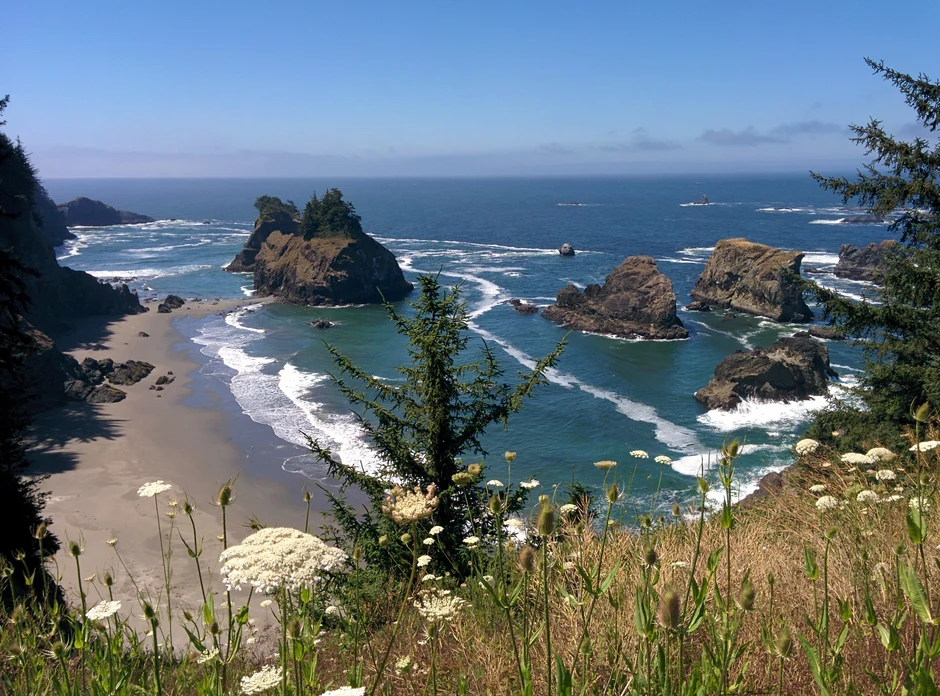
How big an RV or trailer can the campgrounds take?
No campground in this guide publishes a campground wide maximum length for an RV or trailer. Length in the Oregon state parks is a per site figure, carried as driveway length and maximum vehicle length for each site in the reservation portal, and every vehicle including a towed vehicle must fit inside the paved driveway. The one park page length on the state roster is at Loeb, where the five electrical sites with parking beside the site carry a 20 foot length.
At the federal grounds, the longest single site figures run to 66 feet at Tillicum Beach, 54 feet at Eel Creek, 60 feet at Cape Perpetua, and 111 feet at Sutton. Each figure is one site's length, not a promise that a rig of that size fits the campground as a whole. The firmest cap in the guide is the private entry, where Wright's for Camping takes an RV to 25 feet on the sites that accept one.
Is there cell service at the campgrounds?
Plan on coverage that varies park by park, with one park in this guide, Washburne, having effectively none in practice. Campers report no usable service in the Washburne campground across carriers, with reception returning only miles away, so any same day booking or download needs doing before arrival there.
At the other end, campers find Harris Beach the strongest coverage on this coast, and coverage at Nehalem Bay and Tugman is workable in camper accounts. Between those poles, Beverly Beach campers report no usable service in the treed loops, even where coverage is claimed for the park, and South Beach coverage works in camper accounts. At Sunset Bay, signal gathers at the entrance and the beach while interior sites sit quiet, and Loeb coverage is sparse. The two California anchors split in their own way, with Jedediah Smith reception reported as unreliable against an official listing that credits the campground with it, and no in camp service at Mill Creek in camper accounts.
How long can I stay at one of these campgrounds?
At an Oregon state park, a camper may stay no more than 14 nights in a 30 night span, and one campsite holds at most eight people overnight. The four Forest Service campgrounds share a forest wide form of the same limit: 14 days in any 30 day span across the whole Siuslaw National Forest. Nights at Tillicum Beach, Eel Creek, Cape Perpetua, and Sutton draw on one shared count rather than four separate ones.
Do the campgrounds sell firewood or camp supplies?
Firewood is for sale at 16 of the campgrounds in this guide, on the parks' own pages or the operator's. A camper who runs out can usually buy a bundle in camp rather than drive for it.
Full camp stores are rarer. The South Beach Hospitality Center sells souvenirs and camp items, and the Beverly Beach Welcome Center sells firewood and souvenirs. Those two are the only true camp stores in this guide.
Where a price is published it is modest: Beachside sells bundles at $5 with fire starters at $1 each, and Wright's sells wood at $5 a box. The four federal campgrounds name no sales point, so stock up before those stays.
Are there accessible campsites at these campgrounds?
Eleven of the state parks publish a count of accessible campsites on their own profiles, and the counts run park by park rather than as any roster figure. The counts are one each at Loeb and Harris Beach, two each at Cape Blanco, Cape Lookout, Humbug Mountain, and Tugman, and three each at Beverly Beach and Sunset Bay. South Beach publishes five, and Bullards Beach six, the highest published count in this guide. A few more profiles confirm accessible sites without publishing a count. The federal campgrounds' pages do not publish counts, so check the individual park's page and the reservation portal for the site itself before counting on one.
How do I store food overnight?
In your vehicle. The park brochures tell campers to secure all food and food containers inside the vehicle and not to feed wildlife. No campground in this guide provides bear boxes or food lockers. The vehicle is the food storage system at every ground here, so plan the packing around food living in the car or truck overnight.
Can I bring a service animal?
Yes, and service animals stand outside the pet rules. A service dog trained to do work or perform tasks for a person with a disability may enter park buildings and designated swim areas where pets may not. It needs no vest or special identification, and it stays on a leash unless a task requires otherwise.
Park information is checked every season, starting with closures and booking rules. The next check is in early January 2027, with Cape Lookout's reopening first.
When a detail here and a park's own page disagree, believe the park's page and tell us. Readers working the Washington side of the same trip will find Washington Campgrounds by Region and Best Washington State Parks for Camping.
Sources
Oregon State Parks, Reserve page, for the booking window, the 6 a.m. release, the reservation fee and its same day waiver, same day reservations, and camping without a reservation.
Oregon State Parks, first come, first served camping page.
Oregon Parks and Recreation Department, Division 15 rulemaking page, for the cancellation, refund, resale, and dynamic pricing rules effective April 6, 2026.
Oregon State Parks, reservation rates page, for the published nightly ranges and the nonresident surcharge.
Oregon State Parks, statewide FAQ, for the seasonal rate structure at the busiest parks.
Oregon State Parks, day use parking permit article, for the March 30, 2026 permit expansion, its prices, and its camper hangtag exemption.
Oregon State Parks, pets page, for leash rules in parks and on beaches and the snowy plover restrictions.
Oregon Parks and Recreation Department, Cape Lookout GO Bond project page, for the closure from summer 2026 through spring 2027 and the project scope.
Oregon State Parks, individual park profiles for the roster parks in this guide, including Alfred A. Loeb, Cape Blanco, Bullards Beach, Cape Lookout, Umpqua Lighthouse, Fort Stevens, Beverly Beach, South Beach, Harris Beach, Humbug Mountain, Sunset Bay, Devils Lake, Jessie M. Honeyman, William M. Tugman, Beachside, and Carl G. Washburne. For Nehalem Bay, the park's own profile, read in full on its rendered page in November 2026, per site records from the official reservation portal, and the agency's 2026 campground map for the park.
California State Parks, Jedediah Smith Redwoods State Park pages and Del Norte Coast Redwoods State Park pages, for the two California camped entries.
Oregon Administrative Rules, overnight use of the ocean shore, rule text as reproduced, for the beach camping answers.
US Forest Service, Siuslaw National Forest recreation rules and camping pages, for dispersed camping terms and Oregon Dunes reservation requirements.
US Forest Service, Northwest Forest Pass page, for the federal pass boundary.
US Forest Service and Recreation.gov facility pages for Tillicum Beach, Eel Creek, Cape Perpetua, and Sutton campgrounds, for those four campgrounds' site counts, fees, seasons, and booking forms.
Oregon State Parks, Junior Ranger page and events calendar, for the ranger program pattern. Oregon Administrative Rule 736-010-0030, for the service animal exceptions to the pet rules.
Oregon Administrative Rule 736-010-0020 as amended by the department's rule filing effective March 12, 2025, for the stay limit and the eight person occupancy limit, and Oregon Administrative Rule 333-031-0074, for the waste disposal duty.
Oregon Department of Fish and Wildlife, licensing pages and its guide to 50 places to go fishing on the south coast, for the fishing pointer and the Bullards Beach access.
Oregon Health Authority and Department of Environmental Quality, Oregon Beach Monitoring Program and Current Beach Conditions pages, for the ocean water quality advisories.
Wright's for Camping, the operator's site and booking pages, for the Cannon Beach entry's sites, season, fees, and booking.
Tillamook County Parks and Coos County Parks pages, for Barview Jetty, Whalen Island, and Riley Ranch in the boundary notes at the ends of the north coast and south coast sections.
Community record for this guide, camper reports and review accounts as labeled in the text, principally The Dyrt and Campendium campground pages for the roster parks, TripAdvisor review accounts, and family media accounts of Oregon coast camping, paraphrased and attributed by venue pattern in the text and never presented as agency fact.
Oregon Parks and Recreation Department, campfire safety release, for the campfire guidance, and the department's emerald ash borer page, for the firewood guidelines and the five county quarantine. Oregon Administrative Rules 736-010-0040, 736-010-0060, and 736-021-0120, rule texts as reproduced, for the campfire rule, the alcohol rule, and the beach fire rule.
Oregon Department of Forestry, fire restrictions page, for the statewide restriction layer. US Forest Service, Siuslaw National Forest fire page and the snowy plover beach restrictions alert, for the federal fire layer and the dry sand closure areas, with the Recreation.gov facility pages for the four federal campgrounds carrying the federal firewood notice.
County alert and burn sources for the seven roster counties, for the emergencies section: ClatsopALERTS! and the Clatsop County Fire Defense Board releases; Tillamook County emergency management and its Fire Defense Board releases; Lincoln Alerts and the Lincoln County Sheriff's Office Seasonal Hazards, Wildfire page; Lane Alerts and the Lane Regional Air Protection Agency burning advisories; Douglas Alerts with the Douglas and Coos forest protective associations; the Coos County emergency notification system and the Coos Forest Protective Association campfires page; and Curry County emergency management with the sheriff's Everbridge notices. Oregon Health Authority, licensed hospitals list, for the hospital towns, and OR-Alert for the state alert layer.